

 登录
登录
听第11段材料,回答第18至20题。
(
A. The UK.
B. China.
C. The US.
(
A. Red.
B. Blue.
C. Green.
(
A. Dave's.
B. Jeff's.
C. Joan's.
(
B
)18. What is the map about?A. The UK.
B. China.
C. The US.
(
C
)19. What colour is the ruler?A. Red.
B. Blue.
C. Green.
(
C
)20. Whose pen is it?A. Dave's.
B. Jeff's.
C. Joan's.
答案
18. B 19. C 20. C
二、语篇训练
Ⅱ.图表阅读
Name Age Class Greeting
Helen 11 Class One Hello!
Peter 12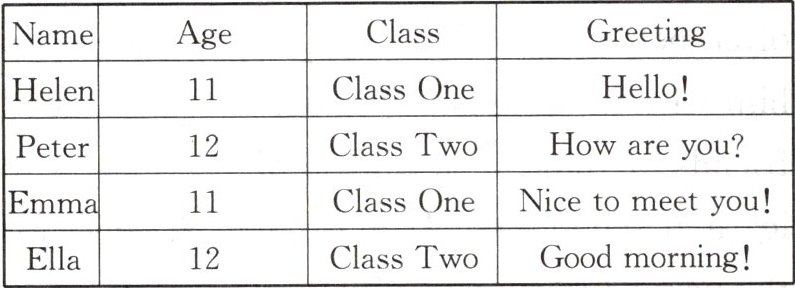 How are you?
Emma 11 Class One Nice to meet you!
Ella 12 Class Two Good morning!
(
A.13. B.12.
C.11.
(
A. Peter and Ella.
B. Helen and Ella.
C. Emma and Helen.
(
A. Nice to meet you too.
B. Good morning!
C. Hello!
Ⅱ.图表阅读
Name Age Class Greeting
Helen 11 Class One Hello!
Peter 12
How are you?Emma 11 Class One Nice to meet you!
Ella 12 Class Two Good morning!
(
C
)21. How old is Helen?A.13. B.12.
C.11.
(
B
)22. Who are NOT in the same(相同的) class?A. Peter and Ella.
B. Helen and Ella.
C. Emma and Helen.
(
B
)23. When Ella greets you, what should you say?A. Nice to meet you too.
B. Good morning!
C. Hello!
答案
21. C 22. B 23. B
解析
【分析】
这是一道图表阅读题,需根据表格中的信息逐一解答问题:
1. 第21题:题目询问Helen的年龄,只需定位表格中Helen所在行的Age列数据即可得出答案;
2. 第22题:题目询问谁不在同一班级,需分别查看选项中两人的Class列信息,对比是否一致;
3. 第23题:题目询问Ella问候时的回应,需找到Ella所在行的Greeting内容,日常交际中需对应回应相同的问候语。
【解析】
21. 定位表格中Helen的信息,其Age列显示为11,对应选项C,故选C;
22. 核对各选项班级信息:A选项Peter和Ella均在Class Two,同班;B选项Helen在Class One,Ella在Class Two,不同班;C选项Emma和Helen均在Class One,同班,故选B;
23. Ella的问候语是Good morning!,日常交际中应对应回应Good morning!,对应选项B,故选B。
【答案】
21. C 22. B 23. B
【知识点】
图表信息提取;英语日常交际用语;班级信息识别
【点评】
本题以表格形式考查学生信息提取能力和日常问候语运用,题目难度较低,只需仔细核对表格数据即可完成解答。
【难度系数】
0.8
这是一道图表阅读题,需根据表格中的信息逐一解答问题:
1. 第21题:题目询问Helen的年龄,只需定位表格中Helen所在行的Age列数据即可得出答案;
2. 第22题:题目询问谁不在同一班级,需分别查看选项中两人的Class列信息,对比是否一致;
3. 第23题:题目询问Ella问候时的回应,需找到Ella所在行的Greeting内容,日常交际中需对应回应相同的问候语。
【解析】
21. 定位表格中Helen的信息,其Age列显示为11,对应选项C,故选C;
22. 核对各选项班级信息:A选项Peter和Ella均在Class Two,同班;B选项Helen在Class One,Ella在Class Two,不同班;C选项Emma和Helen均在Class One,同班,故选B;
23. Ella的问候语是Good morning!,日常交际中应对应回应Good morning!,对应选项B,故选B。
【答案】
21. C 22. B 23. B
【知识点】
图表信息提取;英语日常交际用语;班级信息识别
【点评】
本题以表格形式考查学生信息提取能力和日常问候语运用,题目难度较低,只需仔细核对表格数据即可完成解答。
【难度系数】
0.8
Ⅲ. 短文阅读
Do you want to know how to greet people? Let's learn together.
When you're at work and you meet someone for the first time, it's best to use formal(正式的)greetings. Say "Good morning" or "Good afternoon", and ask "How are you?". You can also say "Nice to meet you!" and then tell them your name.
When we greet family and friends, we use informal(非正式的)greetings like "hello" "hi" or "hey" first. Then we can ask "How are you doing?" to know how he or she is.
In many English-speaking countries, people often shake hands(握手)to greet each other. Some people greet their friends with a hug(拥抱)or a kiss on the cheek. The best way to learn about physical greetings is to watch what other people do.
(
A. Hello! My friend.
B. Hey, how are you doing?
C. Good morning! What's your name?
(
A. Give a hug.
B. Shake hands.
C. Kiss on the cheek.
(
A. 身体的
B. 物质的
C. 物理的
(
A. How to greet friends.
B. The right way to greet people.
C. Formal English and informal English.
Do you want to know how to greet people? Let's learn together.
When you're at work and you meet someone for the first time, it's best to use formal(正式的)greetings. Say "Good morning" or "Good afternoon", and ask "How are you?". You can also say "Nice to meet you!" and then tell them your name.
When we greet family and friends, we use informal(非正式的)greetings like "hello" "hi" or "hey" first. Then we can ask "How are you doing?" to know how he or she is.
In many English-speaking countries, people often shake hands(握手)to greet each other. Some people greet their friends with a hug(拥抱)or a kiss on the cheek. The best way to learn about physical greetings is to watch what other people do.
(
C
)24. What can we say when we meet someone for the first time?A. Hello! My friend.
B. Hey, how are you doing?
C. Good morning! What's your name?
(
B
)25. What do people often do to greet each other in many English-speaking countries?A. Give a hug.
B. Shake hands.
C. Kiss on the cheek.
(
A
)26. What does the underlined word "physical" in Paragraph 4 probably mean?(第四段中画线的“physical”可能是什么意思?)A. 身体的
B. 物质的
C. 物理的
(
B
)27. What is the passage mainly about?(这篇文章主要讲的是什么?)A. How to greet friends.
B. The right way to greet people.
C. Formal English and informal English.
答案
24. C 25. B 26. A 27. B
解析
【分析】
先通读全文理解文章大意,再针对每个题目回到原文定位关键信息,逐一比对选项,结合原文内容排除错误选项,得出正确答案。
【解析】
24题:根据原文第二段"When you're at work and you meet someone for the first time, it's best to use formal greetings. Say 'Good morning' or 'Good afternoon'... and then tell them your name.",可知第一次见面应使用正式问候语,选项C"Good morning! What's your name?"符合要求;A、B选项均为非正式问候语,不符合第一次见面的场景,故排除。
25题:根据原文第四段"In many English-speaking countries, people often shake hands to greet each other.",直接对应选项B,A、C是部分人的问候方式,不符合"often"的描述,故排除。
26题:第四段列举的握手、拥抱、亲吻脸颊均为身体接触类的问候动作,因此"physical"意为"身体的",选A。
27题:全文从正式/非正式问候语、英语国家常见问候动作等方面,介绍了正确的问候方式,对应选项B;A仅涉及朋友问候,C仅涉及语言类型,均不全面,故排除。
【答案】
24.C 25.B 26.A 27.B
【知识点】
细节理解题、词义猜测题、主旨大意题
【点评】
本文围绕英语问候方式展开,题目设置以基础的细节查找、词义猜测和主旨概括为主,难度较低,学生通过定位原文信息即可完成解答,适合巩固阅读理解的基础解题方法。
【难度系数】
0.8
先通读全文理解文章大意,再针对每个题目回到原文定位关键信息,逐一比对选项,结合原文内容排除错误选项,得出正确答案。
【解析】
24题:根据原文第二段"When you're at work and you meet someone for the first time, it's best to use formal greetings. Say 'Good morning' or 'Good afternoon'... and then tell them your name.",可知第一次见面应使用正式问候语,选项C"Good morning! What's your name?"符合要求;A、B选项均为非正式问候语,不符合第一次见面的场景,故排除。
25题:根据原文第四段"In many English-speaking countries, people often shake hands to greet each other.",直接对应选项B,A、C是部分人的问候方式,不符合"often"的描述,故排除。
26题:第四段列举的握手、拥抱、亲吻脸颊均为身体接触类的问候动作,因此"physical"意为"身体的",选A。
27题:全文从正式/非正式问候语、英语国家常见问候动作等方面,介绍了正确的问候方式,对应选项B;A仅涉及朋友问候,C仅涉及语言类型,均不全面,故排除。
【答案】
24.C 25.B 26.A 27.B
【知识点】
细节理解题、词义猜测题、主旨大意题
【点评】
本文围绕英语问候方式展开,题目设置以基础的细节查找、词义猜测和主旨概括为主,难度较低,学生通过定位原文信息即可完成解答,适合巩固阅读理解的基础解题方法。
【难度系数】
0.8
Ⅳ. 阅读还原
Good afternoon, boys and girls. My name is Grace Smith. My first name is Grace. 28.
I'm a middle school student. Look! This is my ID card(学生证). 29.
A. I can spell it.
B. My last name is Smith.
C. What colour is it?
D. What's that?
E. Its number is 00233.
F. How are you?
G. I want to have a new pen.
Good afternoon, boys and girls. My name is Grace Smith. My first name is Grace. 28.
B
And it's also my family name. Nice to meet you!I'm a middle school student. Look! This is my ID card(学生证). 29.
E
I have to bring this card to school every day. Here is my pencil box. 30. D
It's an orange ruler. 31. A
R-U-L-E-R. It's my elder brother's ruler. He is 14 years old, and we go to the same school. I have a new pen. 32. C
It's brown. It's a birthday gift from my mother, so I like it very much.A. I can spell it.
B. My last name is Smith.
C. What colour is it?
D. What's that?
E. Its number is 00233.
F. How are you?
G. I want to have a new pen.
答案
28. B 29. E 30. D 31. A 32. C
解析
【分析】
本题为英语阅读还原题,需结合上下文语境及句子间的逻辑关系,匹配合适的选项。先通读全文,把握Grace介绍个人信息、学生证、文具等内容的语境,再逐一分析每个空前后的提示,选择符合逻辑的选项。
【解析】
1. 28题:前句提到“My first name is Grace”,后句说“And it's also my family name”,可知此处需介绍姓氏,对应选项B(My last name is Smith),故选B。
2. 29题:前句指出“This is my ID card”,学生证的核心信息通常是编号,对应选项E(Its number is 00233),故选E。
3. 30题:后句回答“It's an orange ruler”,可知此处是询问物品是什么,对应选项D(What's that?),故选D。
4. 31题:后句是单词的拼写“R-U-L-E-R”,可知此处需提及拼写相关内容,对应选项A(I can spell it),故选A。
5. 32题:后句回答“It's brown”,可知此处是询问颜色,对应选项C(What colour is it?),故选C。
【答案】28.B 29.E 30.D 31.A 32.C
【知识点】阅读还原题、语境理解、英语日常表达
【点评】本题是初中英语基础题型,主要考查学生对上下文语境的逻辑关联能力,需结合前后句的提示信息匹配选项,整体难度不大,学生理清句子间的联系即可正确作答。
【难度系数】0.7
本题为英语阅读还原题,需结合上下文语境及句子间的逻辑关系,匹配合适的选项。先通读全文,把握Grace介绍个人信息、学生证、文具等内容的语境,再逐一分析每个空前后的提示,选择符合逻辑的选项。
【解析】
1. 28题:前句提到“My first name is Grace”,后句说“And it's also my family name”,可知此处需介绍姓氏,对应选项B(My last name is Smith),故选B。
2. 29题:前句指出“This is my ID card”,学生证的核心信息通常是编号,对应选项E(Its number is 00233),故选E。
3. 30题:后句回答“It's an orange ruler”,可知此处是询问物品是什么,对应选项D(What's that?),故选D。
4. 31题:后句是单词的拼写“R-U-L-E-R”,可知此处需提及拼写相关内容,对应选项A(I can spell it),故选A。
5. 32题:后句回答“It's brown”,可知此处是询问颜色,对应选项C(What colour is it?),故选C。
【答案】28.B 29.E 30.D 31.A 32.C
【知识点】阅读还原题、语境理解、英语日常表达
【点评】本题是初中英语基础题型,主要考查学生对上下文语境的逻辑关联能力,需结合前后句的提示信息匹配选项,整体难度不大,学生理清句子间的联系即可正确作答。
【难度系数】0.7
