

 登录
登录
一、根据中文意思,写出下列句子或对话。
1. 它对我而言很难。
2. 乒乓球有趣。但是我打得不好。
3. 你打得这么好!
4. ——我们明天能再玩吗? ——当然可以!
5. ——你喜欢打篮球吗? ——是的,我喜欢。
1. 它对我而言很难。
It's hard for me.
2. 乒乓球有趣。但是我打得不好。
Ping-pong is fun. But I can't play well.
3. 你打得这么好!
You play so well!
4. ——我们明天能再玩吗? ——当然可以!
— Can we play again tomorrow? — Sure!
5. ——你喜欢打篮球吗? ——是的,我喜欢。
— Do you like playing basketball? — Yes, I do.
答案
1. It's hard for me.
2. Ping-pong is fun. But I can't play well.
3. You play so well!
4. — Can we play again tomorrow? — Sure!
5. — Do you like playing basketball? — Yes, I do.
2. Ping-pong is fun. But I can't play well.
3. You play so well!
4. — Can we play again tomorrow? — Sure!
5. — Do you like playing basketball? — Yes, I do.
解析
【分析】本题为汉译英题型,需结合中文句子的语义,运用对应的英语常用表达、固定搭配及基本句型(如陈述句、一般疑问句)进行翻译,确保译文准确、符合英语表达习惯。
【解析】1. “它”对应It,“对我而言”用固定搭配for me,“很难”译为hard,组合为It's hard for me.;2. “乒乓球”是Ping-pong,“有趣”是fun,“但是”是But,“我打得不好”用情态动词can't表能力,译为I can't play well,组合为Ping-pong is fun. But I can't play well.;3. “你”是You,“打得这么好”译为play so well,组合为You play so well!;4. 一般疑问句“我们明天能再玩吗?”用情态动词Can引导,译为Can we play again tomorrow?,答语“当然可以”译为Sure!;5. 一般疑问句“你喜欢打篮球吗?”用助动词Do引导,“喜欢打篮球”是like playing basketball,答语用Yes, I do.
【答案】1. It's hard for me.
2. Ping-pong is fun. But I can't play well.
3. You play so well!
4. — Can we play again tomorrow? — Sure!
5. — Do you like playing basketball? — Yes, I do.
【知识点】汉译英、日常英语表达、一般疑问句
【点评】本题考查基础的汉译英能力,聚焦日常交际用语的翻译,需掌握常用词汇、固定搭配及基本句型,是英语学习的基础练习,难度较低。
【难度系数】0.8
【解析】1. “它”对应It,“对我而言”用固定搭配for me,“很难”译为hard,组合为It's hard for me.;2. “乒乓球”是Ping-pong,“有趣”是fun,“但是”是But,“我打得不好”用情态动词can't表能力,译为I can't play well,组合为Ping-pong is fun. But I can't play well.;3. “你”是You,“打得这么好”译为play so well,组合为You play so well!;4. 一般疑问句“我们明天能再玩吗?”用情态动词Can引导,译为Can we play again tomorrow?,答语“当然可以”译为Sure!;5. 一般疑问句“你喜欢打篮球吗?”用助动词Do引导,“喜欢打篮球”是like playing basketball,答语用Yes, I do.
【答案】1. It's hard for me.
2. Ping-pong is fun. But I can't play well.
3. You play so well!
4. — Can we play again tomorrow? — Sure!
5. — Do you like playing basketball? — Yes, I do.
【知识点】汉译英、日常英语表达、一般疑问句
【点评】本题考查基础的汉译英能力,聚焦日常交际用语的翻译,需掌握常用词汇、固定搭配及基本句型,是英语学习的基础练习,难度较低。
【难度系数】0.8
二、Mike 和 Helen 在做什么呢?请你从方框中选出合适的句子,把他们的对话补充完整。
(They are at Mike's home. )
Mike: Hello, Helen.
Helen: Hi, Mike. What's that?
Mike: 1.
Helen: Can you play football?
Mike: 2.
Helen: 3.
Mike: Have a go, Helen.
(They are in the sports ground now. )
Helen: 4.
Helen: OK.
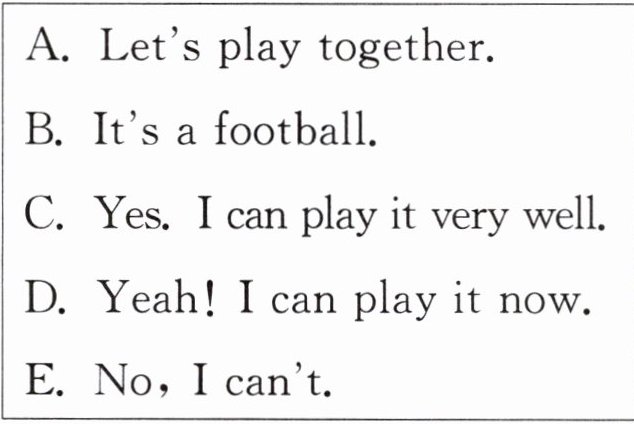
(They are at Mike's home. )
Mike: Hello, Helen.
Helen: Hi, Mike. What's that?
Mike: 1.
B
Helen: Can you play football?
Mike: 2.
C
What about you?Helen: 3.
E
Mike: Have a go, Helen.
(They are in the sports ground now. )
Helen: 4.
D
Mike: Great! 5. A
Helen: OK.
答案
1. B
2. C
3. E
4. D
5. A
2. C
3. E
4. D
5. A
解析
【分析】
本题为补全对话题型,需结合对话上下文的语境与逻辑,匹配合适的句子。先明确每空前后的语句功能:第1空是对物品的询问,需回答物品名称;第2空是Can引导的一般疑问句,需用Yes/No回应;第3空承接反问,结合后文邀请尝试,可知需选表示不会的内容;第4空对应到操场后的表述,需说明现在能玩;第5空是提议类语句,对应一起玩的内容。
【解析】
1. 上句Helen问“What's that?”,需回答物品,B选项“It's a football.”符合语境,故第1空选B;
2. 上句是“Can you play football?”的一般疑问句,需用Yes/No回答,结合语境Mike会踢足球,C选项“Yes. I can play it very well.”匹配,故第2空选C;
3. 上句Mike问“What about you?”,结合后文“Have a go”(尝试一下),可知Helen不会踢,E选项“No, I can't.”符合,故第3空选E;
4. 到操场后,Helen表述自己现在能玩了,D选项“Yeah! I can play it now.”契合,故第4空选D;
5. Mike回应“Great!”后,提议一起玩,A选项“Let's play together.”符合,故第5空选A。
【答案】
1. B;2. C;3. E;4. D;5. A
【知识点】
情景交际;日常用语
【点评】
本题考查日常情景对话的运用,需结合上下文逻辑选择合适语句,难度适中,适合基础阶段学生练习。
【难度系数】
0.6
本题为补全对话题型,需结合对话上下文的语境与逻辑,匹配合适的句子。先明确每空前后的语句功能:第1空是对物品的询问,需回答物品名称;第2空是Can引导的一般疑问句,需用Yes/No回应;第3空承接反问,结合后文邀请尝试,可知需选表示不会的内容;第4空对应到操场后的表述,需说明现在能玩;第5空是提议类语句,对应一起玩的内容。
【解析】
1. 上句Helen问“What's that?”,需回答物品,B选项“It's a football.”符合语境,故第1空选B;
2. 上句是“Can you play football?”的一般疑问句,需用Yes/No回答,结合语境Mike会踢足球,C选项“Yes. I can play it very well.”匹配,故第2空选C;
3. 上句Mike问“What about you?”,结合后文“Have a go”(尝试一下),可知Helen不会踢,E选项“No, I can't.”符合,故第3空选E;
4. 到操场后,Helen表述自己现在能玩了,D选项“Yeah! I can play it now.”契合,故第4空选D;
5. Mike回应“Great!”后,提议一起玩,A选项“Let's play together.”符合,故第5空选A。
【答案】
1. B;2. C;3. E;4. D;5. A
【知识点】
情景交际;日常用语
【点评】
本题考查日常情景对话的运用,需结合上下文逻辑选择合适语句,难度适中,适合基础阶段学生练习。
【难度系数】
0.6
