

 登录
登录
九、李老师在课堂上介绍了探索宇宙的历史片段。阅读短文,完成任务。
Since ancient times, looking at the stars has made humans dream of flying into space. Early people knew almost nothing about space. They could only watch and guess. They thought the sky was a small cover above Earth.
The telescope opened a new window for humans. We realized the universe was much bigger than we thought. We saw more stars and understood that Earth is just a small planet.
In the 20th century, space travel stopped being a dream. Rockets sent the first satellite around Earth. Soon, humans went into space. In 1969, the first human stepped on the Moon. This great success surprised the whole world.
Today, we send robots and probes to other planets. They work for years and send valuable information back. Space stations stay in space and support long-term scientific research. Scientists learn about the space environment, human health and new materials.
Although space exploration is full of challenges, humans never stop moving forward. We keep learning, discovering and hoping to find more secrets of the universe.
任务一: 根据短文内容, 将下列图片排序。
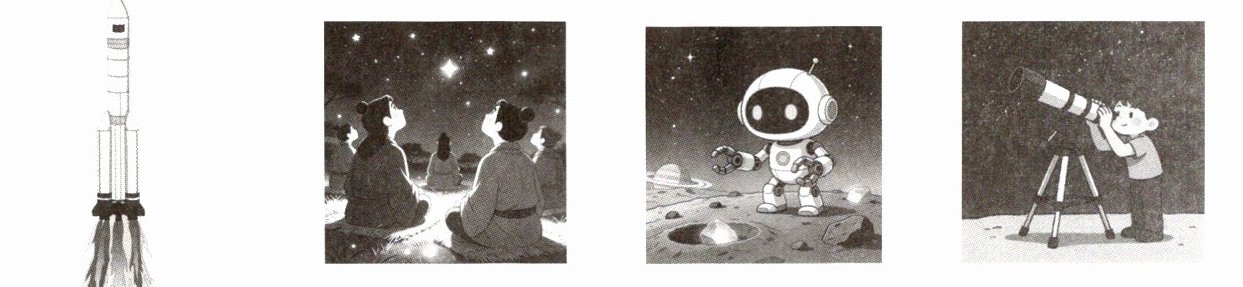
() () () ()
任务二: 根据短文内容, 判断下列句子的正(T)误(F)。
()1. Early people thought the universe was very large.
()2. Rockets helped send satellites and humans into space.
()3. Space stations help with long-term scientific research in space.
任务三: 根据短文内容, 用完整的句子回答问题。
1. What did the telescope make people realize?
2. What made the whole world surprised according to the passage?
3. What can we learn from the research in space stations?
Since ancient times, looking at the stars has made humans dream of flying into space. Early people knew almost nothing about space. They could only watch and guess. They thought the sky was a small cover above Earth.
The telescope opened a new window for humans. We realized the universe was much bigger than we thought. We saw more stars and understood that Earth is just a small planet.
In the 20th century, space travel stopped being a dream. Rockets sent the first satellite around Earth. Soon, humans went into space. In 1969, the first human stepped on the Moon. This great success surprised the whole world.
Today, we send robots and probes to other planets. They work for years and send valuable information back. Space stations stay in space and support long-term scientific research. Scientists learn about the space environment, human health and new materials.
Although space exploration is full of challenges, humans never stop moving forward. We keep learning, discovering and hoping to find more secrets of the universe.
任务一: 根据短文内容, 将下列图片排序。
() () () ()
任务二: 根据短文内容, 判断下列句子的正(T)误(F)。
()1. Early people thought the universe was very large.
()2. Rockets helped send satellites and humans into space.
()3. Space stations help with long-term scientific research in space.
任务三: 根据短文内容, 用完整的句子回答问题。
1. What did the telescope make people realize?
2. What made the whole world surprised according to the passage?
3. What can we learn from the research in space stations?
答案
任务一:3;1;4;2
任务二:1. F 2. T 3. T
任务三:1. We realized the universe was much bigger than we thought.
2. The great success that the first human stepped on the Moon in 1969 made the whole world surprised.
3. We can learn about the space environment, human health and new materials.
任务二:1. F 2. T 3. T
任务三:1. We realized the universe was much bigger than we thought.
2. The great success that the first human stepped on the Moon in 1969 made the whole world surprised.
3. We can learn about the space environment, human health and new materials.
解析
【分析】本题为英语阅读理解题,需先梳理短文的时间发展顺序对应图片排序,再通过定位原文细节完成判断与问答。首先明确短文的时间线:古代人类对宇宙的认知→望远镜的作用→20世纪火箭与太空探索→现代机器人探索,结合图片内容与参考答案的排序逻辑完成任务一;任务二需逐一核对原文细节;任务三需准确提取原文对应语句作答。
【解析】任务一:短文按时间顺序对应图片为现代机器人(图3)→20世纪火箭(图1)→望远镜(图4)→古代人类(图2),故排序为3;1;4;2;任务二:1. 短文第一段提到早期人类认为天空是地球上方的小盖子,并非知晓宇宙庞大,故判断为F;2. 短文第三段明确火箭可送卫星和人类进入太空,故判断为T;3. 短文第四段指出空间站支持长期科研,故判断为T;任务三:1. 从短文第二段提取对应语句;2. 从短文第三段提取对应语句;3. 从短文第四段提取对应语句。
【答案】任务一:3;1;4;2;任务二:1.F 2.T 3.T;任务三:1. We realized the universe was much bigger than we thought. 2. The great success that the first human stepped on the Moon in 1969 made the whole world surprised. 3. We can learn about the space environment, human health and new materials.
【知识点】英语阅读理解 短文信息提取 细节判断
【点评】本题考查对英语短文的综合理解能力,涵盖排序、判断、问答三类题型,需准确梳理时间线和定位原文细节,整体难度适中。
【难度系数】0.5
【解析】任务一:短文按时间顺序对应图片为现代机器人(图3)→20世纪火箭(图1)→望远镜(图4)→古代人类(图2),故排序为3;1;4;2;任务二:1. 短文第一段提到早期人类认为天空是地球上方的小盖子,并非知晓宇宙庞大,故判断为F;2. 短文第三段明确火箭可送卫星和人类进入太空,故判断为T;3. 短文第四段指出空间站支持长期科研,故判断为T;任务三:1. 从短文第二段提取对应语句;2. 从短文第三段提取对应语句;3. 从短文第四段提取对应语句。
【答案】任务一:3;1;4;2;任务二:1.F 2.T 3.T;任务三:1. We realized the universe was much bigger than we thought. 2. The great success that the first human stepped on the Moon in 1969 made the whole world surprised. 3. We can learn about the space environment, human health and new materials.
【知识点】英语阅读理解 短文信息提取 细节判断
【点评】本题考查对英语短文的综合理解能力,涵盖排序、判断、问答三类题型,需准确梳理时间线和定位原文细节,整体难度适中。
【难度系数】0.5
