

 登录
登录
一、完形填空
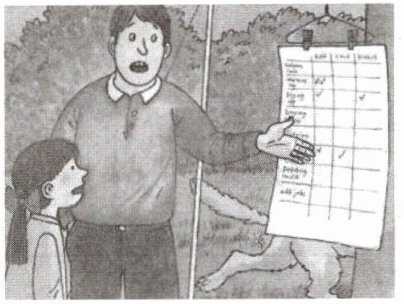
Bella and Kitty’s parents took out a piece of paper.
“What’s that?” Bella and Kitty asked.
“
Bella and Kitty
“If you do the housework, you will get some pocket money,” said Dad.
The next day, they went to the beach (海滩). Bella looked along the beach for shells. But it was cold and windy. She didn’t find special shells in the water.
On their way for lunch, Bella found a shop around. There were shells and beach toys. Bella found an amazing shell, but it was very
After lunch, Bella
“I want to get all the pocket money,” she said.
“I’m sorry, Bella,” said Dad. “Everyone has his
“But Kitty doesn’t
“That’s not the point,” said Dad. “The idea is that we do the work together.”
Bella felt
“Did you see a camera?” asked a young man.
“Here it is,” Bella said.
“Thank you so much. I’m so glad to get it back,” said the young man.
Then the man wanted to give Bella some
(
(
(
(
(
(
(
(
(
(
Bella and Kitty’s parents took out a piece of paper.
“What’s that?” Bella and Kitty asked.
“
A
1 chart (表格),” said Mum.Bella and Kitty
B
2 the chart. It had their names next to a list of housework.“If you do the housework, you will get some pocket money,” said Dad.
The next day, they went to the beach (海滩). Bella looked along the beach for shells. But it was cold and windy. She didn’t find special shells in the water.
On their way for lunch, Bella found a shop around. There were shells and beach toys. Bella found an amazing shell, but it was very
D
3.After lunch, Bella
C
4 Kitty do her work. Dad saw Kitty playing with the dog. He asked Bella why she was doing Kitty’s jobs. Bella’s face went A
5.“I want to get all the pocket money,” she said.
“I’m sorry, Bella,” said Dad. “Everyone has his
D
6.”“But Kitty doesn’t
C
7,” said Bella.“That’s not the point,” said Dad. “The idea is that we do the work together.”
Bella felt
B
8 and looked for shells again. Suddenly (突然), a camera (相机) was in front of her. But there was no one else. She B
9 it up and waited.“Did you see a camera?” asked a young man.
“Here it is,” Bella said.
“Thank you so much. I’m so glad to get it back,” said the young man.
Then the man wanted to give Bella some
C
10. Bella didn’t take it. Dad saw it and smiled (微笑) at Bella. The next day, Dad bought Bella the shells she liked.(
A
) 1. A. Pocket money B. Lucky money C. Paper money D. Smart money(
B
) 2. A. depended on B. looked at C. paid for D. looked for(
D
) 3. A. big B. small C. cheap D. expensive(
C
) 4. A. made B. asked C. helped D. needed(
A
) 5. A. red B. blue C. white D. green(
D
) 6. A. dream B. diet C. deal D. duty(
C
) 7. A. work B. hope C. care D. grow(
B
) 8. A. lucky B. sad C. happy D. afraid(
B
) 9. A. put B. picked C. got D. gave(
C
)10. A. presents B. shells C. money D. advice答案
1. A
2. B
3. D
4. C
5. A
6. D
7. C
8. B
9. B
10. C
2. B
3. D
4. C
5. A
6. D
7. C
8. B
9. B
10. C
解析
【分析】这是一篇围绕家庭责任与诚信的完形填空题,解题思路为:先通读全文把握故事大意,再结合每个空格的前后语境,分析选项词汇的词义、固定搭配,选出符合文意的答案。
【解析】1. 选A:根据后文“做家务得零花钱”的提示,此处指“零花钱表格”,A选项pocket money符合;B是压岁钱,C是纸币,D是“聪明钱”,均不符合。
2. 选B:句意是Bella和Kitty看表格,look at(看)符合语境;A依赖、C支付、D寻找,均不合适。
3. 选D:Bella想攒零花钱,所以贝壳很贵,expensive(昂贵的)符合;A大、B小、C便宜,不符合文意。
4. 选C:后文爸爸询问为何做Kitty的工作,可知Bella帮Kitty做家务,help(帮助)符合;A使、B问、D需要,均不对。
5. 选A:做错事被质问,脸变红,red(红的)符合;B蓝、C白、D绿,不符合。
6. 选D:爸爸强调每个人有自己的责任,duty(责任)符合;A梦想、B饮食、C交易,均不合适。
7. 选C:Bella辩解Kitty不在乎,care(在乎)符合;A工作、B希望、D成长,不符合。
8. 选B:Bella意识到错误后感到难过,sad(难过的)符合;A幸运、C开心、D害怕,均不对。
9. 选B:“捡起相机”是固定搭配pick up,符合语境;A放、C得到、D给,均不合适。
10. 选C:年轻人找回相机想给钱感谢,money(钱)符合;A礼物、B贝壳、D建议,均不对。
【答案】1.A 2.B 3.D 4.C 5.A 6.D 7.C 8.B 9.B 10.C
【知识点】完形填空、词汇辨析、语境理解
【点评】本题通过生活化的故事考查学生对词汇的运用和语境的理解,引导学生理解责任与诚信的意义,难度适中。
【难度系数】0.5
【解析】1. 选A:根据后文“做家务得零花钱”的提示,此处指“零花钱表格”,A选项pocket money符合;B是压岁钱,C是纸币,D是“聪明钱”,均不符合。
2. 选B:句意是Bella和Kitty看表格,look at(看)符合语境;A依赖、C支付、D寻找,均不合适。
3. 选D:Bella想攒零花钱,所以贝壳很贵,expensive(昂贵的)符合;A大、B小、C便宜,不符合文意。
4. 选C:后文爸爸询问为何做Kitty的工作,可知Bella帮Kitty做家务,help(帮助)符合;A使、B问、D需要,均不对。
5. 选A:做错事被质问,脸变红,red(红的)符合;B蓝、C白、D绿,不符合。
6. 选D:爸爸强调每个人有自己的责任,duty(责任)符合;A梦想、B饮食、C交易,均不合适。
7. 选C:Bella辩解Kitty不在乎,care(在乎)符合;A工作、B希望、D成长,不符合。
8. 选B:Bella意识到错误后感到难过,sad(难过的)符合;A幸运、C开心、D害怕,均不对。
9. 选B:“捡起相机”是固定搭配pick up,符合语境;A放、C得到、D给,均不合适。
10. 选C:年轻人找回相机想给钱感谢,money(钱)符合;A礼物、B贝壳、D建议,均不对。
【答案】1.A 2.B 3.D 4.C 5.A 6.D 7.C 8.B 9.B 10.C
【知识点】完形填空、词汇辨析、语境理解
【点评】本题通过生活化的故事考查学生对词汇的运用和语境的理解,引导学生理解责任与诚信的意义,难度适中。
【难度系数】0.5
二、阅读理解
A
Traveling is popular nowadays, but it can be expensive if you go to a place far away. To have a comfortable trip, you have to make a budget ready for your trip. Here is some advice.
1. Where to go

Know about how much money you have for your trip. Use all the apps and websites to learn about the costs. Many traveling diaries (日记) design the route (路线), make notes on food and hotels and tell you the ways to save money. You can also ask friends for their advice, then choose the best one.
2. ▲ to travel
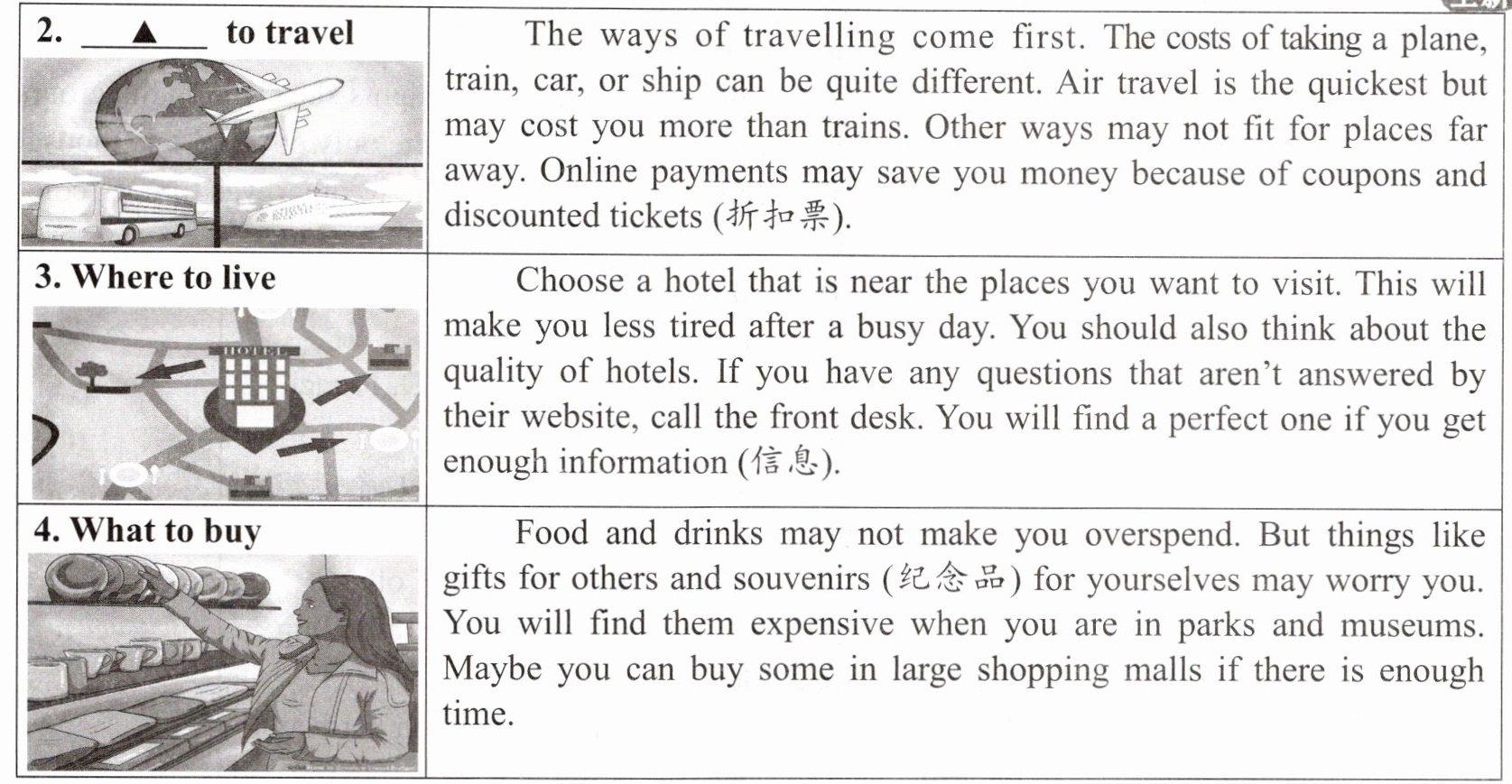
The ways of travelling come first. The costs of taking a plane, train, car, or ship can be quite different. Air travel is the quickest but may cost you more than trains. Other ways may not fit for places far away. Online payments may save you money because of coupons and discounted tickets (折扣票).
3. Where to live
Choose a hotel that is near the places you want to visit. This will make you less tired after a busy day. You should also think about the quality of hotels. If you have any questions that aren't answered by their website, call the front desk. You will find a perfect one if you get enough information (信息).
4. What to buy
Food and drinks may not make you overspend. But things like gifts for others and souvenirs (纪念品) for yourselves may worry you. You will find them expensive when you are in parks and museums. Maybe you can buy some in large shopping malls if there is enough time.
(
A. designing B. travelling C. shopping D. eating
(
A. Who B. Why C. How D. When
(
① souvenir shops ② online diaries
③ friends’ advice ④ hotel information
A. ①②③ B. ①③④ C. ①②④ D. ②③④
(
A. Buying plane or train tickets online can save money.
B. The things in parks and museums are cheap and nice.
C. Hotels far away from the middle of the city can be comfortable.
D. Travelling diaries will tell you everything you want to know.
A
Traveling is popular nowadays, but it can be expensive if you go to a place far away. To have a comfortable trip, you have to make a budget ready for your trip. Here is some advice.
1. Where to go
Know about how much money you have for your trip. Use all the apps and websites to learn about the costs. Many traveling diaries (日记) design the route (路线), make notes on food and hotels and tell you the ways to save money. You can also ask friends for their advice, then choose the best one.
2. ▲ to travel
The ways of travelling come first. The costs of taking a plane, train, car, or ship can be quite different. Air travel is the quickest but may cost you more than trains. Other ways may not fit for places far away. Online payments may save you money because of coupons and discounted tickets (折扣票).
3. Where to live
Choose a hotel that is near the places you want to visit. This will make you less tired after a busy day. You should also think about the quality of hotels. If you have any questions that aren't answered by their website, call the front desk. You will find a perfect one if you get enough information (信息).
4. What to buy
Food and drinks may not make you overspend. But things like gifts for others and souvenirs (纪念品) for yourselves may worry you. You will find them expensive when you are in parks and museums. Maybe you can buy some in large shopping malls if there is enough time.
(
B
) 1. The article is for those who like .A. designing B. travelling C. shopping D. eating
(
C
) 2. Which of the following words can be put in ?A. Who B. Why C. How D. When
(
D
) 3. Which of the following may help you make a trip budget according to the passage?① souvenir shops ② online diaries
③ friends’ advice ④ hotel information
A. ①②③ B. ①③④ C. ①②④ D. ②③④
(
A
) 4. What can we learn from the passage?A. Buying plane or train tickets online can save money.
B. The things in parks and museums are cheap and nice.
C. Hotels far away from the middle of the city can be comfortable.
D. Travelling diaries will tell you everything you want to know.
答案
1. B
2. C
3. D
4. A
2. C
3. D
4. A
解析
【分析】
先通读全文,明确文章主旨是为旅行者提供旅行预算规划的实用建议,分为旅行地点、方式、住宿、购物四个板块。逐题解题时,第1题需把握文章主旨;第2题需匹配小标题与对应内容;第3题需定位原文中与旅行预算相关的信息;第4题需逐一核对选项与原文细节是否一致。
【解析】
1. 第1题:文章围绕旅行预算的建议展开,核心受众是喜欢旅行的人,因此选B。
2. 第2题:第二个小标题下的内容围绕旅行的方式(飞机、火车等)展开,对应“如何旅行”,故选C。
3. 第3题:原文提到旅行日记(②)、朋友建议(③)、酒店信息(④)有助于制定预算;而公园、博物馆的纪念品昂贵,无法帮助控制预算,因此选②③④,即D。
4. 第4题:原文明确在线支付可享优惠券和折扣票,说明在线购票能省钱,A正确;B选项原文指出公园和博物馆的物品昂贵;C选项建议选靠近景点的酒店;D选项旅行日记并非涵盖所有信息,故选A。
【答案】
1.B 2.C 3.D 4.A
【知识点】
英语阅读理解、细节理解、主旨大意
【点评】
本文是实用的旅行指导类阅读,题型常规,考查学生对文章主旨和细节的把握,需精准定位原文信息,难度适中。
【难度系数】
0.6
先通读全文,明确文章主旨是为旅行者提供旅行预算规划的实用建议,分为旅行地点、方式、住宿、购物四个板块。逐题解题时,第1题需把握文章主旨;第2题需匹配小标题与对应内容;第3题需定位原文中与旅行预算相关的信息;第4题需逐一核对选项与原文细节是否一致。
【解析】
1. 第1题:文章围绕旅行预算的建议展开,核心受众是喜欢旅行的人,因此选B。
2. 第2题:第二个小标题下的内容围绕旅行的方式(飞机、火车等)展开,对应“如何旅行”,故选C。
3. 第3题:原文提到旅行日记(②)、朋友建议(③)、酒店信息(④)有助于制定预算;而公园、博物馆的纪念品昂贵,无法帮助控制预算,因此选②③④,即D。
4. 第4题:原文明确在线支付可享优惠券和折扣票,说明在线购票能省钱,A正确;B选项原文指出公园和博物馆的物品昂贵;C选项建议选靠近景点的酒店;D选项旅行日记并非涵盖所有信息,故选A。
【答案】
1.B 2.C 3.D 4.A
【知识点】
英语阅读理解、细节理解、主旨大意
【点评】
本文是实用的旅行指导类阅读,题型常规,考查学生对文章主旨和细节的把握,需精准定位原文信息,难度适中。
【难度系数】
0.6
