

 登录
登录
Ⅱ.短语积累
1. 逃脱;离开
2. 到处;遍及
1. 逃脱;离开
get out
2. 到处;遍及
all over
答案
1. get out 2. all over
解析
【分析】
本题考查英语常用短语的识记,需根据给出的中文含义,匹配对应的英文固定短语,属于英语学习中的基础积累类题目,需牢记常见短语的含义与表达。
【解析】
1. 表示“逃脱;离开”的英文固定短语为get out;
2. 表示“到处;遍及”的英文固定短语为all over。
【答案】
1. get out 2. all over
【知识点】
英语短语积累
【点评】
本题为英语基础短语识记题,侧重考查核心短语的记忆,是英语学习的必备基础内容,难度较低。
【难度系数】
0.9
本题考查英语常用短语的识记,需根据给出的中文含义,匹配对应的英文固定短语,属于英语学习中的基础积累类题目,需牢记常见短语的含义与表达。
【解析】
1. 表示“逃脱;离开”的英文固定短语为get out;
2. 表示“到处;遍及”的英文固定短语为all over。
【答案】
1. get out 2. all over
【知识点】
英语短语积累
【点评】
本题为英语基础短语识记题,侧重考查核心短语的记忆,是英语学习的必备基础内容,难度较低。
【难度系数】
0.9
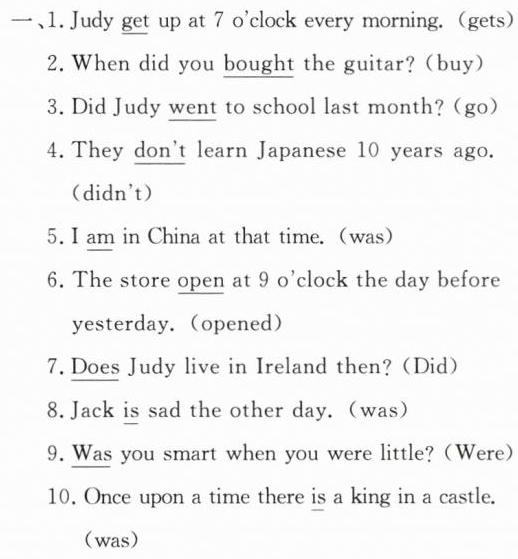
一、用下划线标出句中的错误并改正。
1. Judy get up at 7 o'clock every morning. (
2. When did you bought the guitar? (
3. Did Judy went to school last month? (
4. They don't learn Japanese 10 years ago. (
5. I am in China at that time. (
6. The store open at 9 o'clock the day before yesterday. (
7. Does Judy live in Ireland then? (
8. Jack is sad the other day. (
9. Was you smart when you were little? (
10. Once upon a time there is a king in a castle. (
1. Judy get up at 7 o'clock every morning. (
gets
)2. When did you bought the guitar? (
buy
)3. Did Judy went to school last month? (
go
)4. They don't learn Japanese 10 years ago. (
didn't
)5. I am in China at that time. (
was
)6. The store open at 9 o'clock the day before yesterday. (
opened
)7. Does Judy live in Ireland then? (
Did
)8. Jack is sad the other day. (
was
)9. Was you smart when you were little? (
Were
)10. Once upon a time there is a king in a castle. (
was
)答案
解析
【分析】
本题为英语动词时态改错题,解题思路是先识别句子中的时间状语,以此判断句子的时态(一般现在时/一般过去时),再结合时态规则修正动词形式:一般现在时中主语为第三人称单数时动词用三单形式;一般过去时的疑问句/否定句中,助动词(did/didn't)后需接动词原形;过去时间对应的be动词需根据主语调整为过去式(was/were)。
【解析】
1. 时间状语every morning表经常性动作,用一般现在时,主语Judy是第三人称单数,故将get改为gets;
2. 一般过去时的疑问句中,助动词did后需接动词原形,故将bought改为buy;
3. 同理,did后接动词原形,将went改为go;
4. 时间状语10 years ago表过去,一般过去时的否定句用didn't,故将don't改为didn't;
5. 时间状语at that time表过去,主语是I,be动词am改为was;
6. 时间状语the day before yesterday表过去,动词open改为过去式opened;
7. 时间状语then表过去,一般过去时的疑问句用助动词Did,故将Does改为Did;
8. 时间状语the other day表过去,主语是Jack,be动词is改为was;
9. 时间状语从句中were提示为过去时,主语是you,be动词Was改为Were;
10. 时间状语Once upon a time表过去,be动词is改为was。
【答案】
1. gets;2. buy;3. go;4. didn't;5. was;6. opened;7. Did;8. was;9. Were;10. was
【知识点】
一般现在时;一般过去时;助动词用法
【点评】
本题聚焦基础时态的动词形式应用,需准确判断时间状语对应的时态,掌握助动词后的动词规则,是英语时态学习的典型基础练习。
【难度系数】
0.5
本题为英语动词时态改错题,解题思路是先识别句子中的时间状语,以此判断句子的时态(一般现在时/一般过去时),再结合时态规则修正动词形式:一般现在时中主语为第三人称单数时动词用三单形式;一般过去时的疑问句/否定句中,助动词(did/didn't)后需接动词原形;过去时间对应的be动词需根据主语调整为过去式(was/were)。
【解析】
1. 时间状语every morning表经常性动作,用一般现在时,主语Judy是第三人称单数,故将get改为gets;
2. 一般过去时的疑问句中,助动词did后需接动词原形,故将bought改为buy;
3. 同理,did后接动词原形,将went改为go;
4. 时间状语10 years ago表过去,一般过去时的否定句用didn't,故将don't改为didn't;
5. 时间状语at that time表过去,主语是I,be动词am改为was;
6. 时间状语the day before yesterday表过去,动词open改为过去式opened;
7. 时间状语then表过去,一般过去时的疑问句用助动词Did,故将Does改为Did;
8. 时间状语the other day表过去,主语是Jack,be动词is改为was;
9. 时间状语从句中were提示为过去时,主语是you,be动词Was改为Were;
10. 时间状语Once upon a time表过去,be动词is改为was。
【答案】
1. gets;2. buy;3. go;4. didn't;5. was;6. opened;7. Did;8. was;9. Were;10. was
【知识点】
一般现在时;一般过去时;助动词用法
【点评】
本题聚焦基础时态的动词形式应用,需准确判断时间状语对应的时态,掌握助动词后的动词规则,是英语时态学习的典型基础练习。
【难度系数】
0.5
二、语法填空
Once upon a time, there was a 1.
The king said, "I want you to paint a portrait for me. I can 4.
The king was not a kind man. He was old and weak, but he 6.
Suddenly, the artist laughed and said, "I only 9.
happy. In fact, he was very 10.
Once upon a time, there was a 1.
wise
(wisely) artist. He lived in a small village. Everyone 2. praised
(praise) him for his beautiful paintings. Even the king 3. heard
(hear) about him and asked to see him.The king said, "I want you to paint a portrait for me. I can 4.
promise
(promise) to give you a bag of gold if I like it." The artist 5. agreed
(agree) and started painting.The king was not a kind man. He was old and weak, but he 6.
hated
(hate) to know the truth. So, the artist 7. decided
(decide) to be clever. He painted the king as a strong and handsome man. When the king saw the painting, he 8. smiled
(smile) and said, "You are very wise! I love it!" He gave the artist a bag of gold, just as he promised.Suddenly, the artist laughed and said, "I only 9.
painted
(paint) what you wanted to see." The king pretended to behappy. In fact, he was very 10.
angry
(angry), but he could do nothing because he had already praised him in front of everyone.答案
1. wise 2. praised 3. heard 4. promise
5. agreed 6. hated 7. decided
8. smiled 9. painted 10. angry
5. agreed 6. hated 7. decided
8. smiled 9. painted 10. angry
解析
【分析】
本题为语法填空,需结合词性、时态等语法规则变形:1. 修饰名词需用形容词,需转换所给副词;2-3、5-9空均为叙述过去的故事,需用一般过去时,将动词变为过去式;4空情态动词后接动词原形;10空be动词后需形容词作表语,直接使用所给形容词。
【解析】
1. 空格后为名词artist,需用形容词修饰,故将副词wisely改为形容词wise;
2. 全文讲述过去的故事,用一般过去时,praise的过去式为praised;
3. 一般过去时,hear的过去式为heard;
4. 情态动词can后接动词原形,故用promise;
5. 一般过去时,agree的过去式为agreed;
6. 一般过去时,hate的过去式为hated;
7. 一般过去时,decide的过去式为decided;
8. 一般过去时,smile的过去式为smiled;
9. 叙述过去的动作,用一般过去时,paint的过去式为painted;
10. be动词was后需形容词作表语,所给词angry为形容词,直接使用。
【答案】
1. wise 2. praised 3. heard 4. promise 5. agreed 6. hated 7. decided 8. smiled 9. painted 10. angry
【知识点】
形容词的用法、一般过去时、情态动词的用法
【点评】
本题考查英语基础语法,涵盖词性转换、动词时态、情态动词用法,是初中英语常见题型,掌握基础语法规则即可解答。
【难度系数】
0.3
本题为语法填空,需结合词性、时态等语法规则变形:1. 修饰名词需用形容词,需转换所给副词;2-3、5-9空均为叙述过去的故事,需用一般过去时,将动词变为过去式;4空情态动词后接动词原形;10空be动词后需形容词作表语,直接使用所给形容词。
【解析】
1. 空格后为名词artist,需用形容词修饰,故将副词wisely改为形容词wise;
2. 全文讲述过去的故事,用一般过去时,praise的过去式为praised;
3. 一般过去时,hear的过去式为heard;
4. 情态动词can后接动词原形,故用promise;
5. 一般过去时,agree的过去式为agreed;
6. 一般过去时,hate的过去式为hated;
7. 一般过去时,decide的过去式为decided;
8. 一般过去时,smile的过去式为smiled;
9. 叙述过去的动作,用一般过去时,paint的过去式为painted;
10. be动词was后需形容词作表语,所给词angry为形容词,直接使用。
【答案】
1. wise 2. praised 3. heard 4. promise 5. agreed 6. hated 7. decided 8. smiled 9. painted 10. angry
【知识点】
形容词的用法、一般过去时、情态动词的用法
【点评】
本题考查英语基础语法,涵盖词性转换、动词时态、情态动词用法,是初中英语常见题型,掌握基础语法规则即可解答。
【难度系数】
0.3
