

 登录
登录
Ⅲ. 根据对话内容,从短文后的选项中选出能填入空白处的最佳选项。选项中有一项为多余选项。
Host: Mr Ouyang Honghong, welcome to our programme. You worked with Bingjie for years. 1
Ouyang: Yes. I first met Bingjie in 2007. He just ran up to me to say hello. 2
Host: That's lovely! I am sure you had a lot of happy times together. Well, 3 Can you tell us something about that?
Ouyang: Bingjie worked very hard. He got hurt, but he didn't stop. 4 She was the first person our team found.
Host: Bingjie is a real hero! What do you want to say to him now?
Ouyang: Bingjie, I want to hug you again. 5 You are always my friend.
Host: We all miss him. Thank you for sharing.
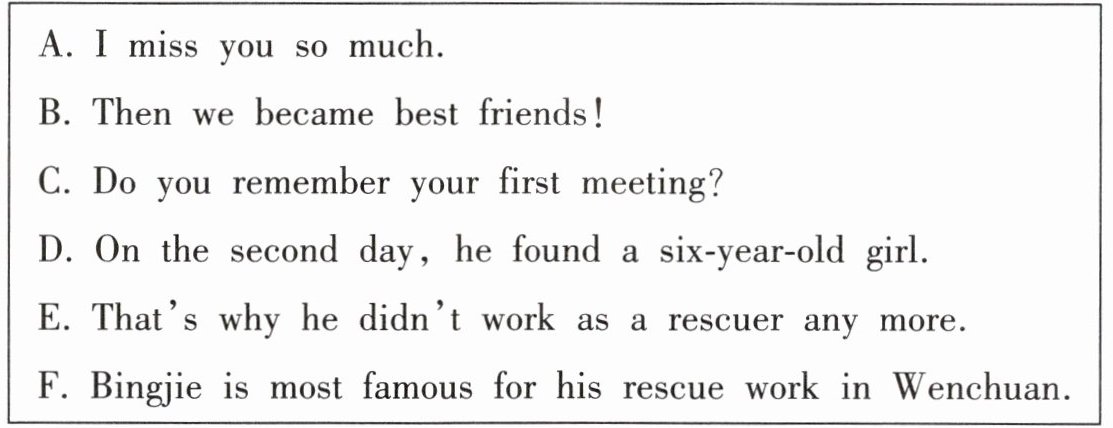
1.
2.
3.
4.
5.
Host: Mr Ouyang Honghong, welcome to our programme. You worked with Bingjie for years. 1
Ouyang: Yes. I first met Bingjie in 2007. He just ran up to me to say hello. 2
Host: That's lovely! I am sure you had a lot of happy times together. Well, 3 Can you tell us something about that?
Ouyang: Bingjie worked very hard. He got hurt, but he didn't stop. 4 She was the first person our team found.
Host: Bingjie is a real hero! What do you want to say to him now?
Ouyang: Bingjie, I want to hug you again. 5 You are always my friend.
Host: We all miss him. Thank you for sharing.
1.
2.
3.
4.
5.
答案
1~5 CBFDA
解析
【分析】
本题为补全对话题型,解题思路是先通读对话和选项,理解对话围绕Bingjie的救援事迹及与欧阳红红的关系展开,再结合每个空的上下文语境、逻辑关系逐一匹配选项:
1. 空1后欧阳红红回答“记得第一次见面”,故此处需是询问是否记得初次见面的句子;
2. 空2前提及初次见面打招呼,后续应顺承说明成为朋友;
3. 空3后要引出Bingjie的救援相关内容,需选介绍其救援成就的句子;
4. 空4后提到“找到的第一个人”,此处需补充找到女孩的细节;
5. 空5前表达想拥抱Bingjie,需选表达想念的句子。
【解析】
1. 空1:根据答语“Yes. I first met Bingjie in 2007.”可知,主持人询问是否记得初次见面,对应选项C;
2. 空2:前句说初次见面他打招呼,后句应顺承说明成为朋友,对应选项B;
3. 空3:主持人要引出Bingjie的救援事迹,选项F“Bingjie以汶川救援闻名”符合语境,对应选项F;
4. 空4:后句提到“她是我们队找到的第一个人”,此处需补充找到女孩的细节,对应选项D;
5. 空5:前句说想拥抱Bingjie,需表达想念,对应选项A。
【答案】
CBFDA
【知识点】
补全对话、情景交际
【点评】
本题考查日常对话的逻辑衔接,需结合上下文语境匹配句子,是初中英语常见题型,难度适中,学生理清对话脉络即可正确作答。
【难度系数】
0.4
本题为补全对话题型,解题思路是先通读对话和选项,理解对话围绕Bingjie的救援事迹及与欧阳红红的关系展开,再结合每个空的上下文语境、逻辑关系逐一匹配选项:
1. 空1后欧阳红红回答“记得第一次见面”,故此处需是询问是否记得初次见面的句子;
2. 空2前提及初次见面打招呼,后续应顺承说明成为朋友;
3. 空3后要引出Bingjie的救援相关内容,需选介绍其救援成就的句子;
4. 空4后提到“找到的第一个人”,此处需补充找到女孩的细节;
5. 空5前表达想拥抱Bingjie,需选表达想念的句子。
【解析】
1. 空1:根据答语“Yes. I first met Bingjie in 2007.”可知,主持人询问是否记得初次见面,对应选项C;
2. 空2:前句说初次见面他打招呼,后句应顺承说明成为朋友,对应选项B;
3. 空3:主持人要引出Bingjie的救援事迹,选项F“Bingjie以汶川救援闻名”符合语境,对应选项F;
4. 空4:后句提到“她是我们队找到的第一个人”,此处需补充找到女孩的细节,对应选项D;
5. 空5:前句说想拥抱Bingjie,需表达想念,对应选项A。
【答案】
CBFDA
【知识点】
补全对话、情景交际
【点评】
本题考查日常对话的逻辑衔接,需结合上下文语境匹配句子,是初中英语常见题型,难度适中,学生理清对话脉络即可正确作答。
【难度系数】
0.4
Ⅳ. 将右侧的“结果与影响”与左侧的“原因与状况”进行连线。(其中一项多余)
原因与状况
结果与影响
1. We lived on a peaceful island.
A. We became slow and couldn't fly.
2. Humans cut down the forest.
B. Our eggs were eaten.
3. Humans brought pigs, cats and dogs.
C. Our home was gone.
4. We were slow and couldn't fly.
D. We had plenty of food and a safe life.
5. Humans hunted us.
E. We are now only in museums.
F. We were easy to hunt.
原因与状况
结果与影响
1. We lived on a peaceful island.
A. We became slow and couldn't fly.
2. Humans cut down the forest.
B. Our eggs were eaten.
3. Humans brought pigs, cats and dogs.
C. Our home was gone.
4. We were slow and couldn't fly.
D. We had plenty of food and a safe life.
5. Humans hunted us.
E. We are now only in museums.
F. We were easy to hunt.
答案
1-D 2-C 3-B 4-F 5-E
解析
【分析】
首先需理解左侧“原因与状况”和右侧“结果与影响”的句子含义,再梳理两者间的因果逻辑,同时注意题目要求有一项多余,逐一匹配对应关系即可。
【解析】
1. 左侧“我们住在和平的岛上”,对应右侧“我们有充足的食物和安全的生活”(D),符合因果逻辑;
2. 左侧“人类砍倒森林”,对应右侧“我们的家没了”(C),符合因果逻辑;
3. 左侧“人类带来猪、猫和狗”,对应右侧“我们的蛋被吃了”(B),符合因果逻辑;
4. 左侧“我们很慢,不能飞”,对应右侧“我们很容易被猎捕”(F),符合因果逻辑;
5. 左侧“人类捕猎我们”,对应右侧“我们现在只在博物馆里”(E),符合因果逻辑;剩余选项A为多余项。
【答案】
1-D 2-C 3-B 4-F 5-E
【知识点】
英语句子含义理解、因果逻辑匹配
【点评】
本题为英语句子因果连线题,难度适中,主要考察学生对句子语义的理解及因果关系的梳理能力,需注意排除多余选项。
【难度系数】
0.6
首先需理解左侧“原因与状况”和右侧“结果与影响”的句子含义,再梳理两者间的因果逻辑,同时注意题目要求有一项多余,逐一匹配对应关系即可。
【解析】
1. 左侧“我们住在和平的岛上”,对应右侧“我们有充足的食物和安全的生活”(D),符合因果逻辑;
2. 左侧“人类砍倒森林”,对应右侧“我们的家没了”(C),符合因果逻辑;
3. 左侧“人类带来猪、猫和狗”,对应右侧“我们的蛋被吃了”(B),符合因果逻辑;
4. 左侧“我们很慢,不能飞”,对应右侧“我们很容易被猎捕”(F),符合因果逻辑;
5. 左侧“人类捕猎我们”,对应右侧“我们现在只在博物馆里”(E),符合因果逻辑;剩余选项A为多余项。
【答案】
1-D 2-C 3-B 4-F 5-E
【知识点】
英语句子含义理解、因果逻辑匹配
【点评】
本题为英语句子因果连线题,难度适中,主要考察学生对句子语义的理解及因果关系的梳理能力,需注意排除多余选项。
【难度系数】
0.6
Ⅴ. 根据课文内容,回答下列问题。
1. Look at the picture of the dodo in the museum. What is the dodo doing now? What does this tell us?
2. The dodo's story is sad. What are some people doing today to make sure other animals don't end up "as dead as a dodo"?
1. Look at the picture of the dodo in the museum. What is the dodo doing now? What does this tell us?
2. The dodo's story is sad. What are some people doing today to make sure other animals don't end up "as dead as a dodo"?
答案
1. It is standing in the museum. / It is looking at the visitors. This tells us that it is not living in the forest anymore.
2. People are trying their best to protect the forests and cut down fewer trees. And they call on more people not to hunt animals.
2. People are trying their best to protect the forests and cut down fewer trees. And they call on more people not to hunt animals.
解析
【分析】
本题要求根据课文内容回答两个关于渡渡鸟的问题,解题时需先定位课文中与渡渡鸟相关的描述:第一题需提取渡渡鸟在博物馆图片中的动作,再分析该场景传达的信息;第二题需提取课文中人类为避免动物灭绝采取的保护措施,按问题要求整理对应内容即可。
【解析】
1. 结合课文中渡渡鸟在博物馆的图片描述,可知渡渡鸟现在正站在博物馆里(或看着参观者),这说明它不再生活在森林中了;
2. 课文中提到人们为避免其他动物灭绝,正在尽力保护森林、减少砍伐,还呼吁大家不猎杀动物,据此整理答案。
【答案】
1. It is standing in the museum. / It is looking at the visitors. This tells us that it is not living in the forest anymore.
2. People are trying their best to protect the forests and cut down fewer trees. And they call on more people not to hunt animals.
【知识点】
根据课文内容回答问题、英语阅读理解
【点评】
本题考查学生对课文内容的理解与信息提取能力,需结合课文原文准确作答,难度适中。
【难度系数】
0.3
本题要求根据课文内容回答两个关于渡渡鸟的问题,解题时需先定位课文中与渡渡鸟相关的描述:第一题需提取渡渡鸟在博物馆图片中的动作,再分析该场景传达的信息;第二题需提取课文中人类为避免动物灭绝采取的保护措施,按问题要求整理对应内容即可。
【解析】
1. 结合课文中渡渡鸟在博物馆的图片描述,可知渡渡鸟现在正站在博物馆里(或看着参观者),这说明它不再生活在森林中了;
2. 课文中提到人们为避免其他动物灭绝,正在尽力保护森林、减少砍伐,还呼吁大家不猎杀动物,据此整理答案。
【答案】
1. It is standing in the museum. / It is looking at the visitors. This tells us that it is not living in the forest anymore.
2. People are trying their best to protect the forests and cut down fewer trees. And they call on more people not to hunt animals.
【知识点】
根据课文内容回答问题、英语阅读理解
【点评】
本题考查学生对课文内容的理解与信息提取能力,需结合课文原文准确作答,难度适中。
【难度系数】
0.3
