

 登录
Ⅰ. 词汇拓展变一变
1. understanding n. →
2. sincere adj. →
3. open adj. →
n. 开始;孔;洞
4. close v. →
n.停业;关闭
5. opportunity n. →
1. understanding n. →
misunderstanding
n. 误解;误会2. sincere adj. →
sincerely
adv. 真诚地;诚实地3. open adj. →
opening
adj. 开篇的;开始的n. 开始;孔;洞
4. close v. →
closing
adj. 结尾的;结束的n.停业;关闭
5. opportunity n. →
opportunities
(pl.) 机会;时机答案
1. misunderstanding 2. sincerely 3. opening
4. closing 5. opportunities
解析
【分析】
本题考查英语词汇的词形变化,需结合构词法规则推导对应词汇:
1. 需表示“误解”,是“理解(understanding)”的否定形式,需加否定前缀mis-构成名词;
2. 形容词变副词的常规规则是词尾加后缀-ly,据此转换;
3. 需表示“开篇的/开始的”,由动词open的动名词形式转化为形容词/名词;
4. 需表示“结尾的/关闭”,由动词close的动名词形式转化为形容词/名词;
5. 需写出名词复数,按“辅音字母+y结尾的名词变复数,改y为i加-es”的规则转换。
【解析】
1. 理解的否定名词:加否定前缀mis-,得misunderstanding;
2. 形容词变副词:sincere词尾加-ly,得sincerely;
3. open的动名词作形容词/名词,得opening;
4. close的动名词作形容词/名词,得closing;
5. opportunity变复数:改y为i加-es,得opportunities。
【答案】
1. misunderstanding
2. sincerely
3. opening
4. closing
5. opportunities
【知识点】
英语构词法、名词词形变化、形容词变副词
【点评】
本题为基础词汇词形变化题,考查常见的构词规则,属于英语学习的基础考点,侧重对核心词汇变形的掌握。
【难度系数】
0.4
Ⅱ. 短语运用练一练
1. When did the event
2. We can
3. Tom
4. Come back home early, or your parents will
5. The guide
1. When did the event
take
place
(发生)?2. We can
benefit
from
(从……获益)our experience.3. Tom
showed
interest
in
(对……表现出兴趣)science at the age of 7.4. Come back home early, or your parents will
worry
about
(担忧)your safety.5. The guide
showed
us
around
(领我们参观)the history museum yesterday.答案
1. take place 2. benefit from 3. showed interest in 4. worry about 5. showed us around
解析
【分析】做这类短语运用题时,需根据括号内的中文提示,回忆对应含义的英语固定动词短语,同时结合句子的句式、时态要求调整短语形式:特殊疑问句中助动词后用动词原形,情态动词后接动词原形,过去时间状语对应的句子用动词过去式。
【解析】1. 表示“发生”的固定短语是take place,本句是一般过去时的特殊疑问句,助动词did后接动词原形,故填take place;2. “从……获益”的固定短语是benefit from,情态动词can后接动词原形,故填benefit from;3. “对……表现出兴趣”的固定短语是show interest in,时间状语“at the age of 7”表过去,需用show的过去式showed,故填showed interest in;4. “担忧”的固定短语是worry about,助动词will后接动词原形,故填worry about;5. “领某人参观”的固定短语是show sb around,时间状语“yesterday”表过去,需用show的过去式showed,故填showed us around。
【答案】1. take place 2. benefit from 3. showed interest in 4. worry about 5. showed us around
【知识点】动词短语,一般过去时,情态动词用法
【点评】本题考查常用动词短语的识记与运用,要求学生掌握固定短语搭配,并能根据句子时态调整动词形式,属于基础题型,难度适中。
【难度系数】0.7
Ⅲ. 句式填写译一译
1. 我和哥哥经常吵架,但我们总是很快就和好了。
(提示:make up)
译文:
2. 如果你想看这部戏,你应该马上预订座位。
译文:
3. 如今,许多人通过短信和社交媒体交流,而不是面对面交流。
译文:
4. 当我们面对面交谈时,我们的肢体语言和声音帮助别人更好地理解我们的意思。
译文:
1. 我和哥哥经常吵架,但我们总是很快就和好了。
(提示:make up)
译文:
My brother and I often have fights, but we always make up soon after.
2. 如果你想看这部戏,你应该马上预订座位。
译文:
If you want to watch the drama, you should book the seats right away.
3. 如今,许多人通过短信和社交媒体交流,而不是面对面交流。
译文:
Many people today communicate by text and social media instead of in person.
4. 当我们面对面交谈时,我们的肢体语言和声音帮助别人更好地理解我们的意思。
译文:
When we meet face to face and talk, our body language and voice help others better understand our meaning.
答案
1. My brother and I often have fights, but we always make up soon after.
2. If you want to watch the drama, you should book the seats right away.
3. Many people today communicate by text and social media instead of in person.
4. When we meet face to face and talk, our body language and voice help others better understand our meaning.
解析
【分析】本题为英语句式翻译题,需结合中文语义,运用指定短语(如make up)及英语常用表达,注意时态(一般现在时)、固定搭配,逐句转换时确保语义准确,符合英语表达习惯。
【解析】1. 中文“我和哥哥经常吵架,但我们总是很快就和好了”,“吵架”译为have fights,结合提示短语“和好了”用make up,故译为My brother and I often have fights, but we always make up soon after.;2. 中文“如果你想看这部戏,你应该马上预订座位”,“想看这部戏”译为want to watch the drama,“马上”译为right away,“预订座位”译为book the seats,故译为If you want to watch the drama, you should book the seats right away.;3. 中文“如今,许多人通过短信和社交媒体交流,而不是面对面交流”,“如今”译为today,“通过...交流”译为communicate by...,“而不是”译为instead of,“面对面”译为in person,故译为Many people today communicate by text and social media instead of in person.;4. 中文“当我们面对面交谈时,我们的肢体语言和声音帮助别人更好地理解我们的意思”,“面对面交谈”译为meet face to face and talk,“肢体语言”译为body language,“帮助别人更好地理解”译为help others better understand,“我们的意思”译为our meaning,故译为When we meet face to face and talk, our body language and voice help others better understand our meaning.
【答案】1. My brother and I often have fights, but we always make up soon after.
2. If you want to watch the drama, you should book the seats right away.
3. Many people today communicate by text and social media instead of in person.
4. When we meet face to face and talk, our body language and voice help others better understand our meaning.
【知识点】英语句式翻译、固定短语运用
【点评】本题考察日常交际场景的英语翻译,需掌握基础固定短语和常用句式,难度适中,适合基础阶段学生练习。
【难度系数】0.7
要点1:trust v.&n. 信任;相信
【语境感悟】
Also, it may be easier to build trust and develop stronger relationship. 也可能更容易建立信任和发展更强的关系。(教材·P78)
I trust his judgment. 我相信他的判断。
【知识归纳】
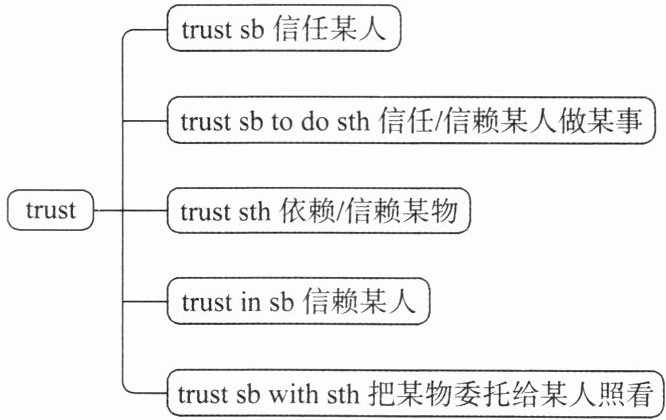
trust既可以作动词,又可以作名词,意为“信任;相信”。常见用法如下:
【迁移运用】
(1) His behaviour lost our
(2) I couldn't t
(3)无论他说什么,都别相信他。
【语境感悟】
Also, it may be easier to build trust and develop stronger relationship. 也可能更容易建立信任和发展更强的关系。(教材·P78)
I trust his judgment. 我相信他的判断。
【知识归纳】
trust既可以作动词,又可以作名词,意为“信任;相信”。常见用法如下:
【迁移运用】
(1) His behaviour lost our
trust
(信任).(2) I couldn't t
rust
him any more because he often tells lies.(3)无论他说什么,都别相信他。
Don't
trust
him, no matter what he says.答案
(1)trust (2)trust (3)Don't trust
解析
【分析】本题考查核心词汇trust的词性及常见用法,需结合每个小题的句子结构、语境判断trust的正确形式:第(1)题中动词lost后需接名词作宾语;第(2)题中情态动词couldn't后需接动词原形;第(3)题是否定祈使句,需用“Don't + 动词原形”结构。
【解析】(1) 句中lost是及物动词,意为“失去”,后面需要名词作宾语,trust作名词时意为“信任”,故填trust;(2) 句中couldn't是情态动词,情态动词后接动词原形,trust作动词时意为“信任”,结合语境“他经常说谎”,故填trust;(3) 否定祈使句的结构是“Don't + 动词原形”,“相信”对应trust,故填Don't trust。
【答案】(1)trust (2)trust (3)Don't trust
【知识点】trust的用法、名词与动词辨析、祈使句
【点评】本题围绕核心词汇trust的不同词性及常见搭配展开,考查基础词汇的运用,属于英语基础题型,需掌握trust的名词、动词用法及否定祈使句结构。
【难度系数】0.5
