

 登录
Ⅰ. 根据句意及首字母或汉语提示填写单词
1. Tom always o
2. My friend is a little n
3. How much did you p
4. Don't
5. If you think you are right, you should
1. Tom always o
ffers
his seat to the old people on the bus.2. My friend is a little n
ervous
when he speaks in front of his class.3. How much did you p
ay
for your new shoes?4. Don't
point
(指向)at others with your chopsticks.5. If you think you are right, you should
continue
(持续)to do it!答案
1. offers 2. nervous 3. pay 4. point 5. continue
解析
【分析】
本题是根据句意及首字母或汉语提示填写单词,解题时需先理解句子语境,再结合首字母或汉语提示,同时关注单词的语法形式(如动词的第三人称单数、原形等)。具体步骤:1. 通读句子把握语境;2. 匹配首字母或汉语提示联想对应单词;3. 验证单词形式是否符合句子语法要求。
【解析】
1. 句意:汤姆在公交车上总是给老人让座。结合首字母o,“offer sth to sb”是固定搭配,主语Tom为第三人称单数,一般现在时,故填offers。
2. 句意:我的朋友在班级前讲话时有点紧张。结合首字母n,“nervous”表示“紧张的”,符合语境,故填nervous。
3. 句意:你的新鞋花了多少钱?“pay for”是固定搭配,意为“为……付款”,助动词did后接动词原形,故填pay。
4. 句意:不要用筷子指向别人。“指向”对应的英文是“point”,“point at”是固定短语,祈使句否定形式用动词原形,故填point。
5. 句意:如果你认为你是对的,你应该继续做。“继续”对应的英文是“continue”,情态动词should后接动词原形,故填continue。
【答案】
1. offers 2. nervous 3. pay 4. point 5. continue
【知识点】
根据首字母填单词、根据汉语提示填单词
【点评】
本题为基础词汇填空题,考查核心词汇的拼写及常用搭配,侧重基础词汇的运用,难度较低。
【难度系数】
0.8
Ⅱ. 用括号内所给单词的适当形式填空
1. Try not to talk with a
2. His father is repairing the machine
3. It's
4. It's rude to ask a woman's
5. I don't want to be a famous person, but only to be
1. Try not to talk with a
stranger
(strange).2. His father is repairing the machine
carefully
(careful).3. It's
impolite
(polite) to talk back(顶嘴) with your parents.4. It's rude to ask a woman's
personal
(person) questions.5. I don't want to be a famous person, but only to be
myself
(I).答案
1. stranger 2. carefully 3. impolite 4. personal 5. myself
解析
【分析】
先通读每个句子,分析空格处所需词性,结合括号内单词的词性转换,同时结合句意判断形式:1. 空格前有不定冠词a,需填名词;2. 空格修饰动词,需用副词;3. 根据句意需用形容词的否定形式;4. 空格修饰名词,需用形容词;5. 结合句意需用反身代词。
【解析】
1. 不定冠词a后接可数名词单数,strange是形容词,转换为名词stranger(陌生人),符合句意,故填stranger。
2. 此处修饰动词repairing,需用副词,careful是形容词,其副词形式为carefully,故填carefully。
3. 句意表达“顶嘴是不礼貌的”,polite的否定形式为impolite,符合语境,故填impolite。
4. 空格修饰名词questions,需用形容词,person是名词,其形容词形式为personal(个人的),故填personal。
5. 结合句意“只想做我自己”,需用反身代词myself,构成“be oneself”结构,故填myself。
【答案】
1. stranger 2. carefully 3. impolite 4. personal 5. myself
【知识点】
词性转换、反身代词用法、形容词否定
【点评】
本题为英语单词适当形式填空的基础题型,考查词性转换、形容词否定及反身代词的运用,是初中英语核心基础考点,需掌握单词词性变化规则与语境适配。
【难度系数】
0.7
Ⅲ. 翻译句子
1. 汤姆是我班最受欢迎的学生之一。
2. 对我来说到吃午饭的时候了。
3. 你应该注意你的拼写。
4. 这辆自行车我花了300元。
5. 你能帮我查明火车什么时候离开吗?
1. 汤姆是我班最受欢迎的学生之一。
Tom is one of the most popular students in my class.
2. 对我来说到吃午饭的时候了。
It's time for me to have lunch.
3. 你应该注意你的拼写。
You should pay attention to your spelling.
4. 这辆自行车我花了300元。
I paid 300 yuan for the bike. /I spent 300 yuan on the bike.
5. 你能帮我查明火车什么时候离开吗?
Can you help me find out when the train will leave?
答案
1. Tom is one of the most popular students in my class.
2. It's time for me to have lunch.
3. You should pay attention to your spelling.
4. I paid 300 yuan for the bike. /I spent 300 yuan on the bike.
5. Can you help me find out when the train will leave?
解析
【分析】
翻译句子需结合英语常用固定结构、句型及短语:1. 表达“……之一”用“one of + the + 形容词最高级 + 可数名词复数”结构,“最受欢迎的”对应most popular,“在我班”为in my class;2. 固定句型“It's time for sb to do sth”表示“对某人来说到做某事的时间了”,“吃午饭”是have lunch;3. 固定短语“pay attention to”表示“注意”,“应该”用情态动词should;4. 表示“花费”的常用表达有“人+pay+钱+for+物品”“人+spend+钱+on+物品”;5. “帮某人做某事”是help sb do sth,“查明”是find out,宾语从句需用陈述语序。
【解析】
1. 按照“one of + 最高级 + 复数名词”结构,翻译为Tom is one of the most popular students in my class;
2. 套用固定句型It's time for sb to do sth,翻译为It's time for me to have lunch;
3. 结合情态动词should和固定短语pay attention to,翻译为You should pay attention to your spelling;
4. 选用“人+pay+钱+for+物品”或“人+spend+钱+on+物品”结构,翻译为I paid 300 yuan for the bike. /I spent 300 yuan on the bike;
5. 结合help sb do sth结构,宾语从句用陈述语序,翻译为Can you help me find out when the train will leave;
【答案】
1. Tom is one of the most popular students in my class.
2. It's time for me to have lunch.
3. You should pay attention to your spelling.
4. I paid 300 yuan for the bike. /I spent 300 yuan on the bike.
5. Can you help me find out when the train will leave?
【知识点】
汉译英、固定句型、固定短语
【点评】
本题为初中英语基础汉译英题型,考察常用固定结构、句型及短语,是英语学习的核心基础内容,需熟练掌握核心表达。
【难度系数】
0.7
Ⅳ.补全对话
A: Hi, everybody. I'm Becky. Welcome back to "The Problem Line". Today, we're going to talk about problems with parents. Okay, it's time for another call. 1.
B: Hello. My name's David.
A: Hi, David. Welcome to "The Problem Line". 2.
B: Well, I'm having problems with my mum. Every time we talk about something, we argue.
A: 3.
B: I know. But she always arranges(安排) everything for me. I can't even decide what to wear at weekends.
A: That's too bad. 4.
B: I tried, but she never listened to me. She thinks I should listen to her because I'm her child.
A: Well, that's a difficult problem. 5.
C: Hello, I'm Vera. I think David should ask his teacher for help. Perhaps his mother will listen to his teacher.
B: OK. I'll have a try. Thank you.
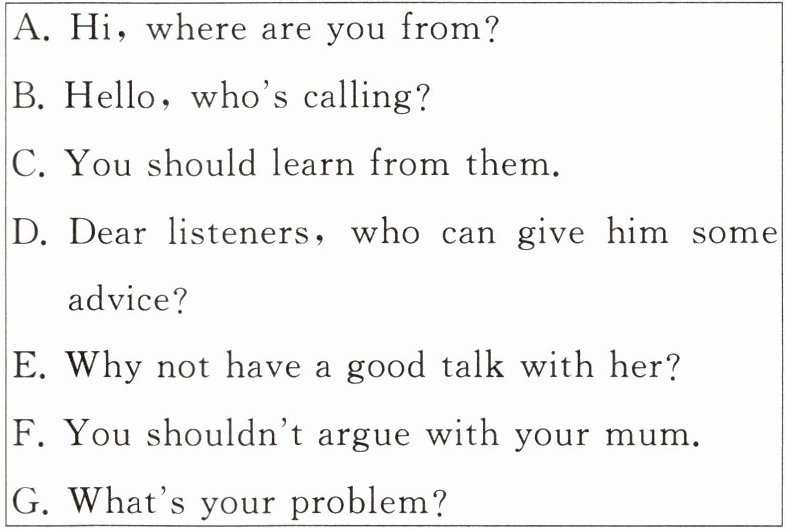
A. Hi, where are you from?
B. Hello, who's calling?
C. You should learn from them.
D. Dear listeners, who can give him some advice?
E. Why not have a good talk with her?
F. You shouldn't argue with your mum.
G. What's your problem?
A: Hi, everybody. I'm Becky. Welcome back to "The Problem Line". Today, we're going to talk about problems with parents. Okay, it's time for another call. 1.
B
B: Hello. My name's David.
A: Hi, David. Welcome to "The Problem Line". 2.
G
B: Well, I'm having problems with my mum. Every time we talk about something, we argue.
A: 3.
F
It's impolite.B: I know. But she always arranges(安排) everything for me. I can't even decide what to wear at weekends.
A: That's too bad. 4.
E
B: I tried, but she never listened to me. She thinks I should listen to her because I'm her child.
A: Well, that's a difficult problem. 5.
D
C: Hello, I'm Vera. I think David should ask his teacher for help. Perhaps his mother will listen to his teacher.
B: OK. I'll have a try. Thank you.
A. Hi, where are you from?
B. Hello, who's calling?
C. You should learn from them.
D. Dear listeners, who can give him some advice?
E. Why not have a good talk with her?
F. You shouldn't argue with your mum.
G. What's your problem?
答案
1-5 BGFED
解析
【分析】
本题是情景交际类补全对话,需结合对话的热线节目场景及上下文逻辑,逐空匹配合适的句子:1. 第1空对应询问来电者身份的需求;2. 第2空对应询问对方问题的需求;3. 第3空对应劝阻吵架的需求;4. 第4空对应提出沟通建议的需求;5. 第5空对应向听众征求建议的需求。
【解析】
1. 第1空:前文提到接入新热线,后文是来电者自我介绍,因此选询问来电者身份的B选项“Hello, who's calling?”;
2. 第2空:后文是来电者说明和妈妈的问题,因此选询问对方问题的G选项“What's your problem?”;
3. 第3空:前文提到和妈妈吵架,后文指出吵架不礼貌,因此选劝阻吵架的F选项“You shouldn't argue with your mum.”;
4. 第4空:后文提到尝试沟通但妈妈不听,因此选建议沟通的E选项“Why not have a good talk with her?”;
5. 第5空:后文是听众给出建议,因此选向听众征求建议的D选项“Dear listeners, who can give him some advice?”;
综上,答案依次为B、G、F、E、D,即BGFED。
【答案】
BGFED
【知识点】
情景交际、补全对话
【点评】
本题围绕热线节目中的亲子矛盾展开,考查情景交际用语的运用,需结合上下文逻辑选择句子,是初中英语基础题型。
【难度系数】
0.7
