

 登录
登录
3-1 Answer the questions. 回答问题。
(1) Why do cats climb shelves or poke their noses into boxes?
(2) Why does your cat sit nearby and look at you sometimes?
(3) What do octopuses want to do when they open jars and boxes?
(1) Why do cats climb shelves or poke their noses into boxes?
Because they are looking for a comfortable place to nap and exploring their surroundings.
(2) Why does your cat sit nearby and look at you sometimes?
That's probably because she finds it interesting to watch me and is curious about what I am doing.
(3) What do octopuses want to do when they open jars and boxes?
They want to find out what's inside.
答案
(1) Because they are looking for a comfortable place to nap and exploring their surroundings.
(2) That's probably because she finds it interesting to watch me and is curious about what I am doing.
(3) They want to find out what's inside.
(2) That's probably because she finds it interesting to watch me and is curious about what I am doing.
(3) They want to find out what's inside.
解析
【分析】本题为英语常识类问答,需结合动物的日常行为习性来解答。每个问题均询问动物特定行为的原因,需依据常见的动物行为逻辑匹配合理解释,确保答案符合英语表达习惯且与给定参考答案一致。
【解析】(1) 猫爬架子或闻盒子是因为它们在寻找舒适的睡觉场所,同时探索周围环境;(2) 猫有时坐在旁边看你,可能是因为觉得看你很有趣,并且好奇你正在做什么;(3) 章鱼打开罐子和盒子是想知道里面有什么东西。
【答案】(1) Because they are looking for a comfortable place to nap and exploring their surroundings.
(2) That's probably because she finds it interesting to watch me and is curious about what I am doing.
(3) They want to find out what's inside.
【知识点】英语问答、动物行为常识
【点评】本题为基础英语常识题,结合动物日常习性设置问题,考察学生对英语问题的理解能力和相关常识的运用,题目难度较低。
【难度系数】0.8
【解析】(1) 猫爬架子或闻盒子是因为它们在寻找舒适的睡觉场所,同时探索周围环境;(2) 猫有时坐在旁边看你,可能是因为觉得看你很有趣,并且好奇你正在做什么;(3) 章鱼打开罐子和盒子是想知道里面有什么东西。
【答案】(1) Because they are looking for a comfortable place to nap and exploring their surroundings.
(2) That's probably because she finds it interesting to watch me and is curious about what I am doing.
(3) They want to find out what's inside.
【知识点】英语问答、动物行为常识
【点评】本题为基础英语常识题,结合动物日常习性设置问题,考察学生对英语问题的理解能力和相关常识的运用,题目难度较低。
【难度系数】0.8
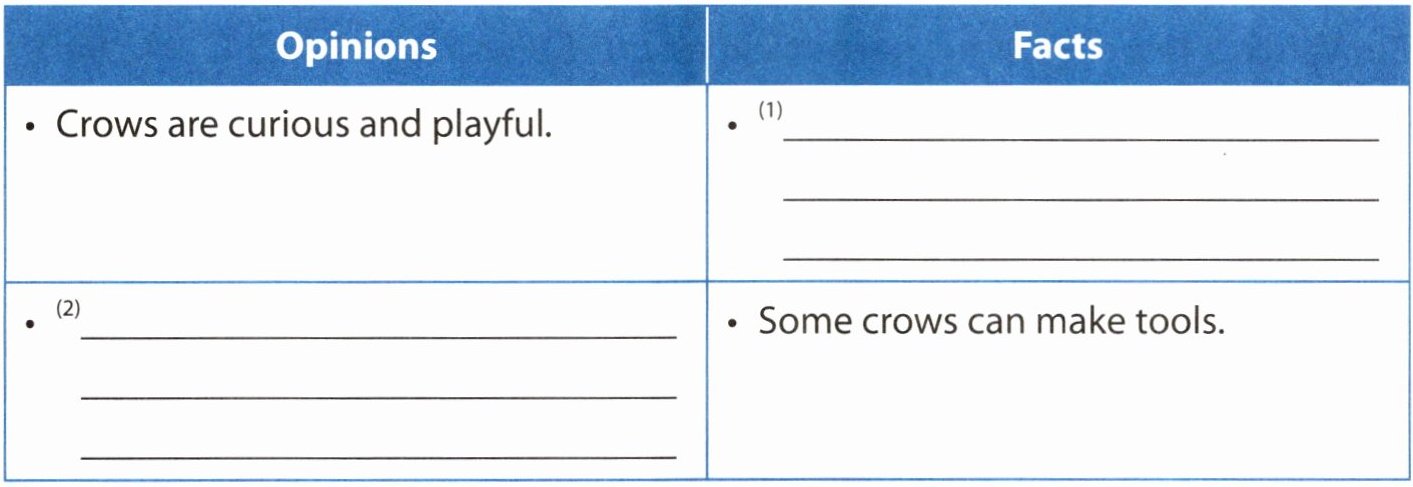
3-2 Complete the table with the information from paragraph 4. 从第4段中选择恰当的内容完成表格填写。
Crows: The smart problem solvers
Crows: The smart problem solvers
答案
(1) They are always looking for new things to explore and play with.
(2) Crows are very clever and can solve problems quickly.
(2) Crows are very clever and can solve problems quickly.
解析
【分析】
这道题要求根据文章第4段内容,区分“观点(Opinions,主观表达的看法)”和“事实(Facts,客观存在的内容)”来完成表格。解题思路:首先明确Opinions是主观判断类语句,Facts是客观描述类语句;接着对应表格两行,第一行需为“乌鸦好奇又爱玩”的观点匹配对应客观事实,第二行需为“一些乌鸦会制作工具”的事实匹配对应主观观点,最后从第4段提取符合要求的内容填写即可。
【解析】
根据题目要求,结合第4段信息:
(1)对应观点“Crows are curious and playful.”的客观事实,填写描述乌鸦探索玩耍的具体客观内容:They are always looking for new things to explore and play with.
(2)对应事实“Some crows can make tools.”的主观观点,填写评价乌鸦能力的主观看法:Crows are very clever and can solve problems quickly.
【答案】
(1) They are always looking for new things to explore and play with.
(2) Crows are very clever and can solve problems quickly.
【知识点】
英语阅读理解,观点与事实区分,信息提取匹配
【点评】
本题考查学生对文章指定段落内容的理解,以及区分观点和事实、提取匹配信息的能力,属于基础阅读理解题型。
【难度系数】
0.5
这道题要求根据文章第4段内容,区分“观点(Opinions,主观表达的看法)”和“事实(Facts,客观存在的内容)”来完成表格。解题思路:首先明确Opinions是主观判断类语句,Facts是客观描述类语句;接着对应表格两行,第一行需为“乌鸦好奇又爱玩”的观点匹配对应客观事实,第二行需为“一些乌鸦会制作工具”的事实匹配对应主观观点,最后从第4段提取符合要求的内容填写即可。
【解析】
根据题目要求,结合第4段信息:
(1)对应观点“Crows are curious and playful.”的客观事实,填写描述乌鸦探索玩耍的具体客观内容:They are always looking for new things to explore and play with.
(2)对应事实“Some crows can make tools.”的主观观点,填写评价乌鸦能力的主观看法:Crows are very clever and can solve problems quickly.
【答案】
(1) They are always looking for new things to explore and play with.
(2) Crows are very clever and can solve problems quickly.
【知识点】
英语阅读理解,观点与事实区分,信息提取匹配
【点评】
本题考查学生对文章指定段落内容的理解,以及区分观点和事实、提取匹配信息的能力,属于基础阅读理解题型。
【难度系数】
0.5
1 Rewrite the sentences as required. 按要求改写句子。
(1) The villagers dug a well to get groundwater for drinking. (对划线部分提问)
(2) To my surprise, her curiosity about the world never seemed to disappear. (保持句意基本不变)
I
(3) I must back up all my important files first. Then I will update my phone’s software. (两句合并为一句)
I
(1) The villagers dug a well to get groundwater for drinking. (对划线部分提问)
Why
did
the villagers dig a well?(2) To my surprise, her curiosity about the world never seemed to disappear. (保持句意基本不变)
I
was
surprised
to find that her curiosity about the world never seemed to disappear.(3) I must back up all my important files first. Then I will update my phone’s software. (两句合并为一句)
I
won't
update my phone’s software until
I back up all my important files.答案
(1) Why did (2) was surprised (3) won't, until
解析
【分析】
1. 第(1)题:划线部分是表目的的状语,对目的提问用疑问词Why;原句是一般过去时(动词dug为过去式),构成特殊疑问句需借助助动词did,主语后用动词原形,因此填Why did。
2. 第(2)题:“To my surprise”的同义表达是“I was surprised to...”,原句时态为一般过去时,主语是I,be动词用was,因此填was surprised。
3. 第(3)题:原句逻辑是“先备份文件,再更新软件”,对应“not...until...”(直到……才……)结构,即“我不会更新软件直到备份重要文件”,时态用一般将来时的否定式won't,因此填won't, until。
【解析】
(1) 对目的状语提问用疑问词Why;原句为一般过去时,特殊疑问句结构为“疑问词+did+主语+动词原形”,原句动词dug的原形是dig,故填Why did。
(2) “To my surprise”可转换为“I was surprised to...”,原句时态为一般过去时,主语I搭配be动词was,故填was surprised。
(3) 两句合并需体现“直到……才……”的逻辑,用连词until,一般将来时的否定式won't,故填won't, until。
【答案】
(1) Why did (2) was surprised (3) won't, until
【知识点】
句型转换、特殊疑问句、连词until的用法
【点评】
本题为英语基础句型转换题,考察学生对特殊疑问句、同义表达及常用连词的掌握,属于英语基础应用类题目,难度较低。
【难度系数】
0.8
1. 第(1)题:划线部分是表目的的状语,对目的提问用疑问词Why;原句是一般过去时(动词dug为过去式),构成特殊疑问句需借助助动词did,主语后用动词原形,因此填Why did。
2. 第(2)题:“To my surprise”的同义表达是“I was surprised to...”,原句时态为一般过去时,主语是I,be动词用was,因此填was surprised。
3. 第(3)题:原句逻辑是“先备份文件,再更新软件”,对应“not...until...”(直到……才……)结构,即“我不会更新软件直到备份重要文件”,时态用一般将来时的否定式won't,因此填won't, until。
【解析】
(1) 对目的状语提问用疑问词Why;原句为一般过去时,特殊疑问句结构为“疑问词+did+主语+动词原形”,原句动词dug的原形是dig,故填Why did。
(2) “To my surprise”可转换为“I was surprised to...”,原句时态为一般过去时,主语I搭配be动词was,故填was surprised。
(3) 两句合并需体现“直到……才……”的逻辑,用连词until,一般将来时的否定式won't,故填won't, until。
【答案】
(1) Why did (2) was surprised (3) won't, until
【知识点】
句型转换、特殊疑问句、连词until的用法
【点评】
本题为英语基础句型转换题,考察学生对特殊疑问句、同义表达及常用连词的掌握,属于英语基础应用类题目,难度较低。
【难度系数】
0.8
