

 登录
登录
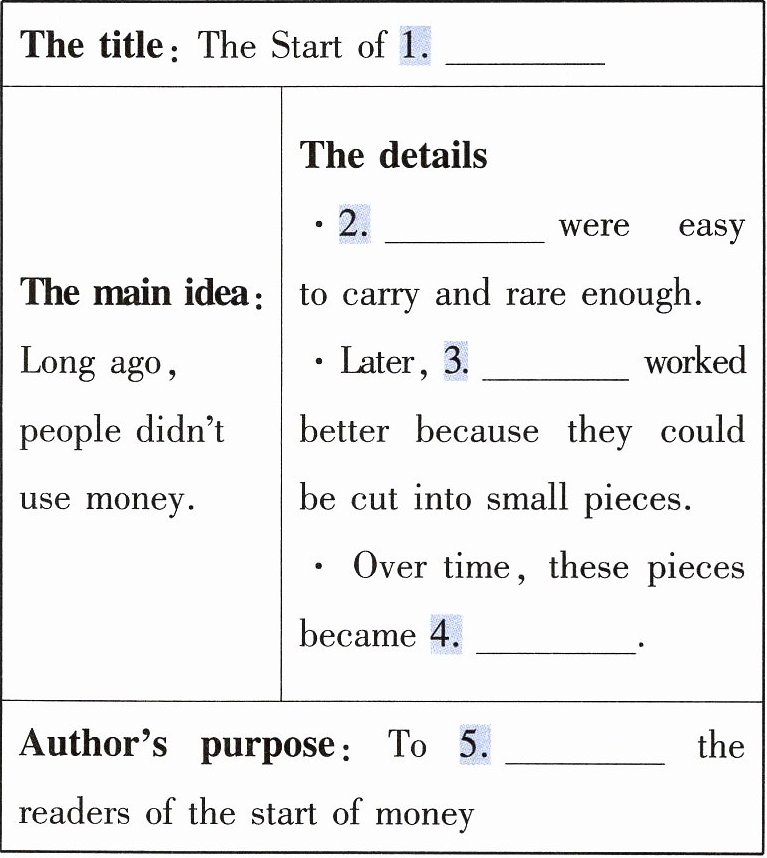
二、根据短文完成表格。
Long ago, people didn't use money like we
do now. They traded things instead. For
example, a farmer might give a cow to a baker
and get bread in return. This was called
"barter". But the barter had a problem. What if
the baker didn't need a cow? How would trade
take place? They needed something everyone
wanted. Maybe shells (贝壳)? They were easy
to carry and rare (稀有的) enough. Later,
metals (金属) worked better because they
could be cut into small pieces.
Over time, these pieces became coins.
Coins were simple and everyone knew their
value. That's how money began. It solved the
old problem, making trade easier for everyone.
Long ago, people didn't use money like we
do now. They traded things instead. For
example, a farmer might give a cow to a baker
and get bread in return. This was called
"barter". But the barter had a problem. What if
the baker didn't need a cow? How would trade
take place? They needed something everyone
wanted. Maybe shells (贝壳)? They were easy
to carry and rare (稀有的) enough. Later,
metals (金属) worked better because they
could be cut into small pieces.
Over time, these pieces became coins.
Coins were simple and everyone knew their
value. That's how money began. It solved the
old problem, making trade easier for everyone.
答案
二、1. Money 2. Shells 3. metals 4. coins
5. inform
5. inform
解析
【分析】
这是一篇信息提取类的阅读填空题,解题思路非常清晰:首先通读全文,把握文章核心主题是介绍货币的起源,之后按照表格每个空给出的前后提示,回到原文精准定位对应的语句,直接提取匹配的正确词汇即可:首先标题对应全文核心主题,确定是货币的开端;之后三个细节空都可以在原文找到完全匹配描述的事物,最后一空结合作者写作目的和固定搭配规则就能得出答案。
【解析】
我们逐空结合原文内容推导答案:
1. 全文围绕货币的诞生过程展开,结尾也明确点明“That's how money began”,因此标题补充为Money;
2. 原文明确给出语句“Maybe shells (贝壳)? They were easy to carry and rare (稀有的) enough.”,和空后的描述完全匹配,因此填Shells;
3. 原文直接对应“Later, metals (金属) worked better because they could be cut into small pieces.”,和表格细节描述完全一致,因此填metals;
4. 原文语句“Over time, these pieces became coins.”和表格内容完全对应,因此填coins;
5. 作者的写作目的是向读者介绍、告知货币的起源,固定搭配inform sb of sth表示“告知某人某事”,完全符合语境,因此填inform。
【答案】
1. Money 2. Shells 3. metals 4. coins 5. inform
【知识点】
阅读信息提取;固定短语搭配
【点评】
本题属于基础阅读题型,所有答案都可以在原文中直接定位获取,不需要复杂的逻辑推理,学生只要耐心对照原文细节查找对应内容,就可以顺利完成作答,同时也顺带考察了常见固定搭配的掌握情况。
【难度系数】
0.8
这是一篇信息提取类的阅读填空题,解题思路非常清晰:首先通读全文,把握文章核心主题是介绍货币的起源,之后按照表格每个空给出的前后提示,回到原文精准定位对应的语句,直接提取匹配的正确词汇即可:首先标题对应全文核心主题,确定是货币的开端;之后三个细节空都可以在原文找到完全匹配描述的事物,最后一空结合作者写作目的和固定搭配规则就能得出答案。
【解析】
我们逐空结合原文内容推导答案:
1. 全文围绕货币的诞生过程展开,结尾也明确点明“That's how money began”,因此标题补充为Money;
2. 原文明确给出语句“Maybe shells (贝壳)? They were easy to carry and rare (稀有的) enough.”,和空后的描述完全匹配,因此填Shells;
3. 原文直接对应“Later, metals (金属) worked better because they could be cut into small pieces.”,和表格细节描述完全一致,因此填metals;
4. 原文语句“Over time, these pieces became coins.”和表格内容完全对应,因此填coins;
5. 作者的写作目的是向读者介绍、告知货币的起源,固定搭配inform sb of sth表示“告知某人某事”,完全符合语境,因此填inform。
【答案】
1. Money 2. Shells 3. metals 4. coins 5. inform
【知识点】
阅读信息提取;固定短语搭配
【点评】
本题属于基础阅读题型,所有答案都可以在原文中直接定位获取,不需要复杂的逻辑推理,学生只要耐心对照原文细节查找对应内容,就可以顺利完成作答,同时也顺带考察了常见固定搭配的掌握情况。
【难度系数】
0.8
三、阅读理解。
We can pay in many ways, but each needs
care. Cash is good for buying small things like a
pencil or a bus ticket. It's easy to use because
you just need to hand over the right amount.
You can see exactly how much you're spending.
But you should keep it in a safe place. If you
lose cash, it's hard to get back. So never carry
more than you need, especially when going to a
busy place.
Credit cards are another way. They're good
for more expensive things. Always check the
records after paying. Make sure the number
matches what you spent. If not, contact(联系)
the shop or the bank right away to solve the
problem. Most shops or banks can fix mistakes
in a certain time.
There are also some payment Apps on
mobile phones. They're fast. You can pay with a
scan, even for things online. They are helpful
when you forget your wallet at home. But never
share your payment password(密码). If you do
it, maybe someone will use it to pay without
your knowledge. Keep them secret, just like
your diary.
No matter how you pay, safety comes first.
With safe ways of payment, shops can focus on
selling good things, and customers can feel
comfortable in their buys. It makes buying and
selling a happy thing for all.
根据材料内容选择最佳答案。
(
"hand over" in paragraph 1 probably
mean?
A. Number. B. Invent.
C. Give. D. Suggest.
(
about?
A. How to pay with credit cards
safely.
B. How to check the spending
records.
C. How to make banks fix mistakes.
D. How to buy bigger things.
(
need to pay but find your wallet left
at home, what can you do?
A. Go home to get it.
B. Let someone help you pay.
C. Borrow money from others to pay.
D. Pay with payment Apps on your
phone.
(
according to the text?
A. Keep it in a safe place.
B. No matter how you pay, safety
comes first.
C. Make sure the number matches
what you spent.
D. Keep them secret, just like your
diary.
(
How could he pay safely according to
the text?
A. By telling an adult.
B. By seeing the right amount.
C. By checking records after paying.
D. By being careful with his payment
password.
We can pay in many ways, but each needs
care. Cash is good for buying small things like a
pencil or a bus ticket. It's easy to use because
you just need to hand over the right amount.
You can see exactly how much you're spending.
But you should keep it in a safe place. If you
lose cash, it's hard to get back. So never carry
more than you need, especially when going to a
busy place.
Credit cards are another way. They're good
for more expensive things. Always check the
records after paying. Make sure the number
matches what you spent. If not, contact(联系)
the shop or the bank right away to solve the
problem. Most shops or banks can fix mistakes
in a certain time.
There are also some payment Apps on
mobile phones. They're fast. You can pay with a
scan, even for things online. They are helpful
when you forget your wallet at home. But never
share your payment password(密码). If you do
it, maybe someone will use it to pay without
your knowledge. Keep them secret, just like
your diary.
No matter how you pay, safety comes first.
With safe ways of payment, shops can focus on
selling good things, and customers can feel
comfortable in their buys. It makes buying and
selling a happy thing for all.
根据材料内容选择最佳答案。
(
C
)1. What does the underlined phrase"hand over" in paragraph 1 probably
mean?
A. Number. B. Invent.
C. Give. D. Suggest.
(
A
)2. What does paragraph 2 mainly talkabout?
A. How to pay with credit cards
safely.
B. How to check the spending
records.
C. How to make banks fix mistakes.
D. How to buy bigger things.
(
D
)3. According to the text, when youneed to pay but find your wallet left
at home, what can you do?
A. Go home to get it.
B. Let someone help you pay.
C. Borrow money from others to pay.
D. Pay with payment Apps on your
phone.
(
B
)4. Which of the following is an opinionaccording to the text?
A. Keep it in a safe place.
B. No matter how you pay, safety
comes first.
C. Make sure the number matches
what you spent.
D. Keep them secret, just like your
diary.
(
D
)5. Michael likes paying with his phone.How could he pay safely according to
the text?
A. By telling an adult.
B. By seeing the right amount.
C. By checking records after paying.
D. By being careful with his payment
password.
答案
三、1. C "It's easy to use because you just
need to hand over the right
amount."句意为"它(现金)
很方便使用,因为你只需要交出
正确的金额"。hand over意为
"移交,交出",在本句中可理解
为"给",可用give替换。故
选C。
2. A 综合第二段内容可知,这一段作
者主要讲述怎么用信用卡安全支
付。故选A。
3. D "They are helpful when you forget
your wallet at home."句意为"在
忘带钱包时,它们(支付App)
就派上用场了"。故选D。
4. B A、C、D三句均为祈使句,表建
议或命令。B选项为陈述句,句
意为"无论你怎样支付,安全第
一",陈述了作者的观点。故
选B。
5. D 由第三段"But never share your
payment password."可知,用手
机支付一定保护好支付密码。故
选D。
need to hand over the right
amount."句意为"它(现金)
很方便使用,因为你只需要交出
正确的金额"。hand over意为
"移交,交出",在本句中可理解
为"给",可用give替换。故
选C。
2. A 综合第二段内容可知,这一段作
者主要讲述怎么用信用卡安全支
付。故选A。
3. D "They are helpful when you forget
your wallet at home."句意为"在
忘带钱包时,它们(支付App)
就派上用场了"。故选D。
4. B A、C、D三句均为祈使句,表建
议或命令。B选项为陈述句,句
意为"无论你怎样支付,安全第
一",陈述了作者的观点。故
选B。
5. D 由第三段"But never share your
payment password."可知,用手
机支付一定保护好支付密码。故
选D。
解析
【分析】
拿到这篇阅读理解,首先先通读全文,梳理清楚文章介绍的三种支付方式(现金、信用卡、手机支付APP)的特点、使用注意事项,明确全文核心主题是支付安全。之后逐题对应考点解题:1. 词义猜测题直接定位划线短语所在的上下文,结合现金支付的日常场景推断短语含义;2. 段落主旨题通读对应段落,排除只覆盖局部细节的干扰选项,提炼段落核心表达;3. 细节查找题直接定位题干关键词“忘带钱包”对应的原文位置,直接匹配答案;4. 观点辨析题区分文中的操作指引类祈使句和作者的核心态度观点;5. 细节应用题定位手机支付的安全规则,匹配对应选项即可。
【解析】
1. 定位第一段划线短语所在句子:“It's easy to use because you just need to hand over the right amount.”,结合现金支付的场景,使用现金时只需要递给商家对应数额的钱币即可,hand over意为“交出、递给”,和选项C的Give含义完全吻合,A.Number(计数)、B.Invent(发明)、D.Suggest(建议)均不符合语境,因此选C。
2. 通读第二段可知,段落围绕信用卡支付展开,先后提到了消费后核对账单记录、发现金额不符立刻联系商家或银行解决问题,全部内容都在讲解信用卡的安全支付方法,B选项“核对消费记录”、C选项“让银行修正错误”都只是段落中的局部细节,D选项“购买更贵的商品”只是信用卡的适用场景,均不是段落核心主旨,因此选A。
3. 定位第三段相关描述:“They are helpful when you forget your wallet at home.”,此处的They指代前文提到的手机上的支付App,说明忘带钱包时可以使用手机支付App完成付款,对应选项D,因此选D。
4. 逐一辨析选项:A选项“把现金放在安全的地方”是现金支付的操作提示,C选项“确保金额和你的消费数额一致”是信用卡支付的操作要求,D选项“像你的日记一样保密密码”是手机支付的操作指引,三者都属于具体操作建议,只有B选项“无论你用什么方式支付,安全第一”是作者全文传递的核心观点,因此选B。
5. 定位第三段手机支付的安全规则:“But never share your payment password(密码). If you do it, maybe someone will use it to pay without your knowledge.”,说明使用手机支付要妥善保管、小心对待自己的支付密码,对应选项D,因此选D。
【答案】
1-5 CADBD
【知识点】
词义猜测,细节理解,主旨大意
【点评】
本篇阅读选取贴近学生日常生活的支付安全主题,考点覆盖了初中英语阅读常见的词义猜测、细节定位、段落主旨、观点辨析多个题型,难度梯度平缓,既考察学生的文本信息提取能力,也能引导学生建立正确的移动支付安全意识,做题时注意不要把局部细节误判为段落主旨即可轻松得分。
【难度系数】
0.7
拿到这篇阅读理解,首先先通读全文,梳理清楚文章介绍的三种支付方式(现金、信用卡、手机支付APP)的特点、使用注意事项,明确全文核心主题是支付安全。之后逐题对应考点解题:1. 词义猜测题直接定位划线短语所在的上下文,结合现金支付的日常场景推断短语含义;2. 段落主旨题通读对应段落,排除只覆盖局部细节的干扰选项,提炼段落核心表达;3. 细节查找题直接定位题干关键词“忘带钱包”对应的原文位置,直接匹配答案;4. 观点辨析题区分文中的操作指引类祈使句和作者的核心态度观点;5. 细节应用题定位手机支付的安全规则,匹配对应选项即可。
【解析】
1. 定位第一段划线短语所在句子:“It's easy to use because you just need to hand over the right amount.”,结合现金支付的场景,使用现金时只需要递给商家对应数额的钱币即可,hand over意为“交出、递给”,和选项C的Give含义完全吻合,A.Number(计数)、B.Invent(发明)、D.Suggest(建议)均不符合语境,因此选C。
2. 通读第二段可知,段落围绕信用卡支付展开,先后提到了消费后核对账单记录、发现金额不符立刻联系商家或银行解决问题,全部内容都在讲解信用卡的安全支付方法,B选项“核对消费记录”、C选项“让银行修正错误”都只是段落中的局部细节,D选项“购买更贵的商品”只是信用卡的适用场景,均不是段落核心主旨,因此选A。
3. 定位第三段相关描述:“They are helpful when you forget your wallet at home.”,此处的They指代前文提到的手机上的支付App,说明忘带钱包时可以使用手机支付App完成付款,对应选项D,因此选D。
4. 逐一辨析选项:A选项“把现金放在安全的地方”是现金支付的操作提示,C选项“确保金额和你的消费数额一致”是信用卡支付的操作要求,D选项“像你的日记一样保密密码”是手机支付的操作指引,三者都属于具体操作建议,只有B选项“无论你用什么方式支付,安全第一”是作者全文传递的核心观点,因此选B。
5. 定位第三段手机支付的安全规则:“But never share your payment password(密码). If you do it, maybe someone will use it to pay without your knowledge.”,说明使用手机支付要妥善保管、小心对待自己的支付密码,对应选项D,因此选D。
【答案】
1-5 CADBD
【知识点】
词义猜测,细节理解,主旨大意
【点评】
本篇阅读选取贴近学生日常生活的支付安全主题,考点覆盖了初中英语阅读常见的词义猜测、细节定位、段落主旨、观点辨析多个题型,难度梯度平缓,既考察学生的文本信息提取能力,也能引导学生建立正确的移动支付安全意识,做题时注意不要把局部细节误判为段落主旨即可轻松得分。
【难度系数】
0.7
