

 登录
登录
Ⅳ. Read and judge. 读一读,判断句子中单词的画线部分发音是否相同,相同的写“T”,不相符的写“F”。
(
(
(
(
(
(
T
) 1. The signs show good manners.(
F
) 2. The baby plays with chopsticks.(
T
) 3. She talks and laughs when eating.(
T
) 4. Sue washes the dishes after dinner.(
F
) 5. We always let the elders or guests take seats first.答案
1. T 2. F 3. T 4. T 5. F
解析
【分析】判断单词画线部分发音需掌握英语后缀s/es的发音规则:清辅音后读/s/,浊辅音/元音后读/z/,以s/x/ch/sh等结尾加es读/ɪz/。逐题分析:1. 两词的s均在浊辅音后,读/z/,发音相同;2. plays的s在元音后读/z/,chopsticks的s在清辅音后读/s/,发音不同;3. 两词的s均在清辅音后读/s/,发音相同;4. 两词的es在sh结尾后读/ɪz/,发音相同;5. elders的s读/z/,guests、seats的s读/s/,发音不同。
【解析】根据发音规则逐一判断:1. signs的s发音为/z/,manners的s发音为/z/,相同→填T;2. plays的s发音为/z/,chopsticks的s发音为/s/,不同→填F;3. talks的s发音为/s/,laughs的s发音为/s/,相同→填T;4. washes的es发音为/ɪz/,dishes的es发音为/ɪz/,相同→填T;5. elders的s发音为/z/,guests、seats的s发音为/s/,不同→填F。
【答案】1. T 2. F 3. T 4. T 5. F
【知识点】英语语音发音,名词复数发音,动词第三人称单数发音
【点评】本题考查小学英语基础语音中后缀s/es的发音规律,需区分不同语境下的发音差异,是常见的语音判断题型,侧重基础知识点的应用。
【难度系数】0.6
【解析】根据发音规则逐一判断:1. signs的s发音为/z/,manners的s发音为/z/,相同→填T;2. plays的s发音为/z/,chopsticks的s发音为/s/,不同→填F;3. talks的s发音为/s/,laughs的s发音为/s/,相同→填T;4. washes的es发音为/ɪz/,dishes的es发音为/ɪz/,相同→填T;5. elders的s发音为/z/,guests、seats的s发音为/s/,不同→填F。
【答案】1. T 2. F 3. T 4. T 5. F
【知识点】英语语音发音,名词复数发音,动词第三人称单数发音
【点评】本题考查小学英语基础语音中后缀s/es的发音规律,需区分不同语境下的发音差异,是常见的语音判断题型,侧重基础知识点的应用。
【难度系数】0.6
Ⅴ. Read and choose. 为温馨提示栏中的内容分类,将序号填在相应的圆圈里。(共同的温馨提示填在中间部分)
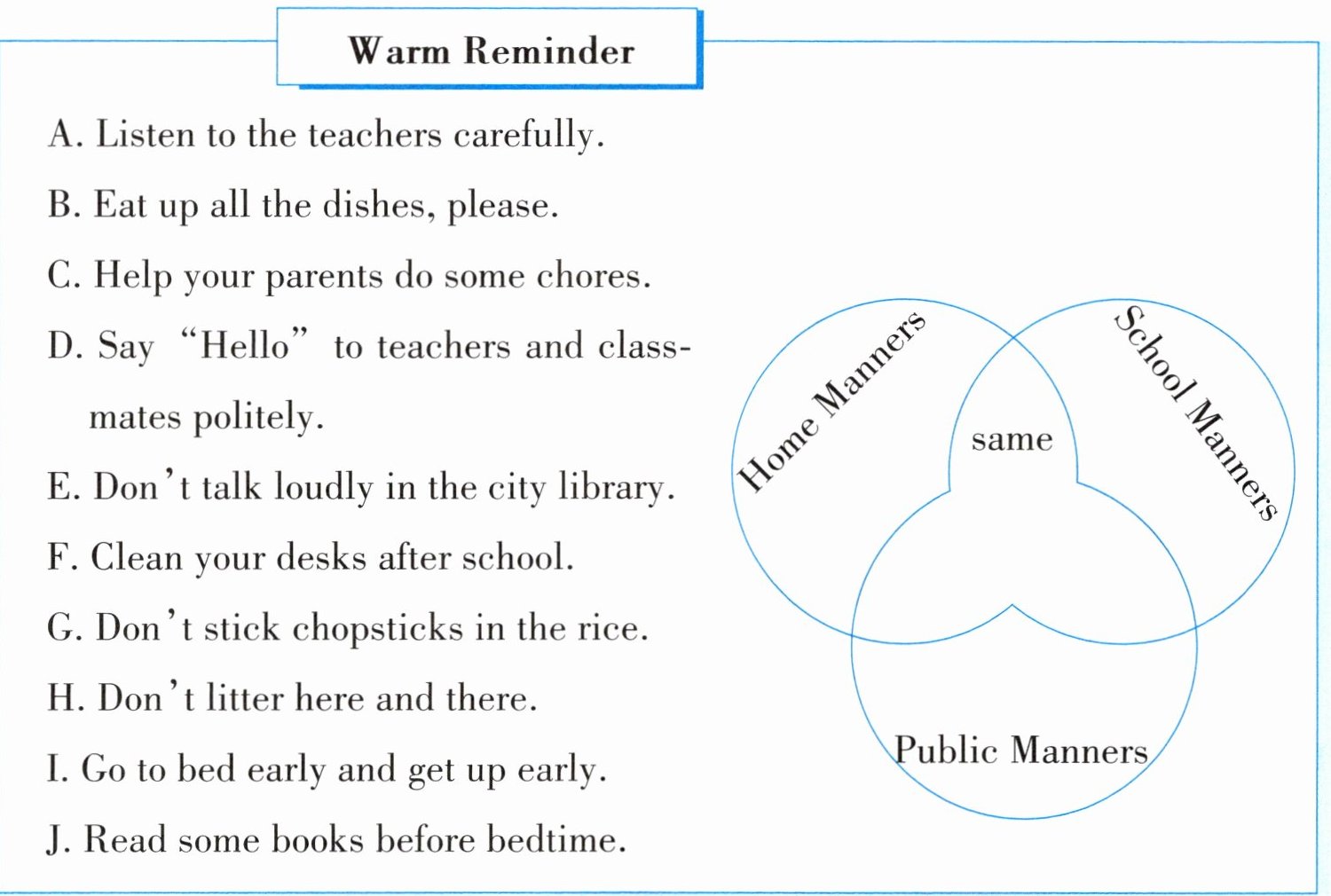
A. Listen to the teachers carefully.
B. Eat up all the dishes, please.
C. Help your parents do some chores.
D. Say “Hello” to teachers and class- mates politely.
E. Don’t talk loudly in the city library.
F. Clean your desks after school.
G. Don’t stick chopsticks in the rice.
H. Don’t litter here and there.
Ⅰ. Go to bed early and get up early.
J. Read some books before bedtime.
A. Listen to the teachers carefully.
B. Eat up all the dishes, please.
C. Help your parents do some chores.
D. Say “Hello” to teachers and class- mates politely.
E. Don’t talk loudly in the city library.
F. Clean your desks after school.
G. Don’t stick chopsticks in the rice.
H. Don’t litter here and there.
Ⅰ. Go to bed early and get up early.
J. Read some books before bedtime.
答案
Home Manners: C I J
School Manners: A D F
Public Manners: E
Same: B G H
School Manners: A D F
Public Manners: E
Same: B G H
解析
【分析】首先明确三类礼仪的场景:Home Manners(家庭礼仪,家庭中的行为规范)、School Manners(学校礼仪,校园内的行为规范)、Public Manners(公共礼仪,公共场合的行为规范),中间Same部分是家庭和学校都适用的礼仪。再逐个分析选项的适用场景,对应分类即可。
【解析】1. 家庭礼仪(Home Manners):是家庭中的行为要求,对应帮父母做家务(C)、早睡早起(I)、睡前读书(J);2. 学校礼仪(School Manners):是校园内的行为要求,对应认真听老师讲课(A)、礼貌问候师生(D)、放学后打扫课桌(F);3. 公共礼仪(Public Manners):是公共场合的行为要求,对应不在市图书馆大声说话(E);4. 共通礼仪(Same):家庭和学校都适用的行为,对应吃光所有饭菜(B)、不把筷子插在饭里(G)、不乱扔垃圾(H)。
【答案】Home Manners: C I J;School Manners: A D F;Public Manners: E;Same: B G H
【知识点】日常礼仪分类、英语场景词汇
【点评】本题结合生活场景考查礼仪分类,贴近学生日常,帮助理解不同场景的行为规范。
【难度系数】0.6
【解析】1. 家庭礼仪(Home Manners):是家庭中的行为要求,对应帮父母做家务(C)、早睡早起(I)、睡前读书(J);2. 学校礼仪(School Manners):是校园内的行为要求,对应认真听老师讲课(A)、礼貌问候师生(D)、放学后打扫课桌(F);3. 公共礼仪(Public Manners):是公共场合的行为要求,对应不在市图书馆大声说话(E);4. 共通礼仪(Same):家庭和学校都适用的行为,对应吃光所有饭菜(B)、不把筷子插在饭里(G)、不乱扔垃圾(H)。
【答案】Home Manners: C I J;School Manners: A D F;Public Manners: E;Same: B G H
【知识点】日常礼仪分类、英语场景词汇
【点评】本题结合生活场景考查礼仪分类,贴近学生日常,帮助理解不同场景的行为规范。
【难度系数】0.6
Ⅵ. Read and match. 参照例子,将下列同学的行为与《小学生文明守则》的条款进行匹配,将序号写在方框里。
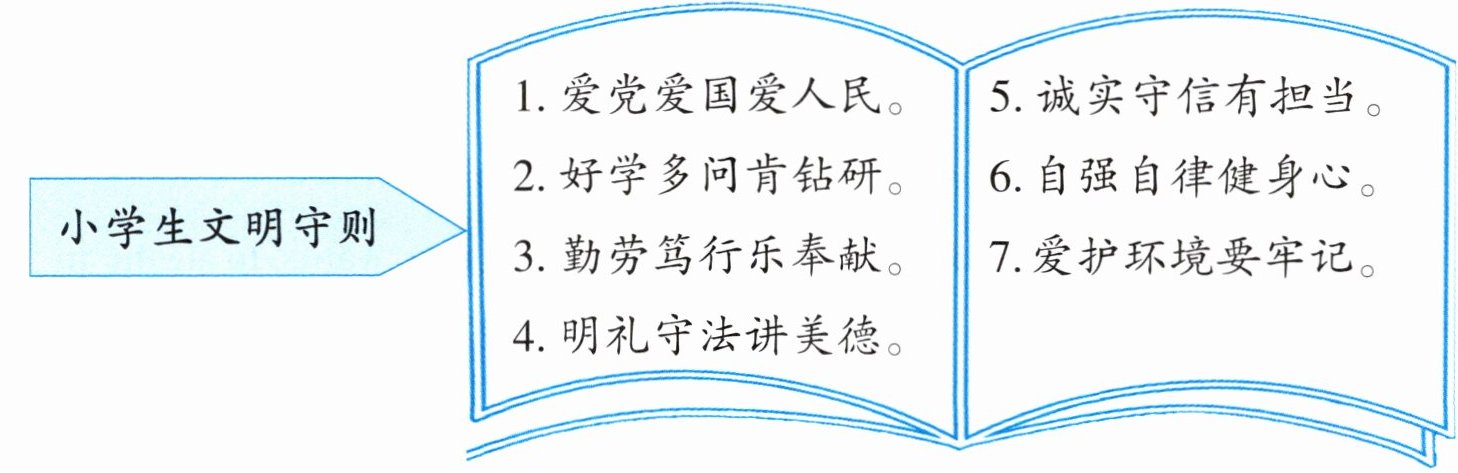
2 例:Xia Yiyi always listens to the teachers carefully in class. She loves thinking. She often raises her hands to answer questions.
Wang Tao is good at sports. He often plays balls with his friends after class. His classmates all like him.
Kate goes to the park on Sunday. A boy is picking the flowers. Kate stops him and says, “Don’t pick the flowers. We should take care of the flowers and plants.”
Li Li often does some chores. She can clean the table and wash the clothes. Sometimes she cleans the toilet. She is such a helpful girl.
Ben was waiting at the bus stop. When a bus was coming, a boy rushed to the bus. Ben stopped him, “Don’t rush. We should wait in line and get on the bus one by one.”
2 例:Xia Yiyi always listens to the teachers carefully in class. She loves thinking. She often raises her hands to answer questions.
Wang Tao is good at sports. He often plays balls with his friends after class. His classmates all like him.
Kate goes to the park on Sunday. A boy is picking the flowers. Kate stops him and says, “Don’t pick the flowers. We should take care of the flowers and plants.”
Li Li often does some chores. She can clean the table and wash the clothes. Sometimes she cleans the toilet. She is such a helpful girl.
Ben was waiting at the bus stop. When a bus was coming, a boy rushed to the bus. Ben stopped him, “Don’t rush. We should wait in line and get on the bus one by one.”
答案
2-6-7-3-4
解析
【分析】首先要明确每个同学的行为特点,再对应《小学生文明守则》各条款的含义,逐一匹配得出结果。步骤为:先解读每个同学的行为,再将行为与守则条款的内容进行对应,最终完成匹配。
【解析】1. 例中Xia Yiyi认真听课、爱思考、主动举手回答问题,对应守则2“好学多问肯钻研”,已给出;
2. Wang Tao擅长运动,课后和朋友打球,对应守则6“自强自律健身心”;
3. Kate阻止他人摘花,爱护花草,对应守则7“爱护环境要牢记”;
4. Li Li主动做家务,勤劳肯干,对应守则3“勤劳笃行乐奉献”;
5. Ben阻止他人插队,遵守公共秩序,对应守则4“明礼守法讲美德”。
因此匹配结果为2-6-7-3-4。
【答案】2-6-7-3-4
【知识点】文明守则理解、行为匹配
【点评】本题结合学生日常行为考查对《小学生文明守则》的理解,贴近生活实际,需要准确对应行为与守则内容,难度适中。
【难度系数】0.3
【解析】1. 例中Xia Yiyi认真听课、爱思考、主动举手回答问题,对应守则2“好学多问肯钻研”,已给出;
2. Wang Tao擅长运动,课后和朋友打球,对应守则6“自强自律健身心”;
3. Kate阻止他人摘花,爱护花草,对应守则7“爱护环境要牢记”;
4. Li Li主动做家务,勤劳肯干,对应守则3“勤劳笃行乐奉献”;
5. Ben阻止他人插队,遵守公共秩序,对应守则4“明礼守法讲美德”。
因此匹配结果为2-6-7-3-4。
【答案】2-6-7-3-4
【知识点】文明守则理解、行为匹配
【点评】本题结合学生日常行为考查对《小学生文明守则》的理解,贴近生活实际,需要准确对应行为与守则内容,难度适中。
【难度系数】0.3
