

 登录
登录
B
Face changing, or "Bianlian", is an important part of Sichuan opera. 4.
Face changing needs a lot of skills. 6.
· Wiping (抹)
The performer hides (隐藏) the colorful greasepaint (油彩) in a secret part of his face. When he needs to change his face, he wipes his hands across his face quickly. 7.
· Blowing
When the performers dance, they quickly blow powder (粉) in their hands or in a small box on stage. The face color changes at once after the powder lands on their faces.
· Pulling
8.
Face changing is an amazing form of art! It is popular with people all over the world.
阅读短文,从方框内所列选项中选出最佳选项填入对应空白处,使短文通顺、连贯。
A. Then it changes to another face.
B. There are 3 face changing skills.
C. People like face changing for many reasons.
D. And it is also one of the great treasures (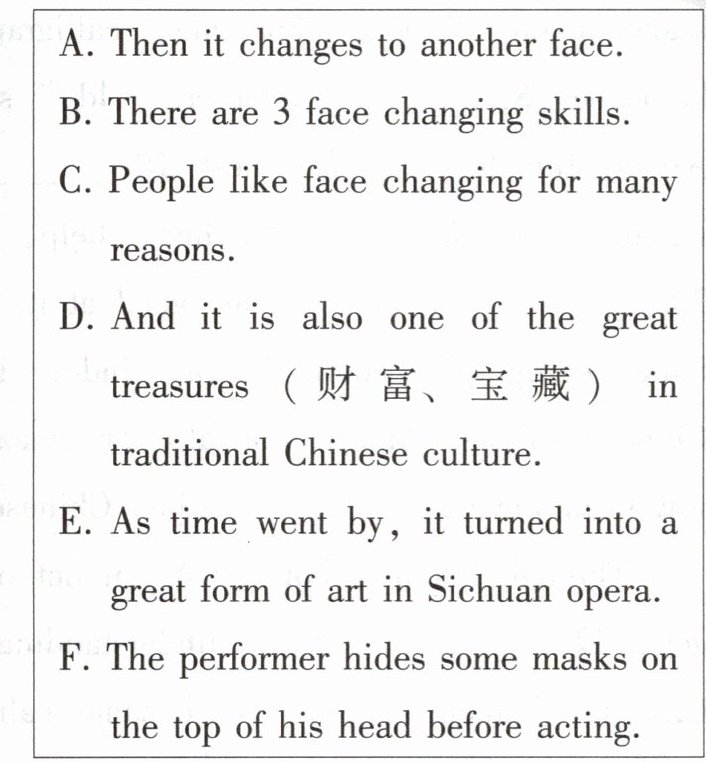 富、宝藏 ) in traditional Chinese culture.
E. As time went by, it turned into a great form of art in Sichuan opera.
F. The performer hides some masks on the top of his head before acting.
Face changing, or "Bianlian", is an important part of Sichuan opera. 4.
D
It has a long history of about 300 years. In ancient times, people had to work in the mountains. In order to scare (使害怕) the animals away, they painted colorful pictures on their faces. 5. E
Face changing needs a lot of skills. 6.
B
· Wiping (抹)
The performer hides (隐藏) the colorful greasepaint (油彩) in a secret part of his face. When he needs to change his face, he wipes his hands across his face quickly. 7.
A
· Blowing
When the performers dance, they quickly blow powder (粉) in their hands or in a small box on stage. The face color changes at once after the powder lands on their faces.
· Pulling
8.
F
He pulls them to change his face into red, green, blue or black to show different feelings such as happiness, sadness and so on.Face changing is an amazing form of art! It is popular with people all over the world.
阅读短文,从方框内所列选项中选出最佳选项填入对应空白处,使短文通顺、连贯。
A. Then it changes to another face.
B. There are 3 face changing skills.
C. People like face changing for many reasons.
D. And it is also one of the great treasures (
富、宝藏 ) in traditional Chinese culture.E. As time went by, it turned into a great form of art in Sichuan opera.
F. The performer hides some masks on the top of his head before acting.
答案
4. D 5. E 6. B 7. A 8. F
解析
【分析】
本题为语篇句子还原题,需结合上下文的逻辑关系、语境及核心主题(川剧变脸)匹配选项。解题时先通读全文把握主题,再逐个分析空白处前后内容的衔接逻辑:第4空承接变脸的重要性,第5空承接变脸的历史发展,第6空引出下文的三种技巧,第7空承接抹脸动作的结果,第8空引出拉面具的前提。
【解析】
1. 第4空:前文提到变脸是川剧的重要部分,选项D“它也是中国传统文化的瑰宝之一”承接上文对变脸重要性的描述,符合语境,故选D;
2. 第5空:前文讲述古代人们画脸吓动物的起源,后文提到其成为川剧艺术,选项E“随着时间推移,它变成了川剧的一种伟大艺术形式”承接历史发展的逻辑,故选E;
3. 第6空:后文列举了抹、吹、拉三种变脸技巧,选项B“有三种变脸技巧”引出下文的具体内容,故选B;
4. 第7空:前文描述抹油彩变脸的动作,选项A“然后它变成另一个脸”是该动作的结果,承接上文,故选A;
5. 第8空:后文提到拉面具变脸的动作,选项F“演员在表演前把一些面具藏在头顶”是拉面具变脸的前提,引出下文,故选F。
【答案】4.D 5.E 6.B 7.A 8.F
【知识点】语篇衔接、句子还原、文化常识
【点评】本题围绕川剧变脸主题,考查学生对语篇逻辑和上下文衔接的理解能力,需结合语境匹配选项,是初中英语常见题型,难度适中。
【难度系数】0.5
本题为语篇句子还原题,需结合上下文的逻辑关系、语境及核心主题(川剧变脸)匹配选项。解题时先通读全文把握主题,再逐个分析空白处前后内容的衔接逻辑:第4空承接变脸的重要性,第5空承接变脸的历史发展,第6空引出下文的三种技巧,第7空承接抹脸动作的结果,第8空引出拉面具的前提。
【解析】
1. 第4空:前文提到变脸是川剧的重要部分,选项D“它也是中国传统文化的瑰宝之一”承接上文对变脸重要性的描述,符合语境,故选D;
2. 第5空:前文讲述古代人们画脸吓动物的起源,后文提到其成为川剧艺术,选项E“随着时间推移,它变成了川剧的一种伟大艺术形式”承接历史发展的逻辑,故选E;
3. 第6空:后文列举了抹、吹、拉三种变脸技巧,选项B“有三种变脸技巧”引出下文的具体内容,故选B;
4. 第7空:前文描述抹油彩变脸的动作,选项A“然后它变成另一个脸”是该动作的结果,承接上文,故选A;
5. 第8空:后文提到拉面具变脸的动作,选项F“演员在表演前把一些面具藏在头顶”是拉面具变脸的前提,引出下文,故选F。
【答案】4.D 5.E 6.B 7.A 8.F
【知识点】语篇衔接、句子还原、文化常识
【点评】本题围绕川剧变脸主题,考查学生对语篇逻辑和上下文衔接的理解能力,需结合语境匹配选项,是初中英语常见题型,难度适中。
【难度系数】0.5
二、短文填空。
阅读下面短文,在空白处填入一个适当的单词或用括号内单词的正确形式填空。
Do you like calligraphy? As a Chinese student, do you think it is easy 9.
“When I first 11.
Aryan comes to China to study 13.
“When I first came to China, I didn't know much Chinese. For me, calligraphy belonged 18.
Through his new hobby, Aryan not only got a 22.
Now he has a good time living in China.
阅读下面短文,在空白处填入一个适当的单词或用括号内单词的正确形式填空。
Do you like calligraphy? As a Chinese student, do you think it is easy 9.
or
difficult to learn? How about 10. students
(student) from other countries?“When I first 11.
started
(start) learning calligraphy, my work was ugly (丑的). But when the brush was in my teacher's hand, it 12. turned
(turn) into Harry Potter's magic wand (魔杖),” said Aryan, from Afghanistan.Aryan comes to China to study 13.
Chinese
(China) in Beijing. Now he 14. is studying
(study) Chinese calligraphy. This is his 15. sixth
(six) year in China. During his stay in China, he sees China make great progress in many 16. ways
(way). He also finds that Chinese 17. is
(be) becoming a global language.“When I first came to China, I didn't know much Chinese. For me, calligraphy belonged 18.
to
another world,” said Aryan. But he tried his best 19. to learn
(learn) it. With the teacher's help, he 20. slowly
(slow) became good at it. He found calligraphy could be a window into Chinese culture. And it was also an amazing way to improve 21. his
(he) Chinese.Through his new hobby, Aryan not only got a 22.
better
(good) understanding of Chinese characters, but also became calmer when facing 23. difficulty/difficulties
(difficult).Now he has a good time living in China.
答案
9. or 10. students 11. started
12. turned 13. Chinese 14. is studying
15. sixth 16. ways 17. is 18. to
19. to learn 20. slowly 21. his
22. better 23. difficulty/difficulties
12. turned 13. Chinese 14. is studying
15. sixth 16. ways 17. is 18. to
19. to learn 20. slowly 21. his
22. better 23. difficulty/difficulties
解析
【分析】
这是一道英语短文填空题,需结合语境、语法规则(如时态、词性、固定搭配等)完成填空。解题思路如下:
1. 第9题:空格连接easy和difficult两个形容词,表选择关系,用连词or;
2. 第10题:other后接可数名词复数,student的复数是students;
3. 第11题:描述过去的动作“第一次开始学书法”,用一般过去时,start的过去式started;
4. 第12题:同样描述过去的动作,用turn的过去式turned;
5. 第13题:“学汉语”用名词Chinese;
6. 第14题:时间状语now提示用现在进行时,结构为am/is/are + doing,主语he对应is studying;
7. 第15题:表示“第六年”,用序数词sixth;
8. 第16题:many后接可数名词复数,way的复数是ways;
9. 第17题:主语Chinese(汉语)是单数,一般现在时be动词用is;
10. 第18题:固定搭配belong to,意为“属于”;
11. 第19题:固定搭配try one's best to do sth,用不定式to learn;
12. 第20题:修饰动词became,用副词slowly;
13. 第21题:修饰名词Chinese,用形容词性物主代词his;
14. 第22题:表示“更好的理解”,用good的比较级better;
15. 第23题:表示“面对困难”,名词difficulty可单数或复数difficulties。
【解析】
根据语境和语法规则,各空依次填入:
9. or(表选择的连词);10. students(名词复数);11. started(一般过去式);12. turned(一般过去式);13. Chinese(名词“汉语”);14. is studying(现在进行时);15. sixth(序数词);16. ways(名词复数);17. is(一般现在时be动词);18. to(固定搭配belong to);19. to learn(不定式);20. slowly(副词修饰动词);21. his(形容词性物主代词);22. better(比较级);23. difficulty/difficulties(名词)。
【答案】
9. or 10. students 11. started 12. turned 13. Chinese 14. is studying 15. sixth 16. ways 17. is 18. to 19. to learn 20. slowly 21. his 22. better 23. difficulty/difficulties
【知识点】
英语短文填空解题技巧、动词时态、名词的数与格
【点评】
本题为英语短文填空题,考查基础词汇、核心语法(时态、词性、固定搭配等),语境贴近学生生活,难度适中,需学生结合语境灵活运用所学知识完成填空。
【难度系数】
0.6
这是一道英语短文填空题,需结合语境、语法规则(如时态、词性、固定搭配等)完成填空。解题思路如下:
1. 第9题:空格连接easy和difficult两个形容词,表选择关系,用连词or;
2. 第10题:other后接可数名词复数,student的复数是students;
3. 第11题:描述过去的动作“第一次开始学书法”,用一般过去时,start的过去式started;
4. 第12题:同样描述过去的动作,用turn的过去式turned;
5. 第13题:“学汉语”用名词Chinese;
6. 第14题:时间状语now提示用现在进行时,结构为am/is/are + doing,主语he对应is studying;
7. 第15题:表示“第六年”,用序数词sixth;
8. 第16题:many后接可数名词复数,way的复数是ways;
9. 第17题:主语Chinese(汉语)是单数,一般现在时be动词用is;
10. 第18题:固定搭配belong to,意为“属于”;
11. 第19题:固定搭配try one's best to do sth,用不定式to learn;
12. 第20题:修饰动词became,用副词slowly;
13. 第21题:修饰名词Chinese,用形容词性物主代词his;
14. 第22题:表示“更好的理解”,用good的比较级better;
15. 第23题:表示“面对困难”,名词difficulty可单数或复数difficulties。
【解析】
根据语境和语法规则,各空依次填入:
9. or(表选择的连词);10. students(名词复数);11. started(一般过去式);12. turned(一般过去式);13. Chinese(名词“汉语”);14. is studying(现在进行时);15. sixth(序数词);16. ways(名词复数);17. is(一般现在时be动词);18. to(固定搭配belong to);19. to learn(不定式);20. slowly(副词修饰动词);21. his(形容词性物主代词);22. better(比较级);23. difficulty/difficulties(名词)。
【答案】
9. or 10. students 11. started 12. turned 13. Chinese 14. is studying 15. sixth 16. ways 17. is 18. to 19. to learn 20. slowly 21. his 22. better 23. difficulty/difficulties
【知识点】
英语短文填空解题技巧、动词时态、名词的数与格
【点评】
本题为英语短文填空题,考查基础词汇、核心语法(时态、词性、固定搭配等),语境贴近学生生活,难度适中,需学生结合语境灵活运用所学知识完成填空。
【难度系数】
0.6
