

 登录
登录
四、阅读理解。
① Chemistry is everywhere in our daily life. Sometimes
it's easy to see. At other times, it can be very hard to see the everyday chemistry at work, but nearly everything you touch has some chemicals(化学物质) in it.
② Chemistry helps to make products for use. Something as simple as toothpaste has at least three chemicals that keep your teeth clean. Other things in your daily life are created by chemistry, such as hair products and soap. Without chemistry, we would never have known that we need soap to get the oil out of clothes.
③ Chemistry also helps us understand the world around us. Thanks to chemistry, we know bleach(漂白剂) can't be mixed with vinegar(醋), because the mixture can produce harmful gas.
④ Chemistry plays a big role(作用) in food preparation. Cooking food causes it to go through a chemical change. That is the reason why cooked food often tastes different from uncooked food. Too much or too little of any chemical material makes a difference to the result of baking(烘焙). For example, the cake can be too soft or too hard.
⑤ Chemistry isn't something that just lives in a laboratory; it's something that you meet hundreds of times in life. Knowing how chemistry works will give you a greater understanding of the life.
1. What can the chemistry in soap help us?
A. To clean the teeth.
B. To make the teeth strong.
C. To clean the oil off clothes.
D. To make the clothes new.
2. From the third paragraph, we know that .
A. we can mix bleach with vinegar
B. the mixture can produce useful gas
C. we can't mix bleach with vinegar
D. chemistry can't help us make products
3. The fourth paragraph mainly tells us that .
A. cooked food is much better than uncooked food
B. chemistry plays a big role in food preparation
C. there are no chemical changes while we are cooking
D. the cake can't be too soft or too hard with chemistry
4. Which of the following shows the structure(结构)of the passage?(①=Paragraph 1)
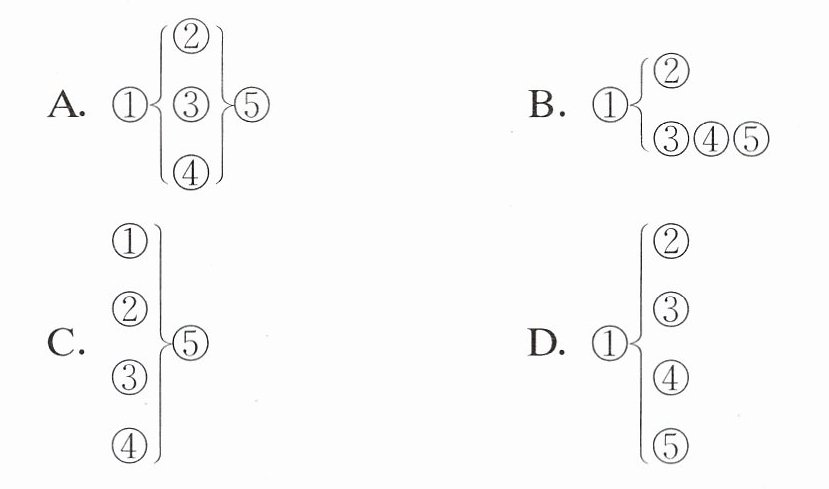
5. What's the main idea of the passage?
A. Chemistry and food.
B. Chemistry around the world.
C. Chemistry and products.
D. Chemistry in everyday life.
① Chemistry is everywhere in our daily life. Sometimes
it's easy to see. At other times, it can be very hard to see the everyday chemistry at work, but nearly everything you touch has some chemicals(化学物质) in it.
② Chemistry helps to make products for use. Something as simple as toothpaste has at least three chemicals that keep your teeth clean. Other things in your daily life are created by chemistry, such as hair products and soap. Without chemistry, we would never have known that we need soap to get the oil out of clothes.
③ Chemistry also helps us understand the world around us. Thanks to chemistry, we know bleach(漂白剂) can't be mixed with vinegar(醋), because the mixture can produce harmful gas.
④ Chemistry plays a big role(作用) in food preparation. Cooking food causes it to go through a chemical change. That is the reason why cooked food often tastes different from uncooked food. Too much or too little of any chemical material makes a difference to the result of baking(烘焙). For example, the cake can be too soft or too hard.
⑤ Chemistry isn't something that just lives in a laboratory; it's something that you meet hundreds of times in life. Knowing how chemistry works will give you a greater understanding of the life.
1. What can the chemistry in soap help us?
A. To clean the teeth.
B. To make the teeth strong.
C. To clean the oil off clothes.
D. To make the clothes new.
2. From the third paragraph, we know that .
A. we can mix bleach with vinegar
B. the mixture can produce useful gas
C. we can't mix bleach with vinegar
D. chemistry can't help us make products
3. The fourth paragraph mainly tells us that .
A. cooked food is much better than uncooked food
B. chemistry plays a big role in food preparation
C. there are no chemical changes while we are cooking
D. the cake can't be too soft or too hard with chemistry
4. Which of the following shows the structure(结构)of the passage?(①=Paragraph 1)
5. What's the main idea of the passage?
A. Chemistry and food.
B. Chemistry around the world.
C. Chemistry and products.
D. Chemistry in everyday life.
答案
1. C 2. C 3. B 4. A 5. D
解析
【分析】
本题为英语阅读理解题,共5道小题,需结合文章内容逐一分析:1-3题是细节理解题,需定位原文对应句子;4题是文章结构题,需梳理各段落的逻辑关系;5题是主旨大意题,需抓住文章核心主题。
【解析】
1. 细节理解题:根据第二段最后一句“Without chemistry, we would never have known that we need soap to get the oil out of clothes.”可知,肥皂中的化学物质帮助去除衣服上的油,故选C。
2. 细节理解题:根据第三段“Thanks to chemistry, we know bleach(漂白剂) can't be mixed with vinegar(醋), because the mixture can produce harmful gas.”可知,不能将漂白剂和醋混合,故选C。
3. 主旨大意题:第四段首句“Chemistry plays a big role(作用) in food preparation.”是该段主题句,点明段落核心,故选B。
4. 文章结构题:第一段总述化学在日常生活中无处不在;第二、三、四段分别从制造产品、理解世界、食物准备三个方面阐述化学的作用;第五段总结化学在生活中随处可见,对应选项A的结构(①总起,②③④并列分述,⑤总结),故选A。
5. 主旨大意题:文章首句“Chemistry is everywhere in our daily life.”点明核心主题,全文围绕化学在日常生活中的应用展开,故选D。
【答案】
1. C 2. C 3. B 4. A 5. D
【知识点】
英语阅读理解、细节理解、主旨大意、文章结构
【点评】
本题考查说明文阅读理解,涵盖细节理解、主旨大意、文章结构等考点,需学生准确定位原文信息、梳理段落逻辑,整体难度适中。
【难度系数】
0.6
本题为英语阅读理解题,共5道小题,需结合文章内容逐一分析:1-3题是细节理解题,需定位原文对应句子;4题是文章结构题,需梳理各段落的逻辑关系;5题是主旨大意题,需抓住文章核心主题。
【解析】
1. 细节理解题:根据第二段最后一句“Without chemistry, we would never have known that we need soap to get the oil out of clothes.”可知,肥皂中的化学物质帮助去除衣服上的油,故选C。
2. 细节理解题:根据第三段“Thanks to chemistry, we know bleach(漂白剂) can't be mixed with vinegar(醋), because the mixture can produce harmful gas.”可知,不能将漂白剂和醋混合,故选C。
3. 主旨大意题:第四段首句“Chemistry plays a big role(作用) in food preparation.”是该段主题句,点明段落核心,故选B。
4. 文章结构题:第一段总述化学在日常生活中无处不在;第二、三、四段分别从制造产品、理解世界、食物准备三个方面阐述化学的作用;第五段总结化学在生活中随处可见,对应选项A的结构(①总起,②③④并列分述,⑤总结),故选A。
5. 主旨大意题:文章首句“Chemistry is everywhere in our daily life.”点明核心主题,全文围绕化学在日常生活中的应用展开,故选D。
【答案】
1. C 2. C 3. B 4. A 5. D
【知识点】
英语阅读理解、细节理解、主旨大意、文章结构
【点评】
本题考查说明文阅读理解,涵盖细节理解、主旨大意、文章结构等考点,需学生准确定位原文信息、梳理段落逻辑,整体难度适中。
【难度系数】
0.6
