

 登录
登录
四、任务型阅读(每小题 1.5 分,满分 15 分)
阅读下面短文,并根据所读内容在文章后的表格里填入最恰当的单词,每个空格只填一个单词。
Rivers are the lifeblood of human civilizations(文明). As one of the longest - lasting civilizations, China has a large number of rivers. A total of 45,203 rivers, each with a drainage area(流域面积)of more than 50 square kilometres, run across the country.
The most famous ones are the Yangtze and Yellow Rivers. As the longest river in Asia and third longest in the world, the Yangtze River is more than 6,300 kilometres long. It rises from the Qinghai - Xizang Plateau(高原)and flows through 11 provincial - level administrative regions(省级行政区)before ending in the East China Sea. Second to the Yangtze River is the Yellow River, with a length of 5,464 kilometres as it flows from the west to the east of China.
Apart from its big number of natural rivers, China also has a lot of beautiful man - made rivers. The Grand Canal is one example. With a history of more than 2,500 years, the Grand Canal is well - known and stretches(延伸)nearly 3,200 kilometres and connects(连接)the north and south of China.
These rivers and canals keep raising the Chinese people and their culture. They bring rich soil and enough water for farming, which makes many areas “land of fish and rice”. Connecting China as a whole, the water network runs through geographical boundaries(界限)and gives people a good way to transport. People are able to trade in other places and develop economy(经济). These rivers are deeply remembered and loved in Chinese culture, as can be found in Chinese poetry, art, literature, and folk stories.
To protect these bodies of water, many actions have been taken in recent years. For example, the Ministry of Water Resources announced plans to bring back 700, 000 hectares(公顷)of degraded natural forest and treat almost 1.4 million hectares of land suffering from desertification by 2025. Through these measures, our rivers have seen many good changes—birds flying above the wetlands and farmers happily harvesting on farming lands.

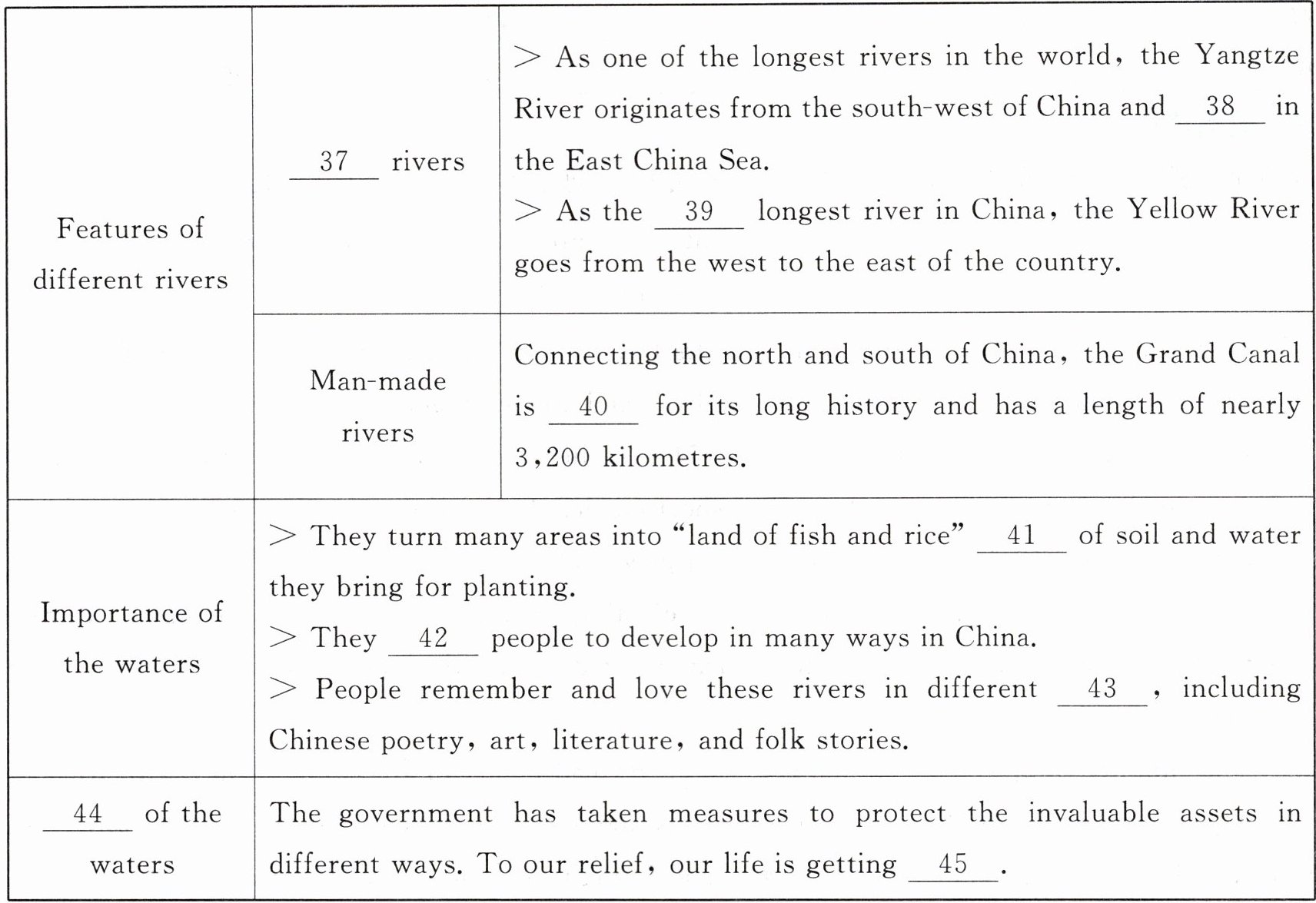
36.
37.
38.
39.
40.
41.
42.
43.
44.
45.
阅读下面短文,并根据所读内容在文章后的表格里填入最恰当的单词,每个空格只填一个单词。
Rivers are the lifeblood of human civilizations(文明). As one of the longest - lasting civilizations, China has a large number of rivers. A total of 45,203 rivers, each with a drainage area(流域面积)of more than 50 square kilometres, run across the country.
The most famous ones are the Yangtze and Yellow Rivers. As the longest river in Asia and third longest in the world, the Yangtze River is more than 6,300 kilometres long. It rises from the Qinghai - Xizang Plateau(高原)and flows through 11 provincial - level administrative regions(省级行政区)before ending in the East China Sea. Second to the Yangtze River is the Yellow River, with a length of 5,464 kilometres as it flows from the west to the east of China.
Apart from its big number of natural rivers, China also has a lot of beautiful man - made rivers. The Grand Canal is one example. With a history of more than 2,500 years, the Grand Canal is well - known and stretches(延伸)nearly 3,200 kilometres and connects(连接)the north and south of China.
These rivers and canals keep raising the Chinese people and their culture. They bring rich soil and enough water for farming, which makes many areas “land of fish and rice”. Connecting China as a whole, the water network runs through geographical boundaries(界限)and gives people a good way to transport. People are able to trade in other places and develop economy(经济). These rivers are deeply remembered and loved in Chinese culture, as can be found in Chinese poetry, art, literature, and folk stories.
To protect these bodies of water, many actions have been taken in recent years. For example, the Ministry of Water Resources announced plans to bring back 700, 000 hectares(公顷)of degraded natural forest and treat almost 1.4 million hectares of land suffering from desertification by 2025. Through these measures, our rivers have seen many good changes—birds flying above the wetlands and farmers happily harvesting on farming lands.
36.
rivers
37.
Natural
38.
ends
39.
second
40.
famous/known
41.
because
42.
help
43.
forms
44.
Changes
45.
better
答案
【文章大意】本文是一篇说明文,主要介绍了中国的天然河流和人工河流,并介绍了保护水源的措施。
36. rivers 37. Natural 38. ends 39. second 40. famous/known 41. because 42. help 43. forms 44. Changes 45. better
36. rivers 37. Natural 38. ends 39. second 40. famous/known 41. because 42. help 43. forms 44. Changes 45. better
解析
【分析】
做这道任务型阅读题的思路如下:首先第一步先通读全文,明确文章核心主题是介绍中国的天然河流、人工运河,以及河流对中华文明的作用和近年的护水举措,理清整体行文结构。第二步对照表格的框架,定位每个空格对应的原文段落,优先查找原文出现的对应表达,同时注意结合空格的语法要求(单复数、时态、大小写)、上下文逻辑关系进行同义替换或词形调整,严格遵守每个空格仅填一个单词的规则,最后代入单词通读表格验证逻辑通顺。
【解析】
36. 全文核心围绕中国的各类河流展开介绍,表格总主题对应核心名词rivers;
37. 后文对应人工河流的分类,原文将河流划分为天然河流和人工河流两大类别,此处位于句首首字母大写,填Natural;
38. 定位原文第二段“flows through 11 provincial-level administrative regions before ending in the East China Sea”,表格句子主语为it,时态为一般现在时,谓语用第三人称单数ends;
39. 定位原文第二段“Second to the Yangtze River is the Yellow River”,说明黄河长度仅次于长江,是中国第二长河,填second;
40. 定位原文第三段“the Grand Canal is well-known”,well-known的同义表达为famous/known,填famous/known;
41. 空格前后为因果逻辑:河流深受中国文化铭记喜爱,原因是相关元素大量出现在诗歌、艺术、民间故事等文化载体中,填because;
42. 定位原文第四段“People are able to trade in other places and develop economy”,说明河流为人们开展贸易、发展经济提供便利,起到助力作用,填help;
43. 定位原文第四段“Connecting China as a whole, the water network runs through geographical boundaries”,水网跨越地理界限,形成连通的整体,主语the water network为单数,一般现在时谓语用forms;
44. 最后一段介绍护水措施落地后,流域出现的各类向好转变,空格位于小标题位置首字母大写,填Changes;
45. 护水措施实施后,湿地生态、农耕环境都得到改善,比之前状态更好,填better。
【答案】
36. rivers 37. Natural 38. ends 39. second 40. famous/known 41. because 42. help 43. forms 44. Changes 45. better
【知识点】
任务型阅读、细节信息定位、词形转换
【点评】
本题属于典型的初中英语任务型阅读题型,大部分空格可通过直接定位原文细节得出答案,少量空格需要结合上下文逻辑做简单的同义替换和语法调整,既考查学生快速查找文本信息的能力,也兼顾了对语篇逻辑理解、词汇灵活运用能力的考查,整体区分度设置合理。
【难度系数】
0.6
做这道任务型阅读题的思路如下:首先第一步先通读全文,明确文章核心主题是介绍中国的天然河流、人工运河,以及河流对中华文明的作用和近年的护水举措,理清整体行文结构。第二步对照表格的框架,定位每个空格对应的原文段落,优先查找原文出现的对应表达,同时注意结合空格的语法要求(单复数、时态、大小写)、上下文逻辑关系进行同义替换或词形调整,严格遵守每个空格仅填一个单词的规则,最后代入单词通读表格验证逻辑通顺。
【解析】
36. 全文核心围绕中国的各类河流展开介绍,表格总主题对应核心名词rivers;
37. 后文对应人工河流的分类,原文将河流划分为天然河流和人工河流两大类别,此处位于句首首字母大写,填Natural;
38. 定位原文第二段“flows through 11 provincial-level administrative regions before ending in the East China Sea”,表格句子主语为it,时态为一般现在时,谓语用第三人称单数ends;
39. 定位原文第二段“Second to the Yangtze River is the Yellow River”,说明黄河长度仅次于长江,是中国第二长河,填second;
40. 定位原文第三段“the Grand Canal is well-known”,well-known的同义表达为famous/known,填famous/known;
41. 空格前后为因果逻辑:河流深受中国文化铭记喜爱,原因是相关元素大量出现在诗歌、艺术、民间故事等文化载体中,填because;
42. 定位原文第四段“People are able to trade in other places and develop economy”,说明河流为人们开展贸易、发展经济提供便利,起到助力作用,填help;
43. 定位原文第四段“Connecting China as a whole, the water network runs through geographical boundaries”,水网跨越地理界限,形成连通的整体,主语the water network为单数,一般现在时谓语用forms;
44. 最后一段介绍护水措施落地后,流域出现的各类向好转变,空格位于小标题位置首字母大写,填Changes;
45. 护水措施实施后,湿地生态、农耕环境都得到改善,比之前状态更好,填better。
【答案】
36. rivers 37. Natural 38. ends 39. second 40. famous/known 41. because 42. help 43. forms 44. Changes 45. better
【知识点】
任务型阅读、细节信息定位、词形转换
【点评】
本题属于典型的初中英语任务型阅读题型,大部分空格可通过直接定位原文细节得出答案,少量空格需要结合上下文逻辑做简单的同义替换和语法调整,既考查学生快速查找文本信息的能力,也兼顾了对语篇逻辑理解、词汇灵活运用能力的考查,整体区分度设置合理。
【难度系数】
0.6
