

 登录
登录
第二节 根据短文内容,从选项中选出能填入空白处的最佳选项。选项中有两项为多余选项。
Today more people use reusable things. The “Bring Your Own” (BYO) trend is very common. People choose reusable versions of many things they used to throw away after using once.
A popular example is the reusable coffee cup. Many people who love coffee take their own mugs to coffee shops. Some companies give lower prices when people use their own cups.
Some cities, such as Berkeley, charge more money if you use a single-use cup. 16.
The companies is trying new plans: you can borrow a durable(耐用的)cup and give it back later. They hope there will be no more single-use cups by 2030!
Reusable water bottles are also popular. Factories make nice bottles with fun designs. 17.
Reusable straws and cutlery(餐具)are another change. People stopped using plastic straws and cutlery, so metal or bamboo ones became popular. 18.
19.
Using reusable items means fewer single-use things in landfills or oceans. Even small changes help a lot! 20.
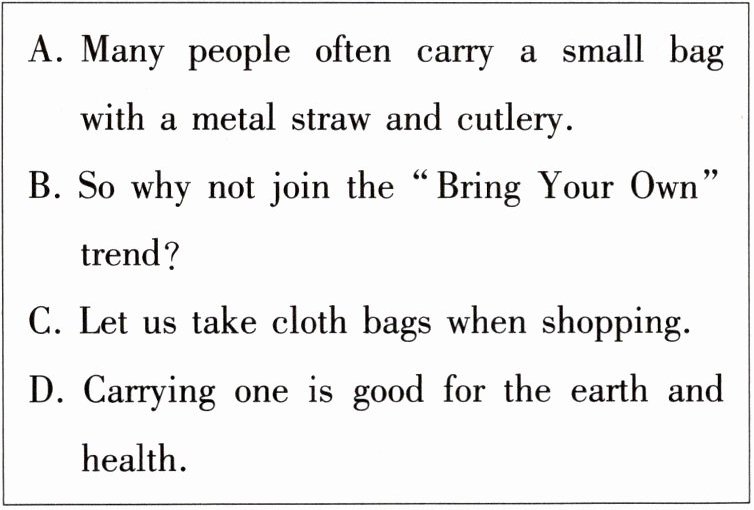
A. Many people often carry a small bag with a metal straw and cutlery.
B. So why not join the “Bring Your Own” trend?
C. Let us take cloth bags when shopping.
D. Carrying one is good for the earth and health.
E. It’s a good idea to bring their own cups.
F. These encourage people to bring their own cups. own cups.
G. Shopping bags have changed, too.
Today more people use reusable things. The “Bring Your Own” (BYO) trend is very common. People choose reusable versions of many things they used to throw away after using once.
A popular example is the reusable coffee cup. Many people who love coffee take their own mugs to coffee shops. Some companies give lower prices when people use their own cups.
Some cities, such as Berkeley, charge more money if you use a single-use cup. 16.
F
The companies is trying new plans: you can borrow a durable(耐用的)cup and give it back later. They hope there will be no more single-use cups by 2030!
Reusable water bottles are also popular. Factories make nice bottles with fun designs. 17.
D
. Plastic bottles may have bad chemicals, after all. Workplaces, schools and gyms have water stations to help people fill their bottles.Reusable straws and cutlery(餐具)are another change. People stopped using plastic straws and cutlery, so metal or bamboo ones became popular. 18.
A
19.
G
Cloth bags are easy to see. People also use mesh bags(网兜)for fruits and vegetables, not plastic ones.Using reusable items means fewer single-use things in landfills or oceans. Even small changes help a lot! 20.
B
In 2025, reusable items are just normal—let’s make them part of our daily life!A. Many people often carry a small bag with a metal straw and cutlery.
B. So why not join the “Bring Your Own” trend?
C. Let us take cloth bags when shopping.
D. Carrying one is good for the earth and health.
E. It’s a good idea to bring their own cups.
F. These encourage people to bring their own cups. own cups.
G. Shopping bags have changed, too.
答案
16. F 17. D 18. A 19. G 20. B
解析
【分析】
本题为英语七选五题型,核心话题是“自带物品(BYO)”的环保趋势,需结合上下文的逻辑关系(如指代、举例、衔接、总结等)选择最佳选项。解题思路:先通读全文把握整体语境,再逐空分析前后文内容,匹配符合逻辑的选项:16空需衔接城市收费、公司计划与鼓励自带杯子的关联;17空需承接水瓶话题说明好处;18空需举例说明使用可重复吸管餐具的做法;19空需引出购物袋变化的话题;20空需总结呼吁加入趋势。
【解析】
1. 第16空:前文提到部分城市对一次性杯子收费更高,后文讲公司推出借耐用杯子的计划,F选项“These encourage people to bring their own cups.”(这些措施鼓励人们自带杯子),衔接上下文,符合逻辑,故选F。
2. 第17空:前文介绍可重复用水瓶受欢迎,后文说明塑料瓶含有害化学物质,D选项“Carrying one is good for the earth and health.”(带水瓶对地球和健康有益),承接水瓶话题,说明好处,故选D。
3. 第18空:前文提到可重复吸管和餐具流行,A选项“Many people often carry a small bag with a metal straw and cutlery.”(很多人常带装金属吸管和餐具的小包),举例说明人们的具体做法,故选A。
4. 第19空:后文讲布袋、网兜代替塑料袋的内容,G选项“Shopping bags have changed, too.”(购物袋也变了),引出下文话题,故选G。
5. 第20空:前文强调小改变的作用,后文呼吁让可重复物品成为日常,B选项“So why not join the “Bring Your Own” trend?”(为什么不加入“自带物品”趋势呢?),总结并发出呼吁,故选B。
【答案】
16.F 17.D 18.A 19.G 20.B
【知识点】
英语阅读理解;七选五题型;语篇逻辑衔接
【点评】
本题围绕环保趋势展开,考查学生对语篇上下文逻辑关系的理解能力,需把握句子间的指代、举例、衔接等逻辑,是常见的英语阅读题型,难度适中。
【难度系数】
0.6
本题为英语七选五题型,核心话题是“自带物品(BYO)”的环保趋势,需结合上下文的逻辑关系(如指代、举例、衔接、总结等)选择最佳选项。解题思路:先通读全文把握整体语境,再逐空分析前后文内容,匹配符合逻辑的选项:16空需衔接城市收费、公司计划与鼓励自带杯子的关联;17空需承接水瓶话题说明好处;18空需举例说明使用可重复吸管餐具的做法;19空需引出购物袋变化的话题;20空需总结呼吁加入趋势。
【解析】
1. 第16空:前文提到部分城市对一次性杯子收费更高,后文讲公司推出借耐用杯子的计划,F选项“These encourage people to bring their own cups.”(这些措施鼓励人们自带杯子),衔接上下文,符合逻辑,故选F。
2. 第17空:前文介绍可重复用水瓶受欢迎,后文说明塑料瓶含有害化学物质,D选项“Carrying one is good for the earth and health.”(带水瓶对地球和健康有益),承接水瓶话题,说明好处,故选D。
3. 第18空:前文提到可重复吸管和餐具流行,A选项“Many people often carry a small bag with a metal straw and cutlery.”(很多人常带装金属吸管和餐具的小包),举例说明人们的具体做法,故选A。
4. 第19空:后文讲布袋、网兜代替塑料袋的内容,G选项“Shopping bags have changed, too.”(购物袋也变了),引出下文话题,故选G。
5. 第20空:前文强调小改变的作用,后文呼吁让可重复物品成为日常,B选项“So why not join the “Bring Your Own” trend?”(为什么不加入“自带物品”趋势呢?),总结并发出呼吁,故选B。
【答案】
16.F 17.D 18.A 19.G 20.B
【知识点】
英语阅读理解;七选五题型;语篇逻辑衔接
【点评】
本题围绕环保趋势展开,考查学生对语篇上下文逻辑关系的理解能力,需把握句子间的指代、举例、衔接等逻辑,是常见的英语阅读题型,难度适中。
【难度系数】
0.6
