

 登录
登录
某综合实践活动小组尝试利用无人机测算某山体的海拔.当无人机位于海拔为70 m的C处时,测得与山顶A处的仰角α为$45°$,活动小组设计了如下两种方案.请分别利用两种测算方案,计算该山体的海拔(AB的长).(参考数据:$\sin 35° \approx 0.57,\cos 35° \approx 0.82,\tan 35° \approx 0.70$)
| | 方案一 | 方案二 |
| --- | --- | --- |
| 测量示意图 |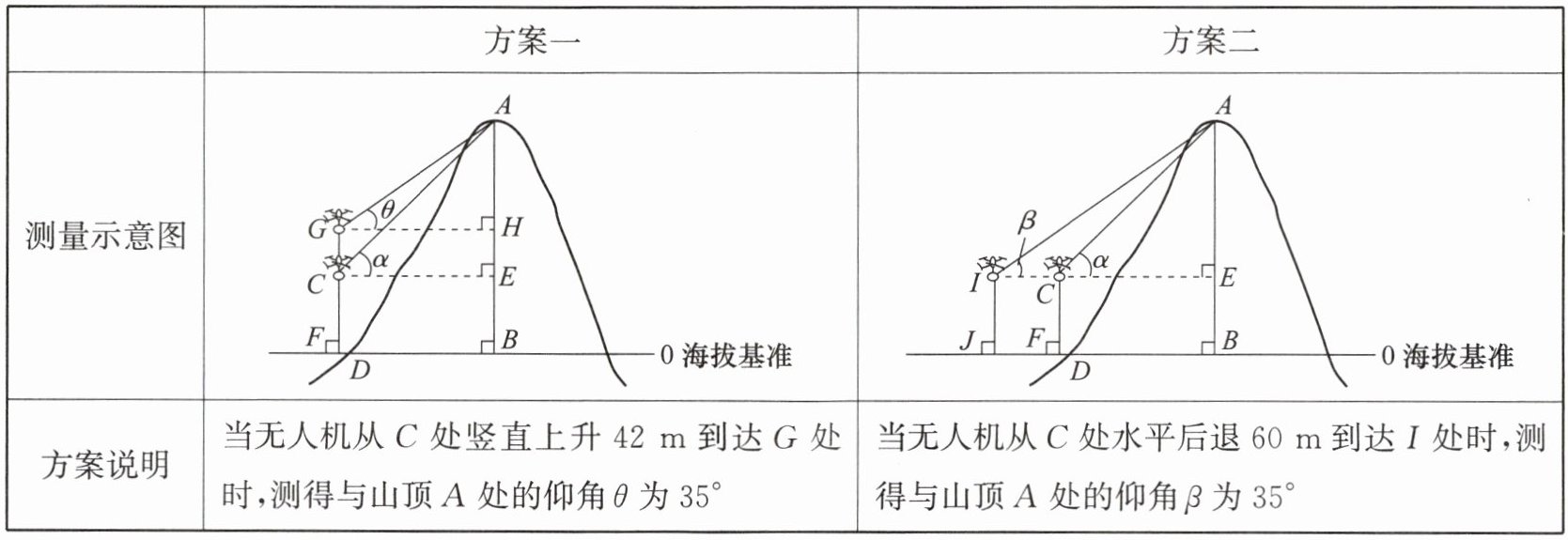 | |
| |
| 方案说明 | 当无人机从C处竖直上升42 m到达G处时,测得与山顶A处的仰角θ为$35°$ | 当无人机从C处水平后退60 m到达I处时,测得与山顶A处的仰角β为$35°$ |
| | 方案一 | 方案二 |
| --- | --- | --- |
| 测量示意图 |
| || 方案说明 | 当无人机从C处竖直上升42 m到达G处时,测得与山顶A处的仰角θ为$35°$ | 当无人机从C处水平后退60 m到达I处时,测得与山顶A处的仰角β为$35°$ |
答案
方案一:由题意得 $CF=70\ \mathrm{m},CG=42\ \mathrm{m},α=45°,θ=35°$.
易得四边形 CFBE、四边形 GCEH 均为矩形,
设 $CE=GH=x\ \mathrm{m}$.
在 $\mathrm{Rt}△ ACE$ 中,$α=45°$,$\therefore AE=CE=x\ \mathrm{m}$.
$\because HE=CG=42\ \mathrm{m}$,$\therefore AH=AE-HE=(x-42)\mathrm{m}$.
在 $\mathrm{Rt}△ AGH$ 中,$θ=35°$,
$\therefore AH=GH· \tan 35°$,$\therefore x-42=0.7x$,
解得 $x=140$,$\therefore AE=140\ \mathrm{m}$,
$\therefore AB=AE+EB=AE+CF=140+70=210(\mathrm{m})$.
答:山体的海拔约为 210 m.
方案二:由题意得 $CF=70\ \mathrm{m},IC=60\ \mathrm{m},α=45°,β=35°$.
易得 $CF=EB=70\ \mathrm{m}$,设 $CE=x\ \mathrm{m}$.
在 $\mathrm{Rt}△ ACE$ 中,$α=45°$,
$\therefore AE=CE=x\ \mathrm{m}$,$\therefore IE=IC+CE=(60+x)\mathrm{m}$.
在 $\mathrm{Rt}△ AIE$ 中,$β=35°$,
$\therefore AE=IE· \tan 35°$,$\therefore x=0.7(60+x)$,
解得 $x=140$,$\therefore AE=140\ \mathrm{m}$,
$\therefore AB=AE+EB=140+70=210(\mathrm{m})$.
答:山体的海拔约为 210 m.
易得四边形 CFBE、四边形 GCEH 均为矩形,
设 $CE=GH=x\ \mathrm{m}$.
在 $\mathrm{Rt}△ ACE$ 中,$α=45°$,$\therefore AE=CE=x\ \mathrm{m}$.
$\because HE=CG=42\ \mathrm{m}$,$\therefore AH=AE-HE=(x-42)\mathrm{m}$.
在 $\mathrm{Rt}△ AGH$ 中,$θ=35°$,
$\therefore AH=GH· \tan 35°$,$\therefore x-42=0.7x$,
解得 $x=140$,$\therefore AE=140\ \mathrm{m}$,
$\therefore AB=AE+EB=AE+CF=140+70=210(\mathrm{m})$.
答:山体的海拔约为 210 m.
方案二:由题意得 $CF=70\ \mathrm{m},IC=60\ \mathrm{m},α=45°,β=35°$.
易得 $CF=EB=70\ \mathrm{m}$,设 $CE=x\ \mathrm{m}$.
在 $\mathrm{Rt}△ ACE$ 中,$α=45°$,
$\therefore AE=CE=x\ \mathrm{m}$,$\therefore IE=IC+CE=(60+x)\mathrm{m}$.
在 $\mathrm{Rt}△ AIE$ 中,$β=35°$,
$\therefore AE=IE· \tan 35°$,$\therefore x=0.7(60+x)$,
解得 $x=140$,$\therefore AE=140\ \mathrm{m}$,
$\therefore AB=AE+EB=140+70=210(\mathrm{m})$.
答:山体的海拔约为 210 m.
解析
【分析】
本题的核心突破口是C处测得山顶A的仰角为45°,可得Rt△ACE为等腰直角三角形,即AE=CE,因此可设CE=x m,则AE=x m,再结合两个方案的不同测量条件,利用35°角的三角函数关系列方程求解即可:
①方案一:无人机竖直上升42 m后,构造Rt△AGH,利用矩形性质得到GH=CE=x,AH=AE-42,结合tan35°的定义列方程;
②方案二:无人机水平后退60 m后,构造Rt△AIE,得到水平距离IE=60+x,结合tan35°的定义列方程;
最终求解出x后,AB=AE+EB,其中EB等于C处的海拔70 m,即可得到山体海拔。
【解析】
方案一:
由题意得 $CF=70\ \mathrm{m},CG=42\ \mathrm{m},α=45°,θ=35°$。
易得四边形 $CFBE$、四边形 $GCEH$ 均为矩形,
设 $CE=GH=x\ \mathrm{m}$。
在 $\mathrm{Rt}△ ACE$ 中,$α=45°$,$\therefore AE=CE=x\ \mathrm{m}$。
$\because HE=CG=42\ \mathrm{m}$,$\therefore AH=AE-HE=(x-42)\mathrm{m}$。
在 $\mathrm{Rt}△ AGH$ 中,$θ=35°$,
$\therefore AH=GH· \tan 35°$,$\therefore x-42=0.7x$,
解得 $x=140$,$\therefore AE=140\ \mathrm{m}$,
$\therefore AB=AE+EB=AE+CF=140+70=210(\mathrm{m})$。
方案二:
由题意得 $CF=70\ \mathrm{m},IC=60\ \mathrm{m},α=45°,β=35°$。
易得 $CF=EB=70\ \mathrm{m}$,设 $CE=x\ \mathrm{m}$。
在 $\mathrm{Rt}△ ACE$ 中,$α=45°$,
$\therefore AE=CE=x\ \mathrm{m}$,$\therefore IE=IC+CE=(60+x)\mathrm{m}$。
在 $\mathrm{Rt}△ AIE$ 中,$β=35°$,
$\therefore AE=IE· \tan 35°$,$\therefore x=0.7(60+x)$,
解得 $x=140$,$\therefore AE=140\ \mathrm{m}$,
$\therefore AB=AE+EB=140+70=210(\mathrm{m})$。
【答案】
该山体的海拔为$\boxed{210\ \mathrm{m}}$
【知识点】
解直角三角形的应用(仰角问题)、矩形的性质、一元一次方程的应用
【点评】
本题结合实际测量场景,考查了三角函数在几何实际问题中的应用,解题关键是根据仰角构造直角三角形,利用45°角的特殊性设未知数,再结合35°角的三角函数关系建立方程求解,两种不同测量方案逻辑相通,能有效锻炼学生构建几何模型、应用方程思想解题的能力。
【难度系数】
0.7
本题的核心突破口是C处测得山顶A的仰角为45°,可得Rt△ACE为等腰直角三角形,即AE=CE,因此可设CE=x m,则AE=x m,再结合两个方案的不同测量条件,利用35°角的三角函数关系列方程求解即可:
①方案一:无人机竖直上升42 m后,构造Rt△AGH,利用矩形性质得到GH=CE=x,AH=AE-42,结合tan35°的定义列方程;
②方案二:无人机水平后退60 m后,构造Rt△AIE,得到水平距离IE=60+x,结合tan35°的定义列方程;
最终求解出x后,AB=AE+EB,其中EB等于C处的海拔70 m,即可得到山体海拔。
【解析】
方案一:
由题意得 $CF=70\ \mathrm{m},CG=42\ \mathrm{m},α=45°,θ=35°$。
易得四边形 $CFBE$、四边形 $GCEH$ 均为矩形,
设 $CE=GH=x\ \mathrm{m}$。
在 $\mathrm{Rt}△ ACE$ 中,$α=45°$,$\therefore AE=CE=x\ \mathrm{m}$。
$\because HE=CG=42\ \mathrm{m}$,$\therefore AH=AE-HE=(x-42)\mathrm{m}$。
在 $\mathrm{Rt}△ AGH$ 中,$θ=35°$,
$\therefore AH=GH· \tan 35°$,$\therefore x-42=0.7x$,
解得 $x=140$,$\therefore AE=140\ \mathrm{m}$,
$\therefore AB=AE+EB=AE+CF=140+70=210(\mathrm{m})$。
方案二:
由题意得 $CF=70\ \mathrm{m},IC=60\ \mathrm{m},α=45°,β=35°$。
易得 $CF=EB=70\ \mathrm{m}$,设 $CE=x\ \mathrm{m}$。
在 $\mathrm{Rt}△ ACE$ 中,$α=45°$,
$\therefore AE=CE=x\ \mathrm{m}$,$\therefore IE=IC+CE=(60+x)\mathrm{m}$。
在 $\mathrm{Rt}△ AIE$ 中,$β=35°$,
$\therefore AE=IE· \tan 35°$,$\therefore x=0.7(60+x)$,
解得 $x=140$,$\therefore AE=140\ \mathrm{m}$,
$\therefore AB=AE+EB=140+70=210(\mathrm{m})$。
【答案】
该山体的海拔为$\boxed{210\ \mathrm{m}}$
【知识点】
解直角三角形的应用(仰角问题)、矩形的性质、一元一次方程的应用
【点评】
本题结合实际测量场景,考查了三角函数在几何实际问题中的应用,解题关键是根据仰角构造直角三角形,利用45°角的特殊性设未知数,再结合35°角的三角函数关系建立方程求解,两种不同测量方案逻辑相通,能有效锻炼学生构建几何模型、应用方程思想解题的能力。
【难度系数】
0.7
