

 登录
登录
中考趋势 Ⅳ. 阅读还原(每小题2分,共10分)
从方框中选出能填入空白处的最佳选项。选项中有一项多余。
Why Can’t People Stop Touching Museum Exhibits(展品)?
When visiting the British Museum, you can see visitors touch ancient bowls even though the museum rules say no touching is allowed. Museum guards say it’s impossible to stop people from breaking the no-touch rule. 1
Most museum-going is still a mainly visual(视觉的) experience for visitors to admire the artworks. 2 But over the past few years, more and more museums have been working to
include additional senses, like sounds and smells. But touch, especially, is only allowed in certain areas, like the Louvre’s Touch Gallery, or the British Museum’s Hands On Desks.
3 Before there were museums, there were curiosity rooms filled with a collection of interesting objects from around the world. When people visited the collection, the objects were passed around. Museums continued with this spirit of openness at first.
But as museums grew, the spirit no longer existed. When you've got 4 million visitors a year, you can hardly have everybody touching something. Sometimes people are likely to damage the artworks. So the rule against touching artworks makes great sense. Smaller museums still sometimes encourage visitors to touch their objects. 4
Why are we so unwilling to keep our hands to ourselves? Some people just want to make sure the artworks are real. But there's a larger truth. 5 Visitors say that they want to feel how deep an engraving(雕刻) goes, so as to better understand the artistic skills. In this way, touching is part of trying to somehow make contact with the past.
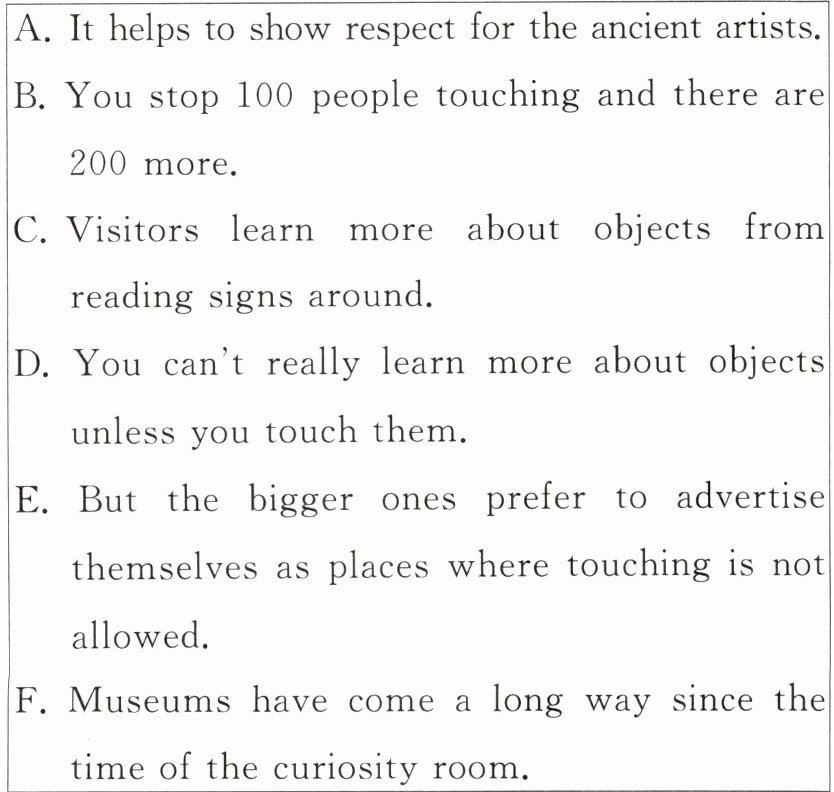
A. It helps to show respect for the ancient artists.
B. You stop 100 people touching and there are 200 more.
C. Visitors learn more about objects from reading signs around.
D. You can't really learn more about objects unless you touch them.
E. But the bigger ones prefer to advertise themselves as places where touching is not allowed.
F. Museums have come a long way since the time of the curiosity room.
英语七上(江苏版)
1.
从方框中选出能填入空白处的最佳选项。选项中有一项多余。
Why Can’t People Stop Touching Museum Exhibits(展品)?
When visiting the British Museum, you can see visitors touch ancient bowls even though the museum rules say no touching is allowed. Museum guards say it’s impossible to stop people from breaking the no-touch rule. 1
Most museum-going is still a mainly visual(视觉的) experience for visitors to admire the artworks. 2 But over the past few years, more and more museums have been working to
include additional senses, like sounds and smells. But touch, especially, is only allowed in certain areas, like the Louvre’s Touch Gallery, or the British Museum’s Hands On Desks.
3 Before there were museums, there were curiosity rooms filled with a collection of interesting objects from around the world. When people visited the collection, the objects were passed around. Museums continued with this spirit of openness at first.
But as museums grew, the spirit no longer existed. When you've got 4 million visitors a year, you can hardly have everybody touching something. Sometimes people are likely to damage the artworks. So the rule against touching artworks makes great sense. Smaller museums still sometimes encourage visitors to touch their objects. 4
Why are we so unwilling to keep our hands to ourselves? Some people just want to make sure the artworks are real. But there's a larger truth. 5 Visitors say that they want to feel how deep an engraving(雕刻) goes, so as to better understand the artistic skills. In this way, touching is part of trying to somehow make contact with the past.
A. It helps to show respect for the ancient artists.
B. You stop 100 people touching and there are 200 more.
C. Visitors learn more about objects from reading signs around.
D. You can't really learn more about objects unless you touch them.
E. But the bigger ones prefer to advertise themselves as places where touching is not allowed.
F. Museums have come a long way since the time of the curiosity room.
英语七上(江苏版)
1.
B
2. C
3. F
4. E
5. D
答案
Ⅳ. 1.B 2.C 3.F 4.E 5.D
【语篇解读】本文是一篇说明文,主要介绍了为什么人们不能停止触摸博物馆的展品。
1. B 解析:根据前文“Museum guards say it's impossible to stop people from breaking the no-touch rule.”可知,此处应说明完全阻止人们接触文物是不可能的,选项B“你阻止100个人触碰,还有200多人。”符合语境。故选B。
2. C 解析:根据前文“Most museum-going is still a mainly visual experience for visitors to admire the artworks.”可知,空格处仍然是强调视觉体验,选项C“参观者通过阅读周围的标志来了解更多关于物品的信息。”符合语境。故选C。
3. F 解析:根据后文“Before there were museums, there were curiosity rooms filled with a collection of interesting objects from around the world.”可知,本段主要讲了好奇心心室,选项F“自从有了好奇心心室以来,博物馆已经走过了漫长的道路。”符合语境。故选F。
4. E 解析:根据前文“Smaller museums still sometimes encourage visitors to touch their objects.”可知,空格处应说明较大的博物馆会怎样,选项E“但大一点的博物馆更喜欢把自己标榜为不可触碰(展览品)的地方。”符合语境。故选E。
5. D 解析:根据后文“Visitors say that they want to feel how deep an engraving goes, so as to better understand the artistic skills. In this way, touching is part of trying to somehow make contact with the past.”可知,此处解释了为什么游客想触摸展品,选项D“除非你触摸它们,否则你无法真正了解更多关于物体的知识。”符合语境。故选D。
【语篇解读】本文是一篇说明文,主要介绍了为什么人们不能停止触摸博物馆的展品。
1. B 解析:根据前文“Museum guards say it's impossible to stop people from breaking the no-touch rule.”可知,此处应说明完全阻止人们接触文物是不可能的,选项B“你阻止100个人触碰,还有200多人。”符合语境。故选B。
2. C 解析:根据前文“Most museum-going is still a mainly visual experience for visitors to admire the artworks.”可知,空格处仍然是强调视觉体验,选项C“参观者通过阅读周围的标志来了解更多关于物品的信息。”符合语境。故选C。
3. F 解析:根据后文“Before there were museums, there were curiosity rooms filled with a collection of interesting objects from around the world.”可知,本段主要讲了好奇心心室,选项F“自从有了好奇心心室以来,博物馆已经走过了漫长的道路。”符合语境。故选F。
4. E 解析:根据前文“Smaller museums still sometimes encourage visitors to touch their objects.”可知,空格处应说明较大的博物馆会怎样,选项E“但大一点的博物馆更喜欢把自己标榜为不可触碰(展览品)的地方。”符合语境。故选E。
5. D 解析:根据后文“Visitors say that they want to feel how deep an engraving goes, so as to better understand the artistic skills. In this way, touching is part of trying to somehow make contact with the past.”可知,此处解释了为什么游客想触摸展品,选项D“除非你触摸它们,否则你无法真正了解更多关于物体的知识。”符合语境。故选D。
解析
【分析】
本题为英语阅读还原题,解题时需先通读全文把握主旨(探讨人们忍不住触摸博物馆展品的原因),再分析每个空格前后的语境逻辑(如转折、递进、因果、指代等),逐一匹配选项,最后排除多余选项,确保所选选项符合上下文衔接。
【解析】
1. 第1空:前文提到博物馆保安称无法阻止人们违反不触摸规则,B项“你阻止100个人触碰,还有200多人”承接前文,说明完全阻止触碰不可能,符合语境;
2. 第2空:前文指出参观博物馆主要是视觉体验,C项“参观者通过阅读周围的标志来了解更多关于物品的信息”属于视觉相关的体验,承接前文;
3. 第3空:后文讲述博物馆出现前的curiosity room,F项“自从有了好奇心心室以来,博物馆已经走过了漫长的道路”引出本段关于博物馆发展历史的内容,符合语境;
4. 第4空:前文提到小博物馆有时鼓励触摸,E项“但大一点的博物馆更喜欢把自己标榜为不可触碰(展览品)的地方”与前文形成对比,符合逻辑;
5. 第5空:后文说明触摸能帮助理解艺术技巧,D项“除非你触摸它们,否则你无法真正了解更多关于物体的知识”解释了触摸的作用,承接后文。
【答案】
1.B 2.C 3.F 4.E 5.D
【知识点】
英语阅读还原、语境逻辑衔接、说明文阅读
【点评】
本题是中考常见的英语阅读还原题,考查学生的阅读理解能力和逻辑推理能力,需结合上下文语境分析选项的衔接性,难度适中,区分度较好。
【难度系数】
0.5
本题为英语阅读还原题,解题时需先通读全文把握主旨(探讨人们忍不住触摸博物馆展品的原因),再分析每个空格前后的语境逻辑(如转折、递进、因果、指代等),逐一匹配选项,最后排除多余选项,确保所选选项符合上下文衔接。
【解析】
1. 第1空:前文提到博物馆保安称无法阻止人们违反不触摸规则,B项“你阻止100个人触碰,还有200多人”承接前文,说明完全阻止触碰不可能,符合语境;
2. 第2空:前文指出参观博物馆主要是视觉体验,C项“参观者通过阅读周围的标志来了解更多关于物品的信息”属于视觉相关的体验,承接前文;
3. 第3空:后文讲述博物馆出现前的curiosity room,F项“自从有了好奇心心室以来,博物馆已经走过了漫长的道路”引出本段关于博物馆发展历史的内容,符合语境;
4. 第4空:前文提到小博物馆有时鼓励触摸,E项“但大一点的博物馆更喜欢把自己标榜为不可触碰(展览品)的地方”与前文形成对比,符合逻辑;
5. 第5空:后文说明触摸能帮助理解艺术技巧,D项“除非你触摸它们,否则你无法真正了解更多关于物体的知识”解释了触摸的作用,承接后文。
【答案】
1.B 2.C 3.F 4.E 5.D
【知识点】
英语阅读还原、语境逻辑衔接、说明文阅读
【点评】
本题是中考常见的英语阅读还原题,考查学生的阅读理解能力和逻辑推理能力,需结合上下文语境分析选项的衔接性,难度适中,区分度较好。
【难度系数】
0.5
