

 登录
Ⅳ. 句子翻译
1. 我在中国生活时感觉像在自己家一样自在。
2. 一提到玩具,这个男孩就变得兴奋起来。
3. 她没有收下礼物,只是笑了笑就离开了。
4. 中国人习惯等长辈开始用餐后,自己再开始吃饭。
5. 如果对方比你年长很多,直接叫他们的名字是不礼貌的。
6. 中国和英国的礼仪之间存在一些相似之处。
1. 我在中国生活时感觉像在自己家一样自在。
I feel/felt at home while living in China.
2. 一提到玩具,这个男孩就变得兴奋起来。
When it comes to toys, the boy becomes excited.
3. 她没有收下礼物,只是笑了笑就离开了。
Instead of accepting the gift, she just smiled and left.
4. 中国人习惯等长辈开始用餐后,自己再开始吃饭。
Chinese people are used to starting eating after the elderly.
5. 如果对方比你年长很多,直接叫他们的名字是不礼貌的。
It's not polite/impolite to call/address people by their names if they're much older than you.
6. 中国和英国的礼仪之间存在一些相似之处。
There is something similar between the manners in China and the UK.
答案
1. I feel/felt at home while living in China.
2. When it comes to toys, the boy becomes excited.
3. Instead of accepting the gift, she just smiled and left.
4. Chinese people are used to starting eating after the elderly.
5. It's not polite/impolite to call/address people by their names if they're much older than you.
6. There is something similar between the manners in China and the UK.
Ⅴ. 阅读理解
Whether you are teaching an elementary Spanish class or passing on Spanish to your children, it is important to teach children good manners. And there are culturally proper behaviours that children need to know.
These five behaviours are considered good manners throughout Latin America. Of course, these are good manners in the USA too, but they are not given as much attention because the opposite behaviours are not considered particularly rude in Spanish-speaking countries. However, the opposite behaviours are negative
and can change the impression people have of children (and adults)!
All of these good manners can be practised by children with different language levels.
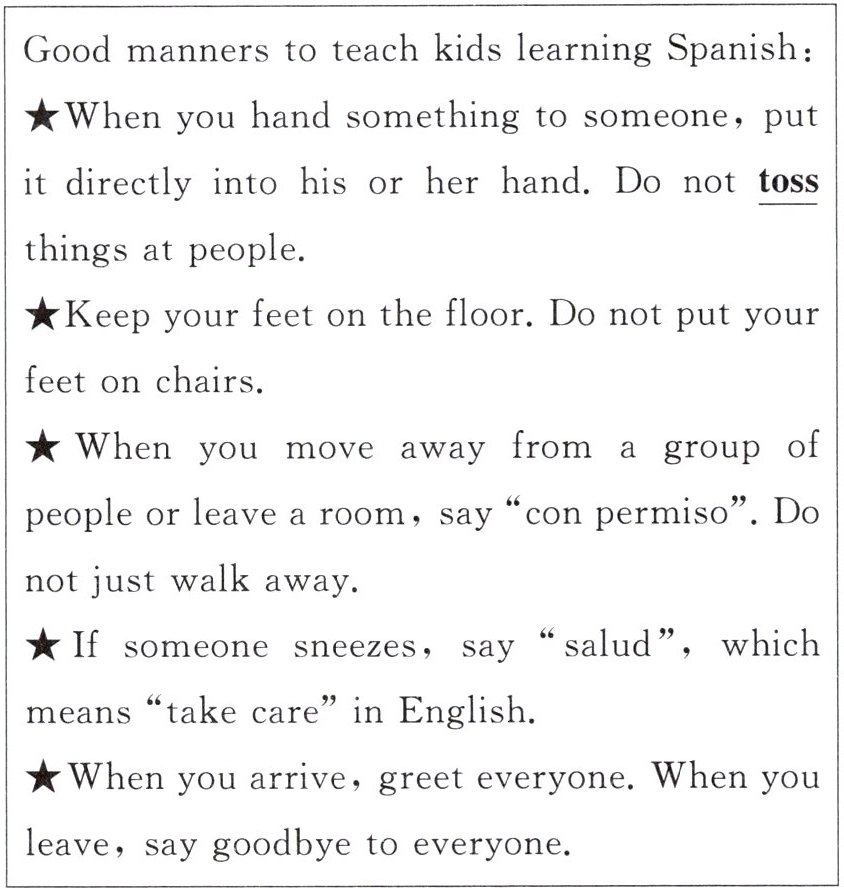
Good manners to teach kids learning Spanish:
★When you hand something to someone, put it directly into his or her hand. Do not toss things at people.
★Keep your feet on the floor. Do not put your feet on chairs.
★ When you move away from a group of people or leave a room, say “con permiso”. Do not just walk away.
★If someone sneezes, say “salud”, which means “take care” in English.
★When you arrive, greet everyone. When you leave, say goodbye to everyone.
There are lots of resources for teaching children good manners in Spanish. Many polite behaviours also include language. Here you will find resources for teaching polite expressions, including books and a song. There are also videos that teach polite behaviours.
In my experience, kids are interested in what is considered polite behaviour in different cultures, and they want to learn to act properly. We work hard teaching them to use Spanish. It is important that they also know how to interact so that others are comfortable and they can make the most of the language they have learned.
1. 语言能力 推断能力 The passage is probably written for
A. travellers who will go abroad on holiday
B. teachers who are teaching in the Spanish class
C. parents who care about their children's manners
D. children who want to pass their Spanish tests
2. The underlined word “toss” in the passage can be replaced by “
A. send B. make C. throw D. look
3. 语言能力 分析能力 According to the passage, which is considered a proper behaviour?
A. Jim keeps his feet on his friend's chair.
B. Jim sneezes, and his friend gets angry with him.
C. Jim comes in and says good morning to his classmates.
D. Jim doesn't say goodbye to everyone when he leaves a room.
4. The best title for the passage can be “
A. Good Manners for Spanish Learners
B. The History of the Spanish Language
C. How to Behave Well in the Spanish Class
D. Some Ways of Teaching Children Spanish
Whether you are teaching an elementary Spanish class or passing on Spanish to your children, it is important to teach children good manners. And there are culturally proper behaviours that children need to know.
These five behaviours are considered good manners throughout Latin America. Of course, these are good manners in the USA too, but they are not given as much attention because the opposite behaviours are not considered particularly rude in Spanish-speaking countries. However, the opposite behaviours are negative
and can change the impression people have of children (and adults)!
All of these good manners can be practised by children with different language levels.
Good manners to teach kids learning Spanish:
★When you hand something to someone, put it directly into his or her hand. Do not toss things at people.
★Keep your feet on the floor. Do not put your feet on chairs.
★ When you move away from a group of people or leave a room, say “con permiso”. Do not just walk away.
★If someone sneezes, say “salud”, which means “take care” in English.
★When you arrive, greet everyone. When you leave, say goodbye to everyone.
There are lots of resources for teaching children good manners in Spanish. Many polite behaviours also include language. Here you will find resources for teaching polite expressions, including books and a song. There are also videos that teach polite behaviours.
In my experience, kids are interested in what is considered polite behaviour in different cultures, and they want to learn to act properly. We work hard teaching them to use Spanish. It is important that they also know how to interact so that others are comfortable and they can make the most of the language they have learned.
1. 语言能力 推断能力 The passage is probably written for
B
.A. travellers who will go abroad on holiday
B. teachers who are teaching in the Spanish class
C. parents who care about their children's manners
D. children who want to pass their Spanish tests
2. The underlined word “toss” in the passage can be replaced by “
C
”.A. send B. make C. throw D. look
3. 语言能力 分析能力 According to the passage, which is considered a proper behaviour?
A. Jim keeps his feet on his friend's chair.
B. Jim sneezes, and his friend gets angry with him.
C. Jim comes in and says good morning to his classmates.
D. Jim doesn't say goodbye to everyone when he leaves a room.
4. The best title for the passage can be “
A
”.A. Good Manners for Spanish Learners
B. The History of the Spanish Language
C. How to Behave Well in the Spanish Class
D. Some Ways of Teaching Children Spanish
答案
1-4 BCCA
【语篇解读】本文是一篇说明文。文章主要介绍了在孩子学习西班牙语时要教给他们的五种被认为有礼貌的行为。
1. B 解析:推理判断题。根据文章第一句“Whether you are teaching an elementary Spanish class or passing on Spanish to your children, it is important to teach children good manners.”可推断,这篇文章是写给教孩子西班牙语的老师或家长的,结合选项可知 B 项正确。故选 B。
易错点拨 选项 C 仅表述为“关心孩子礼仪的家长”,未限定“西班牙语相关”,范围模糊,普通家长无需了解西班牙语文化中的特定礼仪,C 错误。
2. C 解析:词义猜测题。根据“toss”所在句的前一句“When you hand something to someone, put it directly into his or her hand.”并结合四个选项可猜测,给别人递东西时应该直接放在他或她的手里,不能“扔”。故选 C。
3. C 解析:推理判断题。根据最后一个礼貌行为中“When you arrive, greet everyone.”可推断,C 项“Jim comes in and says good morning to his classmates.”是一种恰当的行为。故选 C。
4. A 解析:标题归纳题。通过阅读全文可知,这篇文章介绍的是学习西班牙语的孩子应该知道的礼貌行为。故选 A。
