

 登录
Ⅵ. 中考趋势 短文还原
从方框中选出能填入空白处的最佳选项。选项中有两项多余。
新素材 国际青年会议礼仪 Now international communication is much easier than before. In 2025 and 2026, many world youth meetings take place in China. Young people from different countries come to study and have fun together.
1.
People in different countries greet each other in different ways. It is important to know these basic habits. 2.
3.
Some topics are not good when talking with foreign friends. For example, it is not nice to ask about age or money. 4.
Joining international youth meetings is a great experience. Learning simple foreign customs(风俗) helps you talk well with others. 5.
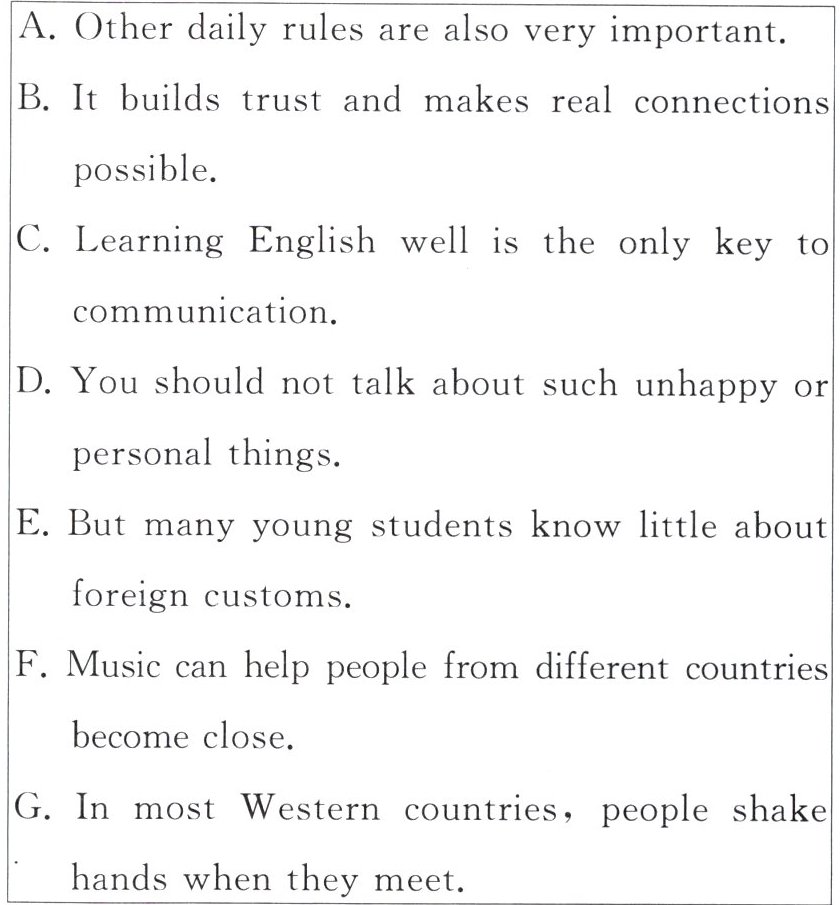
从方框中选出能填入空白处的最佳选项。选项中有两项多余。
新素材 国际青年会议礼仪 Now international communication is much easier than before. In 2025 and 2026, many world youth meetings take place in China. Young people from different countries come to study and have fun together.
1.
E
They may worry about making mistakes or being impolite when meeting foreign friends.People in different countries greet each other in different ways. It is important to know these basic habits. 2.
G
In Japan, people usually bow(鞠躬) to say hello. In India, people put their hands together and nod. These small actions show good manners.3.
A
When you are in public places, you should keep quiet in many foreign countries. Making loud sounds is not polite. You should also wait in line when you buy food or enter a room. These rules are easy to follow.Some topics are not good when talking with foreign friends. For example, it is not nice to ask about age or money. 4.
D
You can talk about hobbies, sport, music or school life. These topics are easy and relaxing.Joining international youth meetings is a great experience. Learning simple foreign customs(风俗) helps you talk well with others. 5.
B
答案
1-5 EGADB
【语篇解读】本文是一篇说明文,主要介绍了参加国际青年交流时应了解的问候、公共场合和交谈禁忌等跨文化礼仪,以及学习这些习俗的意义。
Ⅶ. 任务型阅读
阅读并根据下面的短文,在表格中的空格里填入一个最恰当的单词。
文化意识 跨文化交流(重庆二模改编)In our connected world, cross-cultural communication is becoming very important. When people from different countries meet, understanding cultural differences can help avoid problems and create friendships.
The first lesson is about body language. In Western cultures, a strong handshake shows confidence when greeting. But for Korean people, they usually bow slightly instead. Americans think eye contact(接触) shows they are honest, while in some Asian countries, too much eye contact may seem impolite. Even simple actions like thumbs-up can cause confusion—it means “good” in the USA but is rude in parts of the Middle East.
Good listening is another key. In Finland, people often stay silent for a moment after someone speaks to show respect. However, in Brazil, silence might make people uncomfortable. My Spanish friend once told me, “When I first visited China, I thought silent listeners weren’t interested. Later I learnt it was their way to show careful thinking.”
Speaking with local expressions builds trust. When my classmate Emma visited Paris and said “Bonjour”(hello) and “Merci”(thank you) to French people, they always smiled and were willing to help. But direct translation of idioms sometimes fails. The English saying “break a leg”(meaning good luck) would sound scary if translated into other languages! The Chinese idiom “ma ma hu hu”(horse-horse-tiger-tiger) actually means “just okay”, which often puzzles foreigners. So it’s important to understand the actual meanings behind them.
To improve cross-cultural communication, watch foreign films, read travel books, or join international school projects. Never be afraid to ask friendly questions like “Could you teach me a local custom?” Remember, mistakes are normal. Last month, our German exchange student accidentally used the informal “du”(you) in a formal meeting. Everyone laughed kindly, and it became a fun culture lesson!
| Bridging Cultures Through Communication |
| --- |
| In the connected world, cross-cultural communication is of great 1.
| Body language | In Western cultures, a strong handshake shows confidence while Koreans 2.
| Listening habits | In Finland, people keep in 6.
| Using local ways to speak | 8.
| How to improve | There are lots of 10.
阅读并根据下面的短文,在表格中的空格里填入一个最恰当的单词。
文化意识 跨文化交流(重庆二模改编)In our connected world, cross-cultural communication is becoming very important. When people from different countries meet, understanding cultural differences can help avoid problems and create friendships.
The first lesson is about body language. In Western cultures, a strong handshake shows confidence when greeting. But for Korean people, they usually bow slightly instead. Americans think eye contact(接触) shows they are honest, while in some Asian countries, too much eye contact may seem impolite. Even simple actions like thumbs-up can cause confusion—it means “good” in the USA but is rude in parts of the Middle East.
Good listening is another key. In Finland, people often stay silent for a moment after someone speaks to show respect. However, in Brazil, silence might make people uncomfortable. My Spanish friend once told me, “When I first visited China, I thought silent listeners weren’t interested. Later I learnt it was their way to show careful thinking.”
Speaking with local expressions builds trust. When my classmate Emma visited Paris and said “Bonjour”(hello) and “Merci”(thank you) to French people, they always smiled and were willing to help. But direct translation of idioms sometimes fails. The English saying “break a leg”(meaning good luck) would sound scary if translated into other languages! The Chinese idiom “ma ma hu hu”(horse-horse-tiger-tiger) actually means “just okay”, which often puzzles foreigners. So it’s important to understand the actual meanings behind them.
To improve cross-cultural communication, watch foreign films, read travel books, or join international school projects. Never be afraid to ask friendly questions like “Could you teach me a local custom?” Remember, mistakes are normal. Last month, our German exchange student accidentally used the informal “du”(you) in a formal meeting. Everyone laughed kindly, and it became a fun culture lesson!
| Bridging Cultures Through Communication |
| --- |
| In the connected world, cross-cultural communication is of great 1.
importance
. || Body language | In Western cultures, a strong handshake shows confidence while Koreans 2.
prefer
a slight bow. Americans think eye contact means 3. honesty
, while in some Asian countries, you should 4. avoid
too much eye contact. Thumbs-up means “good” in the USA, but it is not 5. polite
in parts of the Middle East. || Listening habits | In Finland, people keep in 6.
silence
to show respect after someone speaks. But in Brazil, it’s improper to stay silent. In China, silent listening means people are thinking 7. carefully
. || Using local ways to speak | 8.
Saying
“Bonjour” and “Merci” in France can make French people happy. Direct translation of idioms may cause 9. confusion/problems
. You should understand their true meanings. || How to improve | There are lots of 10.
ways
to improve. It’s normal to make mistakes when learning. |答案
【语篇解读】本文是一篇说明文。文章围绕跨文化交流展开,介绍了跨文化交流的重要性,并从肢体语言、良好倾听、使用当地表达这三个交流方式阐述文化差异,还给出了提升跨文化交流能力的建议。
1. importance 2. prefer 3. honesty 4. avoid 5. polite
6. silence 7. carefully 8. Saying 9. confusion/problems
10. ways
