

 登录
登录
Ⅷ. Complete the dialogue(按要求完成对话)
Situation: Lucy and her classmate Tom are talking about the school folk culture activity and traditional Chinese customs.
Lucy: Hi, Tom! I heard our school held a special folk culture activity in the hall last Friday. Have you taken part in this meaningful activity?
Tom:
Lucy: That's such a pity! I was absent because of a cold and missed the whole activity. Could you
Tom: No problem. I strongly advise you to try making Chinese knots. They are bright, beautiful and full of special cultural meanings. The teachers also told us some interesting stories about them.
Lucy: It sounds fun.
Tom: I believe it's educational and meaningful. It helps us students understand and love our traditional culture better.
Lucy: Thank you so much for telling me so many useful details. I've learnt a lot from your sharing.
Tom:
Situation: Lucy and her classmate Tom are talking about the school folk culture activity and traditional Chinese customs.
Lucy: Hi, Tom! I heard our school held a special folk culture activity in the hall last Friday. Have you taken part in this meaningful activity?
Tom:
Yes, I have.
1(肯定回答). I really had a great time there. We learned about a lot of traditional local customs, watched a wonderful folk music performance, and tried several kinds of easy and interesting traditional handcrafts with the help of our teachers.Lucy: That's such a pity! I was absent because of a cold and missed the whole activity. Could you
recommend an interesting folk activity
2(推荐一个有趣的民俗体验项目)to me? I really want to get close to our traditional folk culture by myself later.Tom: No problem. I strongly advise you to try making Chinese knots. They are bright, beautiful and full of special cultural meanings. The teachers also told us some interesting stories about them.
Lucy: It sounds fun.
What do you think of this folk activity/How do you like this folk activity
3(询问对这次民俗活动的看法)?Tom: I believe it's educational and meaningful. It helps us students understand and love our traditional culture better.
Lucy: Thank you so much for telling me so many useful details. I've learnt a lot from your sharing.
Tom:
You're welcome. /It's my pleasure.
4(回应感谢).答案
(供参考)
1. Yes, I have.
2. recommend an interesting folk activity
3. What do you think of this folk activity/How do you like this folk activity
4. You're welcome. /It's my pleasure.
1. Yes, I have.
2. recommend an interesting folk activity
3. What do you think of this folk activity/How do you like this folk activity
4. You're welcome. /It's my pleasure.
解析
【分析】
本题为英语补全对话题,需结合上下文语境、对话逻辑及常用交际用语完成填空。第1空需对现在完成时的一般疑问句作肯定回答;第2空需匹配Lucy想让Tom推荐民俗体验项目的诉求;第3空需询问对民俗活动的看法;第4空需回应感谢。
【解析】
1. 上文是现在完成时的一般疑问句“Have you taken part in this meaningful activity?”,其肯定回答为“Yes, I have.”,故填此内容。
2. Lucy因缺席活动想让Tom推荐有趣的民俗体验项目,结合语境填“recommend an interesting folk activity”。
3. 询问对某事物的看法常用句型“What do you think of...?”或“How do you like...?”,此处对应询问对民俗活动的看法,故填对应句型。
4. 回应感谢的常用表达为“You're welcome.”或“It's my pleasure.”,故填其中任意一个即可。
【答案】
1. Yes, I have.
2. recommend an interesting folk activity
3. What do you think of this folk activity/How do you like this folk activity
4. You're welcome. /It's my pleasure.
【知识点】
补全对话;日常交际用语
【点评】
本题考查日常交际用语在对话中的运用,结合上下文语境即可完成填空,侧重基础交际能力的考查,难度适中。
【难度系数】
0.6
本题为英语补全对话题,需结合上下文语境、对话逻辑及常用交际用语完成填空。第1空需对现在完成时的一般疑问句作肯定回答;第2空需匹配Lucy想让Tom推荐民俗体验项目的诉求;第3空需询问对民俗活动的看法;第4空需回应感谢。
【解析】
1. 上文是现在完成时的一般疑问句“Have you taken part in this meaningful activity?”,其肯定回答为“Yes, I have.”,故填此内容。
2. Lucy因缺席活动想让Tom推荐有趣的民俗体验项目,结合语境填“recommend an interesting folk activity”。
3. 询问对某事物的看法常用句型“What do you think of...?”或“How do you like...?”,此处对应询问对民俗活动的看法,故填对应句型。
4. 回应感谢的常用表达为“You're welcome.”或“It's my pleasure.”,故填其中任意一个即可。
【答案】
1. Yes, I have.
2. recommend an interesting folk activity
3. What do you think of this folk activity/How do you like this folk activity
4. You're welcome. /It's my pleasure.
【知识点】
补全对话;日常交际用语
【点评】
本题考查日常交际用语在对话中的运用,结合上下文语境即可完成填空,侧重基础交际能力的考查,难度适中。
【难度系数】
0.6
Ⅰ. Read the passage and complete the task(根据以下内容完成任务)
Festivals are colourful parts of world cultures. They carry special meanings and show people’s best wishes for life and family. Each festival has its own special traditions. Below are five typical customs from different global festivals.
| Customs | Festival Introductions |
| --- | --- |
| 1. Wearing green clothes, joining crowded street parades and enjoying traditional Irish music and group dances. | A. Diwali (India): It is one of the most important festivals in India, widely known as the Festival of Lights. People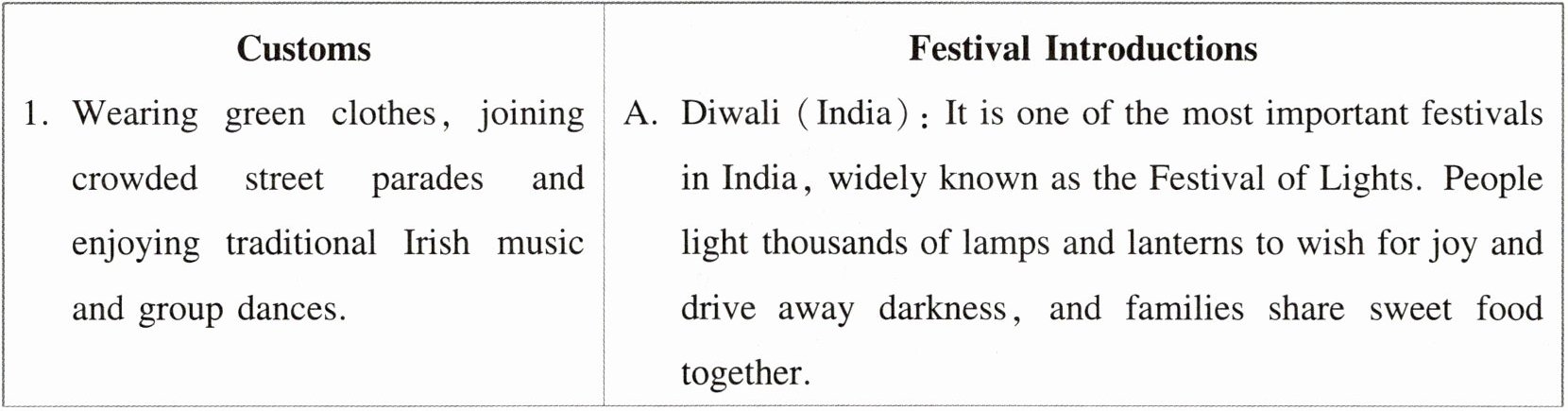 light thousands of lamps and lanterns to wish for joy and drive away darkness, and families share sweet food together. |
续表
| Customs | Festival Introductions |
| --- | --- |
| 2. Lighting oil lamps and colourful lanterns to celebrate the victory of light over darkness and sharing sweet traditional snacks with family members at home. | B. Day of the Dead (Mexico): It is a unique and warm Mexican festival. Instead of being sad, people celebrate to remember their dead family members with flower skulls and their favourite dishes. |
| 3. Making lively decorations and preparing special meals to remember and honour family members who have passed away. | C. The Mid-Autumn Festival (China): It is a traditional festival for family reunion. People eat mooncakes and watch the full moon, expressing their love and missing for family members far away. |
| 4. Hiking high into snowy mountains, wearing colourful traditional costumes and performing special dances to worship stars and sacred glaciers. | D. Saint Patrick’s Day (Ireland): It is a well-known Irish national festival. People wear green clothes, take part in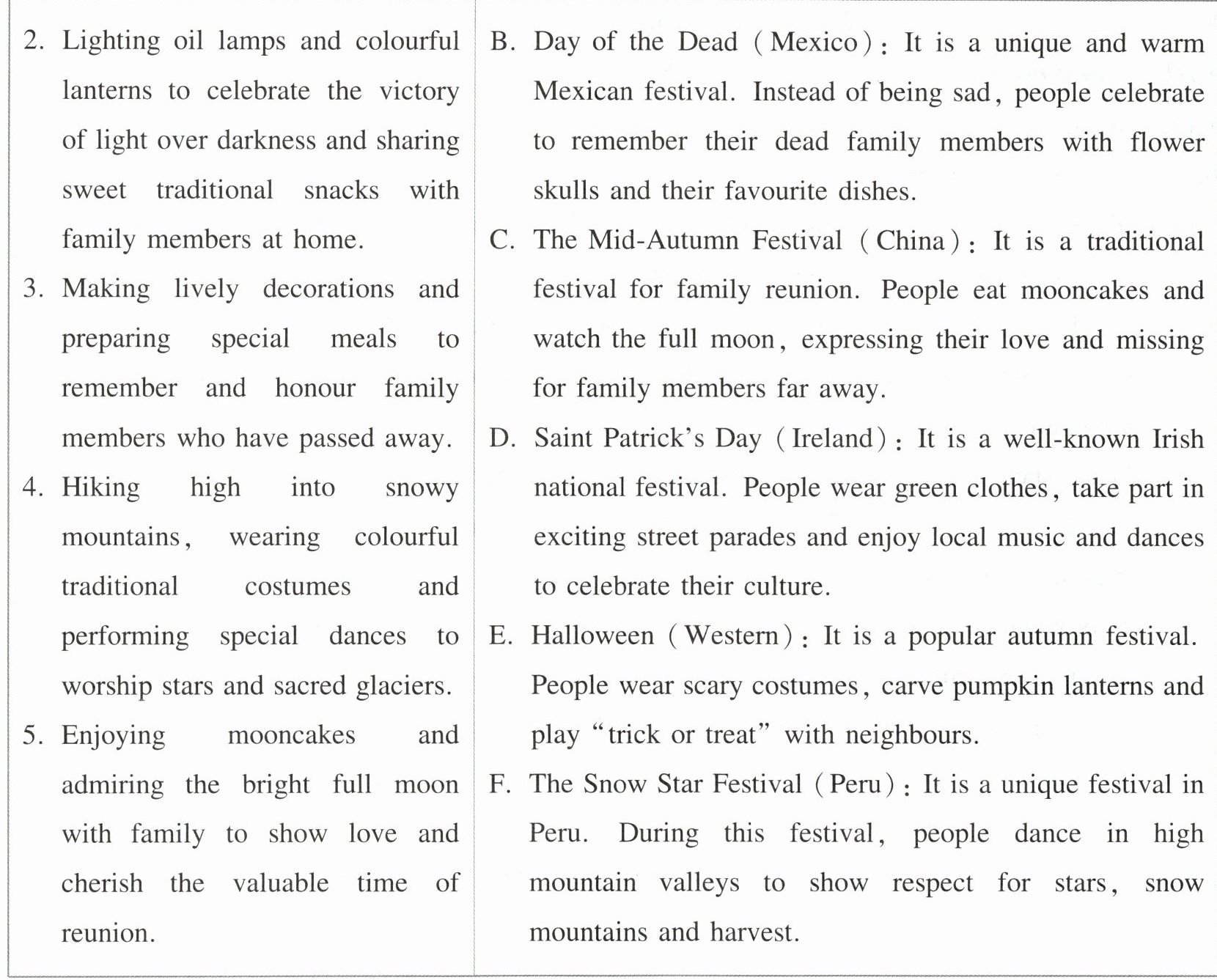 exciting street parades and enjoy local music and dances to celebrate their culture. |
| 5. Enjoying mooncakes and admiring the bright full moon with family to show love and cherish the valuable time of reunion. | E. Halloween (Western): It is a popular autumn festival. People wear scary costumes, carve pumpkin lanterns and play “trick or treat” with neighbours. |
| | F. The Snow Star Festival (Peru): It is a unique festival in Peru. During this festival, people dance in high mountain valleys to show respect for stars, snow mountains and harvest. |
Task: Choose the proper festival instruction from A to F for each custom.
1.
Festivals are colourful parts of world cultures. They carry special meanings and show people’s best wishes for life and family. Each festival has its own special traditions. Below are five typical customs from different global festivals.
| Customs | Festival Introductions |
| --- | --- |
| 1. Wearing green clothes, joining crowded street parades and enjoying traditional Irish music and group dances. | A. Diwali (India): It is one of the most important festivals in India, widely known as the Festival of Lights. People
light thousands of lamps and lanterns to wish for joy and drive away darkness, and families share sweet food together. |续表
| Customs | Festival Introductions |
| --- | --- |
| 2. Lighting oil lamps and colourful lanterns to celebrate the victory of light over darkness and sharing sweet traditional snacks with family members at home. | B. Day of the Dead (Mexico): It is a unique and warm Mexican festival. Instead of being sad, people celebrate to remember their dead family members with flower skulls and their favourite dishes. |
| 3. Making lively decorations and preparing special meals to remember and honour family members who have passed away. | C. The Mid-Autumn Festival (China): It is a traditional festival for family reunion. People eat mooncakes and watch the full moon, expressing their love and missing for family members far away. |
| 4. Hiking high into snowy mountains, wearing colourful traditional costumes and performing special dances to worship stars and sacred glaciers. | D. Saint Patrick’s Day (Ireland): It is a well-known Irish national festival. People wear green clothes, take part in
exciting street parades and enjoy local music and dances to celebrate their culture. || 5. Enjoying mooncakes and admiring the bright full moon with family to show love and cherish the valuable time of reunion. | E. Halloween (Western): It is a popular autumn festival. People wear scary costumes, carve pumpkin lanterns and play “trick or treat” with neighbours. |
| | F. The Snow Star Festival (Peru): It is a unique festival in Peru. During this festival, people dance in high mountain valleys to show respect for stars, snow mountains and harvest. |
Task: Choose the proper festival instruction from A to F for each custom.
1.
D
2. A
3. B
4. F
5. C
答案
1. D 2. A 3. B 4. F 5. C
解析
【分析】
本题为节日文化类阅读匹配题,解题思路是先提取每个习俗描述的核心关键词,再与对应节日介绍的核心信息进行匹配,逐一确定答案。
【解析】
1. 习俗1的核心关键词为“穿绿衣服、街头游行、爱尔兰音乐舞蹈”,对应D选项(爱尔兰圣帕特里克节,含穿绿衣、参加街头游行等内容),故1选D;
2. 习俗2的核心关键词为“点灯、和家人分享甜点心”,对应A选项(印度排灯节,即灯节,有点灯、分享甜食的习俗),故2选A;
3. 习俗3的核心关键词为“纪念逝去家人、准备特殊餐食”,对应B选项(墨西哥亡灵节,用于纪念逝去的家人),故3选B;
4. 习俗4的核心关键词为“爬雪山、敬星星和冰川”,对应F选项(秘鲁雪星节,有敬星星、雪山的习俗),故4选F;
5. 习俗5的核心关键词为“吃月饼、赏月”,对应C选项(中国中秋节,有吃月饼、赏月的习俗),故5选C。
【答案】
1. D 2. A 3. B 4. F 5. C
【知识点】
英语阅读匹配、节日文化常识
【点评】
本题通过匹配节日习俗与对应节日介绍,考查学生对不同国家节日文化的理解,解题关键是抓住核心关键词对应,难度较低,适合基础阶段学生练习。
【难度系数】
0.3
本题为节日文化类阅读匹配题,解题思路是先提取每个习俗描述的核心关键词,再与对应节日介绍的核心信息进行匹配,逐一确定答案。
【解析】
1. 习俗1的核心关键词为“穿绿衣服、街头游行、爱尔兰音乐舞蹈”,对应D选项(爱尔兰圣帕特里克节,含穿绿衣、参加街头游行等内容),故1选D;
2. 习俗2的核心关键词为“点灯、和家人分享甜点心”,对应A选项(印度排灯节,即灯节,有点灯、分享甜食的习俗),故2选A;
3. 习俗3的核心关键词为“纪念逝去家人、准备特殊餐食”,对应B选项(墨西哥亡灵节,用于纪念逝去的家人),故3选B;
4. 习俗4的核心关键词为“爬雪山、敬星星和冰川”,对应F选项(秘鲁雪星节,有敬星星、雪山的习俗),故4选F;
5. 习俗5的核心关键词为“吃月饼、赏月”,对应C选项(中国中秋节,有吃月饼、赏月的习俗),故5选C。
【答案】
1. D 2. A 3. B 4. F 5. C
【知识点】
英语阅读匹配、节日文化常识
【点评】
本题通过匹配节日习俗与对应节日介绍,考查学生对不同国家节日文化的理解,解题关键是抓住核心关键词对应,难度较低,适合基础阶段学生练习。
【难度系数】
0.3
