

 登录
登录
Ⅳ. 任务型阅读(每小题1分,共10分)
阅读并根据下面的短文,在表格中的空里填入一个最恰当的单词。
新素材 大学生就业趋势 A recent report tells us that many Chinese students are making a different choice after finishing college. Instead of working in big cities, they prefer to go to small towns or counties. This is quite a big change for them.
In the past, like in 2018, only 20% of new graduates chose to work in smaller places. But by 2024, this number went up to 35%. Why did they make this change? The report gives us some reasons.
Some graduates wanted to be closer to their families. They believed that people in small towns and counties were friendlier and always ready to help each other. Others had a dream to improve their hometown and make it a better place to live. What's more, the government also encouraged(鼓励) graduates to work in these places by offering more job chances.
Usually, most graduates in China want to work in big cities. But after a few months, some of them start to feel the pressure(压力) from high competition for jobs or high living costs. These problems make them worried, and they start thinking about going back home.
The report also says that graduates feel happier and more relaxed after leaving big cities. In fact, nearly 60% of them stayed in their hometowns for at least five years. And their salaries(工资) also increased. In 2018, their average salary was 4,640 yuan, but by 2024, it went up to 5,877 yuan.
Zhang Yi was a 27-year-old young man who chose to go back home. After graduating from a university in the UK in 2023, he got a good job offer in a hospital in Shanghai, but he decided to stay in his hometown instead. He said, "I think my hometown needs me more, and I want to help people in my hometown to live a better life."
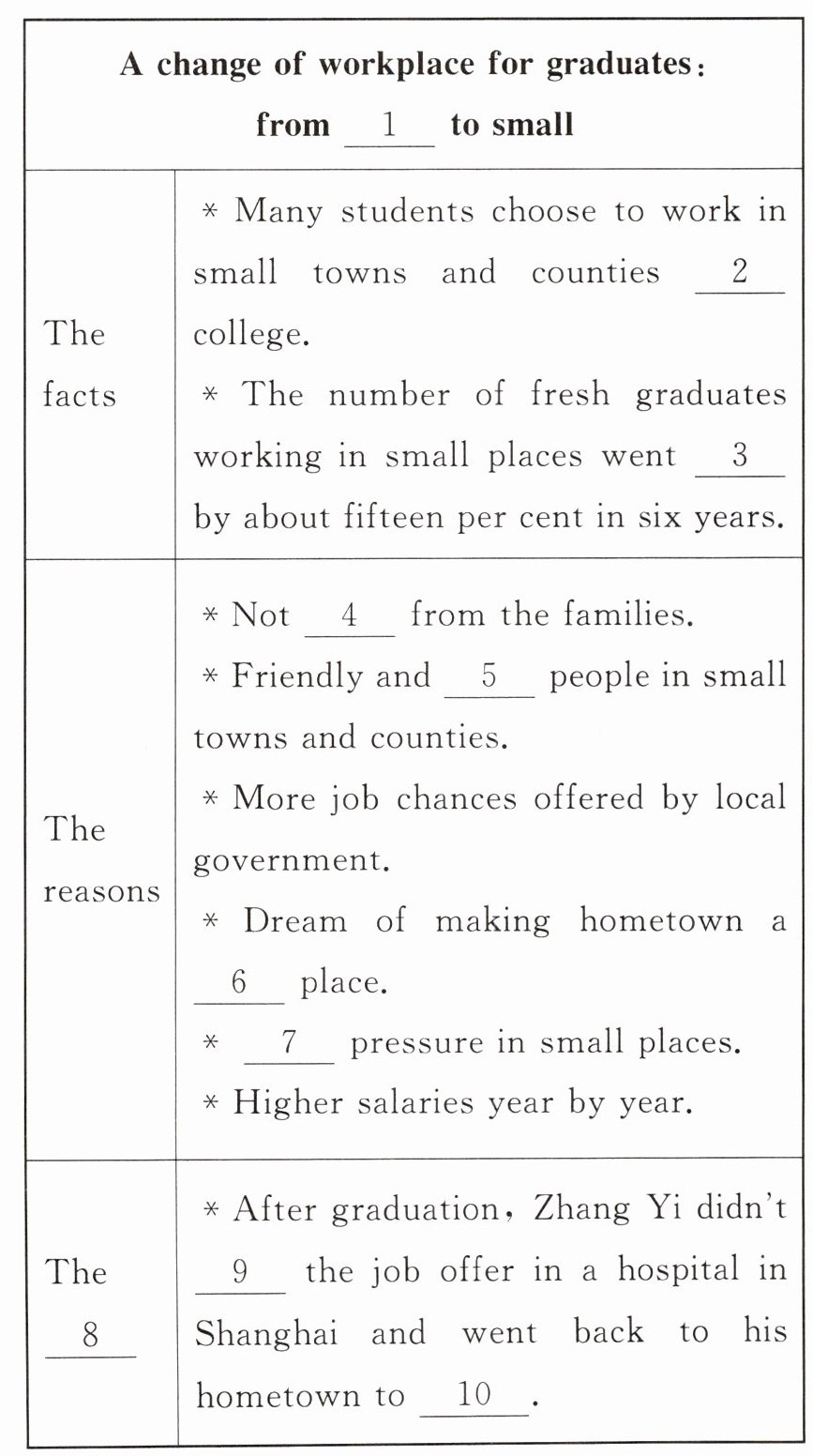
阅读并根据下面的短文,在表格中的空里填入一个最恰当的单词。
新素材 大学生就业趋势 A recent report tells us that many Chinese students are making a different choice after finishing college. Instead of working in big cities, they prefer to go to small towns or counties. This is quite a big change for them.
In the past, like in 2018, only 20% of new graduates chose to work in smaller places. But by 2024, this number went up to 35%. Why did they make this change? The report gives us some reasons.
Some graduates wanted to be closer to their families. They believed that people in small towns and counties were friendlier and always ready to help each other. Others had a dream to improve their hometown and make it a better place to live. What's more, the government also encouraged(鼓励) graduates to work in these places by offering more job chances.
Usually, most graduates in China want to work in big cities. But after a few months, some of them start to feel the pressure(压力) from high competition for jobs or high living costs. These problems make them worried, and they start thinking about going back home.
The report also says that graduates feel happier and more relaxed after leaving big cities. In fact, nearly 60% of them stayed in their hometowns for at least five years. And their salaries(工资) also increased. In 2018, their average salary was 4,640 yuan, but by 2024, it went up to 5,877 yuan.
Zhang Yi was a 27-year-old young man who chose to go back home. After graduating from a university in the UK in 2023, he got a good job offer in a hospital in Shanghai, but he decided to stay in his hometown instead. He said, "I think my hometown needs me more, and I want to help people in my hometown to live a better life."
答案
Ⅳ.1. big 2. after 3. up 4. far 5. helpful/kind 6. better 7. Lower/Less 8. example 9. take 10. work
解析
【分析】
先明确表格主题为大学生就业从大城市转向小城镇的变化,解题时需先分析每个空格的语境与语法要求,再回到短文中定位对应信息,筛选出符合语境的恰当单词,确保答案准确。
【解析】
1. 空格1:根据原文第一段“Instead of working in big cities, they prefer to go to small towns or counties”,可知就业从大城市转向小地方,故填big。
2. 空格2:原文第一段“after finishing college”对应“大学毕业后”,结合句子结构,填after。
3. 空格3:原文第二段提到2018年20%,2024年35%,数量上升,go up为固定搭配,故填up。
4. 空格4:原文第三段“Some graduates wanted to be closer to their families”,即不远离家庭,not far from符合语境,故填far。
5. 空格5:原文第三段“people in small towns and counties were friendlier and always ready to help each other”,对应friendly或helpful,故填helpful/kind。
6. 空格6:原文第三段“make it a better place to live”,故填better。
7. 空格7:原文第四段提到大城市有压力,第五段说明小地方更轻松,压力更低,Lower/Less符合语境,故填Lower/Less。
8. 空格8:最后一部分以张毅为例,故填example。
9. 空格9:原文最后一段“he got a good job offer... but he decided to stay in his hometown instead”,即没有接受工作offer,take the job offer为固定搭配,故填take。
10. 空格10:张毅回到家乡工作,结合语境,故填work。
【答案】
1. big 2. after 3. up 4. far 5. helpful/kind 6. better 7. Lower/Less 8. example 9. take 10. work
【知识点】
任务型阅读;信息定位;词汇运用
【点评】
本题为任务型阅读题,围绕大学生就业选择的变化设置题目,考查学生快速定位短文信息、结合语境填写恰当单词的能力,难度适中,适合练习信息提取与词汇运用。
【难度系数】
0.7
先明确表格主题为大学生就业从大城市转向小城镇的变化,解题时需先分析每个空格的语境与语法要求,再回到短文中定位对应信息,筛选出符合语境的恰当单词,确保答案准确。
【解析】
1. 空格1:根据原文第一段“Instead of working in big cities, they prefer to go to small towns or counties”,可知就业从大城市转向小地方,故填big。
2. 空格2:原文第一段“after finishing college”对应“大学毕业后”,结合句子结构,填after。
3. 空格3:原文第二段提到2018年20%,2024年35%,数量上升,go up为固定搭配,故填up。
4. 空格4:原文第三段“Some graduates wanted to be closer to their families”,即不远离家庭,not far from符合语境,故填far。
5. 空格5:原文第三段“people in small towns and counties were friendlier and always ready to help each other”,对应friendly或helpful,故填helpful/kind。
6. 空格6:原文第三段“make it a better place to live”,故填better。
7. 空格7:原文第四段提到大城市有压力,第五段说明小地方更轻松,压力更低,Lower/Less符合语境,故填Lower/Less。
8. 空格8:最后一部分以张毅为例,故填example。
9. 空格9:原文最后一段“he got a good job offer... but he decided to stay in his hometown instead”,即没有接受工作offer,take the job offer为固定搭配,故填take。
10. 空格10:张毅回到家乡工作,结合语境,故填work。
【答案】
1. big 2. after 3. up 4. far 5. helpful/kind 6. better 7. Lower/Less 8. example 9. take 10. work
【知识点】
任务型阅读;信息定位;词汇运用
【点评】
本题为任务型阅读题,围绕大学生就业选择的变化设置题目,考查学生快速定位短文信息、结合语境填写恰当单词的能力,难度适中,适合练习信息提取与词汇运用。
【难度系数】
0.7
