

 登录
登录
根据短文内容,完成下列任务。
The Laba Festival
Basic Information
The Laba Festival is one of the most important traditional festivals in China.
1. ______ For Chinese people, this special festival marks the beginning of the Spring Festival season. As soon as the Laba Festival comes, people begin to clean their houses, buy delicious food and make full preparations for the coming new year. Everyone looks forward to the warm and happy festival time.
Long History
The Laba Festival has a long history of thousands of years in China. In ancient times, people held celebrations to show thanks for the good harvest and healthy life. 2. This old festival has been passed down from generation to generation and still keeps its special meaning today.
Main Tradition: Laba Porridge
The most popular tradition on this day is eating Laba porridge. People usually make it with rice, beans, nuts and dried fruits. 3. On the cold morning of the Laba Festival, family members often cook porridge together. Sharing a bowl of hot and sweet porridge helps people keep warm and enjoy the love from their family.
Another Custom: Laba Garlic(蒜)
Another traditional food is Laba garlic. 4. Slowly, the garlic will turn green and taste a little sour. It becomes a great and special dish when people eat jiaozi at the Spring Festival with their family and friends.
Festival Meaning
The Laba Festival carries good wishes for health and happiness. It helps us remember our great traditional culture and brings family members closer. 5. It teaches us to value our traditions and enjoy the simple and beautiful happiness in our daily life.
任务一:根据短文内容,将下面五个句子还原到短文中。
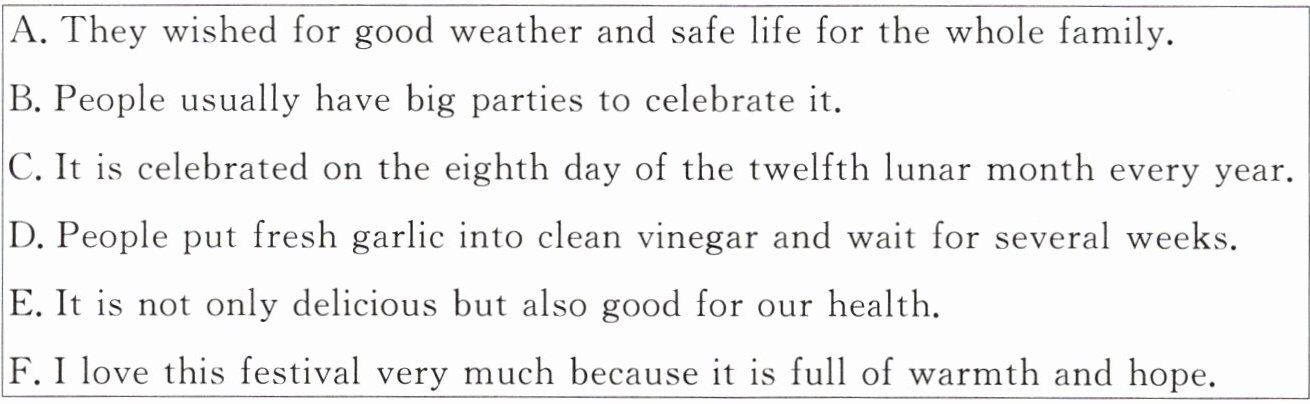
A. They wished for good weather and safe life for the whole family.
B. People usually have big parties to celebrate it.
C. It is celebrated on the eighth day of the twelfth lunar month every year.
D. People put fresh garlic into clean vinegar and wait for several weeks.
E. It is not only delicious but also good for our health.
F. I love this festival very much because it is full of warmth and hope.
任务二:根据短文内容,选择正确的答案。
()1. When is the Laba Festival celebrated?
A. On January 1st.
B. On the first day of spring.
C. On the eighth day of the twelfth lunar month.
D. On the fifth day of the first lunar month.
()2. What do people use to make Laba porridge?
A. Meat, vegetables and rice.
B. Rice, beans, nuts and dried fruits.
C. Flour, eggs and sugar.
D. Milk, bread and butter.
()3. Why do people make Laba garlic?
A. Because it is a sweet dessert.
B. Because it is a special dish for the Spring Festival.
C. Because it can help people lose weight.
D. Because it is only eaten on the Laba Festival morning.
()4. What does the writer think of the Laba Festival?
A. It is boring and old.
B. It is full of warmth and hope.
C. It is too difficult to understand.
D. It's noisy and crowded.
()5. Which of the following is TRUE about the history of Laba Festival?
A. It has a long history of thousands of years.
B. It is a new festival with only 100 years of history.
C. It started in modern times.
D. It has no recorded history at all.
任务三:根据短文内容,回答下列问题。
1. What does the Laba Festival mark for Chinese people?
2. What do Chinese people cook on the festival morning?
3. What happens to the garlic after people put it into vinegar for weeks?
4. What does the Laba Festival help people remember?
5. What can we learn from the passage?
【拓展篇】
The Laba Festival
Basic Information
The Laba Festival is one of the most important traditional festivals in China.
1. ______ For Chinese people, this special festival marks the beginning of the Spring Festival season. As soon as the Laba Festival comes, people begin to clean their houses, buy delicious food and make full preparations for the coming new year. Everyone looks forward to the warm and happy festival time.
Long History
The Laba Festival has a long history of thousands of years in China. In ancient times, people held celebrations to show thanks for the good harvest and healthy life. 2. This old festival has been passed down from generation to generation and still keeps its special meaning today.
Main Tradition: Laba Porridge
The most popular tradition on this day is eating Laba porridge. People usually make it with rice, beans, nuts and dried fruits. 3. On the cold morning of the Laba Festival, family members often cook porridge together. Sharing a bowl of hot and sweet porridge helps people keep warm and enjoy the love from their family.
Another Custom: Laba Garlic(蒜)
Another traditional food is Laba garlic. 4. Slowly, the garlic will turn green and taste a little sour. It becomes a great and special dish when people eat jiaozi at the Spring Festival with their family and friends.
Festival Meaning
The Laba Festival carries good wishes for health and happiness. It helps us remember our great traditional culture and brings family members closer. 5. It teaches us to value our traditions and enjoy the simple and beautiful happiness in our daily life.
任务一:根据短文内容,将下面五个句子还原到短文中。
A. They wished for good weather and safe life for the whole family.
B. People usually have big parties to celebrate it.
C. It is celebrated on the eighth day of the twelfth lunar month every year.
D. People put fresh garlic into clean vinegar and wait for several weeks.
E. It is not only delicious but also good for our health.
F. I love this festival very much because it is full of warmth and hope.
任务二:根据短文内容,选择正确的答案。
()1. When is the Laba Festival celebrated?
A. On January 1st.
B. On the first day of spring.
C. On the eighth day of the twelfth lunar month.
D. On the fifth day of the first lunar month.
()2. What do people use to make Laba porridge?
A. Meat, vegetables and rice.
B. Rice, beans, nuts and dried fruits.
C. Flour, eggs and sugar.
D. Milk, bread and butter.
()3. Why do people make Laba garlic?
A. Because it is a sweet dessert.
B. Because it is a special dish for the Spring Festival.
C. Because it can help people lose weight.
D. Because it is only eaten on the Laba Festival morning.
()4. What does the writer think of the Laba Festival?
A. It is boring and old.
B. It is full of warmth and hope.
C. It is too difficult to understand.
D. It's noisy and crowded.
()5. Which of the following is TRUE about the history of Laba Festival?
A. It has a long history of thousands of years.
B. It is a new festival with only 100 years of history.
C. It started in modern times.
D. It has no recorded history at all.
任务三:根据短文内容,回答下列问题。
1. What does the Laba Festival mark for Chinese people?
2. What do Chinese people cook on the festival morning?
3. What happens to the garlic after people put it into vinegar for weeks?
4. What does the Laba Festival help people remember?
5. What can we learn from the passage?
【拓展篇】
答案
任务一:
1. C
2. A
3. E
4. D
5. F
任务二:
1. C
2. B
3. B
4. B
5. A
任务三:
1. It marks the beginning of the Spring Festival season.
2. They cook Laba porridge.
3. The garlic will turn green and taste a little sour.
4. It helps people remember their great traditional culture.
5. We should value our traditions and enjoy the simple and beautiful happiness in our daily life. (答案合理即可)
1. C
2. A
3. E
4. D
5. F
任务二:
1. C
2. B
3. B
4. B
5. A
任务三:
1. It marks the beginning of the Spring Festival season.
2. They cook Laba porridge.
3. The garlic will turn green and taste a little sour.
4. It helps people remember their great traditional culture.
5. We should value our traditions and enjoy the simple and beautiful happiness in our daily life. (答案合理即可)
解析
任务一解析:
1. 第一空位于基础信息段,前文引出腊八节是中国重要传统节日,后文介绍它的节日意义,C选项“它在每年农历十二月初八庆祝”是对节日基本时间信息的补充,符合段落逻辑,故选C。
2. 第二空位于历史介绍段,前文提到古代人们举办庆祝活动感谢丰收与健康生活,A选项“他们祈求风调雨顺、全家平安”承接古代人们的祈福内容,上下文连贯,故选A。
3. 第三空位于腊八粥介绍部分,前文介绍腊八粥的制作原料,E选项“它不仅美味,还对我们的健康有益”是对腊八粥的特点补充,符合语境,故选E。
4. 第四空位于腊八蒜介绍部分,后文提到蒜会慢慢变绿、带酸味,D选项“人们把新鲜大蒜放进干净的醋里,等待几周”是腊八蒜的制作步骤,衔接后文的变化,故选D。
5. 第五空位于节日意义段末尾,后文介绍节日带给我们的启示,F选项“我非常喜欢这个节日,因为它充满温暖和希望”作为收尾表达对节日的感受,逻辑通顺,故选F。
任务二解析:
1. 细节理解题,根据原文内容,腊八节在农历十二月初八庆祝,对应选项C。
2. 细节理解题,原文明确提到“People usually make it with rice, beans, nuts and dried fruits”,对应选项B。
3. 细节理解题,原文提到腊八蒜是春节家人朋友一起吃饺子时的特色菜品,对应选项B。
4. 细节理解题,作者在文末表达自己喜爱腊八节,认为它充满温暖和希望,对应选项B。
5. 细节理解题,原文历史部分第一句说明腊八节有几千年的悠久历史,对应选项A。
任务三解析:
所有问题均可从原文定位找到对应信息,提取原文内容作答即可。
1. 第一空位于基础信息段,前文引出腊八节是中国重要传统节日,后文介绍它的节日意义,C选项“它在每年农历十二月初八庆祝”是对节日基本时间信息的补充,符合段落逻辑,故选C。
2. 第二空位于历史介绍段,前文提到古代人们举办庆祝活动感谢丰收与健康生活,A选项“他们祈求风调雨顺、全家平安”承接古代人们的祈福内容,上下文连贯,故选A。
3. 第三空位于腊八粥介绍部分,前文介绍腊八粥的制作原料,E选项“它不仅美味,还对我们的健康有益”是对腊八粥的特点补充,符合语境,故选E。
4. 第四空位于腊八蒜介绍部分,后文提到蒜会慢慢变绿、带酸味,D选项“人们把新鲜大蒜放进干净的醋里,等待几周”是腊八蒜的制作步骤,衔接后文的变化,故选D。
5. 第五空位于节日意义段末尾,后文介绍节日带给我们的启示,F选项“我非常喜欢这个节日,因为它充满温暖和希望”作为收尾表达对节日的感受,逻辑通顺,故选F。
任务二解析:
1. 细节理解题,根据原文内容,腊八节在农历十二月初八庆祝,对应选项C。
2. 细节理解题,原文明确提到“People usually make it with rice, beans, nuts and dried fruits”,对应选项B。
3. 细节理解题,原文提到腊八蒜是春节家人朋友一起吃饺子时的特色菜品,对应选项B。
4. 细节理解题,作者在文末表达自己喜爱腊八节,认为它充满温暖和希望,对应选项B。
5. 细节理解题,原文历史部分第一句说明腊八节有几千年的悠久历史,对应选项A。
任务三解析:
所有问题均可从原文定位找到对应信息,提取原文内容作答即可。
