

 登录
登录
3. 存现句的主谓一致
(1)存现句句型的主语通常在be动词之后。
如果句子的主语是可数名词单数或不可数名词,be动词用is;如果句子主语是可数名词复数,be动词用are。
e.g. There
瓶子里有些牛奶。
There
(2)there be后跟两个或两个以上主语时,be动词的形式要与离它最近的主语的数保持一致,即“就近原则”。
e.g. There
(1)存现句句型的主语通常在be动词之后。
如果句子的主语是可数名词单数或不可数名词,be动词用is;如果句子主语是可数名词复数,be动词用are。
e.g. There
is
some milk in the bottle.瓶子里有些牛奶。
There
are
some pencils in my pencil box. 我的铅笔盒里有些铅笔。(2)there be后跟两个或两个以上主语时,be动词的形式要与离它最近的主语的数保持一致,即“就近原则”。
e.g. There
is
a pen and some答案
3. (1) is; are (2) is
解析
【分析】本题考查there be存现句的主谓一致规则,需分两种情况判断be动词形式:一是主语在be动词后时,根据主语的可数性/单复数确定be动词;二是存在多个主语时遵循就近原则,即be动词的形式与离它最近的主语的数保持一致。
【解析】(1)第一句中主语是不可数名词milk,根据规则be动词用is;第二句主语是可数名词复数pencils,be动词用are。(2)there be句型遵循就近原则,离be动词最近的主语是单数的a pen,因此be动词用is。
【答案】is; are; is
【知识点】there be句型主谓一致、就近原则、存现句
【点评】本题为基础语法题,核心考查there be句型的主谓一致规则,只要牢记主语后置的判断方法和就近原则,即可轻松解答。
【难度系数】0.8
【解析】(1)第一句中主语是不可数名词milk,根据规则be动词用is;第二句主语是可数名词复数pencils,be动词用are。(2)there be句型遵循就近原则,离be动词最近的主语是单数的a pen,因此be动词用is。
【答案】is; are; is
【知识点】there be句型主谓一致、就近原则、存现句
【点评】本题为基础语法题,核心考查there be句型的主谓一致规则,只要牢记主语后置的判断方法和就近原则,即可轻松解答。
【难度系数】0.8
books on the desk. 桌上有一支钢笔和一些书。
There
4. 存现句与have/ has的区别
(1)there be强调的是位置关系,表示“某地有某物/人”;
(2)have/ has强调的是所属关系。
5. there be和have/ has不能同时使用,但有时可以相互转换。
e.g. There are about 1, 000 students in our school. = Our school
二、方位介词的用法
1. 表示方位的介词in, on, under, behind等通常与名词组成介词短语,指明物品所在的具体方位。名词前常有定冠词the / 不定冠词a, an / 形容词性物主代词等。
2. 常见方位介词
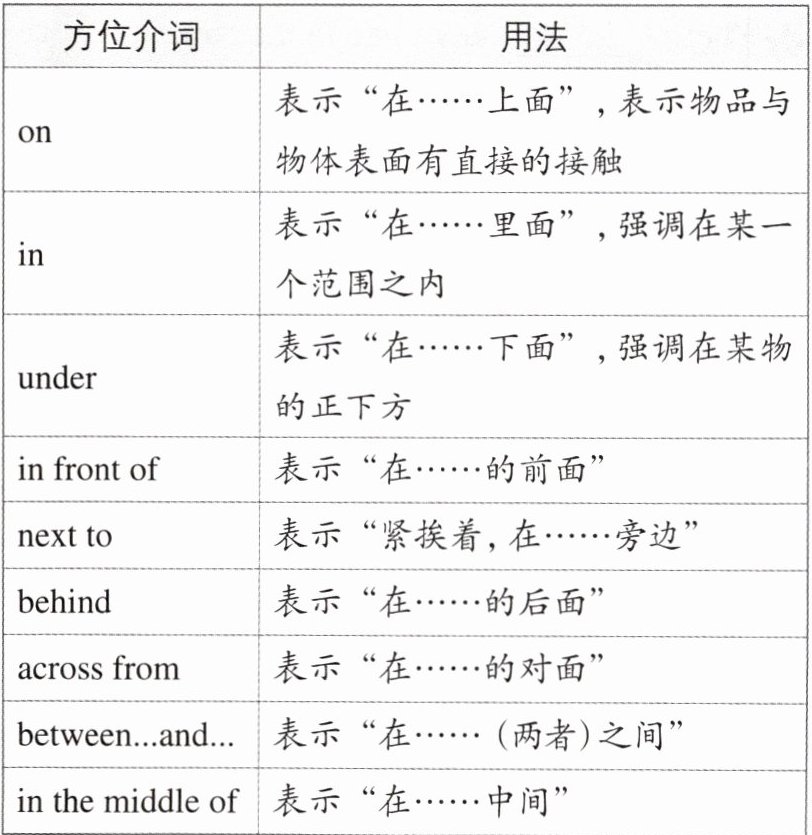
e.g. There is a hospital
The art room is
注意:(1)in front of与in the front of区别
in front of 在物体外部的前面
in the front of 在物体内部的前面
e.g. Jim sits behind me, so I sit
The driver is
(2)in与on区别
in the tree 在树上(外来的,如鸟)
on the tree 在树上(本来就有的,树上结的果子、树叶等)
e.g. There are two birds
There are some apples
There
are
some books and a pen on the desk. 桌上有一些书和一支钢笔。4. 存现句与have/ has的区别
(1)there be强调的是位置关系,表示“某地有某物/人”;
(2)have/ has强调的是所属关系。
5. there be和have/ has不能同时使用,但有时可以相互转换。
e.g. There are about 1, 000 students in our school. = Our school
has
about 1, 000 students. 我们学校有大约1, 000名学生。二、方位介词的用法
1. 表示方位的介词in, on, under, behind等通常与名词组成介词短语,指明物品所在的具体方位。名词前常有定冠词the / 不定冠词a, an / 形容词性物主代词等。
2. 常见方位介词
e.g. There is a hospital
across from
our school. 我们学校对面有个医院。The art room is
next to
the music room. 艺术教室挨着音乐教室。注意:(1)in front of与in the front of区别
in front of 在物体外部的前面
in the front of 在物体内部的前面
e.g. Jim sits behind me, so I sit
in front of
him. 吉姆坐在我后面,所以我坐在吉姆前面。The driver is
in the front of
the car. 司机在小汽车的前面。(2)in与on区别
in the tree 在树上(外来的,如鸟)
on the tree 在树上(本来就有的,树上结的果子、树叶等)
e.g. There are two birds
in
the tree. 树上有两只鸟。There are some apples
on
the tree. 树上有一些苹果。答案
3. (2) are 5. has
2. across from; next to
(1) in front of; in the front of (2) in; on
2. across from; next to
(1) in front of; in the front of (2) in; on
解析
【分析】
这道题考查there be句型的就近原则、there be与have/has的转换,以及方位介词的用法。解题时,需掌握:1. there be句型遵循就近原则,be动词由靠近它的名词单复数决定;2. there be表“某地有某物”,have/has表所属关系,主语为第三人称单数时用has;3. 方位介词需结合词义和用法区别,如across from(对面)、in front of(物体外部前)、in the front of(物体内部前)、in the tree(外来物)、on the tree(本身物)等。
【解析】
1. 句子“There ____ some books and a pen on the desk”中,there be句型遵循就近原则,靠近be动词的是复数名词“some books”,因此be动词用are。
2. 句子“Our school ____ about 1,000 students”中,主语“Our school”是第三人称单数,表所属关系,故用has。
3. “There is a hospital ____ our school”表示“医院在学校对面”,用方位介词短语across from。
4. “The art room is ____ the music room”表示“艺术教室挨着音乐教室”,用next to。
5. “Jim sits behind me, so I sit ____ him”中,“我在吉姆的前面”是物体外部的前面,用in front of。
6. “The driver is ____ the car”中,“司机在汽车内部的前面”,用in the front of。
7. “There are two birds ____ the tree”中,鸟是树的外来物,用in the tree。
8. “There are some apples ____ the tree”中,苹果是树本身的果实,用on the tree。
【答案】
3. (2) are;5. has;2. across from;next to;(1) in front of;in the front of;(2) in;on
【知识点】
there be句型、方位介词、have/has用法
【点评】
本题为初中英语基础考点,考查核心语法和方位介词的基础用法,需牢记规则和词义区别,整体难度适中。
【难度系数】
0.5
这道题考查there be句型的就近原则、there be与have/has的转换,以及方位介词的用法。解题时,需掌握:1. there be句型遵循就近原则,be动词由靠近它的名词单复数决定;2. there be表“某地有某物”,have/has表所属关系,主语为第三人称单数时用has;3. 方位介词需结合词义和用法区别,如across from(对面)、in front of(物体外部前)、in the front of(物体内部前)、in the tree(外来物)、on the tree(本身物)等。
【解析】
1. 句子“There ____ some books and a pen on the desk”中,there be句型遵循就近原则,靠近be动词的是复数名词“some books”,因此be动词用are。
2. 句子“Our school ____ about 1,000 students”中,主语“Our school”是第三人称单数,表所属关系,故用has。
3. “There is a hospital ____ our school”表示“医院在学校对面”,用方位介词短语across from。
4. “The art room is ____ the music room”表示“艺术教室挨着音乐教室”,用next to。
5. “Jim sits behind me, so I sit ____ him”中,“我在吉姆的前面”是物体外部的前面,用in front of。
6. “The driver is ____ the car”中,“司机在汽车内部的前面”,用in the front of。
7. “There are two birds ____ the tree”中,鸟是树的外来物,用in the tree。
8. “There are some apples ____ the tree”中,苹果是树本身的果实,用on the tree。
【答案】
3. (2) are;5. has;2. across from;next to;(1) in front of;in the front of;(2) in;on
【知识点】
there be句型、方位介词、have/has用法
【点评】
本题为初中英语基础考点,考查核心语法和方位介词的基础用法,需牢记规则和词义区别,整体难度适中。
【难度系数】
0.5
