

 登录
登录
三、阅读理解
According to UNESCO, many children in villages in some African countries do not go to school. They have to work to make money for their families. And more than half of the people in these countries live without electricity (电).
A company is now working to deal with both of these problems. It has built a special solar power station (太阳能电站), which is in the shape of a cow, called "Solar Cow". The company encourages parents in those poor villages to send their children to school by setting up Solar Cows at schools.
Just like its name, the Solar Cow can charge batteries (给电池充电) called "Solar Milk". The Solar Milks provide electricity for the families. The batteries can only be charged using the Solar Cow, so children have to go to school to get the electricity. Every day, children put their batteries into the bottom of their school's Solar Cow. They go to class while the batteries are being charged. At the end of the day, they take the batteries home.
Since 2018, this company has set up two Solar Cows in Kenya and one in Tanzania. The company also started to raise money for more Solar Cows to help children in Africa.
(
A. An animal. B. A solar battery.
C. A mobile phone. D. A solar power station.
(
① Children go to school with batteries.
② Children take the charged batteries home.
③ Children have classes while the batteries are being charged.
④ Children put the batteries into the bottom of their school's Solar Cow.
A. ①④③② B. ①③④② C. ②④③① D. ②①③④
(
A. 1. B. 2. C. 3. D. 4.
(
A. Solar Cows have provided electricity for the schools.
B. Some African children don't go to school because they have to work.
C. More than half of people in Kenya and Tanzania live without electricity.
D. Solar Cows are solving two problems at the same time in African countries.
According to UNESCO, many children in villages in some African countries do not go to school. They have to work to make money for their families. And more than half of the people in these countries live without electricity (电).
A company is now working to deal with both of these problems. It has built a special solar power station (太阳能电站), which is in the shape of a cow, called "Solar Cow". The company encourages parents in those poor villages to send their children to school by setting up Solar Cows at schools.
Just like its name, the Solar Cow can charge batteries (给电池充电) called "Solar Milk". The Solar Milks provide electricity for the families. The batteries can only be charged using the Solar Cow, so children have to go to school to get the electricity. Every day, children put their batteries into the bottom of their school's Solar Cow. They go to class while the batteries are being charged. At the end of the day, they take the batteries home.
Since 2018, this company has set up two Solar Cows in Kenya and one in Tanzania. The company also started to raise money for more Solar Cows to help children in Africa.
(
D
) 1. What is a Solar Cow?A. An animal. B. A solar battery.
C. A mobile phone. D. A solar power station.
(
A
) 2. What is the correct order for children to get the electricity for their families?① Children go to school with batteries.
② Children take the charged batteries home.
③ Children have classes while the batteries are being charged.
④ Children put the batteries into the bottom of their school's Solar Cow.
A. ①④③② B. ①③④② C. ②④③① D. ②①③④
(
C
) 3. How many Solar Cows has the company set up in total since 2018?A. 1. B. 2. C. 3. D. 4.
(
D
) 4. What does this passage mainly talk about?A. Solar Cows have provided electricity for the schools.
B. Some African children don't go to school because they have to work.
C. More than half of people in Kenya and Tanzania live without electricity.
D. Solar Cows are solving two problems at the same time in African countries.
答案
1.D 2.A 3.C 4.D
解析
【分析】首先通读全文,明确文章核心是介绍名为“Solar Cow”的太阳能电站,它同时解决非洲儿童失学和当地缺电两个问题。针对每道题,先判断题型(细节题、排序题、计算题、主旨题),再定位原文对应内容,逐一分析选项,排除错误答案,选出正确选项。
【解析】1. 细节理解题:根据第二段“It has built a special solar power station, which is in the shape of a cow, called 'Solar Cow'.”可知,Solar Cow是太阳能电站,故选D。
2. 细节排序题:根据第三段“children have to go to school to get the electricity”及后续步骤“put their batteries into the bottom of their school's Solar Cow→go to class while the batteries are being charged→take the batteries home”,可知顺序为①④③②,故选A。
3. 细节计算题:根据第四段“set up two Solar Cows in Kenya and one in Tanzania”,总数为2+1=3,故选C。
4. 主旨大意题:文章开头提出非洲的两个问题(儿童失学、缺电),第二段指出Solar Cow同时解决这两个问题,全文围绕其作用展开,故选D。
【答案】1.D 2.A 3.C 4.D
【知识点】英语阅读理解,细节理解,主旨大意
【点评】本文是一篇介绍太阳能电站助力非洲儿童的英语阅读理解,题型覆盖细节查找、排序计算和主旨归纳,考查学生快速定位信息与归纳总结的能力,整体难度适中。
【难度系数】0.7
【解析】1. 细节理解题:根据第二段“It has built a special solar power station, which is in the shape of a cow, called 'Solar Cow'.”可知,Solar Cow是太阳能电站,故选D。
2. 细节排序题:根据第三段“children have to go to school to get the electricity”及后续步骤“put their batteries into the bottom of their school's Solar Cow→go to class while the batteries are being charged→take the batteries home”,可知顺序为①④③②,故选A。
3. 细节计算题:根据第四段“set up two Solar Cows in Kenya and one in Tanzania”,总数为2+1=3,故选C。
4. 主旨大意题:文章开头提出非洲的两个问题(儿童失学、缺电),第二段指出Solar Cow同时解决这两个问题,全文围绕其作用展开,故选D。
【答案】1.D 2.A 3.C 4.D
【知识点】英语阅读理解,细节理解,主旨大意
【点评】本文是一篇介绍太阳能电站助力非洲儿童的英语阅读理解,题型覆盖细节查找、排序计算和主旨归纳,考查学生快速定位信息与归纳总结的能力,整体难度适中。
【难度系数】0.7
四、补全对话
阅读对话,从方框中选出能填入空格处的最佳选项,有两个多余选项。
Peter: I think humans and animals should be friends.
Nina:
Peter: We get a lot from them, like milk and wool (毛).
Nina: Yeah, and in what other ways are we connected?
Peter: Well, some animals can be our pets.
Nina: That's true.
Peter: They can make us feel happy.
Nina: Right. Then what can we do to help wild animals?
Peter:
Nina: That's smart. What else can we do?
Peter:
Nina: Sounds interesting. It's also a great hands-on way to help.
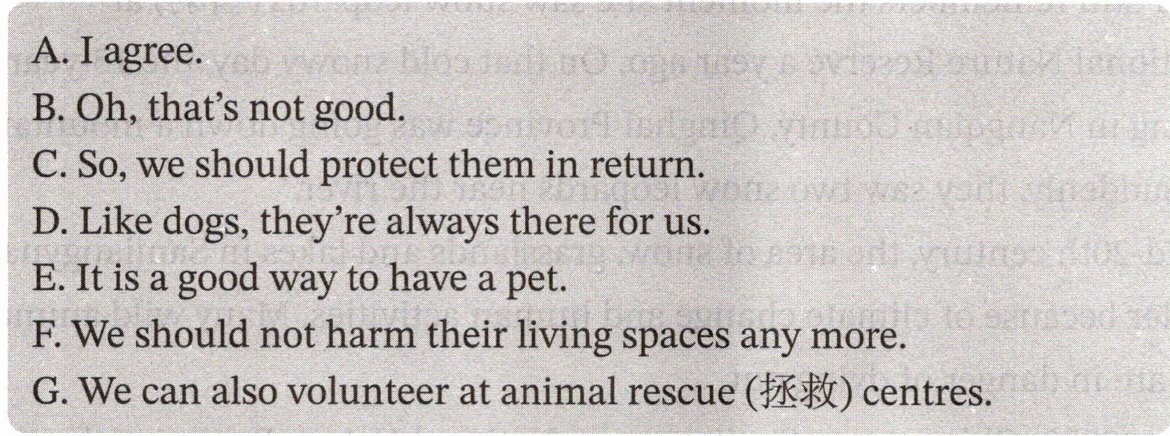
A. I agree.
B. Oh, that's not good.
C. So, we should protect them in return.
D. Like dogs, they're always there for us.
E. It is a good way to have a pet.
F. We should not harm their living spaces any more.
G. We can also volunteer at animal rescue (拯救) centres.
1. 2. 3. 4. 5.
阅读对话,从方框中选出能填入空格处的最佳选项,有两个多余选项。
Peter: I think humans and animals should be friends.
Nina:
A
1 But what can we get from animals?Peter: We get a lot from them, like milk and wool (毛).
Nina: Yeah, and in what other ways are we connected?
Peter: Well, some animals can be our pets.
D
2Nina: That's true.
Peter: They can make us feel happy.
C
3Nina: Right. Then what can we do to help wild animals?
Peter:
F
4Nina: That's smart. What else can we do?
Peter:
G
5Nina: Sounds interesting. It's also a great hands-on way to help.
A. I agree.
B. Oh, that's not good.
C. So, we should protect them in return.
D. Like dogs, they're always there for us.
E. It is a good way to have a pet.
F. We should not harm their living spaces any more.
G. We can also volunteer at animal rescue (拯救) centres.
1. 2. 3. 4. 5.
答案
1.A 2.D 3.C 4.F 5.G
解析
【分析】
本题为英语补全对话题,需结合对话上下文的逻辑关系和语境,选择符合情景的句子。对话围绕“人与动物的关系及保护动物的措施”展开,依次分析每个空格的前后内容,匹配对应选项:第1空需回应Peter的观点,第2空需承接“宠物”的话题,第3空需衔接“人类从动物获益”的内容,第4空需回答“帮助野生动物的措施”,第5空需回应“其他帮助方式”。
【解析】
1. 第1空:Peter提出“人类和动物应该是朋友”,Nina后续询问能从动物获得什么,说明Nina同意该观点,故选A(I agree.)。
2. 第2空:Peter提到“有些动物可以当我们的宠物”,D选项“Like dogs, they're always there for us.”是对宠物作用的举例,符合语境,故选D。
3. 第3空:前文说明人类从动物处获得诸多益处,此处应表达“作为回报应保护动物”,对应C选项,故选C。
4. 第4空:Nina询问帮助野生动物的方法,F选项“We should not harm their living spaces any more.”是合理的保护措施,故选F。
5. 第5空:Nina问还有什么可做的,G选项“We can also volunteer at animal rescue centres.”是具体的帮助方式,符合语境,故选G。
【答案】
1.A 2.D 3.C 4.F 5.G
【知识点】
英语补全对话、情景交际
【点评】
本题围绕人与动物的关系展开,考查学生对日常交际用语的理解与运用,需结合上下文逻辑匹配选项,难度适中。
【难度系数】
0.5
本题为英语补全对话题,需结合对话上下文的逻辑关系和语境,选择符合情景的句子。对话围绕“人与动物的关系及保护动物的措施”展开,依次分析每个空格的前后内容,匹配对应选项:第1空需回应Peter的观点,第2空需承接“宠物”的话题,第3空需衔接“人类从动物获益”的内容,第4空需回答“帮助野生动物的措施”,第5空需回应“其他帮助方式”。
【解析】
1. 第1空:Peter提出“人类和动物应该是朋友”,Nina后续询问能从动物获得什么,说明Nina同意该观点,故选A(I agree.)。
2. 第2空:Peter提到“有些动物可以当我们的宠物”,D选项“Like dogs, they're always there for us.”是对宠物作用的举例,符合语境,故选D。
3. 第3空:前文说明人类从动物处获得诸多益处,此处应表达“作为回报应保护动物”,对应C选项,故选C。
4. 第4空:Nina询问帮助野生动物的方法,F选项“We should not harm their living spaces any more.”是合理的保护措施,故选F。
5. 第5空:Nina问还有什么可做的,G选项“We can also volunteer at animal rescue centres.”是具体的帮助方式,符合语境,故选G。
【答案】
1.A 2.D 3.C 4.F 5.G
【知识点】
英语补全对话、情景交际
【点评】
本题围绕人与动物的关系展开,考查学生对日常交际用语的理解与运用,需结合上下文逻辑匹配选项,难度适中。
【难度系数】
0.5
