

 登录
登录
一、信息还原
根据短文内容,从短文后方框内所给的选项中选择可以填入空白处的最佳选项。选项中有两项为多余选项。
Travelling is one of the most wonderful ways for students to learn about the world and relax from heavy study. When we visit different places, we can not only enjoy beautiful views but also learn new knowledge and experience different cultures. Travelling helps us open our eyes and makes our life more colourful. 1
First, you can take a cultural trip. You may visit old cities with a long history, like Nanjing, Xi'an and Luoyang. These cities have seen thousands of years of Chinese history and left many great places of interest. 2 You can walk on the ancient city walls, visit historic temples and enjoy special traditional artworks. This kind of trip helps you learn much more about Chinese history and culture.
Second, you can enjoy a nature trip. You can go to mountains, national parks or quiet rivers. Away from the busy city life, you will feel relaxed and peaceful. 3 You can take beautiful photos, breathe fresh air and relax your mind and body from busy school life.
Third, try a family trip. Going out with family members is always warm and happy. It is a good break from your daily study. 4 You can share interesting stories, try delicious local food and make sweet and happy memories together.
5 No matter what kind of trip you take, you will learn new things, have great fun and see the real beauty of the world around you.
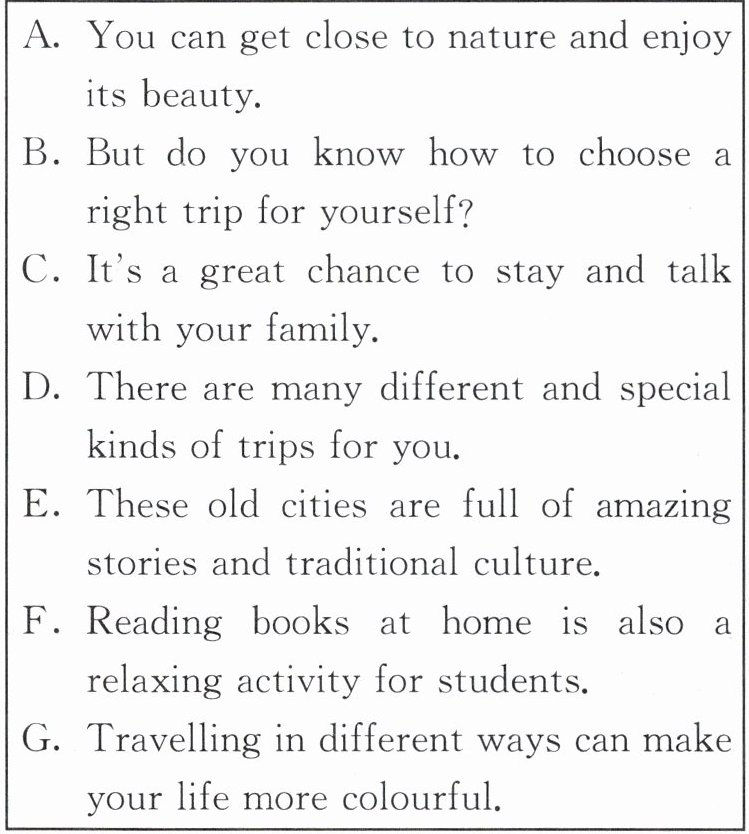
1. 2. 3.
4. 5.
根据短文内容,从短文后方框内所给的选项中选择可以填入空白处的最佳选项。选项中有两项为多余选项。
Travelling is one of the most wonderful ways for students to learn about the world and relax from heavy study. When we visit different places, we can not only enjoy beautiful views but also learn new knowledge and experience different cultures. Travelling helps us open our eyes and makes our life more colourful. 1
First, you can take a cultural trip. You may visit old cities with a long history, like Nanjing, Xi'an and Luoyang. These cities have seen thousands of years of Chinese history and left many great places of interest. 2 You can walk on the ancient city walls, visit historic temples and enjoy special traditional artworks. This kind of trip helps you learn much more about Chinese history and culture.
Second, you can enjoy a nature trip. You can go to mountains, national parks or quiet rivers. Away from the busy city life, you will feel relaxed and peaceful. 3 You can take beautiful photos, breathe fresh air and relax your mind and body from busy school life.
Third, try a family trip. Going out with family members is always warm and happy. It is a good break from your daily study. 4 You can share interesting stories, try delicious local food and make sweet and happy memories together.
5 No matter what kind of trip you take, you will learn new things, have great fun and see the real beauty of the world around you.
1. 2. 3.
4. 5.
答案
1.B 2.E 3.A 4.C 5.D
解析
1. 前文提到旅行让生活多彩,后文开始介绍不同类型的旅行,此处应引出选择合适旅行的话题,故选B;2. 前文提到古老城市,后文介绍在古城的活动,此处应承接古城的文化相关内容,故选E;3. 本段讲自然旅行,后文提到拍照等亲近自然的活动,此处应对应自然旅行的特点,故选A;4. 本段讲家庭旅行,后文提到和家人分享等内容,此处应对应家庭旅行的意义,故选C;5. 前文介绍了三种旅行类型,后文总结无论哪种旅行都有好处,此处应总述有多种旅行可选,故选D。
二、词汇运用
1. I find it is (mean) to support charities. A lot of people can get help.
2. The book (translate) into four languages last year.
3. By (train) local doctors and nurses, we hope to help more people.
4. —Can you afford (travel) abroad?
—No. It costs too much.
5. —Do you know the (interview) on TV?
—Of course. He is very famous.
三、完形填空
Boris, a foreign student at the Communication University of China, often shows his experiences of Chinese 1 on his vlog (视频博客). In one video, 2, Boris showed how he had learned the Chinese word dongxi. He translated each part 3 into “east west”. And he introduced one reason why dongxi came to mean “things”. He told people that all marketplaces in 4 Chinese cities were set up along a single 5 that ran from east to west. So when you would say “qu mai dongxi”, you’d be saying, “I’m going to buy things.” Some other 6 show him reading Chinese poems and performing Kung fu, which are quite welcome among his 40,000 7.
Like many foreigners, Boris once 8 that all Chinese people could perform Kung fu, fly onto roofs and walk over walls. Besides, he thought the country was not that 9. But after he went to study in China in 2019, his view changed. “China is developing 10, but many people’s impressions of China still stay in the 1970s,” Boris said. “That’s why I started to shoot vlogs to 11 Chinese culture in 2019.”
Boris has posted many vlogs online. But making vlogs is not 12. Take reading Saying Goodbye to Cambridge Again by Xu Zhimo as an example. “I can understand and read every word in it,” Boris said. “But to touch readers, I need to use proper feelings while I’m reading.” So he looked for a lot of 13 information to make his feelings suit each part of the 14.
Boris said that he wanted to continue reducing the differences 15 the two cultures and would spare no effort to do his part.
()1. A. food B. scenery C. culture D. painting
()2. A. in fact B. of course C. for example D. as a result
()3. A. separately B. correctly C. completely D. successfully
()4. A. modern B. ancient C. well—known D. small
()5. A. road B. building C. bridge D. river
()6. A. videos B. books C. interviews D. pictures
()7. A. sisters B. fans C. classmates D. tourists
()8. A. noticed B. wondered C. believed D. expected
()9. A. poor B. developed C. weak D. beautiful
()10. A. quickly B. slowly C. hardly D. directly
()11. A. enjoy B. share C. remember D. improve
()12. A. easy B. difficult C. expensive D. exciting
()13. A. science B. background C. medicine D. tradition
()14. A. opera B. song C. poem D. article
()15. A. from B. during C. between D. beside
1. I find it is (mean) to support charities. A lot of people can get help.
2. The book (translate) into four languages last year.
3. By (train) local doctors and nurses, we hope to help more people.
4. —Can you afford (travel) abroad?
—No. It costs too much.
5. —Do you know the (interview) on TV?
—Of course. He is very famous.
三、完形填空
Boris, a foreign student at the Communication University of China, often shows his experiences of Chinese 1 on his vlog (视频博客). In one video, 2, Boris showed how he had learned the Chinese word dongxi. He translated each part 3 into “east west”. And he introduced one reason why dongxi came to mean “things”. He told people that all marketplaces in 4 Chinese cities were set up along a single 5 that ran from east to west. So when you would say “qu mai dongxi”, you’d be saying, “I’m going to buy things.” Some other 6 show him reading Chinese poems and performing Kung fu, which are quite welcome among his 40,000 7.
Like many foreigners, Boris once 8 that all Chinese people could perform Kung fu, fly onto roofs and walk over walls. Besides, he thought the country was not that 9. But after he went to study in China in 2019, his view changed. “China is developing 10, but many people’s impressions of China still stay in the 1970s,” Boris said. “That’s why I started to shoot vlogs to 11 Chinese culture in 2019.”
Boris has posted many vlogs online. But making vlogs is not 12. Take reading Saying Goodbye to Cambridge Again by Xu Zhimo as an example. “I can understand and read every word in it,” Boris said. “But to touch readers, I need to use proper feelings while I’m reading.” So he looked for a lot of 13 information to make his feelings suit each part of the 14.
Boris said that he wanted to continue reducing the differences 15 the two cultures and would spare no effort to do his part.
()1. A. food B. scenery C. culture D. painting
()2. A. in fact B. of course C. for example D. as a result
()3. A. separately B. correctly C. completely D. successfully
()4. A. modern B. ancient C. well—known D. small
()5. A. road B. building C. bridge D. river
()6. A. videos B. books C. interviews D. pictures
()7. A. sisters B. fans C. classmates D. tourists
()8. A. noticed B. wondered C. believed D. expected
()9. A. poor B. developed C. weak D. beautiful
()10. A. quickly B. slowly C. hardly D. directly
()11. A. enjoy B. share C. remember D. improve
()12. A. easy B. difficult C. expensive D. exciting
()13. A. science B. background C. medicine D. tradition
()14. A. opera B. song C. poem D. article
()15. A. from B. during C. between D. beside
答案
词汇运用:1. meaningful;2. was translated;3. training;4. to travel;5. interviewer
完形填空:1.C;2.C;3.A;4.B;5.A;6.A;7.B;8.C;9.A;10.A;11.B;12.A;13.B;14.C;15.C
完形填空:1.C;2.C;3.A;4.B;5.A;6.A;7.B;8.C;9.A;10.A;11.B;12.A;13.B;14.C;15.C
解析
词汇运用:
1. 此处需形容词作表语,mean的形容词meaningful表示“有意义的”,符合“it is + adj + to do sth”结构,故填meaningful。
2. 主语the book与translate是被动关系,时间状语last year表过去,故用一般过去时的被动语态was translated。
3. by是介词,后接动名词,故填training。
4. afford to do sth是固定搭配,意为“负担得起做某事”,故填to travel。
5. 此处指“采访者”,interview的名词interviewer,结合后面的he可知填interviewer。
完形填空:
1. 考查名词,根据语境,Boris分享的是中国文化的经历,选C。
2. 考查短语,此处举例说明,for example符合,选C。
3. 考查副词,separately表示“分开地”,指把“东”“西”分开翻译,选A。
4. 考查形容词,根据“市场沿东西走向设置”,是古代城市的情况,选B。
5. 考查名词,市场沿路设置,选A。
6. 考查名词,前文提到vlog,此处指其他视频,选A。
7. 考查名词,视频受粉丝欢迎,选B。
8. 考查动词,此处指曾经相信的错误观念,选C。
9. 考查形容词,指觉得中国不那么落后,选A。
10. 考查副词,中国发展快,选A。
11. 考查动词,拍摄视频是为了分享中国文化,选B。
12. 考查形容词,制作视频不容易,选A。
13. 考查名词,需要找背景信息来匹配情感,选B。
14. 考查名词,前文提到读诗,选C。
15. 考查介词,两者之间的差异,between符合,选C。
1. 此处需形容词作表语,mean的形容词meaningful表示“有意义的”,符合“it is + adj + to do sth”结构,故填meaningful。
2. 主语the book与translate是被动关系,时间状语last year表过去,故用一般过去时的被动语态was translated。
3. by是介词,后接动名词,故填training。
4. afford to do sth是固定搭配,意为“负担得起做某事”,故填to travel。
5. 此处指“采访者”,interview的名词interviewer,结合后面的he可知填interviewer。
完形填空:
1. 考查名词,根据语境,Boris分享的是中国文化的经历,选C。
2. 考查短语,此处举例说明,for example符合,选C。
3. 考查副词,separately表示“分开地”,指把“东”“西”分开翻译,选A。
4. 考查形容词,根据“市场沿东西走向设置”,是古代城市的情况,选B。
5. 考查名词,市场沿路设置,选A。
6. 考查名词,前文提到vlog,此处指其他视频,选A。
7. 考查名词,视频受粉丝欢迎,选B。
8. 考查动词,此处指曾经相信的错误观念,选C。
9. 考查形容词,指觉得中国不那么落后,选A。
10. 考查副词,中国发展快,选A。
11. 考查动词,拍摄视频是为了分享中国文化,选B。
12. 考查形容词,制作视频不容易,选A。
13. 考查名词,需要找背景信息来匹配情感,选B。
14. 考查名词,前文提到读诗,选C。
15. 考查介词,两者之间的差异,between符合,选C。
