

 登录
登录
三、任务型阅读
阅读下面短文,并根据所读内容在文章后的表格里填入最恰当的单词,每个空格只填一个单词。
Seal carving, or zhuanke in Chinese, is a traditional form of art that started in China and later spread across East Asia. It means cutting a design into the bottom face of the seal (印章). A seal can be made of all kinds of materials such as stone, wood, or metal. Traditionally, seals were used to mark official documents and personal possessions (财产).
To begin seal carving, a design is first drawn onto the surface of the seal. The design can be anything from a symbol to a word or phrase. Then, by using a carving tool, the design is carefully etched (蚀刻) into the surface of the seal. This requires a lot of skills and patience.
After the carving is complete, ink is applied (涂) to the surface of the seal. The ink is then pressed onto paper, leaving an impression (压痕) of the design which is a unique symbol of the individual (个人) or organization that owns the seal.
Seal carving has been a popular art form in China for over three thousand years. It is still practised today and is appreciated for its beauty and unique culture. Many people learn seal carving as a hobby.
Overall, seal carving is an important part of Chinese culture and history. It is a fascinating art form that requires both skills and creativity. For those interested in Chinese culture or art, seal carving is really worth exploring.
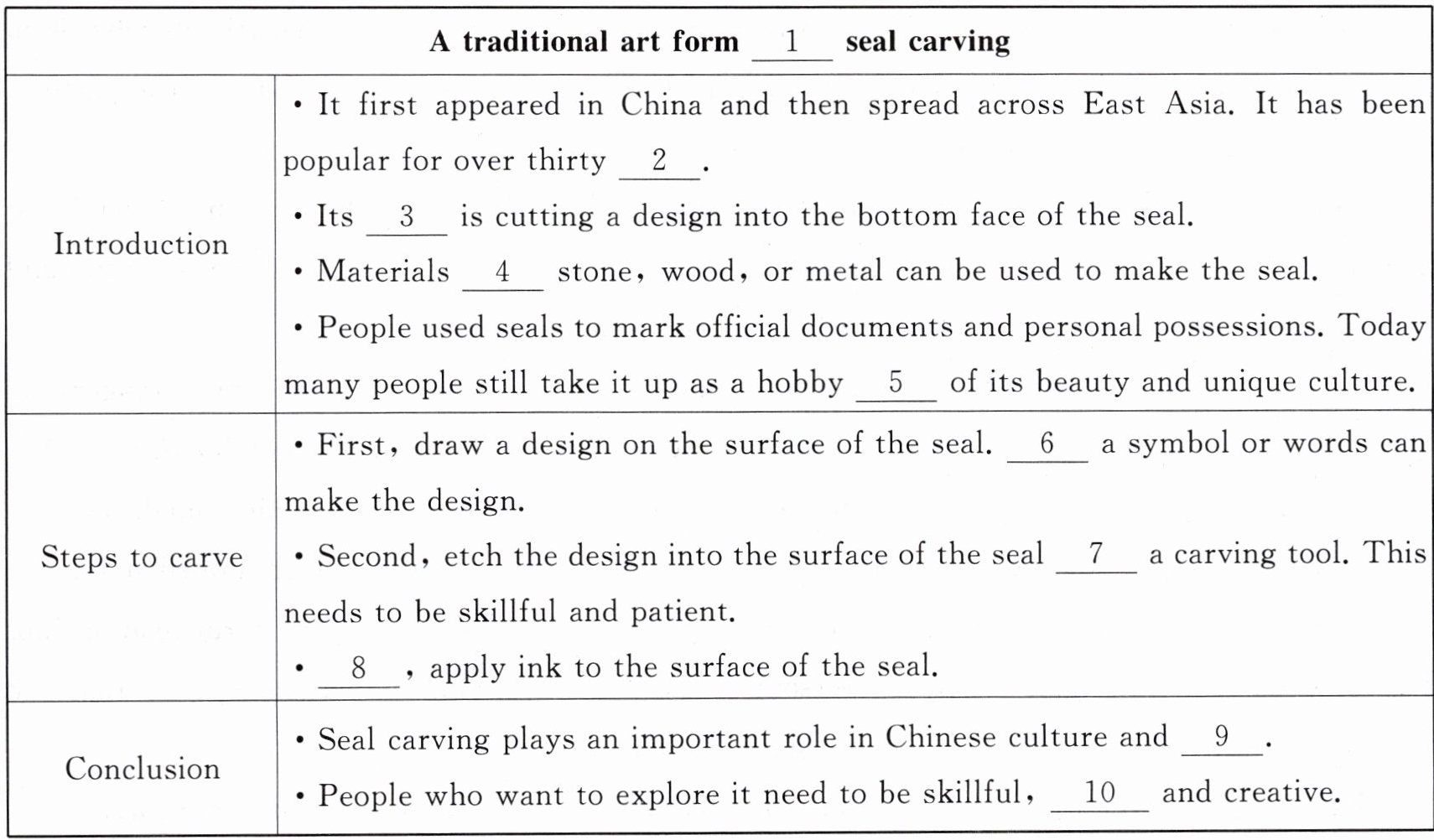
• Its 3 is cutting a design into the bottom face of the seal.
• Materials 4 stone, wood, or metal can be used to make the seal.
• Second, etch the design into the surface of the seal 7 a carving tool. This needs to be skillful and patient.
1.
2.
3.
4.
5.
6.
7.
8.
9.
10.
阅读下面短文,并根据所读内容在文章后的表格里填入最恰当的单词,每个空格只填一个单词。
Seal carving, or zhuanke in Chinese, is a traditional form of art that started in China and later spread across East Asia. It means cutting a design into the bottom face of the seal (印章). A seal can be made of all kinds of materials such as stone, wood, or metal. Traditionally, seals were used to mark official documents and personal possessions (财产).
To begin seal carving, a design is first drawn onto the surface of the seal. The design can be anything from a symbol to a word or phrase. Then, by using a carving tool, the design is carefully etched (蚀刻) into the surface of the seal. This requires a lot of skills and patience.
After the carving is complete, ink is applied (涂) to the surface of the seal. The ink is then pressed onto paper, leaving an impression (压痕) of the design which is a unique symbol of the individual (个人) or organization that owns the seal.
Seal carving has been a popular art form in China for over three thousand years. It is still practised today and is appreciated for its beauty and unique culture. Many people learn seal carving as a hobby.
Overall, seal carving is an important part of Chinese culture and history. It is a fascinating art form that requires both skills and creativity. For those interested in Chinese culture or art, seal carving is really worth exploring.
• Its 3 is cutting a design into the bottom face of the seal.
• Materials 4 stone, wood, or metal can be used to make the seal.
• Second, etch the design into the surface of the seal 7 a carving tool. This needs to be skillful and patient.
1.
2.
3.
4.
5.
6.
7.
8.
9.
10.
答案
【文章大意】本文是一篇说明文,主要介绍了篆刻这一传统艺术形式,详细阐述了篆刻的含义、制作材料、传统用途,然后详细介绍了雕刻步骤,最后强调它在中国文化和历史中的重要地位以及探索这门艺术所需的特质,旨在让读者全面了解篆刻这一传统艺术。
1. named/called 2. centuries 3. meaning 4. like/including 5. because 6. Either 7. with/using 8. Third/Finally 9. history 10. patient/interested
1. named/called 2. centuries 3. meaning 4. like/including 5. because 6. Either 7. with/using 8. Third/Finally 9. history 10. patient/interested
解析
【分析】
解题时,首先要通读全文,明确文章主旨是介绍中国传统艺术——篆刻的定义、材料、制作步骤、历史文化价值等内容。然后根据表格的结构框架,逐个定位原文对应信息:
1. 对于涉及名称的空格,从原文“Seal carving, or zhuanke in Chinese”中提取同义表达;
2. 涉及时间的空格,将原文“over three thousand years”转换为对应的可数名词形式;
3. 定义类空格,直接提取原文中解释含义的名词形式;
4. 材料列举类空格,替换原文的“such as”为同义的介词;
5. 逻辑关系类空格,根据上下文因果或选择逻辑确定连接词;
6. 步骤类空格,依据原文的顺序词(To begin...Then...)确定后续步骤的标志词;
7. 工具使用类空格,转换原文的“by using”为同义介词或动词;
8. 最后结合文章末尾的总结内容,提取描述篆刻特质或适合人群的形容词。全程要注意每个空格仅填一个单词,确保词性、形式符合要求。
【解析】
1. 根据第一段“Seal carving, or zhuanke in Chinese”,可知篆刻也被称为“zhuanke”,此处需填表示“被叫做”的词,故填named/called。
2. 由第四段“Seal carving has been a popular art form in China for over three thousand years”,“over three thousand years”等同于“many centuries”,故填centuries。
3. 第一段“It means cutting a design into the bottom face of the seal”,此处需要表示“含义”的名词,故填meaning。
4. 第一段“A seal can be made of all kinds of materials such as stone, wood, or metal”,“such as”的同义词为like/including,故填like/including。
5. 结合上下文逻辑,表格此处是说明篆刻受欢迎的原因,需填因果连词,故填because。
6. 第二段“The design can be anything from a symbol to a word or phrase”,“from...to”对应的选择结构为“Either...or”,故填Either。
7. 第二段“by using a carving tool”,表示“用工具”可用介词with或动词using,故填with/using。
8. 原文制作步骤依次为To begin...Then...After the carving is complete...,此处对应后续步骤的标志词,故填Third/Finally。
9. 最后一段“Overall, seal carving is an important part of Chinese culture and history”,此处对应“历史”相关内容,故填history。
10. 根据最后一段“It requires both skills and creativity”或“For those interested in Chinese culture or art”,可提取描述相关特质或人群的形容词,故填patient/interested。
【答案】
1. named/called
2. centuries
3. meaning
4. like/including
5. because
6. Either
7. with/using
8. Third/Finally
9. history
10. patient/interested
【知识点】
任务型信息匹配、同义词转换、说明文细节提取
【点评】
本文围绕中国传统艺术篆刻展开,任务型阅读既考查学生对说明文细节信息的定位与提取能力,又考查同义词转换、逻辑推理等语言运用能力,同时渗透了中国传统文化常识,有助于学生在提升语言能力的同时了解传统艺术。
【难度系数】
0.6
解题时,首先要通读全文,明确文章主旨是介绍中国传统艺术——篆刻的定义、材料、制作步骤、历史文化价值等内容。然后根据表格的结构框架,逐个定位原文对应信息:
1. 对于涉及名称的空格,从原文“Seal carving, or zhuanke in Chinese”中提取同义表达;
2. 涉及时间的空格,将原文“over three thousand years”转换为对应的可数名词形式;
3. 定义类空格,直接提取原文中解释含义的名词形式;
4. 材料列举类空格,替换原文的“such as”为同义的介词;
5. 逻辑关系类空格,根据上下文因果或选择逻辑确定连接词;
6. 步骤类空格,依据原文的顺序词(To begin...Then...)确定后续步骤的标志词;
7. 工具使用类空格,转换原文的“by using”为同义介词或动词;
8. 最后结合文章末尾的总结内容,提取描述篆刻特质或适合人群的形容词。全程要注意每个空格仅填一个单词,确保词性、形式符合要求。
【解析】
1. 根据第一段“Seal carving, or zhuanke in Chinese”,可知篆刻也被称为“zhuanke”,此处需填表示“被叫做”的词,故填named/called。
2. 由第四段“Seal carving has been a popular art form in China for over three thousand years”,“over three thousand years”等同于“many centuries”,故填centuries。
3. 第一段“It means cutting a design into the bottom face of the seal”,此处需要表示“含义”的名词,故填meaning。
4. 第一段“A seal can be made of all kinds of materials such as stone, wood, or metal”,“such as”的同义词为like/including,故填like/including。
5. 结合上下文逻辑,表格此处是说明篆刻受欢迎的原因,需填因果连词,故填because。
6. 第二段“The design can be anything from a symbol to a word or phrase”,“from...to”对应的选择结构为“Either...or”,故填Either。
7. 第二段“by using a carving tool”,表示“用工具”可用介词with或动词using,故填with/using。
8. 原文制作步骤依次为To begin...Then...After the carving is complete...,此处对应后续步骤的标志词,故填Third/Finally。
9. 最后一段“Overall, seal carving is an important part of Chinese culture and history”,此处对应“历史”相关内容,故填history。
10. 根据最后一段“It requires both skills and creativity”或“For those interested in Chinese culture or art”,可提取描述相关特质或人群的形容词,故填patient/interested。
【答案】
1. named/called
2. centuries
3. meaning
4. like/including
5. because
6. Either
7. with/using
8. Third/Finally
9. history
10. patient/interested
【知识点】
任务型信息匹配、同义词转换、说明文细节提取
【点评】
本文围绕中国传统艺术篆刻展开,任务型阅读既考查学生对说明文细节信息的定位与提取能力,又考查同义词转换、逻辑推理等语言运用能力,同时渗透了中国传统文化常识,有助于学生在提升语言能力的同时了解传统艺术。
【难度系数】
0.6
