

 登录
Did you notice how nature sometimes repeats itself? Something that repeats is called a pattern. There are many patterns for you to study and learn.
Look around you. Patterns are everywhere. You may see bright and colorful patterns if you look at fish in the sea. In a bee's honeycomb, the six-sided shape is repeated many times. Some leaves always have five points on them.
Listening carefully, you will find a noisy world. Dogs bark, the rain falls and the wind blows. Are these patterns? Of course! Sounds that repeat are patterns. A cricket (蟋蟀) uses its wings to make repeated chirping (啁啾叫) sounds. Do you know that a cricket's chirp changes with the temperature? The hotter it is, the more chirps a cricket will make.
Try to find out how living things grow around you. Seeds (种子) grow into plants. A butterfly begins life as an egg. Each living thing has its own pattern as it grows. When a human baby is born, it is small. With time, the baby
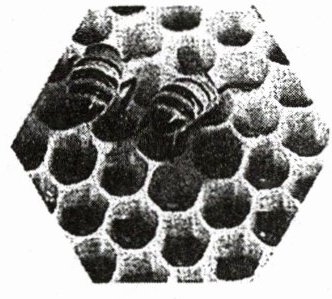
a honeycomb
learns to lift its head and learns to roll over. Finally, the baby learns to stand up and walk. This kind of pattern is called a pattern of development.
If something happens over and over,it , too, forms a pattern. For example, you get up at 7:00 every morning. You get dressed and then eat breakfast at 7:30 a. m. If you repeat this many times, it becomes a pattern. Having a music class every Monday is a pattern. So is going to school five days a week and having Saturday and Sunday off.
It seems as if the world is full of patterns. Just think — without patterns, the world would be much harder to study!
根据材料内容选择最佳答案。
31. What makes the pattern in a bee's honeycomb?
A. The shape.
B. The color.
C. The taste.
D. The weight.
32. What is Paragraph 3 mainly about?
A. Patterns you can see.
B. Patterns you can hear.
C. Patterns you can smell.
D. Patterns you can touch.
33. Which picture shows "a pattern of development"?

A B C D
34. What does the underlined word "it" in Paragraph 5 refer to?
A. Getting up at 7:00 every morning.
B. Eating breakfast at 7:30 a. m.
C. Something happening over and over.
D. Going to school five days a week.
35. What is the writer's purpose in writing the text?
A. To share knowledge of patterns.
B. To discuss when patterns were found.
C. To explain why patterns are beautiful.
D. To show the difficulty of studying patterns.
D
Look around you. Patterns are everywhere. You may see bright and colorful patterns if you look at fish in the sea. In a bee's honeycomb, the six-sided shape is repeated many times. Some leaves always have five points on them.
Listening carefully, you will find a noisy world. Dogs bark, the rain falls and the wind blows. Are these patterns? Of course! Sounds that repeat are patterns. A cricket (蟋蟀) uses its wings to make repeated chirping (啁啾叫) sounds. Do you know that a cricket's chirp changes with the temperature? The hotter it is, the more chirps a cricket will make.
Try to find out how living things grow around you. Seeds (种子) grow into plants. A butterfly begins life as an egg. Each living thing has its own pattern as it grows. When a human baby is born, it is small. With time, the baby
a honeycomb
learns to lift its head and learns to roll over. Finally, the baby learns to stand up and walk. This kind of pattern is called a pattern of development.
If something happens over and over,
It seems as if the world is full of patterns. Just think — without patterns, the world would be much harder to study!
根据材料内容选择最佳答案。
31. What makes the pattern in a bee's honeycomb?
A. The shape.
B. The color.
C. The taste.
D. The weight.
32. What is Paragraph 3 mainly about?
A. Patterns you can see.
B. Patterns you can hear.
C. Patterns you can smell.
D. Patterns you can touch.
33. Which picture shows "a pattern of development"?
A B C D
34. What does the underlined word "it" in Paragraph 5 refer to?
A. Getting up at 7:00 every morning.
B. Eating breakfast at 7:30 a. m.
C. Something happening over and over.
D. Going to school five days a week.
35. What is the writer's purpose in writing the text?
A. To share knowledge of patterns.
B. To discuss when patterns were found.
C. To explain why patterns are beautiful.
D. To show the difficulty of studying patterns.
D
答案
31. A 32. B 33. D 34. C 35. A
