

 登录
登录
B
In the morning, we went camping along a path in Green Natural Park. We were happy because it was a sunny day. 6.
However, in the afternoon, when we finished our picnic at one o'clock, it was dark and windy. Soon, there was a heavy
rain. 7.
Twenty minutes passed and it was still raining. There were hours to go before we got to the camp. It was even worse that our small compass(指南针) showed that we went the wrong way. 8.
We had to make a quick decision as it was raining heavily. Chris said we could put up a tent to hide in, so Mary and Tom helped to put up the tent. 9.
At about five o'clock, it stopped raining. We decided to stop the camping trip because all of us were very tired.
This camping trip may not be wonderful, but we know each other better. 10.
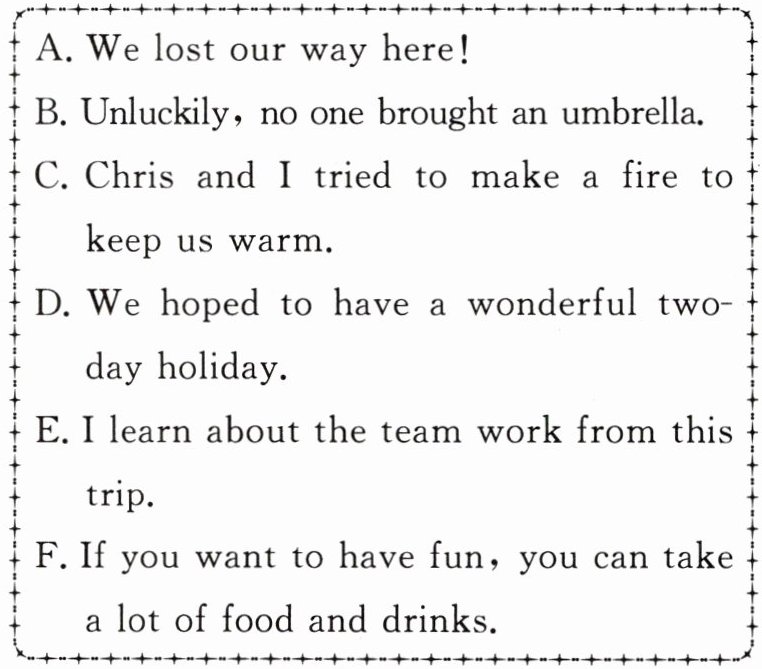
In the morning, we went camping along a path in Green Natural Park. We were happy because it was a sunny day. 6.
D
On the way, we kept singing and making jokes.However, in the afternoon, when we finished our picnic at one o'clock, it was dark and windy. Soon, there was a heavy
rain. 7.
B
We ran around but we could find no place to hide.Twenty minutes passed and it was still raining. There were hours to go before we got to the camp. It was even worse that our small compass(指南针) showed that we went the wrong way. 8.
A
We had to make a quick decision as it was raining heavily. Chris said we could put up a tent to hide in, so Mary and Tom helped to put up the tent. 9.
C
But we weren't able to make a fire, as everything was wet. We dried ourselves, chatted and waited inside the tent.At about five o'clock, it stopped raining. We decided to stop the camping trip because all of us were very tired.
This camping trip may not be wonderful, but we know each other better. 10.
E
It is the most important thing!答案
6.D 7.B 8.A 9.C 10.E
解析
【分析】
本题为英语完形填空题,需结合上下文语境逻辑匹配合适句子完成短文。解题时先通读全文把握露营旅行的整体脉络,再逐个分析每个空缺处前后的语境,选择符合逻辑的选项:第6空对应旅行前的期待,第7空对应下雨后的状况,第8空对应迷路的情况,第9空对应尝试生火的行为,第10空对应旅行的收获。
【解析】
1. 第6空:前文提到晴天很开心,后文说路上唱歌开玩笑,D项“We hoped to have a wonderful two-day holiday”(我们希望有个愉快的两天假期)符合旅行前的期待语境,故选D。
2. 第7空:前文说下大雨,后文提到没地方躲,B项“Unluckily, no one brought an umbrella”(不幸的是,没人带伞)符合下雨没伞的状况,故选B。
3. 第8空:前文说指南针显示走错路,A项“We lost our way here!”(我们在这里迷路了)对应走错路的情况,故选A。
4. 第9空:后文说不能生火,C项“Chris and I tried to make a fire to keep us warm”(克里斯和我尝试生火取暖)提到尝试生火,与后文转折呼应,故选C。
5. 第10空:前文说互相更了解,E项“I learn about the team work from this trip”(我从这次旅行中学到了团队合作)对应旅行的重要收获,故选E。
【答案】6.D 7.B 8.A 9.C 10.E
【知识点】英语完形填空、上下文语境理解
【点评】本题围绕露营旅行展开,考查学生对语篇逻辑和语境的理解能力,需结合前后文内容匹配句子,难度适中。
【难度系数】0.4
本题为英语完形填空题,需结合上下文语境逻辑匹配合适句子完成短文。解题时先通读全文把握露营旅行的整体脉络,再逐个分析每个空缺处前后的语境,选择符合逻辑的选项:第6空对应旅行前的期待,第7空对应下雨后的状况,第8空对应迷路的情况,第9空对应尝试生火的行为,第10空对应旅行的收获。
【解析】
1. 第6空:前文提到晴天很开心,后文说路上唱歌开玩笑,D项“We hoped to have a wonderful two-day holiday”(我们希望有个愉快的两天假期)符合旅行前的期待语境,故选D。
2. 第7空:前文说下大雨,后文提到没地方躲,B项“Unluckily, no one brought an umbrella”(不幸的是,没人带伞)符合下雨没伞的状况,故选B。
3. 第8空:前文说指南针显示走错路,A项“We lost our way here!”(我们在这里迷路了)对应走错路的情况,故选A。
4. 第9空:后文说不能生火,C项“Chris and I tried to make a fire to keep us warm”(克里斯和我尝试生火取暖)提到尝试生火,与后文转折呼应,故选C。
5. 第10空:前文说互相更了解,E项“I learn about the team work from this trip”(我从这次旅行中学到了团队合作)对应旅行的重要收获,故选E。
【答案】6.D 7.B 8.A 9.C 10.E
【知识点】英语完形填空、上下文语境理解
【点评】本题围绕露营旅行展开,考查学生对语篇逻辑和语境的理解能力,需结合前后文内容匹配句子,难度适中。
【难度系数】0.4
C
visit, arrive, leave, do, feed, talk, take,
appear, play, sleep, have
For the whole year, I waited for the summer holidays to start all the time, because I
would 11.
In the evening when we were discussing what 13.
The place was not far. The bus ride only 15.
My cousins and I 18.
D
visit, arrive, leave, do, feed, talk, take,
appear, play, sleep, have
For the whole year, I waited for the summer holidays to start all the time, because I
would 11.
have
a good time in my uncle's family in India. Finally I 12. arrived
there on the first day of June by plane.In the evening when we were discussing what 13.
to do
the next day, my uncle advised us 14. to visit
an elephant sanctuary(保护区). We were very happy to see elephants.The place was not far. The bus ride only 15.
took
half an hour. My uncle said it used to be a great palace(宫殿). Before I got in, I was afraid that the elephants might stamp(踩) on me, but soon I got relaxed. I saw a cute baby elephant 16. playing
balls there. Then more elephants came over. Some elephants were taking a shower while others 17. were sleeping
under the trees. The guide told us that there were 49 elephants. They liked palm leaves(棕榈叶). Each ate about three bundles(捆) of palm leaves at a time.My cousins and I 18.
fed
the elephants and took lots of photos of them. Soon we had to 19. leave
. On our way home, we kept 20. talking
about the visit happily. Later that night I dreamed of playing with elephants. It was truly an unusual journey in my life.D
答案
11. have
12. arrived
13. to do
14. to visit
15. took
16. playing
17. were sleeping
18. fed
19. leave
20. talking
12. arrived
13. to do
14. to visit
15. took
16. playing
17. were sleeping
18. fed
19. leave
20. talking
解析
【分析】
本题为英语动词形式填空题,解题思路为:首先通读全文,理解文章讲述的“我”暑假去印度叔叔家的经历;然后针对每个空格,结合语法结构(如时态、固定搭配、非谓语形式)和上下文语境,选择括号内动词的正确形式。例如:第11题根据固定搭配及would的用法确定形式,第12题根据过去时间确定时态,以此类推,逐步推导每个空格的答案。
【解析】
11. 固定搭配“have a good time”意为“玩得开心”,would后接动词原形,故填have;
12. 描述过去(6月1日)的动作,用一般过去时,“到达那里”对应arrive的过去式arrived,故填arrived;
13. “疑问词what+不定式to do”作discuss的宾语,意为“讨论第二天要做什么”,故填to do;
14. 固定搭配“advise sb to do sth”意为“建议某人做某事”,故填to visit;
15. 表示“花费时间”,描述过去动作,用take的过去式took,故填took;
16. 固定搭配“see sb doing sth”意为“看到某人正在做某事”,此处指看到小象正在玩球,故填playing;
17. while连接并列的过去进行时动作,前半句为“were taking a shower”,后半句对应“were sleeping”,故填were sleeping;
18. 描述过去的动作,“喂大象”对应feed的过去式fed,故填fed;
19. 固定搭配“have to do sth”意为“不得不做某事”,后接动词原形,故填leave;
20. 固定搭配“keep doing sth”意为“一直做某事”,此处指一直谈论,故填talking。
【答案】
11. have
12. arrived
13. to do
14. to visit
15. took
16. playing
17. were sleeping
18. fed
19. leave
20. talking
【知识点】
动词固定搭配、一般过去时、非谓语动词
【点评】
本题以记叙文为载体,考查动词的形式运用,涵盖固定搭配、时态、非谓语等基础知识点,需结合语境和语法规则分析,是初中英语常见题型,难度适中。
【难度系数】
0.5
本题为英语动词形式填空题,解题思路为:首先通读全文,理解文章讲述的“我”暑假去印度叔叔家的经历;然后针对每个空格,结合语法结构(如时态、固定搭配、非谓语形式)和上下文语境,选择括号内动词的正确形式。例如:第11题根据固定搭配及would的用法确定形式,第12题根据过去时间确定时态,以此类推,逐步推导每个空格的答案。
【解析】
11. 固定搭配“have a good time”意为“玩得开心”,would后接动词原形,故填have;
12. 描述过去(6月1日)的动作,用一般过去时,“到达那里”对应arrive的过去式arrived,故填arrived;
13. “疑问词what+不定式to do”作discuss的宾语,意为“讨论第二天要做什么”,故填to do;
14. 固定搭配“advise sb to do sth”意为“建议某人做某事”,故填to visit;
15. 表示“花费时间”,描述过去动作,用take的过去式took,故填took;
16. 固定搭配“see sb doing sth”意为“看到某人正在做某事”,此处指看到小象正在玩球,故填playing;
17. while连接并列的过去进行时动作,前半句为“were taking a shower”,后半句对应“were sleeping”,故填were sleeping;
18. 描述过去的动作,“喂大象”对应feed的过去式fed,故填fed;
19. 固定搭配“have to do sth”意为“不得不做某事”,后接动词原形,故填leave;
20. 固定搭配“keep doing sth”意为“一直做某事”,此处指一直谈论,故填talking。
【答案】
11. have
12. arrived
13. to do
14. to visit
15. took
16. playing
17. were sleeping
18. fed
19. leave
20. talking
【知识点】
动词固定搭配、一般过去时、非谓语动词
【点评】
本题以记叙文为载体,考查动词的形式运用,涵盖固定搭配、时态、非谓语等基础知识点,需结合语境和语法规则分析,是初中英语常见题型,难度适中。
【难度系数】
0.5
