

 登录
登录
一、将下列句子中汉语部分译成英语,注意使用适当的形式。
1. Your friend always your pet carefully.(照顾)
2. The birds are now because they do not have enough living space.(处于危险之中)
3. If people trees, wild animals will have nowhere to live.(砍伐)
4. Animals tell their feelings to by acts and sounds just as we do by words.(互相)
5. If we don't buy clothes fur, people will not kill animals.(由……制成的)
1. Your friend always your pet carefully.(照顾)
2. The birds are now because they do not have enough living space.(处于危险之中)
3. If people trees, wild animals will have nowhere to live.(砍伐)
4. Animals tell their feelings to by acts and sounds just as we do by words.(互相)
5. If we don't buy clothes fur, people will not kill animals.(由……制成的)
答案
1. looks after / takes care of
2. in danger
3. cut down
4. each other / one another
5. made of
2. in danger
3. cut down
4. each other / one another
5. made of
解析
1. 表示“照顾”可用固定短语look after / take care of,句中always表示经常性、习惯性动作,时态用一般现在时,主语Your friend是第三人称单数,谓语动词要变为对应的第三人称单数形式。
2. 表示“处于危险之中”是七年级核心固定搭配in danger,可直接填入。
3. 表示“砍伐”可用固定短语cut down,本句是if引导的条件状语从句,遵循“主将从现”规则,主语people为复数,从句谓语使用动词原形即可。
4. 表示“互相”的常用短语是each other / one another,在句中作介词to的宾语,符合句子表意。
5. 表示“由……制成的”(可直接看出原材料)用made of,此处过去分词短语作后置定语,修饰名词clothes。
2. 表示“处于危险之中”是七年级核心固定搭配in danger,可直接填入。
3. 表示“砍伐”可用固定短语cut down,本句是if引导的条件状语从句,遵循“主将从现”规则,主语people为复数,从句谓语使用动词原形即可。
4. 表示“互相”的常用短语是each other / one another,在句中作介词to的宾语,符合句子表意。
5. 表示“由……制成的”(可直接看出原材料)用made of,此处过去分词短语作后置定语,修饰名词clothes。
二、阅读理解。
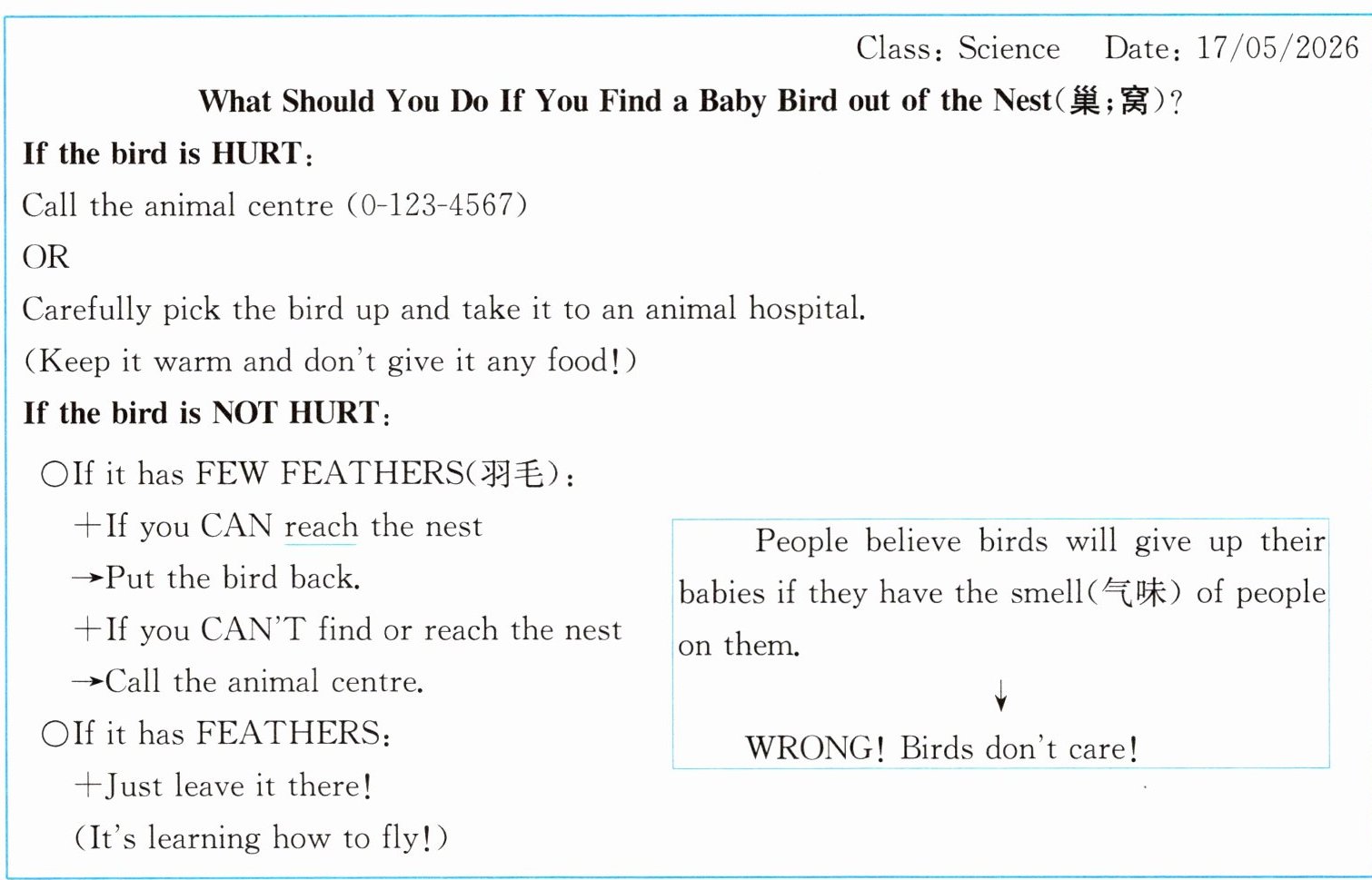
Class: Science Date: 17/05/2026
What Should You Do If You Find a Baby Bird out of the Nest(巢;窝)?
If the bird is HURT:
Call the animal centre (0-123-4567)
OR
Carefully pick the bird up and take it to an animal hospital.
(Keep it warm and don't give it any food!)
If the bird is NOT HURT:
○If it has FEW FEATHERS(羽毛):
+If you CAN reach the nest
→Put the bird back.
+If you CAN'T find or reach the nest
→Call the animal centre.
○If it has FEATHERS:
+Just leave it there!
(It's learning how to fly!)
People believe birds will give up their babies if they have the smell(气味) of people on them.
↓
WRONG! Birds don't care!
1. What should you do if you find a baby bird hurt? ()
A. Just leave it there. B. Put it back to its nest.
C. Call the animal centre. D. Feed it with healthy food.
2. Why should you do nothing about an unhurt baby bird with feathers? ()
A. Because you might hurt it. B. Because it is learning to fly.
C. Because it is afraid of people. D. Because its mum will find it soon.
3. Which of the following is TRUE about mother birds? ()
A. They don't care about their babies at all.
B. They push their babies out of their nest.
C. They mind the smell of people on their babies.
D. They don't care the smell of people on babies.
4. What does the underlined word “reach” mean in Chinese? ()
A. 够着 B. 实现 C. 整理 D. 进入
5. Where do you most probably find this passage? ()
A. In a nature book. B. In a scientist's diary.
C. In a guide book. D. In a student's notebook.
Class: Science Date: 17/05/2026
What Should You Do If You Find a Baby Bird out of the Nest(巢;窝)?
If the bird is HURT:
Call the animal centre (0-123-4567)
OR
Carefully pick the bird up and take it to an animal hospital.
(Keep it warm and don't give it any food!)
If the bird is NOT HURT:
○If it has FEW FEATHERS(羽毛):
+If you CAN reach the nest
→Put the bird back.
+If you CAN'T find or reach the nest
→Call the animal centre.
○If it has FEATHERS:
+Just leave it there!
(It's learning how to fly!)
People believe birds will give up their babies if they have the smell(气味) of people on them.
↓
WRONG! Birds don't care!
1. What should you do if you find a baby bird hurt? ()
A. Just leave it there. B. Put it back to its nest.
C. Call the animal centre. D. Feed it with healthy food.
2. Why should you do nothing about an unhurt baby bird with feathers? ()
A. Because you might hurt it. B. Because it is learning to fly.
C. Because it is afraid of people. D. Because its mum will find it soon.
3. Which of the following is TRUE about mother birds? ()
A. They don't care about their babies at all.
B. They push their babies out of their nest.
C. They mind the smell of people on their babies.
D. They don't care the smell of people on babies.
4. What does the underlined word “reach” mean in Chinese? ()
A. 够着 B. 实现 C. 整理 D. 进入
5. Where do you most probably find this passage? ()
A. In a nature book. B. In a scientist's diary.
C. In a guide book. D. In a student's notebook.
答案
1.C 2.B 3.D 4.A 5.A
解析
1. 细节理解题。根据原文"If the bird is HURT"部分的说明,受伤的幼鸟可以拨打动物中心电话,也可以小心带去动物医院,同时明确要求不要给幼鸟喂食。A选项是未受伤、长有羽毛的幼鸟的处理方式,B选项不符合受伤幼鸟的处理要求,D选项和原文"don't give it any food"的要求矛盾,因此选C。
2. 细节理解题。根据原文"If the bird is NOT HURT"部分中"If it has FEATHERS"的内容:"Just leave it there! (It's learning how to fly!)",可知这类没有受伤、长了羽毛的幼鸟正在学习飞行,所以不需要人为干预,对应B选项。
3. 细节理解题。根据原文右侧的标注内容,人们过去误以为鸟类会因为幼鸟身上沾了人类的气味就抛弃幼鸟,实际上明确标注了"WRONG! Birds don't care!",说明母鸟并不在意人类留在幼鸟身上的气味,D选项表述正确。A选项“母鸟完全不在意自己的幼鸟”不符合原文逻辑,B选项文中没有提到母鸟会把幼鸟推出鸟巢,C选项是错误的旧认知,因此选D。
4. 词义猜测题。划线词reach所在句子的语境是:如果你能够到鸟巢,就可以把幼鸟放回巢里,因此reach在这里的中文含义是“够着”,选A。
5. 推理判断题。本文是科普遇到掉出鸟巢的幼鸟的正确处理方式的自然相关知识,最有可能出现在自然类书籍中。B选项科学家日记、C选项通用指南手册、D选项学生笔记本都不符合这篇科普内容的载体特征,因此选A。
2. 细节理解题。根据原文"If the bird is NOT HURT"部分中"If it has FEATHERS"的内容:"Just leave it there! (It's learning how to fly!)",可知这类没有受伤、长了羽毛的幼鸟正在学习飞行,所以不需要人为干预,对应B选项。
3. 细节理解题。根据原文右侧的标注内容,人们过去误以为鸟类会因为幼鸟身上沾了人类的气味就抛弃幼鸟,实际上明确标注了"WRONG! Birds don't care!",说明母鸟并不在意人类留在幼鸟身上的气味,D选项表述正确。A选项“母鸟完全不在意自己的幼鸟”不符合原文逻辑,B选项文中没有提到母鸟会把幼鸟推出鸟巢,C选项是错误的旧认知,因此选D。
4. 词义猜测题。划线词reach所在句子的语境是:如果你能够到鸟巢,就可以把幼鸟放回巢里,因此reach在这里的中文含义是“够着”,选A。
5. 推理判断题。本文是科普遇到掉出鸟巢的幼鸟的正确处理方式的自然相关知识,最有可能出现在自然类书籍中。B选项科学家日记、C选项通用指南手册、D选项学生笔记本都不符合这篇科普内容的载体特征,因此选A。
