

 登录
登录
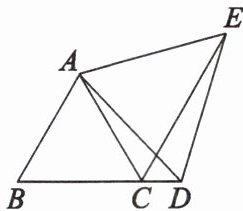
7. 如图,已知$△ ABC$为等边三角形,$D$为$BC$延长线上的一点,$CE$平分$∠ ACD$,$CE=BD$. 求证$△ ADE$为等边三角形.
答案
7. $\because\ \ △ ABC$为等边三角形,
$\therefore\ \ AB=AC,∠ B=∠ ACB=∠ BAC=60°.$
$\therefore\ \ ∠ ACD=180°-∠ ACB=180°-60°=120°.$
$\because\ \ CE$平分$∠ ACD,$
$\therefore\ \ ∠ ACE=\frac{1}{2}∠ ACD=\frac{1}{2}×120°=60°.$
$\therefore\ \ ∠ B=∠ ACE.$
在$△ ABD$和$△ ACE$中,
$\begin{cases}AB=AC,\\∠ B=∠ ACE,\\BD=CE,\end{cases}$
$\therefore\ \ △ ABD≌△ ACE.$
$\therefore\ \ AD=AE,∠ BAD=∠ CAE.$
$\therefore\ \ ∠ BAD-∠ CAD=∠ CAE-∠ CAD,$
即$∠ BAC=∠ DAE.$
$\because\ \ ∠ BAC=60°,$
$\therefore\ \ ∠ DAE=60°.$
又$AD=AE,$
$\therefore\ \ △ ADE$为等边三角形.
$\therefore\ \ AB=AC,∠ B=∠ ACB=∠ BAC=60°.$
$\therefore\ \ ∠ ACD=180°-∠ ACB=180°-60°=120°.$
$\because\ \ CE$平分$∠ ACD,$
$\therefore\ \ ∠ ACE=\frac{1}{2}∠ ACD=\frac{1}{2}×120°=60°.$
$\therefore\ \ ∠ B=∠ ACE.$
在$△ ABD$和$△ ACE$中,
$\begin{cases}AB=AC,\\∠ B=∠ ACE,\\BD=CE,\end{cases}$
$\therefore\ \ △ ABD≌△ ACE.$
$\therefore\ \ AD=AE,∠ BAD=∠ CAE.$
$\therefore\ \ ∠ BAD-∠ CAD=∠ CAE-∠ CAD,$
即$∠ BAC=∠ DAE.$
$\because\ \ ∠ BAC=60°,$
$\therefore\ \ ∠ DAE=60°.$
又$AD=AE,$
$\therefore\ \ △ ADE$为等边三角形.
解析
【分析】
要证明△ADE为等边三角形,可通过“有一个角为60°的等腰三角形是等边三角形”这一判定定理推导。首先从已知等边△ABC入手,可得AB=AC、∠B=∠ACB=60°,进而算出外角∠ACD=120°;再结合CE平分∠ACD,可推出∠ACE=60°,即∠B=∠ACE;此时已知BD=CE,即可通过SAS判定△ABD≌△ACE,得到AD=AE以及∠BAD=∠CAE,通过角的等量代换可证∠DAE=∠BAC=60°,即可判定△ADE为等边三角形。
【解析】
$\because\ \ △ ABC$为等边三角形,
$\therefore\ \ AB=AC,∠ B=∠ ACB=∠ BAC=60°.$
$\therefore\ \ ∠ ACD=180°-∠ ACB=180°-60°=120°.$
$\because\ \ CE$平分$∠ ACD,$
$\therefore\ \ ∠ ACE=\frac{1}{2}∠ ACD=\frac{1}{2}×120°=60°.$
$\therefore\ \ ∠ B=∠ ACE.$
在$△ ABD$和$△ ACE$中,
$\begin{cases}AB=AC,\\∠ B=∠ ACE,\\BD=CE,\end{cases}$
$\therefore\ \ △ ABD≌△ ACE.$
$\therefore\ \ AD=AE,∠ BAD=∠ CAE.$
$\therefore\ \ ∠ BAD-∠ CAD=∠ CAE-∠ CAD,$
即$∠ BAC=∠ DAE.$
$\because\ \ ∠ BAC=60°,$
$\therefore\ \ ∠ DAE=60°.$
又$AD=AE,$
$\therefore\ \ △ ADE$为等边三角形.
【答案】
$\boxed{△ADE}$为等边三角形
【知识点】
等边三角形的性质与判定、全等三角形SAS判定、角平分线的定义
【点评】
本题是等边三角形相关证明的典型题型,将全等三角形的判定、性质与等边三角形的判定结合考查,解题的关键是找准全等三角形,通过全等转化边和角的关系,最终结合等边三角形的判定定理得出结论。
【难度系数】
0.7
要证明△ADE为等边三角形,可通过“有一个角为60°的等腰三角形是等边三角形”这一判定定理推导。首先从已知等边△ABC入手,可得AB=AC、∠B=∠ACB=60°,进而算出外角∠ACD=120°;再结合CE平分∠ACD,可推出∠ACE=60°,即∠B=∠ACE;此时已知BD=CE,即可通过SAS判定△ABD≌△ACE,得到AD=AE以及∠BAD=∠CAE,通过角的等量代换可证∠DAE=∠BAC=60°,即可判定△ADE为等边三角形。
【解析】
$\because\ \ △ ABC$为等边三角形,
$\therefore\ \ AB=AC,∠ B=∠ ACB=∠ BAC=60°.$
$\therefore\ \ ∠ ACD=180°-∠ ACB=180°-60°=120°.$
$\because\ \ CE$平分$∠ ACD,$
$\therefore\ \ ∠ ACE=\frac{1}{2}∠ ACD=\frac{1}{2}×120°=60°.$
$\therefore\ \ ∠ B=∠ ACE.$
在$△ ABD$和$△ ACE$中,
$\begin{cases}AB=AC,\\∠ B=∠ ACE,\\BD=CE,\end{cases}$
$\therefore\ \ △ ABD≌△ ACE.$
$\therefore\ \ AD=AE,∠ BAD=∠ CAE.$
$\therefore\ \ ∠ BAD-∠ CAD=∠ CAE-∠ CAD,$
即$∠ BAC=∠ DAE.$
$\because\ \ ∠ BAC=60°,$
$\therefore\ \ ∠ DAE=60°.$
又$AD=AE,$
$\therefore\ \ △ ADE$为等边三角形.
【答案】
$\boxed{△ADE}$为等边三角形
【知识点】
等边三角形的性质与判定、全等三角形SAS判定、角平分线的定义
【点评】
本题是等边三角形相关证明的典型题型,将全等三角形的判定、性质与等边三角形的判定结合考查,解题的关键是找准全等三角形,通过全等转化边和角的关系,最终结合等边三角形的判定定理得出结论。
【难度系数】
0.7
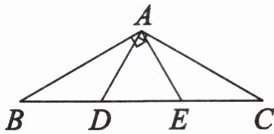
8. 如图,在△ABC中,AB=AC,∠BAC=120°。点D,E在BC上,且AD⊥AC,AE⊥AB。
(1)求证△ADE是等边三角形;
(2)若AE=2,求BC的长。
(1)求证△ADE是等边三角形;
(2)若AE=2,求BC的长。
答案
8. (1)$\because\ \ AB=AC,∠ BAC=120°,$
$\therefore\ \ ∠ B=∠ C=\frac{1}{2}×(180°-∠ BAC)=30°.$
$\because\ \ AD⊥ AC,AE⊥ AB,$
$\therefore\ \ ∠ DAC=∠ EAB=90°.$
$\therefore\ \ ∠ BEA=90°-30°=60°,∠ CDA=90°-30°=60°,$
即$∠ AED=∠ ADE=60°.$
$\therefore\ \ AD=AE.$
$\therefore\ \ △ ADE$是等边三角形.
(2)$\because\ \ △ ADE$是等边三角形,
$\therefore\ \ AD=DE=AE=2.$
$\because\ \ ∠ AED=∠ ADE=60°,∠ B=∠ C=30°,$
$\therefore\ \ ∠ BAD=∠ ADE-∠ B=60°-30°=30°,∠ CAE=∠ AED-∠ C=60°-30°=30°.$
$\therefore\ \ ∠ BAD=∠ B,∠ CAE=∠ C.$
$\therefore\ \ AD=BD=2,AE=CE=2.$
$\therefore\ \ BC=BD+DE+CE=2+2+2=6.$
答:$BC$的长为$6.$
$\therefore\ \ ∠ B=∠ C=\frac{1}{2}×(180°-∠ BAC)=30°.$
$\because\ \ AD⊥ AC,AE⊥ AB,$
$\therefore\ \ ∠ DAC=∠ EAB=90°.$
$\therefore\ \ ∠ BEA=90°-30°=60°,∠ CDA=90°-30°=60°,$
即$∠ AED=∠ ADE=60°.$
$\therefore\ \ AD=AE.$
$\therefore\ \ △ ADE$是等边三角形.
(2)$\because\ \ △ ADE$是等边三角形,
$\therefore\ \ AD=DE=AE=2.$
$\because\ \ ∠ AED=∠ ADE=60°,∠ B=∠ C=30°,$
$\therefore\ \ ∠ BAD=∠ ADE-∠ B=60°-30°=30°,∠ CAE=∠ AED-∠ C=60°-30°=30°.$
$\therefore\ \ ∠ BAD=∠ B,∠ CAE=∠ C.$
$\therefore\ \ AD=BD=2,AE=CE=2.$
$\therefore\ \ BC=BD+DE+CE=2+2+2=6.$
答:$BC$的长为$6.$
解析
【分析】
(1)要证明△ADE是等边三角形,首先利用等腰△ABC的顶角为120°求出底角∠B、∠C的度数,再结合AD⊥AC、AE⊥AB的垂直条件,计算△ADE的两个内角∠ADE、∠AED的度数,若两个角均为60°,即可判定△ADE为等边三角形;
(2)求BC的长度时,先利用等边三角形的性质得到DE的长度,再通过角度推导得到∠BAD=∠B、∠CAE=∠C,利用等角对等边得到BD、CE的长度,最后将BD、DE、CE三段相加即可得到BC的总长。
【解析】
(1) 证明:
$\because\ \ AB=AC,∠ BAC=120°,$
$\therefore\ \ ∠ B=∠ C=\frac{1}{2}×(180°-∠ BAC)=30°.$
$\because\ \ AD⊥ AC,AE⊥ AB,$
$\therefore\ \ ∠ DAC=∠ EAB=90°.$
$\therefore\ \ ∠ BEA=90°-∠B=90°-30°=60°,∠ CDA=90°-∠C=90°-30°=60°,$
即$∠ AED=∠ ADE=60°.$
$\therefore\ \ AD=AE.$
$\therefore\ \ △ ADE$是等边三角形.
(2) 解:
$\because\ \ △ ADE$是等边三角形,$AE=2$,
$\therefore\ \ AD=DE=AE=2.$
$\because\ \ ∠ AED=∠ ADE=60°,∠ B=∠ C=30°,$
$\therefore\ \ ∠ BAD=∠ ADE-∠ B=60°-30°=30°,∠ CAE=∠ AED-∠ C=60°-30°=30°.$
$\therefore\ \ ∠ BAD=∠ B,∠ CAE=∠ C.$
$\therefore\ \ AD=BD=2,AE=CE=2.$
$\therefore\ \ BC=BD+DE+CE=2+2+2=6.$
【答案】
(1) 已证△ADE是等边三角形;
(2) 6
【知识点】
1. 等腰三角形的性质
2. 等边三角形的判定与性质
3. 直角三角形两锐角互余
【点评】
本题属于特殊三角形的基础综合题,解题的关键是先通过等腰三角形性质推导得到30°底角,再结合垂直条件梳理角度关系,进而得到边的等量关系,能有效考查学生对特殊三角形性质、判定的掌握程度。
【难度系数】
0.7
(1)要证明△ADE是等边三角形,首先利用等腰△ABC的顶角为120°求出底角∠B、∠C的度数,再结合AD⊥AC、AE⊥AB的垂直条件,计算△ADE的两个内角∠ADE、∠AED的度数,若两个角均为60°,即可判定△ADE为等边三角形;
(2)求BC的长度时,先利用等边三角形的性质得到DE的长度,再通过角度推导得到∠BAD=∠B、∠CAE=∠C,利用等角对等边得到BD、CE的长度,最后将BD、DE、CE三段相加即可得到BC的总长。
【解析】
(1) 证明:
$\because\ \ AB=AC,∠ BAC=120°,$
$\therefore\ \ ∠ B=∠ C=\frac{1}{2}×(180°-∠ BAC)=30°.$
$\because\ \ AD⊥ AC,AE⊥ AB,$
$\therefore\ \ ∠ DAC=∠ EAB=90°.$
$\therefore\ \ ∠ BEA=90°-∠B=90°-30°=60°,∠ CDA=90°-∠C=90°-30°=60°,$
即$∠ AED=∠ ADE=60°.$
$\therefore\ \ AD=AE.$
$\therefore\ \ △ ADE$是等边三角形.
(2) 解:
$\because\ \ △ ADE$是等边三角形,$AE=2$,
$\therefore\ \ AD=DE=AE=2.$
$\because\ \ ∠ AED=∠ ADE=60°,∠ B=∠ C=30°,$
$\therefore\ \ ∠ BAD=∠ ADE-∠ B=60°-30°=30°,∠ CAE=∠ AED-∠ C=60°-30°=30°.$
$\therefore\ \ ∠ BAD=∠ B,∠ CAE=∠ C.$
$\therefore\ \ AD=BD=2,AE=CE=2.$
$\therefore\ \ BC=BD+DE+CE=2+2+2=6.$
【答案】
(1) 已证△ADE是等边三角形;
(2) 6
【知识点】
1. 等腰三角形的性质
2. 等边三角形的判定与性质
3. 直角三角形两锐角互余
【点评】
本题属于特殊三角形的基础综合题,解题的关键是先通过等腰三角形性质推导得到30°底角,再结合垂直条件梳理角度关系,进而得到边的等量关系,能有效考查学生对特殊三角形性质、判定的掌握程度。
【难度系数】
0.7
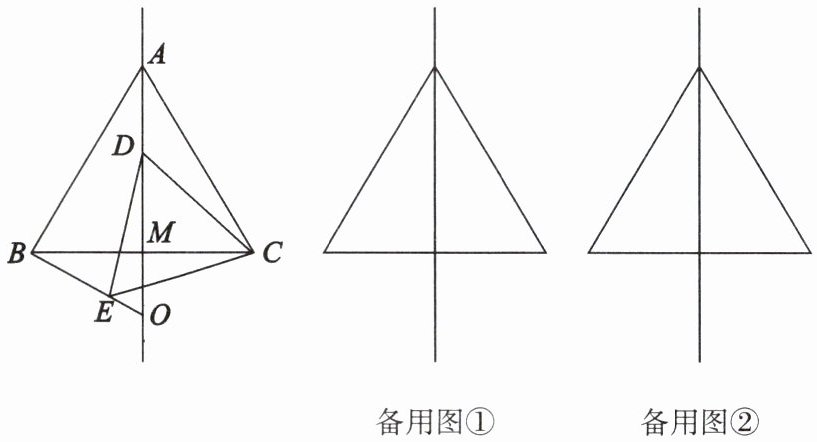
9. 如图,在等边三角形ABC中,线段AM为BC边上的中线.动点D在直线AM上时,以CD为一边在CD的下方作等边三角形CDE,连接BE,设直线BE与直线AM的交点为O.
(1)填空:∠CAM=
(2)如图,若点D在线段AM上:
①求证△ACD≌△BCE;
②求∠AOB的度数.
(3)当动点D在线段AM的延长线和线段MA的延长线上时,∠AOB的度数与(2)相比,有没有变化?为什么?
备用图①
备用图②
(1)填空:∠CAM=
30
°.(2)如图,若点D在线段AM上:
①求证△ACD≌△BCE;
②求∠AOB的度数.
(3)当动点D在线段AM的延长线和线段MA的延长线上时,∠AOB的度数与(2)相比,有没有变化?为什么?
备用图①
备用图②
答案
9. (1)30
(2) ①$\because\ \ △ ABC$和$△ CDE$均是等边三角形,
$\therefore\ \ AC=BC,CD=CE,∠ ACB=∠ DCE=60°.$
$\therefore\ \ ∠ ACB-∠ DCB=∠ DCE-∠ DCB,$
即$∠ ACD=∠ BCE.$
在$△ ACD$和$△ BCE$中,
$\begin{cases}AC=BC,\\∠ ACD=∠ BCE,\\CD=CE,\end{cases}$
$\therefore\ \ △ ACD≌△ BCE.$
②$\because\ \ △ ACD≌△ BCE,$
$\therefore\ \ ∠ CAD=∠ CBE=30°.$
$\because\ \ △ ABC$是等边三角形,线段$AM$为边$BC$上的中线,
$\therefore\ \ ∠ ABC=∠ BAC=60°,AM$平分$∠ BAC.$
$\therefore\ \ ∠ BAO=\frac{1}{2}∠ BAC=30°.$
$\therefore\ \ ∠ ABE=∠ ABC+∠ CBE=60°+30°=90°.$
$\therefore\ \ ∠ AOB=90°-∠ BAO=90°-30°=60°.$
(3)没有变化,仍为$60°$. 理由略.
(2) ①$\because\ \ △ ABC$和$△ CDE$均是等边三角形,
$\therefore\ \ AC=BC,CD=CE,∠ ACB=∠ DCE=60°.$
$\therefore\ \ ∠ ACB-∠ DCB=∠ DCE-∠ DCB,$
即$∠ ACD=∠ BCE.$
在$△ ACD$和$△ BCE$中,
$\begin{cases}AC=BC,\\∠ ACD=∠ BCE,\\CD=CE,\end{cases}$
$\therefore\ \ △ ACD≌△ BCE.$
②$\because\ \ △ ACD≌△ BCE,$
$\therefore\ \ ∠ CAD=∠ CBE=30°.$
$\because\ \ △ ABC$是等边三角形,线段$AM$为边$BC$上的中线,
$\therefore\ \ ∠ ABC=∠ BAC=60°,AM$平分$∠ BAC.$
$\therefore\ \ ∠ BAO=\frac{1}{2}∠ BAC=30°.$
$\therefore\ \ ∠ ABE=∠ ABC+∠ CBE=60°+30°=90°.$
$\therefore\ \ ∠ AOB=90°-∠ BAO=90°-30°=60°.$
(3)没有变化,仍为$60°$. 理由略.
解析
【分析】
(1) 等边三角形每个内角为60°,且中线、角平分线、高线三线合一,AM是BC边上的中线,因此AM也是∠BAC的角平分线,平分60°的顶角即可得到∠CAM的度数。
(2) ①要证△ACD≌△BCE,先根据等边三角形性质得到两组对应边相等,再通过两个60°的角同时减去公共角得到一组对应夹角相等,用SAS即可判定全等。②由全等得对应角∠CBE=∠CAD=30°,结合等边三角形中线的性质得到∠BAO=30°、∠ABC=60°,再利用三角形内角和即可求出∠AOB的度数。
(3) 动点D在直线AM其他位置时,仍可通过等边三角形的性质推导得到△ACD≌△BCE,对应角相等的关系不变,沿用(2)的角度推导逻辑即可判断∠AOB的度数是否变化。
【解析】
(1)
∵△ABC是等边三角形,
∴∠BAC=60°,
∵AM是BC边上的中线,
∴AM平分∠BAC,
∴$∠ CAM=\frac{1}{2}∠ BAC=30°$。
(2) ①证明:
∵$△ ABC$和$△ CDE$均是等边三角形,
$\therefore\ \ AC=BC,CD=CE,∠ ACB=∠ DCE=60°$,
$\therefore\ \ ∠ ACB-∠ DCB=∠ DCE-∠ DCB$,即$∠ ACD=∠ BCE$,
在$△ ACD$和$△ BCE$中,
$\begin{cases}AC=BC,\\∠ ACD=∠ BCE,\\CD=CE,\end{cases}$
$\therefore\ \ △ ACD≌△ BCE$(SAS)。
②解:$\because\ \ △ ACD≌△ BCE$,$\therefore\ \ ∠ CAD=∠ CBE=30°$,
$\because\ \ △ ABC$是等边三角形,线段$AM$为边$BC$上的中线,
$\therefore\ \ ∠ ABC=∠ BAC=60°,AM$平分$∠ BAC$,
$\therefore\ \ ∠ BAO=\frac{1}{2}∠ BAC=30°$,
$\therefore\ \ ∠ ABE=∠ ABC+∠ CBE=60°+30°=90°$,
$\therefore\ \ ∠ AOB=180°-∠ BAO-∠ ABE=180°-30°-90°=60°$。
(3) 没有变化,仍为$60°$。理由:当D在线段AM的延长线或MA的延长线上时,同理可证$△ ACD≌△ BCE$,可得$∠ CBE=∠ CAD=30°$,结合$∠ BAO=30°$,利用三角形内角和仍可推出$∠ AOB=60°$。
【答案】
(1) $\boxed{30}$
(2) ①证明见解析;②$\boxed{∠ AOB=60°}$
(3) 没有变化,仍为$\boxed{60°}$
【知识点】
等边三角形的性质;全等三角形的判定与性质;三线合一
【点评】
本题重点考查等边三角形与全等三角形的综合应用,解题的核心是抓住等边三角形边、角相等的特征推导全等条件,动点问题中核心的全等关系不随点的位置改变,掌握该规律即可快速解题。
【难度系数】
0.7
(1) 等边三角形每个内角为60°,且中线、角平分线、高线三线合一,AM是BC边上的中线,因此AM也是∠BAC的角平分线,平分60°的顶角即可得到∠CAM的度数。
(2) ①要证△ACD≌△BCE,先根据等边三角形性质得到两组对应边相等,再通过两个60°的角同时减去公共角得到一组对应夹角相等,用SAS即可判定全等。②由全等得对应角∠CBE=∠CAD=30°,结合等边三角形中线的性质得到∠BAO=30°、∠ABC=60°,再利用三角形内角和即可求出∠AOB的度数。
(3) 动点D在直线AM其他位置时,仍可通过等边三角形的性质推导得到△ACD≌△BCE,对应角相等的关系不变,沿用(2)的角度推导逻辑即可判断∠AOB的度数是否变化。
【解析】
(1)
∵△ABC是等边三角形,
∴∠BAC=60°,
∵AM是BC边上的中线,
∴AM平分∠BAC,
∴$∠ CAM=\frac{1}{2}∠ BAC=30°$。
(2) ①证明:
∵$△ ABC$和$△ CDE$均是等边三角形,
$\therefore\ \ AC=BC,CD=CE,∠ ACB=∠ DCE=60°$,
$\therefore\ \ ∠ ACB-∠ DCB=∠ DCE-∠ DCB$,即$∠ ACD=∠ BCE$,
在$△ ACD$和$△ BCE$中,
$\begin{cases}AC=BC,\\∠ ACD=∠ BCE,\\CD=CE,\end{cases}$
$\therefore\ \ △ ACD≌△ BCE$(SAS)。
②解:$\because\ \ △ ACD≌△ BCE$,$\therefore\ \ ∠ CAD=∠ CBE=30°$,
$\because\ \ △ ABC$是等边三角形,线段$AM$为边$BC$上的中线,
$\therefore\ \ ∠ ABC=∠ BAC=60°,AM$平分$∠ BAC$,
$\therefore\ \ ∠ BAO=\frac{1}{2}∠ BAC=30°$,
$\therefore\ \ ∠ ABE=∠ ABC+∠ CBE=60°+30°=90°$,
$\therefore\ \ ∠ AOB=180°-∠ BAO-∠ ABE=180°-30°-90°=60°$。
(3) 没有变化,仍为$60°$。理由:当D在线段AM的延长线或MA的延长线上时,同理可证$△ ACD≌△ BCE$,可得$∠ CBE=∠ CAD=30°$,结合$∠ BAO=30°$,利用三角形内角和仍可推出$∠ AOB=60°$。
【答案】
(1) $\boxed{30}$
(2) ①证明见解析;②$\boxed{∠ AOB=60°}$
(3) 没有变化,仍为$\boxed{60°}$
【知识点】
等边三角形的性质;全等三角形的判定与性质;三线合一
【点评】
本题重点考查等边三角形与全等三角形的综合应用,解题的核心是抓住等边三角形边、角相等的特征推导全等条件,动点问题中核心的全等关系不随点的位置改变,掌握该规律即可快速解题。
【难度系数】
0.7
