

 登录
登录
一、根据中文意思完成句子。
1. 月球上没有水也没有生物。
There is no water or
2. 在昆明,一年到头天气既不太热也不太冷。
In Kunming, the weather is
too hot
3. 太阳系有八大行星和其他的星星。
There are eight planets
4. 今天天气很热,气温至少有35℃。
It's too hot today. The temperature is
5. 宇宙中,有些星星是白色的,而有些星星是红色或蓝色的。
In the universe, some stars are white,
1. 月球上没有水也没有生物。
There is no water or
living
things
on the moon.2. 在昆明,一年到头天气既不太热也不太冷。
In Kunming, the weather is
neither
too hot
nor
too cold all year round.3. 太阳系有八大行星和其他的星星。
There are eight planets
as
well
as
other stars in the solar system.4. 今天天气很热,气温至少有35℃。
It's too hot today. The temperature is
at
least
35℃.5. 宇宙中,有些星星是白色的,而有些星星是红色或蓝色的。
In the universe, some stars are white,
while
some stars are red or blue.答案
1. living things 2. neither; nor
3. as well as 4. at least 5. while
3. as well as 4. at least 5. while
解析
【分析】
逐题梳理解题思路:1. 中文“生物”对应英语常用名词短语living things,与句中water并列,符合句子结构;2. “既不…也不…”需用固定并列连词结构neither…nor…,连接两个并列形容词;3. 表示“和、还有”且连接名词时,用常用短语as well as,契合“八大行星和其他星星”的语义;4. “至少”对应固定短语at least,用于修饰气温;5. 前后分句为对比关系,用连词while表“而”,符合语境。
【解析】
1. 考查名词短语:“生物”的标准英语表达为living things,与water并列,故填living things;
2. 考查并列连词:“既不…也不…”的固定搭配为neither…nor…,连接hot和cold两个并列形容词,故填neither; nor;
3. 考查短语:表“和、以及”的短语as well as,用于连接并列名词,符合句子语义,故填as well as;
4. 考查固定短语:“至少”对应的英语短语是at least,修饰气温,故填at least;
5. 考查连词:前后分句为对比关系,用while表“而”,故填while。
【答案】
1. living things 2. neither; nor 3. as well as 4. at least 5. while
【知识点】
固定短语搭配、并列连词用法、名词短语用法
【点评】
本题为初中英语基础填空题,核心考查常用固定短语、并列连词及名词短语的运用,属于必背基础考点,学生只要牢记相关知识点即可轻松解答,难度较低。
【难度系数】
0.7
逐题梳理解题思路:1. 中文“生物”对应英语常用名词短语living things,与句中water并列,符合句子结构;2. “既不…也不…”需用固定并列连词结构neither…nor…,连接两个并列形容词;3. 表示“和、还有”且连接名词时,用常用短语as well as,契合“八大行星和其他星星”的语义;4. “至少”对应固定短语at least,用于修饰气温;5. 前后分句为对比关系,用连词while表“而”,符合语境。
【解析】
1. 考查名词短语:“生物”的标准英语表达为living things,与water并列,故填living things;
2. 考查并列连词:“既不…也不…”的固定搭配为neither…nor…,连接hot和cold两个并列形容词,故填neither; nor;
3. 考查短语:表“和、以及”的短语as well as,用于连接并列名词,符合句子语义,故填as well as;
4. 考查固定短语:“至少”对应的英语短语是at least,修饰气温,故填at least;
5. 考查连词:前后分句为对比关系,用while表“而”,故填while。
【答案】
1. living things 2. neither; nor 3. as well as 4. at least 5. while
【知识点】
固定短语搭配、并列连词用法、名词短语用法
【点评】
本题为初中英语基础填空题,核心考查常用固定短语、并列连词及名词短语的运用,属于必背基础考点,学生只要牢记相关知识点即可轻松解答,难度较低。
【难度系数】
0.7
Planet
Color
Temperature
Living condition for humans
Earth
blue and 1.
neither too 2.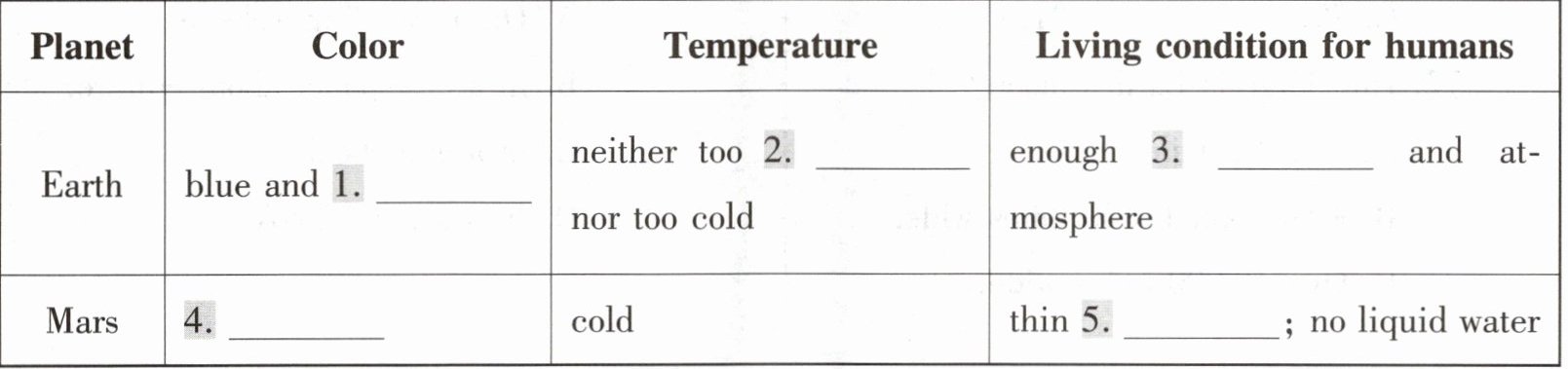
enough 3.
Mars
4.
cold
thin 5.
Color
Temperature
Living condition for humans
Earth
blue and 1.
green
neither too 2.
hot
nor too cold enough 3.
water
and atmosphereMars
4.
red
cold
thin 5.
atmosphere
;no liquid water答案
1. green 2. hot 3. water
4. red 5. atmosphere
4. red 5. atmosphere
解析
【分析】本题是关于地球和火星基本特征的填空题,需结合天文常识(行星外观、温度、生存条件)解答。解题思路:1.回忆地球颜色:地球表面海洋占比大(蓝色),陆地有大量植被(绿色),对应填green;2.地球温度适宜,既不过热也不过冷,对应填hot;3.人类生存需要充足的水和大气,对应填water;4.火星因表面富含氧化铁呈红色,对应填red;5.火星大气层稀薄,对应填atmosphere。
【解析】1.地球表面约71%为蓝色海洋,29%为带绿色植被的陆地,故颜色为blue and green;2.地球处于宜居带,温度既不太高也不太低,故填hot;3.人类生存的必要条件是足够的水和大气,故填water;4.火星表面的氧化铁使其外观呈红色,故填red;5.火星的大气层非常稀薄,故填atmosphere。
【答案】1. green 2. hot 3. water 4. red 5. atmosphere
【知识点】行星特征、天文常识、地球与火星属性
【点评】本题考查基础天文常识,结合表格对应填写即可,难度较低,掌握课本中太阳系行星的基础知识就能正确作答。
【难度系数】0.7
【解析】1.地球表面约71%为蓝色海洋,29%为带绿色植被的陆地,故颜色为blue and green;2.地球处于宜居带,温度既不太高也不太低,故填hot;3.人类生存的必要条件是足够的水和大气,故填water;4.火星表面的氧化铁使其外观呈红色,故填red;5.火星的大气层非常稀薄,故填atmosphere。
【答案】1. green 2. hot 3. water 4. red 5. atmosphere
【知识点】行星特征、天文常识、地球与火星属性
【点评】本题考查基础天文常识,结合表格对应填写即可,难度较低,掌握课本中太阳系行星的基础知识就能正确作答。
【难度系数】0.7
三、阅读理解。
Jupiter is the largest of the eight planets in our solar system. In the spring of 2017, astronomers(天文学家)were searching deep
in space for a possible ninth planet. Instead, they discovered something else: 12 new moons going around Jupiter. In 2018, Jupiter had 79 moons moving around it. That’s more than any
other planet in our solar system.
A team of American scientists discovered these moons. They used a powerful telescope so that they could see small objects billions of miles away. The largest of the new moons is only about 2 miles wide. That’s more than 1,000 times smaller than Earth’s moon. Scientists described one of the new moons as an “oddball”. That’s because it’s traveling in the opposite direction(相反的方向)of the other moons. Experts said it may crash into(撞击)another moon and break into pieces.
“This is like driving down the highway in the wrong direction,” said Scott S. Sheppard. He led the team that found the new moons.
Sheppard said that as technology gets better, we’ll learn even more about Jupiter. “There is a lot we have to discover about our world and the universe,” he said.
根据材料内容选择最佳答案。
(
A. 12.
B. 67.
C. 79.
D. 91.
(
A. About 2 miles wide.
B. More than 1,000 miles wide.
C. Over 2,000 miles wide.
D. About 3,000 miles wide.
(
A. It’s the largest of all the moons going around Jupiter.
B. It’s the farthest away from Jupiter.
C. It is traveling in the opposite direction of the other moons.
D. It will not break into pieces in the future.
(
A. There are still lots of things we need to explore about the universe.
B. We will know everything about the universe with the help of technology.
C. The scientists find Jupiter is very interesting.
D. We never know what will happen in the future.
(
A. On a traveling website.
B. In a newspaper about culture.
C. In a guidebook.
D. In a science book.
Jupiter is the largest of the eight planets in our solar system. In the spring of 2017, astronomers(天文学家)were searching deep
in space for a possible ninth planet. Instead, they discovered something else: 12 new moons going around Jupiter. In 2018, Jupiter had 79 moons moving around it. That’s more than any
other planet in our solar system.
A team of American scientists discovered these moons. They used a powerful telescope so that they could see small objects billions of miles away. The largest of the new moons is only about 2 miles wide. That’s more than 1,000 times smaller than Earth’s moon. Scientists described one of the new moons as an “oddball”. That’s because it’s traveling in the opposite direction(相反的方向)of the other moons. Experts said it may crash into(撞击)another moon and break into pieces.
“This is like driving down the highway in the wrong direction,” said Scott S. Sheppard. He led the team that found the new moons.
Sheppard said that as technology gets better, we’ll learn even more about Jupiter. “There is a lot we have to discover about our world and the universe,” he said.
根据材料内容选择最佳答案。
(
B
)1. How many moons did Jupiter have before the spring of 2017?A. 12.
B. 67.
C. 79.
D. 91.
(
C
)2. How large is Earth’s moon?A. About 2 miles wide.
B. More than 1,000 miles wide.
C. Over 2,000 miles wide.
D. About 3,000 miles wide.
(
C
)3. What can we know about “oddball”?A. It’s the largest of all the moons going around Jupiter.
B. It’s the farthest away from Jupiter.
C. It is traveling in the opposite direction of the other moons.
D. It will not break into pieces in the future.
(
A
)4. What can we learn from the last sentence of the text?A. There are still lots of things we need to explore about the universe.
B. We will know everything about the universe with the help of technology.
C. The scientists find Jupiter is very interesting.
D. We never know what will happen in the future.
(
D
)5. Where can we probably read this text?A. On a traveling website.
B. In a newspaper about culture.
C. In a guidebook.
D. In a science book.
答案
1. B 由第一段可知,2017年春天,天文学家在寻找太阳系中可能存在的第9颗行星时,发现了12颗新的卫星在围绕着木星旋转,2018年有79颗卫星在木星周围,故可知在2017年春天之前,木星有67颗卫星。
2. C 由第二段第三、第四句可知,这些新卫星中最大的宽度约2英里,是地球卫星大小的 1/1000。故可知地球的卫星宽度约是2000多英里。
3. C 由第二段倒数第二句可知,“oddball”和它附近的卫星运行方向相反。故C项符合材料的描述。
4. A 由材料最后科学家说的话可知,关于我们的世界和宇宙还有很多有待探索发现的东西。故A项表述符合语境。
5. D 本材料是关于宇宙探索的科普类短文,故可在科学类书籍中读到。
2. C 由第二段第三、第四句可知,这些新卫星中最大的宽度约2英里,是地球卫星大小的 1/1000。故可知地球的卫星宽度约是2000多英里。
3. C 由第二段倒数第二句可知,“oddball”和它附近的卫星运行方向相反。故C项符合材料的描述。
4. A 由材料最后科学家说的话可知,关于我们的世界和宇宙还有很多有待探索发现的东西。故A项表述符合语境。
5. D 本材料是关于宇宙探索的科普类短文,故可在科学类书籍中读到。
解析
【分析】
本题为天文科普类阅读理解,所有题目均为细节理解题。解题思路:先通读全文把握主旨,再针对每道题的关键词,回原文定位对应段落,仔细比对原文信息与选项内容,排除干扰项,选出最佳答案。
【解析】
1. 定位第一段:2017年春天天文学家发现12颗新卫星,2018年木星共有79颗卫星,因此2017年春天之前木星的卫星数量为79-12=67,对应选项B。
2. 定位第二段:新卫星中最大的宽度约2英里,是地球卫星大小的1/1000,因此地球卫星宽度约为2×1000=2000多英里,对应选项C。
3. 定位第二段:“oddball”被描述为运行方向与其他卫星相反,对应选项C。
4. 定位最后一句:“There is a lot we have to discover about our world and the universe”意为关于我们的世界和宇宙还有很多有待探索的内容,对应选项A。
5. 本文是关于宇宙探索的科普短文,因此最可能在科学类书籍中读到,对应选项D。
【答案】
1.B 2.C 3.C 4.A 5.D
【知识点】
英语阅读理解、细节理解题、科普类阅读
【点评】
本题为天文科普类阅读理解,侧重考查学生定位原文细节信息的能力,题目难度不大,只要仔细查找原文对应内容即可正确解答。
【难度系数】
0.8
本题为天文科普类阅读理解,所有题目均为细节理解题。解题思路:先通读全文把握主旨,再针对每道题的关键词,回原文定位对应段落,仔细比对原文信息与选项内容,排除干扰项,选出最佳答案。
【解析】
1. 定位第一段:2017年春天天文学家发现12颗新卫星,2018年木星共有79颗卫星,因此2017年春天之前木星的卫星数量为79-12=67,对应选项B。
2. 定位第二段:新卫星中最大的宽度约2英里,是地球卫星大小的1/1000,因此地球卫星宽度约为2×1000=2000多英里,对应选项C。
3. 定位第二段:“oddball”被描述为运行方向与其他卫星相反,对应选项C。
4. 定位最后一句:“There is a lot we have to discover about our world and the universe”意为关于我们的世界和宇宙还有很多有待探索的内容,对应选项A。
5. 本文是关于宇宙探索的科普短文,因此最可能在科学类书籍中读到,对应选项D。
【答案】
1.B 2.C 3.C 4.A 5.D
【知识点】
英语阅读理解、细节理解题、科普类阅读
【点评】
本题为天文科普类阅读理解,侧重考查学生定位原文细节信息的能力,题目难度不大,只要仔细查找原文对应内容即可正确解答。
【难度系数】
0.8
