

 登录
登录
1. 如图1-2-9,在 $ △ A B C $中,D,E分别是AC,AB上的点,BD与CE交于点O,给出下列三个条件: $ \textcircled{1} ∠1=∠2 $ $ \textcircled{2} ∠3=∠4 $ $ \textcircled{3} BE=CD。 $
(1) 上述三个条件中,哪两个条件可判定 $ △ ABC $是等腰三角形?(用序号写出所有情形)
(2) 选择(1)中的一种情形,证明 $ △ ABC $是等腰三角形。
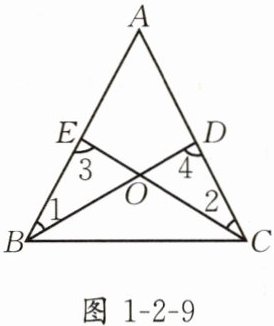
(1) 上述三个条件中,哪两个条件可判定 $ △ ABC $是等腰三角形?(用序号写出所有情形)
(2) 选择(1)中的一种情形,证明 $ △ ABC $是等腰三角形。
答案
1. (1)解:由①③和②③都可以判定$△ ABC$是等腰三角形。
(2)选择①③。
证明:在$△ BOE$和$△ COD$中,
$\because ∠ 1=∠ 2$,$∠ BOE=∠ COD$,$BE=CD$,
$\therefore △ BOE≌△ COD(\mathrm{AAS})$。
$\therefore BO=CO$。$\therefore ∠ OBC=∠ OCB$。
$\therefore ∠ 1+∠ OBC=∠ 2+∠ OCB$,
即$∠ ABC=∠ ACB$。
$\therefore AB=AC$,即$△ ABC$是等腰三角形。
选择②③。
证明:在$△ BOE$和$△ COD$中,
$\because ∠ 3=∠ 4$,$∠ BOE=∠ COD$,$BE=CD$,
$\therefore △ BOE≌△ COD(\mathrm{AAS})$。
$\therefore ∠ 1=∠ 2$,$BO=CO$。
$\therefore ∠ OBC=∠ OCB$。
$\therefore ∠ 1+∠ OBC=∠ 2+∠ OCB$,
即$∠ ABC=∠ ACB$。
$\therefore AB=AC$,即$△ ABC$是等腰三角形。
(2)选择①③。
证明:在$△ BOE$和$△ COD$中,
$\because ∠ 1=∠ 2$,$∠ BOE=∠ COD$,$BE=CD$,
$\therefore △ BOE≌△ COD(\mathrm{AAS})$。
$\therefore BO=CO$。$\therefore ∠ OBC=∠ OCB$。
$\therefore ∠ 1+∠ OBC=∠ 2+∠ OCB$,
即$∠ ABC=∠ ACB$。
$\therefore AB=AC$,即$△ ABC$是等腰三角形。
选择②③。
证明:在$△ BOE$和$△ COD$中,
$\because ∠ 3=∠ 4$,$∠ BOE=∠ COD$,$BE=CD$,
$\therefore △ BOE≌△ COD(\mathrm{AAS})$。
$\therefore ∠ 1=∠ 2$,$BO=CO$。
$\therefore ∠ OBC=∠ OCB$。
$\therefore ∠ 1+∠ OBC=∠ 2+∠ OCB$,
即$∠ ABC=∠ ACB$。
$\therefore AB=AC$,即$△ ABC$是等腰三角形。
2. 如图1-2-10,在 $ △ A B C $中,点D在BC边上,且 $ ∠ A D B=9 0°+\frac{1}{2}∠ C A D。 $
(1) 求证: $ AD=AC $;
(2) 若点 E在 AB边上,连接CE交AD于点F,且 $ ∠ C F D=∠ C A B $ ,AE=BD,求 $ ∠ A B C $的度数。
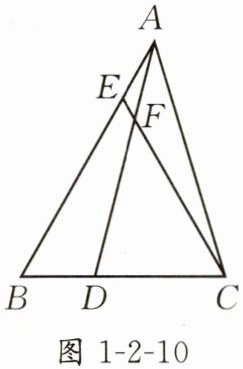
(1) 求证: $ AD=AC $;
(2) 若点 E在 AB边上,连接CE交AD于点F,且 $ ∠ C F D=∠ C A B $ ,AE=BD,求 $ ∠ A B C $的度数。
答案
2. (1)证明:$\because ∠ ADB=∠ ACB+∠ CAD$,
$∠ ADB=90°+\frac{1}{2}∠ CAD$,
$\therefore ∠ ACB=∠ ADB-∠ CAD=90°-\frac{1}{2}∠ CAD$。
$\because ∠ ADB+∠ CDA=180°$,
$\therefore ∠ CDA=180°-∠ ADB=180°-(90°+\frac{1}{2}∠ CAD)=90°-\frac{1}{2}∠ CAD$。
$\therefore ∠ ACB=∠ ADC$。$\therefore AD=AC$。
(2)解:如答图1-2-3,过点$D$作
$DG// CE$交$AB$于点$G$。
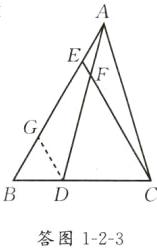
$\because ∠ CFD=∠ CAB$,$∠ CFD=∠ CAD+∠ ACE$,$∠ CAB=∠ CAD+∠ DAB$,
$\therefore ∠ ACE=∠ DAB$。
$\because ∠ ACD=∠ ADC$,$∠ ECB=∠ ACD-∠ ACE$,$∠ B=∠ ADC-∠ DAB$,
$\therefore ∠ ECB=∠ B$。
$\because DG// CE$,
$\therefore ∠ AEC=∠ DGA$,$∠ ECB=∠ BDG$。
$\therefore ∠ BDG=∠ B$。$\therefore DG=BG$。
又$\because AC=DA$,$∠ ACE=∠ DAG$,
$\therefore △ AEC≌△ DGA(\mathrm{AAS})$。$\therefore DG=AE$。
又$\because AE=BD$,$\therefore BG=DG=BD$,
$\therefore △ BDG$为等边三角形,$\therefore ∠ ABC=60°$。
3. 如图1-2-11,在 $ △ A B C $中, $ ∠ B=90° $ $ AB=16 \mathrm{~cm} $ $ BC=12 \mathrm{~cm} $ $ AC=20 \mathrm{~cm} $ P,Q是 $ △ A B C $边上的两个动点,其中点P从点A开始沿 $ A \to B $运动,且速度为每秒1cm,点Q从点B开始沿 $ B \to C \to A $运动,且速度为每秒2cm,它们同时出发,设出发的时间为 t s。
(1) $ B P= $ ___。(用含 t 的代数式表示)
(2) 当点 Q在边 BC上运动时,出发几秒后, $ △ P Q B $是等腰三角形?
(3) 当点 Q 在边 CA 上运动时,出发_______s 后, $ △ BCQ $是以 BC 或 BQ为底边的等腰三角形?

(1) $ B P= $ ___。(用含 t 的代数式表示)
(2) 当点 Q在边 BC上运动时,出发几秒后, $ △ P Q B $是等腰三角形?
(3) 当点 Q 在边 CA 上运动时,出发_______s 后, $ △ BCQ $是以 BC 或 BQ为底边的等腰三角形?
答案
3. 解:(1) $(16 - t)\mathrm{cm}$
(2)当点$Q$在边$BC$上运动,$△ PQB$为等腰三角形时,则有$BP=BQ$,即$16 - t = 2t$,
解得$t = \frac{16}{3}$。经检验符合题意。
$\therefore$出发$\frac{16}{3}\mathrm{s}$后,$△ PQB$能形成等腰三角形。
(3) 11或12 解析:分两种情况讨论。
①当$△ BCQ$是以$BC$为底边的等腰三角形时,$CQ = BQ$,则$∠ C = ∠ CBQ$。
$\because ∠ ABC = 90°$,
$\therefore ∠ CBQ + ∠ ABQ = 90°$,$∠ A + ∠ C = 90°$。
$\therefore ∠ A = ∠ ABQ$。$\therefore BQ = AQ$。
$\therefore CQ = AQ = 10\ \mathrm{cm}$。$\therefore BC + CQ = 22\ \mathrm{cm}$。
$\therefore t = 22÷2 = 11(\mathrm{s})$。
②当$△ BCQ$是以$BQ$为底边的等腰三角形时,$CQ = BC$,
则$BC + CQ = 24\ \mathrm{cm}$,$\therefore t = 24÷2 = 12(\mathrm{s})$。
综上所述,当$t$为11或12时,$△ BCQ$是以$BC$或$BQ$为底边的等腰三角形。
(2)当点$Q$在边$BC$上运动,$△ PQB$为等腰三角形时,则有$BP=BQ$,即$16 - t = 2t$,
解得$t = \frac{16}{3}$。经检验符合题意。
$\therefore$出发$\frac{16}{3}\mathrm{s}$后,$△ PQB$能形成等腰三角形。
(3) 11或12 解析:分两种情况讨论。
①当$△ BCQ$是以$BC$为底边的等腰三角形时,$CQ = BQ$,则$∠ C = ∠ CBQ$。
$\because ∠ ABC = 90°$,
$\therefore ∠ CBQ + ∠ ABQ = 90°$,$∠ A + ∠ C = 90°$。
$\therefore ∠ A = ∠ ABQ$。$\therefore BQ = AQ$。
$\therefore CQ = AQ = 10\ \mathrm{cm}$。$\therefore BC + CQ = 22\ \mathrm{cm}$。
$\therefore t = 22÷2 = 11(\mathrm{s})$。
②当$△ BCQ$是以$BQ$为底边的等腰三角形时,$CQ = BC$,
则$BC + CQ = 24\ \mathrm{cm}$,$\therefore t = 24÷2 = 12(\mathrm{s})$。
综上所述,当$t$为11或12时,$△ BCQ$是以$BC$或$BQ$为底边的等腰三角形。
