

 登录
登录
2. 同学们以“平行四边形纸片的折叠”为主题开展数学活动。在平行四边形ABCD中, AB=10, AD=4 $ \sqrt{10} $ ,其面积为120,点E为BC边上的任意一点,将 $ △ ABE $沿AE折叠,点B的对应点为点 $ B^{\prime} $ 。
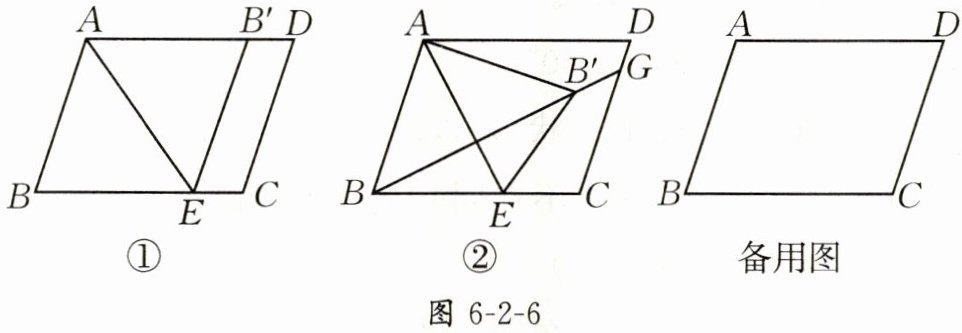
(1) 如图6-2-6 $ \textcircled{1} $ ,若点 $ B^{\prime} $ 恰好落在AD上时,求证:四边形 $ B^{\prime} E C D $为平行四边形;
(2) 如图6-2-6 $ \textcircled{2} $ ,若 $ ∠ B A E=4 5° $ ,连接 $ B B^{\prime} $ ,并延长交CD于点G,求线段 $ B^{\prime} G $的长;
(3) 改变点 E的位置,将 $ △ A B E $沿 AE折叠,连接 $ B^{\prime} C $,当 $ △ B C B^{\prime} $为直角三角形时,求 $ B^{\prime} C $的长度。
(1) 如图6-2-6 $ \textcircled{1} $ ,若点 $ B^{\prime} $ 恰好落在AD上时,求证:四边形 $ B^{\prime} E C D $为平行四边形;
(2) 如图6-2-6 $ \textcircled{2} $ ,若 $ ∠ B A E=4 5° $ ,连接 $ B B^{\prime} $ ,并延长交CD于点G,求线段 $ B^{\prime} G $的长;
(3) 改变点 E的位置,将 $ △ A B E $沿 AE折叠,连接 $ B^{\prime} C $,当 $ △ B C B^{\prime} $为直角三角形时,求 $ B^{\prime} C $的长度。
答案
2. (1)证明:由折叠可得$∠ BAE=∠ B'AE$,$∠ BEA=∠ B'EA$,$BE = B'E$,$AB = AB'$。
$\because$四边形$ABCD$是平行四边形,
$\therefore AB'// BE$,$AB// CD$。
$\therefore ∠ B'AE=∠ AEB$。
$\therefore ∠ BAE=∠ B'AE=∠ BEA=∠ B'EA$。
$\therefore AB// B'E$,$BE = B'E = AB = AB' = CD$。
$\therefore B'E// CD$。
$\therefore$四边形$B'ECD$是平行四边形。
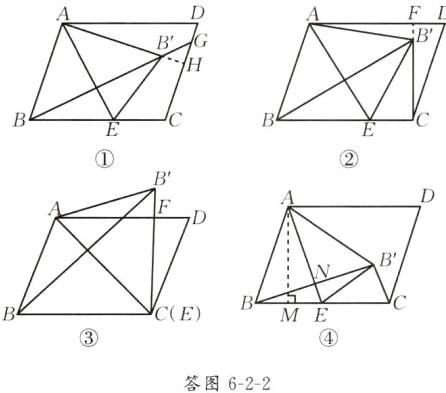
(2)解:如答图6 - 2 - 2①,延长$AB'$交$CD$于点$H$。由折叠可得$∠ BAE=∠ B'AE$,$AB = AB'$。
$\because ∠ BAE = 45°$,
$\therefore ∠ BAB'=∠ BAE+∠ B'AE = 90°$。
$\therefore △ ABB'$是等腰直角三角形。
$\therefore ∠ ABB' = 45°$。
$\because$四边形$ABCD$是平行四边形,$AB = 10$,$AD = 4\sqrt{10}$,
$\therefore AB// CD$,$CD = AB' = AB = 10$。
$\therefore ∠ AHD=∠ BAB' = 90°$,
$∠ B'GH=∠ ABB' = 45°$。
$\therefore △ B'HG$是等腰直角三角形。
$\therefore B'H = HG$。
$\because S_{□ ABCD}=AB· AH = 120$,
$\therefore AH = 12$。
$\therefore B'H = AH - AB' = 2$。
$\therefore HG = 2$。
$\therefore B'G=\sqrt{B'H^{2}+HG^{2}}=2\sqrt{2}$。
(3)解:①当$∠ BCB' = 90°$时,延长$CB'$交$AD$于点$F$,如答图6 - 2 - 2②所示。
$\because$四边形$ABCD$是平行四边形,
$\therefore AD// BC$,$CD = AB = 10$,$BC = AD = 4\sqrt{10}$。
$\therefore ∠ DFC=∠ BCB' = 90°$。
$\therefore CF⊥ AD$。
$\therefore S_{□ ABCD}=AD· CF = 120$。
$\because AD = 4\sqrt{10}$,
$\therefore CF = 3\sqrt{10}$。
$\therefore DF=\sqrt{CD^{2}-CF^{2}}=\sqrt{10}$。
$\therefore AF = AD - DF = 3\sqrt{10}$。
由折叠,得$AB' = AB = 10$。
在$\mathrm{Rt}△ AB'F$中,$B'F=\sqrt{AB'^{2}-AF^{2}}=\sqrt{10}$。
$\therefore B'C = CF - B'F = 2\sqrt{10}$。
如答图6 - 2 - 2③,当$C$,$E$重合时,过点$C$作$CF⊥ AD$于点$F$。
$\because$当$CF⊥ AD$时,$AF = CF = 3\sqrt{10}$,
$\therefore ∠ ACF=∠ CAF = 45°$。
又$\because AD// BC$,
$\therefore ∠ ACB = 45°$。
$\therefore$当$C$,$E$重合时,点$B'$在直线$CF$上,
$\therefore ∠ BCB' = 90°$。
由折叠可得$B'C = BC = AD = 4\sqrt{10}$。
②当$∠ BB'C = 90°$时,如答图6 - 2 - 2④,设$BB'$与$AE$交于点$N$,作$AM⊥ BC$,
$\therefore S_{□ ABCD}=BC· AM = 120$,
$\therefore AM = 3\sqrt{10}$。
$\therefore BM=\sqrt{AB^{2}-AM^{2}}=\sqrt{10}$。
由折叠可得$BE = B'E$,$BB'⊥ AE$,$BB' = 2BN$。
$\therefore ∠ B'BC=∠ BB'E$。
$\because ∠ BB'E+∠ CB'E=∠ B'BC+∠ BCB' = 90°$,
$\therefore ∠ BCB'=∠ CB'E$。
$\therefore B'E = CE$。
$\therefore BE = CE=\frac{1}{2}BC = 2\sqrt{10}$。
$\therefore ME = BE - BM=\sqrt{10}=BM$。
$\therefore AM$垂直平分$BE$。
$\therefore AE = AB = 10$。
$\because S_{△ ABE}=\frac{1}{2}BE· AM=\frac{1}{2}AE· BN$,
$\therefore 2\sqrt{10}×3\sqrt{10}=10BN$。
$\therefore BN = 6$。
$\therefore BB' = 12$。
$\therefore B'C=\sqrt{BC^{2}-BB'^{2}}=4$。
综上所述,$B'C$的长度为$2\sqrt{10}$或$4$或$4\sqrt{10}$。
3. 【问题探究】一条线段沿某个方向平移一段距离后,连接对应端点可以构成一个平行四边形。我们可以利用这一性质,将有些条件通过平移集中在一起来解决一些几何问题。
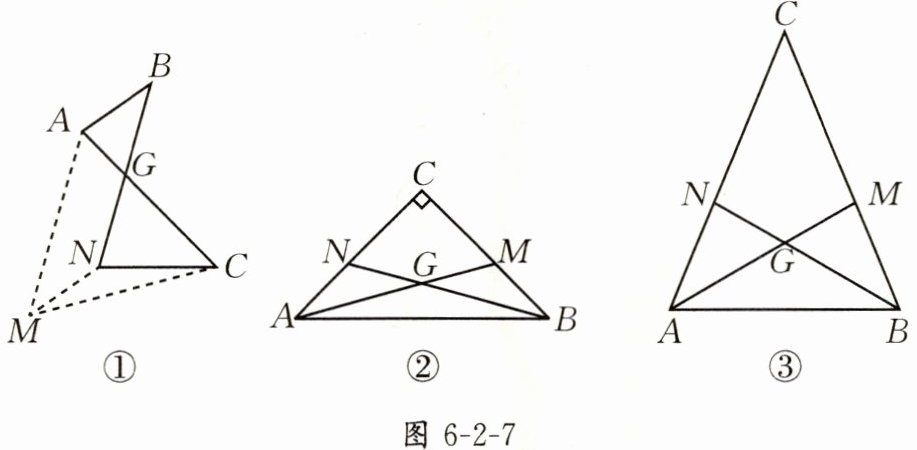
(1) 如图6-2-7 $ \textcircled{1} $ ,两条长度相等的线段AC和BN相交于点G, $ ∠ A G B=6 0° $ ,试说明线段 $ A B+C N≥ B N。 $
分析:考虑通过平移,将 AB,CN和BN集中到同一个三角形中,运用三角形的三边关系来证明。
如图 6-2-7 $ \textcircled{1} $ ,作 AM//BN 且 AM=BN,连接 MN,CM,则四边形 ABNM是_______ (填四边形 ABNM 的形状), $ \therefore AB=MN。 $
$\because A C = B N = A M, ∠ M A C = ∠ A G B = 6 0 ^ {\circ},$
$ \therefore △ A C M $是 ______ (填 $ △ A C M $的形状), $ \therefore MA=MC=BN。 $
当 AB与 CN不平行时,M,N,C三点不在同一直线上,由三角形三边关系可知,MN+ NC ______ MC;(填“>”“=”或“<”)
当AB与CN平行时,M,N,C三点在同一直线上,此时 $ M N+N C=M C $ , $ \therefore A B+ C N≥ B N。 $
【问题解决】
(2) 如图6-2-7 $ \textcircled{2} $ ,在 $ △ ABC $中,AC=BC, $ ∠ C=90° $ ,点M,N分别在BC,AC上,BN交AM于点G, $ ∠ AGB=150° $ ,AN=BM $ \sqrt{3}-1。 $
$ \textcircled{1} $求证: $ AM=BN $;
$ \textcircled{2} $求 AM的长。
【拓展应用】
(3) 如图6-2-7 $ \textcircled{3} $ ,在 $ △ ABC $中, $ ∠ C=45° $ ,点M,N分别在BC,AC上,BN交AM于点G。若 $ AM=BN $ $ ∠ AGB=120° $ $ AN=\sqrt{2} a $ $ BM=b-a(b>a) $ ,直接写出AM的长。(用含a,b的代数式表示)
(1) 如图6-2-7 $ \textcircled{1} $ ,两条长度相等的线段AC和BN相交于点G, $ ∠ A G B=6 0° $ ,试说明线段 $ A B+C N≥ B N。 $
分析:考虑通过平移,将 AB,CN和BN集中到同一个三角形中,运用三角形的三边关系来证明。
如图 6-2-7 $ \textcircled{1} $ ,作 AM//BN 且 AM=BN,连接 MN,CM,则四边形 ABNM是_______ (填四边形 ABNM 的形状), $ \therefore AB=MN。 $
$\because A C = B N = A M, ∠ M A C = ∠ A G B = 6 0 ^ {\circ},$
$ \therefore △ A C M $是 ______ (填 $ △ A C M $的形状), $ \therefore MA=MC=BN。 $
当 AB与 CN不平行时,M,N,C三点不在同一直线上,由三角形三边关系可知,MN+ NC ______ MC;(填“>”“=”或“<”)
当AB与CN平行时,M,N,C三点在同一直线上,此时 $ M N+N C=M C $ , $ \therefore A B+ C N≥ B N。 $
【问题解决】
(2) 如图6-2-7 $ \textcircled{2} $ ,在 $ △ ABC $中,AC=BC, $ ∠ C=90° $ ,点M,N分别在BC,AC上,BN交AM于点G, $ ∠ AGB=150° $ ,AN=BM $ \sqrt{3}-1。 $
$ \textcircled{1} $求证: $ AM=BN $;
$ \textcircled{2} $求 AM的长。
【拓展应用】
(3) 如图6-2-7 $ \textcircled{3} $ ,在 $ △ ABC $中, $ ∠ C=45° $ ,点M,N分别在BC,AC上,BN交AM于点G。若 $ AM=BN $ $ ∠ AGB=120° $ $ AN=\sqrt{2} a $ $ BM=b-a(b>a) $ ,直接写出AM的长。(用含a,b的代数式表示)
答案
3. (1)平行四边形;等边三角形;$>$
(2)①证明:作$BE// AN$且$BE = AN$,连接$AE$,如答图6 - 2 - 3①所示,$\therefore BE = BM$。
$\because AC = BC$,$∠ C = 90°$,
$\therefore ∠ CAB=∠ CBA = 45°$。
$\because BE// AN$且$BE = AN$,
$\therefore$四边形$AEBN$是平行四边形。
$\therefore AE = BN$,$∠ ABE=∠ NAB=∠ MBA = 45°$。
$\therefore △ ABE≌△ ABM$。
$\therefore AM = AE = BN$。
②解:作$AH⊥ BE$交$BE$的延长线于点$H$,如答图6 - 2 - 3①所示。
$\because AE// BN$,
$\therefore ∠ GAE = 180°-∠ AGB = 30°$。
$\because △ ABE≌△ ABM$,
$\therefore ∠ BAE=∠ BAM=\frac{1}{2}∠ GAE = 15°$。
$\therefore ∠ AEH=∠ BAE+∠ ABE = 60°$。
$\therefore ∠ HAE = 30°$。
设$AE = 2x$,则$HE = x$,$\therefore AH=\sqrt{AE^{2}-HE^{2}}=\sqrt{3}x$。
$\because ∠ HAB=∠ ABH = 45°$,
$\therefore BH = AH=\sqrt{3}x$。
$\therefore BE = BH - HE = (\sqrt{3}-1)x$。
$\because BE = BM=\sqrt{3}-1$,
$\therefore (\sqrt{3}-1)x=\sqrt{3}-1$,解得$x = 1$。
$\therefore AM = AE = 2x = 2$。
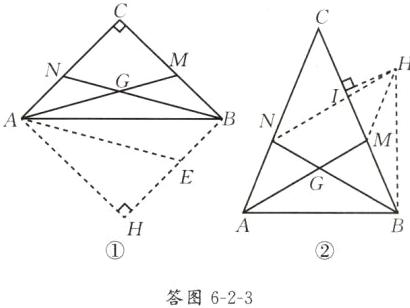
(3)解:$AM$的长为$\sqrt{a^{2}+b^{2}}$。 解析:作$MH// AN$且$MH = AN$,连接$NH$,$BH$,作$HI⊥ BC$,如答图6 - 2 - 3②所示,则四边形$AMHN$是平行四边形,
$\therefore ∠ HMI=∠ C = 45°$,$NH// AM$。
$\therefore MH = AN=\sqrt{2}a$,$NH = AM = BN$。
$\because ∠ NGM=∠ AGB = 120°$,$NH// AM$,
$\therefore ∠ HNB = 180°-∠ NGM = 60°$。
$\therefore △ HNB$是等边三角形。
$\therefore BH = NH = BN = AM$。
$\because MH=\sqrt{2}a$,$∠ HMI = 45°$,
$\therefore HI = MI$。
$\because HI^{2}+MI^{2}=HM^{2}$,
$\therefore HI = MI = a$。
$\because BM = b - a$,
$\therefore BI = BM + MI = b$。
$\therefore AM = BH=\sqrt{BI^{2}+HI^{2}}=\sqrt{a^{2}+b^{2}}$。
