

 登录
登录
六、新情境生活运用 阅读短文,判断正(T)误(F)。(5分)
If you want a more interesting experience when you arrive in a new city or country, here are some better ways to travel, both for you and for the environment.
Way 1: Get out of the car and walk. It's slower, but it's the greenest way to travel. It's also the most rewarding(最有益的)way to see a city, but remember to wear comfortable shoes.
Way 2: Cycling is also a good choice. Many hotels now offer free bikes to guests. It is convenient for people to travel around the city. Some also provide electric bikes that make it easier to go up hills and on longer journeys. Most cities also have shared bikes, and you can pick up one easily. It's not free but very cheap.
Way 3: If you have to take transport in a city, try to take public transport. Most cities now offer lots of information and very clear maps at the city's website.
Way 4: If possible, take buses, trains or ships to travel from city to city. They are usually greener than cars and planes.
Way 5: When the only way to travel is by car, rent(租借)an electric car.Many car rental companies now offer them, so always ask!
( )1. Walking is the only rewarding way to see a city.
( )2. Many hotels and cities offer free bikes to visitors.
( )3. The city's website can help to take public transport.
( )4. Way 1 and Way 4 are the best for people's health.
( )5. Common(普通的)cars are greener than electric cars.
If you want a more interesting experience when you arrive in a new city or country, here are some better ways to travel, both for you and for the environment.
Way 1: Get out of the car and walk. It's slower, but it's the greenest way to travel. It's also the most rewarding(最有益的)way to see a city, but remember to wear comfortable shoes.
Way 2: Cycling is also a good choice. Many hotels now offer free bikes to guests. It is convenient for people to travel around the city. Some also provide electric bikes that make it easier to go up hills and on longer journeys. Most cities also have shared bikes, and you can pick up one easily. It's not free but very cheap.
Way 3: If you have to take transport in a city, try to take public transport. Most cities now offer lots of information and very clear maps at the city's website.
Way 4: If possible, take buses, trains or ships to travel from city to city. They are usually greener than cars and planes.
Way 5: When the only way to travel is by car, rent(租借)an electric car.Many car rental companies now offer them, so always ask!
( )1. Walking is the only rewarding way to see a city.
( )2. Many hotels and cities offer free bikes to visitors.
( )3. The city's website can help to take public transport.
( )4. Way 1 and Way 4 are the best for people's health.
( )5. Common(普通的)cars are greener than electric cars.
答案
1. F 2. F 3. T 4. F 5. F
解析
【分析】
解题思路:首先通读短文,明确五种环保出行方式的具体内容;然后逐个查看题目,回到原文找到对应的描述段落,对比题目表述与原文内容是否一致,以此判断正误。
1. 对于第1题,需关注原文中关于步行是“最有益”还是“唯一有益”的表述;
2. 第2题要区分酒店提供的自行车和城市共享单车是否都是免费的;
3. 第3题查看城市网站是否能为乘坐公共交通提供帮助;
4. 第4题判断Way1和Way4是否都对健康最有益;
5. 第5题对比普通汽车和电动汽车的环保性。
【解析】
1. 根据短文Way1中“It's also the most rewarding(最有益的)way to see a city”可知,步行是最有益的方式,但并非唯一有益的方式,题目中“only rewarding”表述错误,故判断为F。
2. 短文Way2提到“Many hotels now offer free bikes to guests...Most cities also have shared bikes, and you can pick up one easily. It's not free but very cheap.”,说明城市的共享单车不是免费的,题目说“hotels and cities offer free bikes”与原文不符,判断为F。
3. 短文Way3指出“Most cities now offer lots of information and very clear maps at the city's website.”,城市网站提供公共交通的相关信息,能帮助人们乘坐公共交通,表述正确,判断为T。
4. Way1步行对健康有益,但Way4是城际间的公交、火车、船,原文未提及这两种方式是对健康最好的,且Way4侧重环保属性,题目表述错误,判断为F。
5. 短文Way5提到“When the only way to travel is by car, rent(租借)an electric car.”,说明电动汽车比普通汽车更环保,题目中“Common cars are greener than electric cars”表述错误,判断为F。
【答案】
1.F 2.F 3.T 4.F 5.F
【知识点】
细节查找、文意理解、阅读理解判断正误
【点评】
本题围绕环保出行的新情境展开,重点考查学生对文章细节信息的捕捉与对比能力。解题时需精准定位原文内容,仔细甄别题目表述与原文的差异,避免被相似表述误导,有助于培养学生细致严谨的阅读习惯。
【难度系数】
0.6
解题思路:首先通读短文,明确五种环保出行方式的具体内容;然后逐个查看题目,回到原文找到对应的描述段落,对比题目表述与原文内容是否一致,以此判断正误。
1. 对于第1题,需关注原文中关于步行是“最有益”还是“唯一有益”的表述;
2. 第2题要区分酒店提供的自行车和城市共享单车是否都是免费的;
3. 第3题查看城市网站是否能为乘坐公共交通提供帮助;
4. 第4题判断Way1和Way4是否都对健康最有益;
5. 第5题对比普通汽车和电动汽车的环保性。
【解析】
1. 根据短文Way1中“It's also the most rewarding(最有益的)way to see a city”可知,步行是最有益的方式,但并非唯一有益的方式,题目中“only rewarding”表述错误,故判断为F。
2. 短文Way2提到“Many hotels now offer free bikes to guests...Most cities also have shared bikes, and you can pick up one easily. It's not free but very cheap.”,说明城市的共享单车不是免费的,题目说“hotels and cities offer free bikes”与原文不符,判断为F。
3. 短文Way3指出“Most cities now offer lots of information and very clear maps at the city's website.”,城市网站提供公共交通的相关信息,能帮助人们乘坐公共交通,表述正确,判断为T。
4. Way1步行对健康有益,但Way4是城际间的公交、火车、船,原文未提及这两种方式是对健康最好的,且Way4侧重环保属性,题目表述错误,判断为F。
5. 短文Way5提到“When the only way to travel is by car, rent(租借)an electric car.”,说明电动汽车比普通汽车更环保,题目中“Common cars are greener than electric cars”表述错误,判断为F。
【答案】
1.F 2.F 3.T 4.F 5.F
【知识点】
细节查找、文意理解、阅读理解判断正误
【点评】
本题围绕环保出行的新情境展开,重点考查学生对文章细节信息的捕捉与对比能力。解题时需精准定位原文内容,仔细甄别题目表述与原文的差异,避免被相似表述误导,有助于培养学生细致严谨的阅读习惯。
【难度系数】
0.6
七(2025·连云港灌云县期中)任务型阅读。(9分)
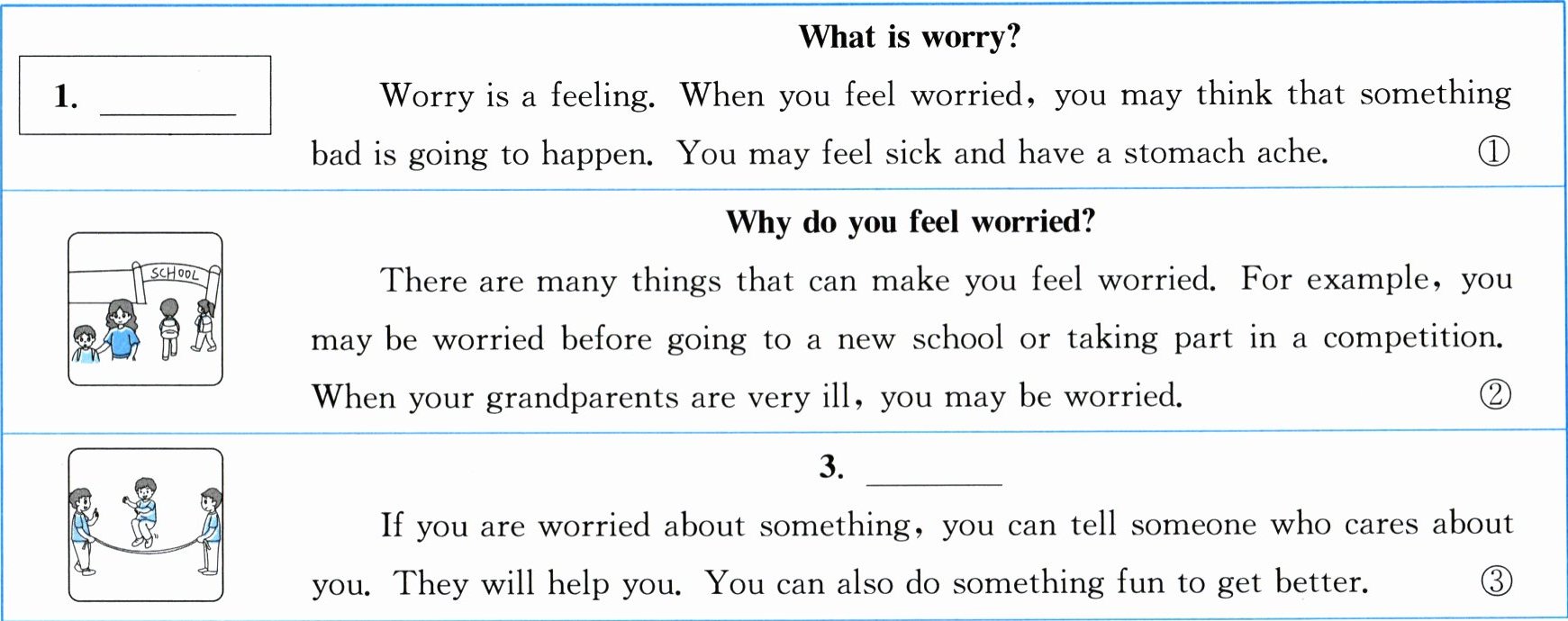


(一)根据材料内容,选择正确的答案。(5分)
( )1. 为材料中的第$ \textcircled{1} $段选择相符的图片。 $( )2. In paragraph \textcircled{2} how many things does the writer show that can make people worried?$
A. One. B. Three. C. Five.
( )3. 为材料中的第$ \textcircled{3} $段选择相符的小标题。
A. How often do you feel worried? B. Who makes you feel worried?
C. What can you do if you feel worried?
$( )4. The underlined phrase “miss out” in paragraph \textcircled{5} means“$_________”in Chinese.
A. 想念 B. 享受 C. 错过
( )5. 新趋势 写作意图 Why does the writer write this reading material?
A. To help us know well about worry. B. To tell us how to be a good listener.
C. To show us that worry is a bad feeling.
(二)根据材料第 $ \textcircled{4} $段中的建议,用数字给下列图片排序。(4分)

(一)根据材料内容,选择正确的答案。(5分)
( )1. 为材料中的第$ \textcircled{1} $段选择相符的图片。 $( )2. In paragraph \textcircled{2} how many things does the writer show that can make people worried?$
A. One. B. Three. C. Five.
( )3. 为材料中的第$ \textcircled{3} $段选择相符的小标题。
A. How often do you feel worried? B. Who makes you feel worried?
C. What can you do if you feel worried?
$( )4. The underlined phrase “miss out” in paragraph \textcircled{5} means“$_________”in Chinese.
A. 想念 B. 享受 C. 错过
( )5. 新趋势 写作意图 Why does the writer write this reading material?
A. To help us know well about worry. B. To tell us how to be a good listener.
C. To show us that worry is a bad feeling.
(二)根据材料第 $ \textcircled{4} $段中的建议,用数字给下列图片排序。(4分)
答案
(一)1. A 2. B 3. C 4. C 5. A
(二)2 3 1 4
(二)2 3 1 4
解析
【分析】
这是一道任务型阅读题,分为选择题和图片排序两部分,解题思路如下:
1. 选择题部分:
第1题:先定位材料第①段的内容,提取核心描述,再对比选项中的图片,找到匹配的图片A。
第2题:回到材料第②段,逐一数出文中提到的会让人担忧的事物数量,确定是三个,从而选B。
第3题:分析第③段的内容,该段是围绕“担忧时可以做什么”展开,对应选项C的小标题。
第4题:结合第⑤段的上下文语境,推测“miss out”的词义,根据语境判断是“错过”的意思,选C。
第5题:通读全文,总结文章主旨,文章围绕“担忧”展开,目的是帮助读者全面了解担忧,所以选A。
2. 图片排序题:先找到材料第④段的建议顺序,再对应每一条建议匹配相应的图片,最终得出排序结果2 3 1 4。
【解析】
(一)选择题:
1. 阅读材料第①段内容,其描述与图片A的内容相符,故选A。
2. 定位第②段,文中提到了三个会让人担忧的事物,因此答案选B。
3. 第③段主要介绍了感到担忧时可以采取的做法,与选项C的小标题“What can you do if you feel worried?”匹配,故选C。
4. 根据第⑤段的语境,“miss out”所在句子表达的是不想错过有趣的事情,所以该短语的中文意思是“错过”,选C。
5. 通读全文可知,文章从担忧的表现、引发担忧的事物、应对方法等方面展开,目的是帮助读者充分了解担忧,故选A。
(二)排序题:
对照材料第④段给出的建议顺序,依次匹配对应的图片,得出排序为2 3 1 4。
【答案】
(一)1. A 2. B 3. C 4. C 5. A
(二)2 3 1 4
【知识点】
任务型阅读解题技巧、词义猜测方法、段落主旨归纳
【点评】
本题涵盖了任务型阅读的常见题型,包括信息匹配、细节查找、词义猜测、主旨意图判断和信息排序,全面考查了学生对文本信息的提取、理解和应用能力,有助于提升学生的阅读理解综合素养。
【难度系数】
0.6
这是一道任务型阅读题,分为选择题和图片排序两部分,解题思路如下:
1. 选择题部分:
第1题:先定位材料第①段的内容,提取核心描述,再对比选项中的图片,找到匹配的图片A。
第2题:回到材料第②段,逐一数出文中提到的会让人担忧的事物数量,确定是三个,从而选B。
第3题:分析第③段的内容,该段是围绕“担忧时可以做什么”展开,对应选项C的小标题。
第4题:结合第⑤段的上下文语境,推测“miss out”的词义,根据语境判断是“错过”的意思,选C。
第5题:通读全文,总结文章主旨,文章围绕“担忧”展开,目的是帮助读者全面了解担忧,所以选A。
2. 图片排序题:先找到材料第④段的建议顺序,再对应每一条建议匹配相应的图片,最终得出排序结果2 3 1 4。
【解析】
(一)选择题:
1. 阅读材料第①段内容,其描述与图片A的内容相符,故选A。
2. 定位第②段,文中提到了三个会让人担忧的事物,因此答案选B。
3. 第③段主要介绍了感到担忧时可以采取的做法,与选项C的小标题“What can you do if you feel worried?”匹配,故选C。
4. 根据第⑤段的语境,“miss out”所在句子表达的是不想错过有趣的事情,所以该短语的中文意思是“错过”,选C。
5. 通读全文可知,文章从担忧的表现、引发担忧的事物、应对方法等方面展开,目的是帮助读者充分了解担忧,故选A。
(二)排序题:
对照材料第④段给出的建议顺序,依次匹配对应的图片,得出排序为2 3 1 4。
【答案】
(一)1. A 2. B 3. C 4. C 5. A
(二)2 3 1 4
【知识点】
任务型阅读解题技巧、词义猜测方法、段落主旨归纳
【点评】
本题涵盖了任务型阅读的常见题型,包括信息匹配、细节查找、词义猜测、主旨意图判断和信息排序,全面考查了学生对文本信息的提取、理解和应用能力,有助于提升学生的阅读理解综合素养。
【难度系数】
0.6
