

 登录
登录
任务型阅读。
探索宇宙的热忱是推动中国航天事业不断进步的动力。请阅读下面对话,完成下列任务。
Host: Hello! Welcome to Science This Week. We all know China's space programme has achieved a lot. To help us learn more, a scientist from China's space programme is joining us from her Beijing office. Dr Li, thank you for talking with us.
Dr Li: My pleasure.
Host: Could you briefly(简要地) talk about the history of China's space programme?
Dr Li: Sure. China's space programme
began in 1956. We launched our first satellite, Dongfanghong-1, in 1970. Space flight started with the launch of Shenzhou-1.
Host: Could you tell us more about the Shenzhou spacecraft?
Dr Li: Shenzhou-1 was China's first unmanned flight. It was launched in 1999. Three more launches followed. The manned missions of Shenzhou-5, 6, and 7 took place in 2003, 2005, and 2008. And in 2012, the first female(女性的) Chinese astronaut went into space in Shenzhou-9.
Host: So, China's first astronaut was sent into space in Shenzhou-5?
Dr Li: Yes. It took the first Chinese astronaut, Yang Liwei, into space.
Host: I've heard another famous name, Tiangong-1. Could you tell us something about it?
Dr Li: It was another great achievement in 2011 that showed China's ability to build space stations.
Host: Wow! China's space technology has advanced quickly over the past years.
Dr Li: Yes. Chinese scientists have put a lot of effort into the space programme and never given up. Without the hard work of all the great scientists in the space programme, we would never have succeeded.
Host: Dr Li, thank you for your time today.
Dr Li: Glad to be here.
任务一:请根据对话内容完成表格,每个空格不超过3个单词。
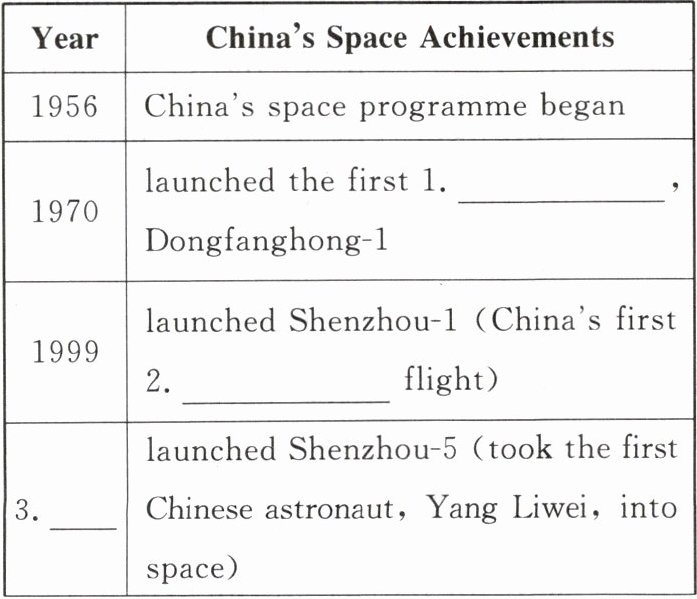
Year | China's Space Achievements
1956 | China's space programme began
1970 | launched the first 1.
1999 | launched Shenzhou-1 (China's first 2.
3.
续表
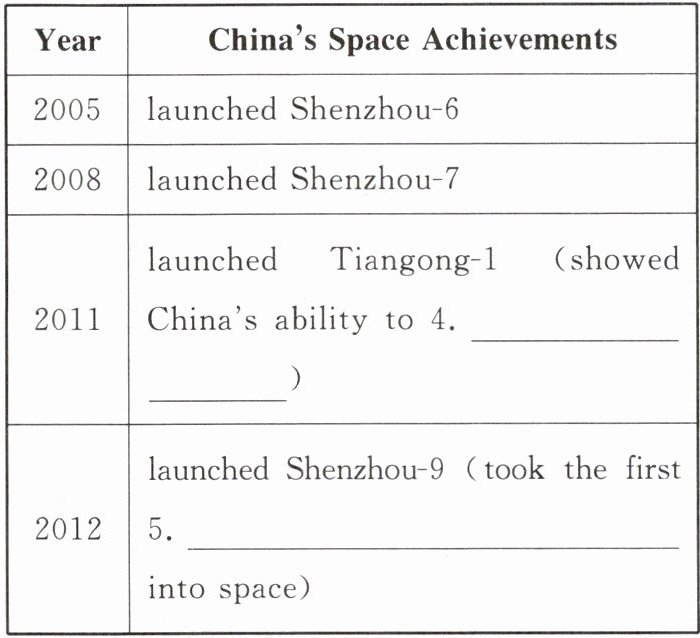
Year | China's Space Achievements
2005 | launched Shenzhou-6
2008 | launched Shenzhou-7
2011 | launched Tiangong-1 (showed China's ability to 4.
2012 | launched Shenzhou-9 (took the first 5.
任务二:请根据对话内容从每小题所给的A、B、C、D四个选项中选出最佳选项。
1. What does the underlined word "advanced" most probably mean? (
A. Stayed the same.
B. Appeared slowly.
C. Stopped suddenly.
D. Developed greatly.
2. What does Dr Li think is the key to China's success in the space programme? (
A. Plenty of money spent on space research.
B. Advanced technology from other countries.
C. The support from the international community.
D. The hard work and the spirit of never giving up of Chinese scientists.
探索宇宙的热忱是推动中国航天事业不断进步的动力。请阅读下面对话,完成下列任务。
Host: Hello! Welcome to Science This Week. We all know China's space programme has achieved a lot. To help us learn more, a scientist from China's space programme is joining us from her Beijing office. Dr Li, thank you for talking with us.
Dr Li: My pleasure.
Host: Could you briefly(简要地) talk about the history of China's space programme?
Dr Li: Sure. China's space programme
began in 1956. We launched our first satellite, Dongfanghong-1, in 1970. Space flight started with the launch of Shenzhou-1.
Host: Could you tell us more about the Shenzhou spacecraft?
Dr Li: Shenzhou-1 was China's first unmanned flight. It was launched in 1999. Three more launches followed. The manned missions of Shenzhou-5, 6, and 7 took place in 2003, 2005, and 2008. And in 2012, the first female(女性的) Chinese astronaut went into space in Shenzhou-9.
Host: So, China's first astronaut was sent into space in Shenzhou-5?
Dr Li: Yes. It took the first Chinese astronaut, Yang Liwei, into space.
Host: I've heard another famous name, Tiangong-1. Could you tell us something about it?
Dr Li: It was another great achievement in 2011 that showed China's ability to build space stations.
Host: Wow! China's space technology has advanced quickly over the past years.
Dr Li: Yes. Chinese scientists have put a lot of effort into the space programme and never given up. Without the hard work of all the great scientists in the space programme, we would never have succeeded.
Host: Dr Li, thank you for your time today.
Dr Li: Glad to be here.
任务一:请根据对话内容完成表格,每个空格不超过3个单词。
Year | China's Space Achievements
1956 | China's space programme began
1970 | launched the first 1.
satellite
, Dongfanghong-11999 | launched Shenzhou-1 (China's first 2.
unmanned
flight)3.
2003
| launched Shenzhou-5 (took the first Chinese astronaut, Yang Liwei, into space)续表
Year | China's Space Achievements
2005 | launched Shenzhou-6
2008 | launched Shenzhou-7
2011 | launched Tiangong-1 (showed China's ability to 4.
build space stations
)2012 | launched Shenzhou-9 (took the first 5.
female Chinese astronaut
into space)任务二:请根据对话内容从每小题所给的A、B、C、D四个选项中选出最佳选项。
1. What does the underlined word "advanced" most probably mean? (
D
)A. Stayed the same.
B. Appeared slowly.
C. Stopped suddenly.
D. Developed greatly.
2. What does Dr Li think is the key to China's success in the space programme? (
D
)A. Plenty of money spent on space research.
B. Advanced technology from other countries.
C. The support from the international community.
D. The hard work and the spirit of never giving up of Chinese scientists.
答案
任务一:
1. satellite
2. unmanned
3. 2003
4. build space stations
5. female Chinese astronaut
任务二:
1. D
2. D
1. satellite
2. unmanned
3. 2003
4. build space stations
5. female Chinese astronaut
任务二:
1. D
2. D
解析
【分析】
本题为任务型阅读,分为信息匹配和选择题两部分。任务一需根据对话内容对应年份与航天成就,解题时要精准定位原文中各年份对应的关键信息,注意空格字数限制;任务二第1题需结合上下文语境推断划线词含义,第2题需找到李博士关于航天成功关键的表述,解题时要紧扣原文细节。
【解析】
任务一:1. 由对话中“launched our first satellite, Dongfanghong-1, in 1970”可知,1970年发射的是第一颗卫星,故填satellite;2. 由“Shenzhou-1 was China's first unmanned flight. It was launched in 1999”可知,1999年神舟1是中国首次无人飞行,故填unmanned;3. 由“The manned missions of Shenzhou-5... took place in 2003”可知,神舟5发射于2003年,故填2003;4. 由“Tiangong-1... showed China's ability to build space stations”可知,天宫1展示了中国建空间站的能力,故填build space stations;5. 由“in 2012, the first female Chinese astronaut went into space in Shenzhou-9”可知,神舟9搭载了首位中国女宇航员,故填female Chinese astronaut。
任务二:1. 划线词“advanced”所在句意为“中国航天技术近年快速发展”,结合语境可知advanced意为“发展”,对应选项D;2. 由“Chinese scientists have put a lot of effort into the space programme and never given up... we would never have succeeded”可知,李博士认为航天成功的关键是中国科学家的努力与不放弃的精神,对应选项D。
【答案】
任务一:1. satellite 2. unmanned 3. 2003 4. build space stations 5. female Chinese astronaut;任务二:1. D 2. D
【知识点】
任务型阅读(信息匹配)、词义猜测、细节理解
【点评】
本题侧重考查学生快速定位原文信息、结合语境推断词义的能力,题目难度适中,只要仔细阅读对话即可完成,是典型的初中英语任务型阅读题型。
【难度系数】
0.3
本题为任务型阅读,分为信息匹配和选择题两部分。任务一需根据对话内容对应年份与航天成就,解题时要精准定位原文中各年份对应的关键信息,注意空格字数限制;任务二第1题需结合上下文语境推断划线词含义,第2题需找到李博士关于航天成功关键的表述,解题时要紧扣原文细节。
【解析】
任务一:1. 由对话中“launched our first satellite, Dongfanghong-1, in 1970”可知,1970年发射的是第一颗卫星,故填satellite;2. 由“Shenzhou-1 was China's first unmanned flight. It was launched in 1999”可知,1999年神舟1是中国首次无人飞行,故填unmanned;3. 由“The manned missions of Shenzhou-5... took place in 2003”可知,神舟5发射于2003年,故填2003;4. 由“Tiangong-1... showed China's ability to build space stations”可知,天宫1展示了中国建空间站的能力,故填build space stations;5. 由“in 2012, the first female Chinese astronaut went into space in Shenzhou-9”可知,神舟9搭载了首位中国女宇航员,故填female Chinese astronaut。
任务二:1. 划线词“advanced”所在句意为“中国航天技术近年快速发展”,结合语境可知advanced意为“发展”,对应选项D;2. 由“Chinese scientists have put a lot of effort into the space programme and never given up... we would never have succeeded”可知,李博士认为航天成功的关键是中国科学家的努力与不放弃的精神,对应选项D。
【答案】
任务一:1. satellite 2. unmanned 3. 2003 4. build space stations 5. female Chinese astronaut;任务二:1. D 2. D
【知识点】
任务型阅读(信息匹配)、词义猜测、细节理解
【点评】
本题侧重考查学生快速定位原文信息、结合语境推断词义的能力,题目难度适中,只要仔细阅读对话即可完成,是典型的初中英语任务型阅读题型。
【难度系数】
0.3
