

 登录
登录
7. 在平面直角坐标系中,$\odot O$的直径为26,圆心$O$为坐标原点,则点$P(-12,-5)$与$\odot O$的位置关系是
点P在 $ \odot O $ 上
。答案
7. 点P在 $ \odot O $ 上
解析
解:$\odot O$的半径$r=\frac{26}{2}=13$。
点$P(-12,-5)$到圆心$O$的距离$OP=\sqrt{(-12-0)^2+(-5-0)^2}=\sqrt{144+25}=\sqrt{169}=13$。
因为$OP=r$,所以点$P$在$\odot O$上。
点P在$\odot O$上
点$P(-12,-5)$到圆心$O$的距离$OP=\sqrt{(-12-0)^2+(-5-0)^2}=\sqrt{144+25}=\sqrt{169}=13$。
因为$OP=r$,所以点$P$在$\odot O$上。
点P在$\odot O$上
8. 已知$\odot O$的半径为2,设点$M$到圆心$O$的距离$OM=a$。若关于$x$的方程$2x^{2}-2\sqrt {2}x+a-1=0$有实数根,则点$M$与$\odot O$的位置关系为
点M在 $ \odot O $ 上或 $ \odot O $ 内
。答案
8. 点M在 $ \odot O $ 上或 $ \odot O $ 内
解析
解:因为方程$2x^{2}-2\sqrt{2}x + a - 1 = 0$有实数根,所以判别式$\Delta = (-2\sqrt{2})^{2}-4×2×(a - 1)\geq0$。
计算判别式:$\Delta = 8 - 8(a - 1) = 8 - 8a + 8 = 16 - 8a$。
则$16 - 8a\geq0$,解得$a\leq2$。
已知$\odot O$半径为$2$,点$M$到圆心$O$的距离$OM = a$,当$a\leq2$时,点$M$在$\odot O$上或$\odot O$内。
点M在$\odot O$上或$\odot O$内
计算判别式:$\Delta = 8 - 8(a - 1) = 8 - 8a + 8 = 16 - 8a$。
则$16 - 8a\geq0$,解得$a\leq2$。
已知$\odot O$半径为$2$,点$M$到圆心$O$的距离$OM = a$,当$a\leq2$时,点$M$在$\odot O$上或$\odot O$内。
点M在$\odot O$上或$\odot O$内
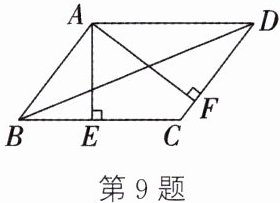
9. 如图,在$□ ABCD$中,$∠BCD$为钝角,$AE⊥BC$,$AF⊥CD$,垂足分别为$E$、$F$,连接$BD$。求证:$A$、$E$、$C$、$F$四点共圆。
答案
9. 连接AC, 交BD于点O, 连接OE、OF. $ \because $ 四边形ABCD是平行四边形, $ \therefore OA = OC = \frac{1}{2}AC $, 即O是AC的中点. $ \because AE \perp BC $, $ AF \perp CD $, $ \therefore $ 在 $ Rt \triangle AEC $ 和 $ Rt \triangle AFC $ 中, $ OE = \frac{1}{2}AC $, $ OF = \frac{1}{2}AC $, $ \therefore OA = OC = OE = OF $, $ \therefore A $、$ E $、$ C $、$ F $ 四点共圆
解析
证明:连接$AC$,交$BD$于点$O$,连接$OE$、$OF$。
$\because$ 四边形$ABCD$是平行四边形,
$\therefore OA = OC = \frac{1}{2}AC$,即$O$是$AC$的中点。
$\because AE \perp BC$,$AF \perp CD$,
$\therefore \triangle AEC$和$\triangle AFC$均为直角三角形。
在$Rt\triangle AEC$中,$OE = \frac{1}{2}AC$;在$Rt\triangle AFC$中,$OF = \frac{1}{2}AC$。
$\therefore OA = OC = OE = OF$。
$\therefore A$、$E$、$C$、$F$四点共圆。
$\because$ 四边形$ABCD$是平行四边形,
$\therefore OA = OC = \frac{1}{2}AC$,即$O$是$AC$的中点。
$\because AE \perp BC$,$AF \perp CD$,
$\therefore \triangle AEC$和$\triangle AFC$均为直角三角形。
在$Rt\triangle AEC$中,$OE = \frac{1}{2}AC$;在$Rt\triangle AFC$中,$OF = \frac{1}{2}AC$。
$\therefore OA = OC = OE = OF$。
$\therefore A$、$E$、$C$、$F$四点共圆。
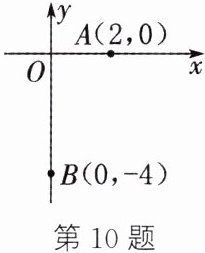
10. 如图,在平面直角坐标系中,以点$A(2,0)$为圆心作圆,使圆经过点$B(0,-4)$。
(1)试判断点$C(0,4)$、$D(-2,0)$、$E(0,8)$与$\odot A$的位置关系;
(2)若点$M(0,m)$在$\odot A$外,则$m$的取值范围是
(1)试判断点$C(0,4)$、$D(-2,0)$、$E(0,8)$与$\odot A$的位置关系;
(2)若点$M(0,m)$在$\odot A$外,则$m$的取值范围是
$ m < -4 $ 或 $ m > 4 $
。答案
10. (1) 连接AB. $ \because A(2, 0) $、$ B(0, -4) $, $ \therefore OA = 2 $, $ OB = 4 $. 在 $ Rt \triangle AOB $ 中, 由勾股定理, 得 $ AB = \sqrt{2^2 + 4^2} = 2\sqrt{5} $, 即 $ \odot A $ 的半径为 $ 2\sqrt{5} $. $ \because C(0, 4) $、$ D(-2, 0) $、$ E(0, 8) $, $ \therefore $ 同理, 可得 $ AC = 2\sqrt{5} $, $ AD = 4 $, $ AE = 2\sqrt{17} $. $ \because AC = 2\sqrt{5} $, $ AD < 2\sqrt{5} $, $ AE > 2\sqrt{5} $, $ \therefore $ 点 $ C(0, 4) $ 在 $ \odot A $ 上, 点 $ D(-2, 0) $ 在 $ \odot A $ 内, 点 $ E(0, 8) $ 在 $ \odot A $ 外 (2) $ m < -4 $ 或 $ m > 4 $
解析
(1) 连接$AB$。
$\because A(2,0)$,$B(0,-4)$,
$\therefore OA=2$,$OB=4$。
在$Rt\triangle AOB$中,由勾股定理得:
$AB=\sqrt{OA^2 + OB^2}=\sqrt{2^2 + 4^2}=2\sqrt{5}$,即$\odot A$的半径为$2\sqrt{5}$。
$\because C(0,4)$,
$\therefore AC=\sqrt{(2-0)^2 + (0-4)^2}=\sqrt{4 + 16}=2\sqrt{5}$,故点$C$在$\odot A$上;
$\because D(-2,0)$,
$\therefore AD=\sqrt{(2 - (-2))^2 + (0 - 0)^2}=\sqrt{16}=4$,
$\because 4 < 2\sqrt{5}$($2\sqrt{5}\approx4.47$),故点$D$在$\odot A$内;
$\because E(0,8)$,
$\therefore AE=\sqrt{(2 - 0)^2 + (0 - 8)^2}=\sqrt{4 + 64}=2\sqrt{17}$,
$\because 2\sqrt{17} > 2\sqrt{5}$,故点$E$在$\odot A$外。
(2) $m < -4$或$m > 4$
$\because A(2,0)$,$B(0,-4)$,
$\therefore OA=2$,$OB=4$。
在$Rt\triangle AOB$中,由勾股定理得:
$AB=\sqrt{OA^2 + OB^2}=\sqrt{2^2 + 4^2}=2\sqrt{5}$,即$\odot A$的半径为$2\sqrt{5}$。
$\because C(0,4)$,
$\therefore AC=\sqrt{(2-0)^2 + (0-4)^2}=\sqrt{4 + 16}=2\sqrt{5}$,故点$C$在$\odot A$上;
$\because D(-2,0)$,
$\therefore AD=\sqrt{(2 - (-2))^2 + (0 - 0)^2}=\sqrt{16}=4$,
$\because 4 < 2\sqrt{5}$($2\sqrt{5}\approx4.47$),故点$D$在$\odot A$内;
$\because E(0,8)$,
$\therefore AE=\sqrt{(2 - 0)^2 + (0 - 8)^2}=\sqrt{4 + 64}=2\sqrt{17}$,
$\because 2\sqrt{17} > 2\sqrt{5}$,故点$E$在$\odot A$外。
(2) $m < -4$或$m > 4$
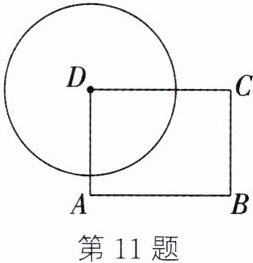
11. 如图,在矩形$ABCD$中,$AB=4$,$AD=3$,以顶点$D$为圆心,半径为$r$作圆。
(1)在点$A$、$B$、$C$中,若有且只有一点在圆内,求$r$的取值范围;
(2)在点$A$、$B$、$C$中,若至少有一点在圆内,至少有一点在圆外,求$r$的取值范围。
(1)在点$A$、$B$、$C$中,若有且只有一点在圆内,求$r$的取值范围;
(2)在点$A$、$B$、$C$中,若至少有一点在圆内,至少有一点在圆外,求$r$的取值范围。
答案
11. 连接DB. $ \because $ 四边形ABCD为矩形, $ \therefore \angle A = 90^{\circ} $, $ DC = AB $. $ \because AB = 4 $, $ AD = 3 $, $ \therefore DC = 4 $, $ BD = \sqrt{3^2 + 4^2} = 5 $, $ \therefore DA < DC < DB $. (1) 由题意, 得只能是点A在 $ \odot D $ 内, 点B、C均不在 $ \odot D $ 内, $ \therefore DA < r \leq DC $, 即 $ 3 < r \leq 4 $ (2) 由题意, 得点A一定在 $ \odot D $ 内, 点B一定在 $ \odot D $ 外, $ \therefore 3 < r < 5 $
解析
(1)连接$DB$。
$\because$ 四边形$ABCD$为矩形,
$\therefore \angle A=90°$,$DC=AB=4$。
$\because AD=3$,
$\therefore BD=\sqrt{AD^2+AB^2}=\sqrt{3^2+4^2}=5$。
$\therefore DA=3$,$DC=4$,$DB=5$,且$DA<DC<DB$。
若有且只有一点在圆内,则该点只能为$A$,点$B$、$C$不在圆内,
$\therefore DA<r\leq DC$,即$3<r\leq4$。
(2)若至少有一点在圆内且至少有一点在圆外,
则点$A$在圆内,点$B$在圆外,
$\therefore DA<r<DB$,即$3<r<5$。
(1)$3<r\leq4$;(2)$3<r<5$。
$\because$ 四边形$ABCD$为矩形,
$\therefore \angle A=90°$,$DC=AB=4$。
$\because AD=3$,
$\therefore BD=\sqrt{AD^2+AB^2}=\sqrt{3^2+4^2}=5$。
$\therefore DA=3$,$DC=4$,$DB=5$,且$DA<DC<DB$。
若有且只有一点在圆内,则该点只能为$A$,点$B$、$C$不在圆内,
$\therefore DA<r\leq DC$,即$3<r\leq4$。
(2)若至少有一点在圆内且至少有一点在圆外,
则点$A$在圆内,点$B$在圆外,
$\therefore DA<r<DB$,即$3<r<5$。
(1)$3<r\leq4$;(2)$3<r<5$。
