

 登录
听下面一段较长的对话,回答第8~10小题。
(
A. By texting.
B. By writing letters.
C. By video calls.
(
A. People exercise more.
B. Life is more convenient.
C. Families talk less.
(
A. Stop using modern technology.
B. Only follow the old habits.
C. Balance technology and healthy habits.
(
B
)8. How did people mainly communicate in the past?A. By texting.
B. By writing letters.
C. By video calls.
(
B
)9. What is one advantage of modern life?A. People exercise more.
B. Life is more convenient.
C. Families talk less.
(
C
)10. What does Amy suggest?A. Stop using modern technology.
B. Only follow the old habits.
C. Balance technology and healthy habits.
答案
8. B
9. B
10. C
第三节:听独白,从A、B、C三个选项中选出正确的选项。
(
A. Russia. B. France. C. Germany.
(
A. Last June. B. Last July. C. Last August.
(
A. Exciting. B. Boring. C. Relaxing.
(
A. She visited the local museum.
B. She learned the local language.
C. She learned to make local food.
(
A. To speak Chinese well.
B. To come to China again.
C. To make more Chinese friends.
(
A
)11. Where does Anna come from?A. Russia. B. France. C. Germany.
(
C
)12. When did Anna come to China?A. Last June. B. Last July. C. Last August.
(
A
)13. What did Anna think of the trip to Zhejiang?A. Exciting. B. Boring. C. Relaxing.
(
C
)14. What did Anna do in Zhejiang?A. She visited the local museum.
B. She learned the local language.
C. She learned to make local food.
(
B
)15. What is Anna's hope?A. To speak Chinese well.
B. To come to China again.
C. To make more Chinese friends.
答案
11. A
12. C
13. A
14. C
15. B
Would you like to be taught by a robot or a computer? Imagine an AI classroom:
there is no robot at the front of the class, just AI programs on your computers and
virtual reality(VR) headsets. Human learning coaches are also in classrooms to lend a
hand, if needed. Here are some comments from the Internet users.
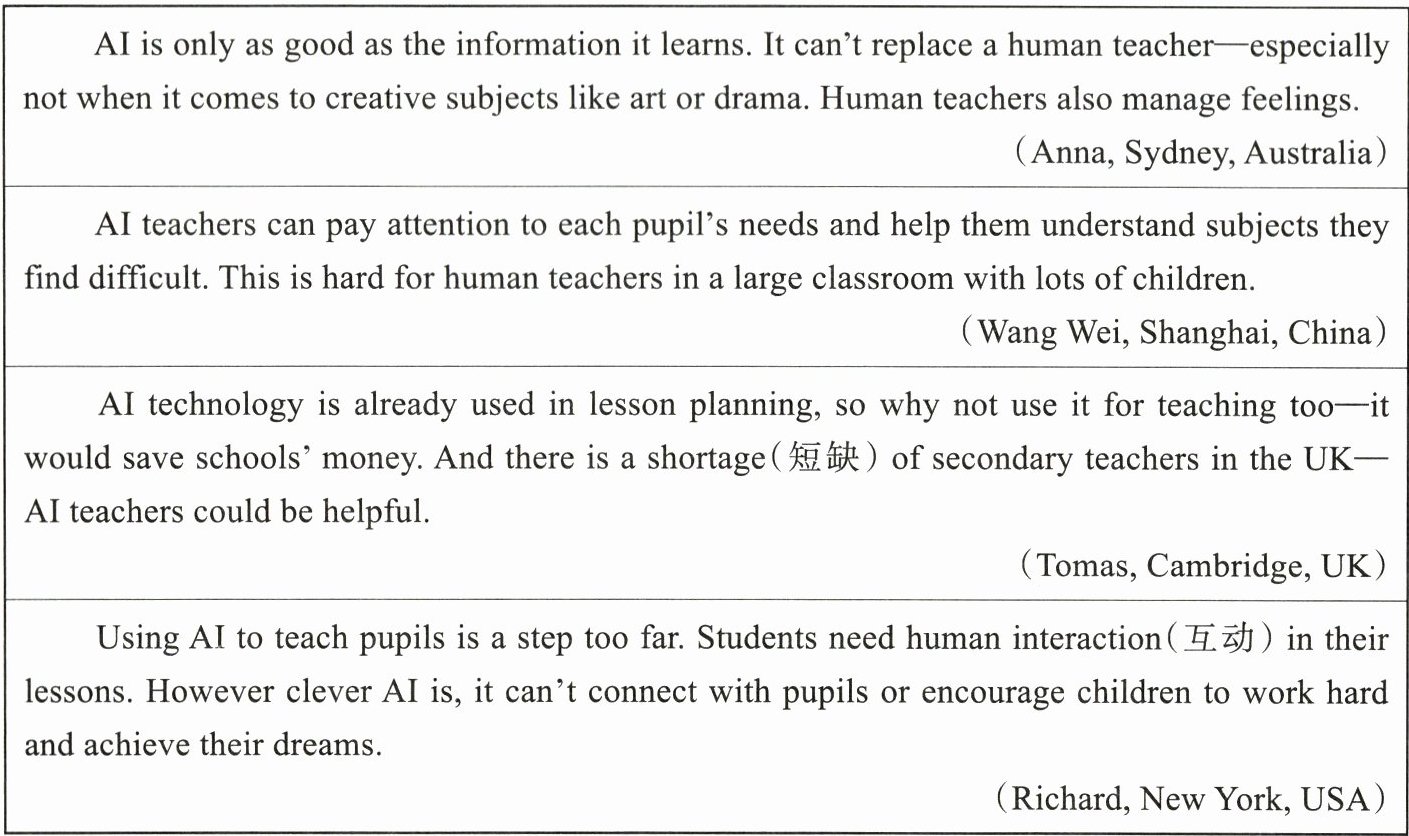
(
A. A robot and computers.
B. Sports coaches and computers.
C. A robot and human teachers.
D. Computers and human teachers.
(
A. AI teachers are helpful and money-saving.
B. AI teachers do better at dealing with students.
C. AI teachers build a real relationship with students.
D. AI teachers can teach students as well as human teachers.
(
A. Health.
B. Sports.
C. Travel.
D. Education.
there is no robot at the front of the class, just AI programs on your computers and
virtual reality(VR) headsets. Human learning coaches are also in classrooms to lend a
hand, if needed. Here are some comments from the Internet users.
(
D
)1. What can we find in an AI classroom?A. A robot and computers.
B. Sports coaches and computers.
C. A robot and human teachers.
D. Computers and human teachers.
(
A
)2. Which of the following ideas does Thomas probably agree with?A. AI teachers are helpful and money-saving.
B. AI teachers do better at dealing with students.
C. AI teachers build a real relationship with students.
D. AI teachers can teach students as well as human teachers.
(
D
)3. In which column of the magazine can we read the text?A. Health.
B. Sports.
C. Travel.
D. Education.
答案
1. D
2. A
3. D
