

 登录
登录
六、读一读,判断下列行为是(T)否(F)环保。
(
(
(
(
(
(
T
)1. Mr Zhang's workplace is far from his home. He goes to work by metro or bus every day.(
F
)2. Mr Smith has a big office. When he goes home, he always forgets to turn off the lights.(
T
)3. Mrs Zhang is a housewife. When she goes to the supermarket, she usually takes reusable bags with her.(
T
)4. Linda's favourite drink is coffee. She buys coffee every morning. But she usually uses her own glass bottle to drink coffee.(
T
)5. Mr Black washes his clothes before bedtime, and he always washes clothes by hand. He doesn't want to use the washing machine.答案
1. T 解析 乘坐地铁或公交上班,减少私家车的使用,能降低碳排放,是环保行为。 2. F 解析 下班忘记关灯,会造成电力资源的浪费,不符合环保的要求。 3. T 解析 去超市时携带可重复使用的袋子,减少一次性塑料袋的使用,能减少污染,是环保行为。 4. T 解析 用自己的玻璃瓶喝咖啡,减少一次性纸杯或塑料杯的使用,能减少垃圾的产生,是环保行为。 5. T 解析 用手洗衣服,不使用洗衣机,能节约水电资源,是环保行为。
解析
【分析】判断环保行为的核心是看行为是否能节约资源、减少污染或降低碳排放。需逐一分析每个小题的行为:1. 远路选择公共交通,减少私家车使用;2. 忘关灯浪费电力;3. 带可重复购物袋减少一次性塑料袋使用;4. 用自己的玻璃瓶减少一次性杯使用;5. 手洗衣服节约水电。根据这些标准即可判断。
【解析】1. 乘坐地铁或公交上班,减少私家车的使用,降低碳排放,属于环保行为,故填T;2. 下班忘记关灯会造成电力资源的浪费,不符合环保要求,故填F;3. 去超市时携带可重复使用的袋子,减少一次性塑料袋的使用,减少污染,属于环保行为,故填T;4. 使用自己的玻璃瓶喝咖啡,减少一次性纸杯或塑料杯的使用,减少垃圾产生,属于环保行为,故填T;5. 用手洗衣服代替洗衣机,节约水电资源,属于环保行为,故填T。
【答案】1. T 2. F 3. T 4. T 5. T
【知识点】环保行为判断、日常环保常识
【点评】本题结合日常场景考查环保知识,贴近学生生活,帮助学生理解环保行为,树立环保意识,难度较低。
【难度系数】0.8
【解析】1. 乘坐地铁或公交上班,减少私家车的使用,降低碳排放,属于环保行为,故填T;2. 下班忘记关灯会造成电力资源的浪费,不符合环保要求,故填F;3. 去超市时携带可重复使用的袋子,减少一次性塑料袋的使用,减少污染,属于环保行为,故填T;4. 使用自己的玻璃瓶喝咖啡,减少一次性纸杯或塑料杯的使用,减少垃圾产生,属于环保行为,故填T;5. 用手洗衣服代替洗衣机,节约水电资源,属于环保行为,故填T。
【答案】1. T 2. F 3. T 4. T 5. T
【知识点】环保行为判断、日常环保常识
【点评】本题结合日常场景考查环保知识,贴近学生生活,帮助学生理解环保行为,树立环保意识,难度较低。
【难度系数】0.8
七、阅读短文,选择正确的答案。
① To protect the Earth, we should save electricity. More and more people are worried about global warming. The world is getting warmer. So we should know how to stay cool in the city.
② In summer, the heatwave lasts a long time. In the city, people have much trouble because of hot weather. They have to find some ways to stay cool without electricity.
③ They build houses that keep out the sun's heat and let in the cool wind. They make more places with shady areas.
④ Plants can help make the city cooler, so people put plants on their house roofs. They also build more parks and gardens.
⑤ In some cities, people paint the buildings with light colours. In this way, the buildings will absorb(吸收) less heat from the sun. People in them will feel cool.
(
A. Because they like cold weather.
B. Because hot weather brings a lot of trouble.
C. Because they want to save electricity.
(
A. 热浪
B. 暖气
C. 加热
(
A. Use fewer windows.
B. Build a tall house.
C. Put some plants on the roof.
(逻辑推理 The buildings in
A. light
B. dark
C. bright
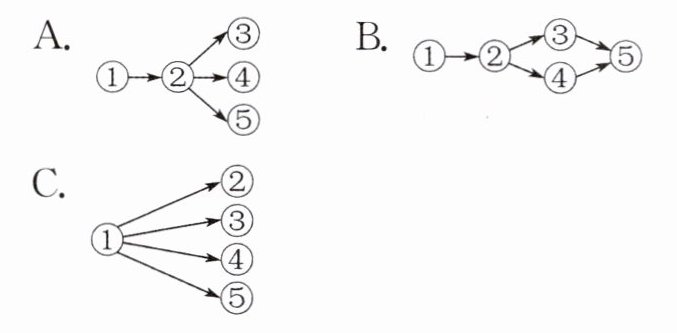
(脉络结构 Which of the following shows the structure of the passage?
① To protect the Earth, we should save electricity. More and more people are worried about global warming. The world is getting warmer. So we should know how to stay cool in the city.
② In summer, the heatwave lasts a long time. In the city, people have much trouble because of hot weather. They have to find some ways to stay cool without electricity.
③ They build houses that keep out the sun's heat and let in the cool wind. They make more places with shady areas.
④ Plants can help make the city cooler, so people put plants on their house roofs. They also build more parks and gardens.
⑤ In some cities, people paint the buildings with light colours. In this way, the buildings will absorb(吸收) less heat from the sun. People in them will feel cool.
(
B
)1. Why do people try to make their houses cooler?A. Because they like cold weather.
B. Because hot weather brings a lot of trouble.
C. Because they want to save electricity.
(
A
)2. The underlined word "heatwave" means "A
" in Chinese.A. 热浪
B. 暖气
C. 加热
(
C
)3. If you are building a house in a hot place, what can you do to keep it cool?A. Use fewer windows.
B. Build a tall house.
C. Put some plants on the roof.
(
B
)4. B
colours will absorb more heat.A. light
B. dark
C. bright
(
A
)5. 答案
1. B 解析 根据原文第二段中“In the city, people have much trouble because of hot weather. They have to find some ways to stay cool without electricity.”可知,人们想让房子变凉快是因为炎热的天气带来了很多麻烦。 2. A 解析 根据原文中“In summer, the heatwave lasts a long time. In the city, people have much trouble because of hot weather.”可知,heatwave 是夏天持续的炎热天气,对应中文“热浪”。 3. C 4. B 解析 根据原文第五段中“In some cities, people paint the buildings with light colours. In this way, the buildings will absorb less heat from the sun.”可知,浅色的建筑吸收的热量更少,由此可推理出,深色的建筑会吸收更多的热量。 5. A
解析
【分析】本题为英语阅读理解题,需根据原文内容解答细节查找、词义猜测、逻辑推理及文章结构类题目。第1题需定位人们想让房屋变凉的原因,对应原文第二段;第2题结合上下文猜测“heatwave”的含义;第3题查找保持房屋凉爽的方法,对应原文第四段;第4题根据第五段浅色建筑吸热少,反推深色建筑吸热多;第5题梳理文章结构,判断各段落的逻辑关系。
【解析】
1. 细节查找题:根据原文第二段“In the city, people have much trouble because of hot weather. They have to find some ways to stay cool without electricity.”可知,炎热天气带来很多麻烦,所以人们想让房子变凉快,答案选B。
2. 词义猜测题:根据上下文“In summer, the heatwave lasts a long time. In the city, people have much trouble because of hot weather.”可知,heatwave是夏天持续的炎热天气,对应中文“热浪”,选A。
3. 细节查找题:根据原文第四段“Plants can help make the city cooler, so people put plants on their house roofs.”可知,在屋顶放植物能让房子变凉,选C。
4. 逻辑推理题:根据原文第五段“people paint the buildings with light colours. In this way, the buildings will absorb less heat from the sun.”可知,浅色建筑吸热少,反之深色建筑吸收更多热量,选B。
5. 文章结构题:原文第一段引出话题,第二段说明夏天炎热带来麻烦,第三、四、五段分别介绍保持凉爽的不同方法,结构为①→②,②引出③、④、⑤,对应选项A的结构,选A。
【答案】1.B 2.A 3.C 4.B 5.A
【知识点】英语阅读理解、词义猜测、逻辑推理、文章结构
【点评】本题综合考查英语阅读的多种核心能力,要求学生精准定位原文信息、结合上下文推断词义、依据文本逻辑进行推理、梳理文章结构,是中等难度的阅读题,适合学生巩固阅读解题技巧。
【难度系数】0.5
【解析】
1. 细节查找题:根据原文第二段“In the city, people have much trouble because of hot weather. They have to find some ways to stay cool without electricity.”可知,炎热天气带来很多麻烦,所以人们想让房子变凉快,答案选B。
2. 词义猜测题:根据上下文“In summer, the heatwave lasts a long time. In the city, people have much trouble because of hot weather.”可知,heatwave是夏天持续的炎热天气,对应中文“热浪”,选A。
3. 细节查找题:根据原文第四段“Plants can help make the city cooler, so people put plants on their house roofs.”可知,在屋顶放植物能让房子变凉,选C。
4. 逻辑推理题:根据原文第五段“people paint the buildings with light colours. In this way, the buildings will absorb less heat from the sun.”可知,浅色建筑吸热少,反之深色建筑吸收更多热量,选B。
5. 文章结构题:原文第一段引出话题,第二段说明夏天炎热带来麻烦,第三、四、五段分别介绍保持凉爽的不同方法,结构为①→②,②引出③、④、⑤,对应选项A的结构,选A。
【答案】1.B 2.A 3.C 4.B 5.A
【知识点】英语阅读理解、词义猜测、逻辑推理、文章结构
【点评】本题综合考查英语阅读的多种核心能力,要求学生精准定位原文信息、结合上下文推断词义、依据文本逻辑进行推理、梳理文章结构,是中等难度的阅读题,适合学生巩固阅读解题技巧。
【难度系数】0.5
