

 登录
登录
一、用所给词的适当形式填空
1. We can reduce waste by
2. Mike is
3. After the accident, he felt like he had a
4. We made a bookshelf by
1. We can reduce waste by
reusing
(reuse) things.2. Mike is
creative
(create) enough to come up with new suggestions.3. After the accident, he felt like he had a
second
(two) life.4. We made a bookshelf by
upcycling
(upcycle) old wooden boxes.答案
1. reusing
2. creative
3. second
4. upcycling
2. creative
3. second
4. upcycling
解析
【分析】
这是用所给词适当形式填空的英语题,需结合词性、固定搭配、句意进行词形变形:1. 介词by后接动词需用动名词;2. “be + adj + enough + to do”结构需形容词作表语;3. 表示“第二次”需用序数词;4. 介词by后接动词需用动名词。
【解析】
1. 第1题:by是介词,介词后接动词时需用动名词(doing)形式,因此将动词reuse变为动名词reusing。
2. 第2题:此处需形容词作表语,构成“be + adj + enough + to do”结构,动词create的形容词形式为creative,意为“有创造力的”,符合语境。
3. 第3题:根据句意“事故后,他觉得自己有了第二次生命”,此处需用two的序数词second,a second life表示“第二次生命”,符合语义。
4. 第4题:by是介词,后接动词需用动名词形式,因此将upcycle变为动名词upcycling。
【答案】
1. reusing
2. creative
3. second
4. upcycling
【知识点】
介词后接动名词、形容词转换、序数词用法
【点评】
本题考查初中英语基础词形变化,涉及介词搭配、形容词构成、序数词使用,知识点基础,难度较低,需掌握常见词形变化规则和固定搭配。
【难度系数】
0.8
这是用所给词适当形式填空的英语题,需结合词性、固定搭配、句意进行词形变形:1. 介词by后接动词需用动名词;2. “be + adj + enough + to do”结构需形容词作表语;3. 表示“第二次”需用序数词;4. 介词by后接动词需用动名词。
【解析】
1. 第1题:by是介词,介词后接动词时需用动名词(doing)形式,因此将动词reuse变为动名词reusing。
2. 第2题:此处需形容词作表语,构成“be + adj + enough + to do”结构,动词create的形容词形式为creative,意为“有创造力的”,符合语境。
3. 第3题:根据句意“事故后,他觉得自己有了第二次生命”,此处需用two的序数词second,a second life表示“第二次生命”,符合语义。
4. 第4题:by是介词,后接动词需用动名词形式,因此将upcycle变为动名词upcycling。
【答案】
1. reusing
2. creative
3. second
4. upcycling
【知识点】
介词后接动名词、形容词转换、序数词用法
【点评】
本题考查初中英语基础词形变化,涉及介词搭配、形容词构成、序数词使用,知识点基础,难度较低,需掌握常见词形变化规则和固定搭配。
【难度系数】
0.8
(
A.pollute
B.recycle
C.break
D.punish
B
)5. We can waste paper and glass to protect resources.A.pollute
B.recycle
C.break
D.punish
答案
5. B
解析
【分析】
首先理解句子语境:句子表达的是为了保护资源,我们对废纸和玻璃采取的动作。接下来逐一分析选项词义,结合“保护资源”的目的,选出符合逻辑的动词。
【解析】
先翻译句子:“我们可以______废纸和玻璃来保护资源”。辨析各选项:A.pollute意为“污染”,不符合保护资源的目的;B.recycle意为“回收利用”,回收废纸和玻璃是保护资源的正确做法;C.break意为“打破”、D.punish意为“惩罚”,均不符合语境。因此选B。
【答案】
B
【知识点】
动词词义辨析;语境运用
【点评】
本题考查基础动词在具体语境中的运用,只需掌握各选项词义并结合“保护资源”的逻辑即可解题,属于基础题型。
【难度系数】
0.9
首先理解句子语境:句子表达的是为了保护资源,我们对废纸和玻璃采取的动作。接下来逐一分析选项词义,结合“保护资源”的目的,选出符合逻辑的动词。
【解析】
先翻译句子:“我们可以______废纸和玻璃来保护资源”。辨析各选项:A.pollute意为“污染”,不符合保护资源的目的;B.recycle意为“回收利用”,回收废纸和玻璃是保护资源的正确做法;C.break意为“打破”、D.punish意为“惩罚”,均不符合语境。因此选B。
【答案】
B
【知识点】
动词词义辨析;语境运用
【点评】
本题考查基础动词在具体语境中的运用,只需掌握各选项词义并结合“保护资源”的逻辑即可解题,属于基础题型。
【难度系数】
0.9
(
A.Really
B.Instead
C.Once
D.Also
B
) 6. To keep fit, she doesn't sit for long. , she goes out to exercise.A.Really
B.Instead
C.Once
D.Also
答案
6. B
解析
【分析】首先梳理句子逻辑:前半句说明“为了保持健康,她不会长时间坐着”,后半句需表达与“长时间坐着”相反的替代动作,需要选择能体现“替代、反而”含义的副词。接下来逐一分析选项,排除不符合语境的内容,确定正确答案。
【解析】句子翻译为“为了保持健康,她不会长时间坐着,反而,她出去锻炼”。A选项Really意为“真正地”,不符合语境;B选项Instead意为“代替,反而”,用于引出与前文相反的动作,契合句子逻辑;C选项Once意为“曾经”,语义不通;D选项Also意为“也”,无法体现前后动作的替代关系,因此选B。
【答案】B
【知识点】副词辨析;语境逻辑
【点评】本题考查副词在具体语境中的运用,需准确把握句子的逻辑关系,区分各副词的含义,属于基础题型,难度较低。
【难度系数】0.3
【解析】句子翻译为“为了保持健康,她不会长时间坐着,反而,她出去锻炼”。A选项Really意为“真正地”,不符合语境;B选项Instead意为“代替,反而”,用于引出与前文相反的动作,契合句子逻辑;C选项Once意为“曾经”,语义不通;D选项Also意为“也”,无法体现前后动作的替代关系,因此选B。
【答案】B
【知识点】副词辨析;语境逻辑
【点评】本题考查副词在具体语境中的运用,需准确把握句子的逻辑关系,区分各副词的含义,属于基础题型,难度较低。
【难度系数】0.3
(
—That's right. As students, we should the time we spend on games.
A.cut down
B.put down
C.take down
D.run down
A
)7.—Playing computer games too much is bad for our eyes and studies.—That's right. As students, we should the time we spend on games.
A.cut down
B.put down
C.take down
D.run down
答案
7. A
解析
【分析】本题考查英语动词短语辨析,解题时需先明确对话语境(玩电脑游戏过多有害,学生应调整游戏时间),再逐一辨析各选项短语含义,结合语境选出符合要求的答案。
【解析】对话含义:“玩太多电脑游戏对我们的眼睛和学习不好。”“没错。作为学生,我们应该______花在游戏上的时间。”选项分析:A. cut down意为“减少”,符合“减少游戏时间”的语境;B. put down意为“放下、记下”,C. take down意为“取下、记下”,D. run down意为“耗尽、撞倒”,均不符合语境,因此选A。
【答案】A
【知识点】动词短语辨析;词汇运用
【点评】本题为英语基础题型,侧重常用动词短语的词义辨析,结合日常语境即可判断,考查学生对核心短语的掌握情况。
【难度系数】0.8
【解析】对话含义:“玩太多电脑游戏对我们的眼睛和学习不好。”“没错。作为学生,我们应该______花在游戏上的时间。”选项分析:A. cut down意为“减少”,符合“减少游戏时间”的语境;B. put down意为“放下、记下”,C. take down意为“取下、记下”,D. run down意为“耗尽、撞倒”,均不符合语境,因此选A。
【答案】A
【知识点】动词短语辨析;词汇运用
【点评】本题为英语基础题型,侧重常用动词短语的词义辨析,结合日常语境即可判断,考查学生对核心短语的掌握情况。
【难度系数】0.8
(
, some students want to go to the moon someday.
A.In fact
B.Such as
C.For example
D.In all
C
)8. Young people have all kinds of dreams., some students want to go to the moon someday.
A.In fact
B.Such as
C.For example
D.In all
答案
8. C
解析
【分析】首先明确句子语境:前句总述年轻人有各种梦想,后句是具体举例说明。需辨析四个选项的用法差异:A项“In fact”意为“事实上”,不符合举例子的语境;B项“Such as”用于列举同类事物,后接名词/名词短语,无法接句子;C项“For example”用于举例,后可接句子且常用逗号隔开,契合此处语境;D项“In all”意为“总共”,与语境不符。因此要选能接句子举例的短语。
【解析】第一步,分析语境:前句总述年轻人有各类梦想,后句是举例说明具体梦想,需选表举例的短语。第二步,辨析选项:A选项“In fact”表强调事实,与举例无关,排除;B选项“Such as”后接名词性成分,空格后是句子,不符合用法,排除;C选项“For example”可接句子用于举例,符合要求;D选项“In all”表总计,不符合语境,排除。因此选C。
【答案】C
【知识点】副词短语辨析;for example与such as的用法区别
【点评】本题考查常见英语短语的用法辨析,重点区分“for example”和“such as”的使用场景,需准确掌握短语搭配规则,属于基础题型。
【难度系数】0.7
【解析】第一步,分析语境:前句总述年轻人有各类梦想,后句是举例说明具体梦想,需选表举例的短语。第二步,辨析选项:A选项“In fact”表强调事实,与举例无关,排除;B选项“Such as”后接名词性成分,空格后是句子,不符合用法,排除;C选项“For example”可接句子用于举例,符合要求;D选项“In all”表总计,不符合语境,排除。因此选C。
【答案】C
【知识点】副词短语辨析;for example与such as的用法区别
【点评】本题考查常见英语短语的用法辨析,重点区分“for example”和“such as”的使用场景,需准确掌握短语搭配规则,属于基础题型。
【难度系数】0.7
三、立德树人·践行环保生活任务型阅读
My father is very interested in dealing with the garbage problem. Last year, he decided to do something about all the wasted food we were
throwing away. Each family wastes a large amount of food yearly—nearly 0.25 tons. We usually throw away the unfinished rice, dishes, and more.
However, there is something we can do with it. If we properly deal with food waste, it can be changed into a kind of rich, dark earth known as compost. This compost can be added to vegetable gardens to make the plants grow really well.
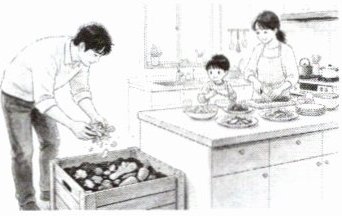
To deal with food waste in my family, my father came up with a good idea: instead of throwing away all our food waste, we put it into the compost bin. Mother Nature will slowly turn it from garbage into earth. Three months later, we were surprised to find that it was full of rich compost material!
Next time you eat outside, just order what you need. Similarly, just make what you need at home when cooking. This also helps to avoid wasting food. Do you have any other ideas? Think about it.
9. How much food waste does each family make yearly?(不超过5个词)
10. What was the father’s idea to deal with food waste?(不超过10个词)
11. 能力训练点·语言组织与表达 In your daily life, what can you do to reduce food waste?(不超过10个词)
My father is very interested in dealing with the garbage problem. Last year, he decided to do something about all the wasted food we were
throwing away. Each family wastes a large amount of food yearly—nearly 0.25 tons. We usually throw away the unfinished rice, dishes, and more.
However, there is something we can do with it. If we properly deal with food waste, it can be changed into a kind of rich, dark earth known as compost. This compost can be added to vegetable gardens to make the plants grow really well.
To deal with food waste in my family, my father came up with a good idea: instead of throwing away all our food waste, we put it into the compost bin. Mother Nature will slowly turn it from garbage into earth. Three months later, we were surprised to find that it was full of rich compost material!
Next time you eat outside, just order what you need. Similarly, just make what you need at home when cooking. This also helps to avoid wasting food. Do you have any other ideas? Think about it.
9. How much food waste does each family make yearly?(不超过5个词)
Nearly 0.25 tons.
10. What was the father’s idea to deal with food waste?(不超过10个词)
Putting food waste into the compost bin.
11. 能力训练点·语言组织与表达 In your daily life, what can you do to reduce food waste?(不超过10个词)
I can plan meals carefully and shop wisely.(言之有理即可)
答案
9. Nearly 0.25 tons.
10. Putting food waste into the compost bin.
11. I can plan meals carefully and shop wisely.(言之有理即可)
10. Putting food waste into the compost bin.
11. I can plan meals carefully and shop wisely.(言之有理即可)
解析
【分析】
本题为任务型阅读题,需根据题干要求从原文中定位关键信息作答,同时严格遵守答案的字数限制。第9题需查找每个家庭每年的食物浪费量,直接定位原文对应数据即可;第10题需提取父亲处理食物垃圾的核心办法,控制字数;第11题是开放性问题,结合日常减少食物浪费的做法,用简洁语言表达即可。
【解析】
9. 定位原文第一段“Each family wastes a large amount of food yearly—nearly 0.25 tons.”,提取符合字数要求的关键信息,故答案为Nearly 0.25 tons.
10. 定位原文第三段“instead of throwing away all our food waste, we put it into the compost bin.”,提炼核心做法并控制字数,故答案为Putting food waste into the compost bin.
11. 结合日常减少食物浪费的可行做法,用简洁语言表达,符合字数要求,故答案为I can plan meals carefully and shop wisely.
【答案】
9. Nearly 0.25 tons.
10. Putting food waste into the compost bin.
11. I can plan meals carefully and shop wisely.
【知识点】
任务型阅读、信息定位、语言表达
【点评】
本题以环保为主题,既考查学生从文本中提取信息的能力,又引导学生践行减少食物浪费的环保行为,体现立德树人的教育目标,题目难度适中。
【难度系数】
0.6
本题为任务型阅读题,需根据题干要求从原文中定位关键信息作答,同时严格遵守答案的字数限制。第9题需查找每个家庭每年的食物浪费量,直接定位原文对应数据即可;第10题需提取父亲处理食物垃圾的核心办法,控制字数;第11题是开放性问题,结合日常减少食物浪费的做法,用简洁语言表达即可。
【解析】
9. 定位原文第一段“Each family wastes a large amount of food yearly—nearly 0.25 tons.”,提取符合字数要求的关键信息,故答案为Nearly 0.25 tons.
10. 定位原文第三段“instead of throwing away all our food waste, we put it into the compost bin.”,提炼核心做法并控制字数,故答案为Putting food waste into the compost bin.
11. 结合日常减少食物浪费的可行做法,用简洁语言表达,符合字数要求,故答案为I can plan meals carefully and shop wisely.
【答案】
9. Nearly 0.25 tons.
10. Putting food waste into the compost bin.
11. I can plan meals carefully and shop wisely.
【知识点】
任务型阅读、信息定位、语言表达
【点评】
本题以环保为主题,既考查学生从文本中提取信息的能力,又引导学生践行减少食物浪费的环保行为,体现立德树人的教育目标,题目难度适中。
【难度系数】
0.6
