

 登录
登录
Ⅱ. 阅读下面短文,掌握其大意,从每小题所给的A、B、C三个选项中选出最佳选项。
A
Chopsticks were invented at least 3,000 years ago. Emperor Xin, also called King Zhou, the last king of the Shang Dynasty, already used ivory(象牙) chopsticks. Common people used chopsticks made of bamboo or wood. Later, there were also metal(金属) chopsticks.
More than 2,000 years ago, Mozi made the first kite. It was a wooden bird. Kites were first used as a sign to ask for help in the fight. Flying kites became people's favorite outdoor activity in the Song Dynasty.
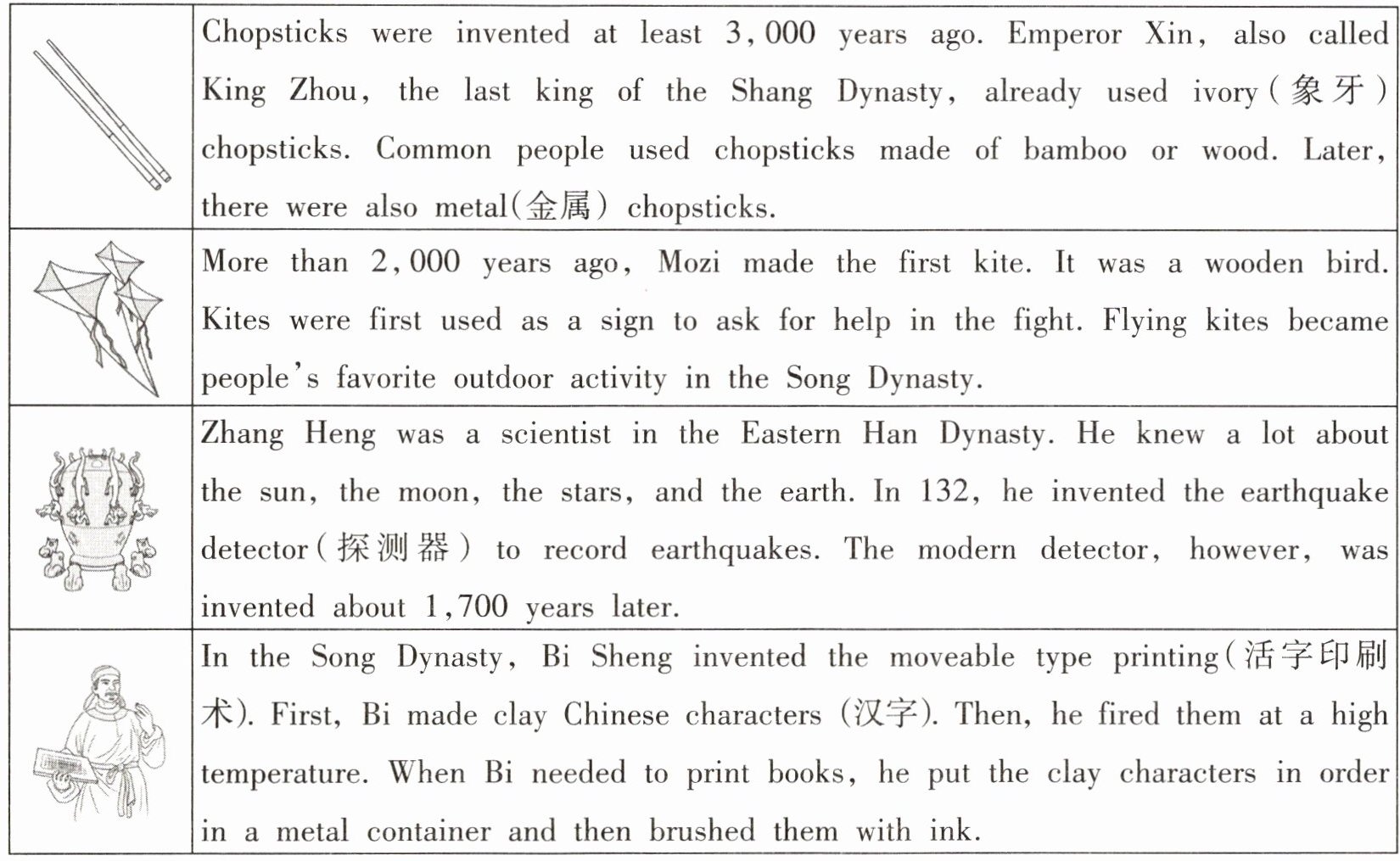
Zhang Heng was a scientist in Eastern Han Dynasty. He knew a lot about the sun, the moon, the stars, and the earth. In 132, he invented the earthquake detector(探测器) to record earthquakes. The modern detector, however, was invented about 1,700 years later.
In the Song Dynasty, Bi Sheng invented the moveable type printing(活字印刷术). First, Bi made clay Chinese characters (汉字). Then, he fired them at a high temperature. When Bi needed to print books, he put the clay characters in order in a metal container and then brushed them with ink.
(
A. Bamboo. B. Ivory. C. Wood.
(
A. In the Shang Dynasty. B. In the Han Dynasty. C. In the Song Dynasty.
(
A. A wooden bird. B. An earthquake detector.
C. Moveable type printing.
(
a. firing the clay pieces at a high temperature
b. brushing the clay characters with ink
c. making clay Chinese characters
d. arranging the clay characters in a holder
A. c→b→a→d B. c→a→d→b C. d→b→c→a
(
A. Ancient Chinese Inventions and Their Uses.
B. Famous Scientists in Chinese History.
C. The Development of Chinese Writing Tools.
A
Chopsticks were invented at least 3,000 years ago. Emperor Xin, also called King Zhou, the last king of the Shang Dynasty, already used ivory(象牙) chopsticks. Common people used chopsticks made of bamboo or wood. Later, there were also metal(金属) chopsticks.
More than 2,000 years ago, Mozi made the first kite. It was a wooden bird. Kites were first used as a sign to ask for help in the fight. Flying kites became people's favorite outdoor activity in the Song Dynasty.
Zhang Heng was a scientist in Eastern Han Dynasty. He knew a lot about the sun, the moon, the stars, and the earth. In 132, he invented the earthquake detector(探测器) to record earthquakes. The modern detector, however, was invented about 1,700 years later.
In the Song Dynasty, Bi Sheng invented the moveable type printing(活字印刷术). First, Bi made clay Chinese characters (汉字). Then, he fired them at a high temperature. When Bi needed to print books, he put the clay characters in order in a metal container and then brushed them with ink.
(
B
)1. What were Emperor Xin's chopsticks made of?A. Bamboo. B. Ivory. C. Wood.
(
C
)2. When did flying kites become people's favorite outdoor activity?A. In the Shang Dynasty. B. In the Han Dynasty. C. In the Song Dynasty.
(
B
)3. What did Zhang Heng invent in 132?A. A wooden bird. B. An earthquake detector.
C. Moveable type printing.
(
B
)4. Which is the right order of the moveable type printing?a. firing the clay pieces at a high temperature
b. brushing the clay characters with ink
c. making clay Chinese characters
d. arranging the clay characters in a holder
A. c→b→a→d B. c→a→d→b C. d→b→c→a
(
A
)5. What is the best title of this passage?A. Ancient Chinese Inventions and Their Uses.
B. Famous Scientists in Chinese History.
C. The Development of Chinese Writing Tools.
答案
(A)1—5 BCBBA
解析
【分析】
本题是关于中国古代发明的英语阅读理解题,共5道小题,包含细节理解和主旨大意类题目。解题思路:先通读全文把握各段落核心内容,针对细节题定位原文对应语句,对比选项得出答案;主旨题需总结全文核心,排除片面或不符选项。
【解析】
1. 第1题:定位原文第一段“Emperor Xin...already used ivory chopsticks”,可知辛帝的筷子是象牙制的,选B。
2. 第2题:定位原文第二段“Flying kites became people's favorite outdoor activity in the Song Dynasty”,可知放风筝成为热门户外活动是在宋代,选C。
3. 第3题:定位原文第三段“In 132, he invented the earthquake detector”,可知张衡132年发明了地动仪,选B。
4. 第4题:定位原文第四段活字印刷步骤:先制作黏土汉字(c)→高温烧制(a)→按顺序排列在容器中(d)→刷墨(b),顺序为c→a→d→b,选B。
5. 第5题:全文围绕中国古代发明(筷子、风筝、地动仪、活字印刷)展开,A选项“Ancient Chinese Inventions and Their Uses”符合;B仅涉及部分科学家,片面;C是书写工具发展,不符,选A。
【答案】BCBBA
【知识点】阅读理解、细节理解、主旨大意
【点评】本题考查学生英语阅读的信息定位、细节理解及主旨归纳能力,内容贴近中国古代文化,难度适中,适合初中学生练习。
【难度系数】0.6
本题是关于中国古代发明的英语阅读理解题,共5道小题,包含细节理解和主旨大意类题目。解题思路:先通读全文把握各段落核心内容,针对细节题定位原文对应语句,对比选项得出答案;主旨题需总结全文核心,排除片面或不符选项。
【解析】
1. 第1题:定位原文第一段“Emperor Xin...already used ivory chopsticks”,可知辛帝的筷子是象牙制的,选B。
2. 第2题:定位原文第二段“Flying kites became people's favorite outdoor activity in the Song Dynasty”,可知放风筝成为热门户外活动是在宋代,选C。
3. 第3题:定位原文第三段“In 132, he invented the earthquake detector”,可知张衡132年发明了地动仪,选B。
4. 第4题:定位原文第四段活字印刷步骤:先制作黏土汉字(c)→高温烧制(a)→按顺序排列在容器中(d)→刷墨(b),顺序为c→a→d→b,选B。
5. 第5题:全文围绕中国古代发明(筷子、风筝、地动仪、活字印刷)展开,A选项“Ancient Chinese Inventions and Their Uses”符合;B仅涉及部分科学家,片面;C是书写工具发展,不符,选A。
【答案】BCBBA
【知识点】阅读理解、细节理解、主旨大意
【点评】本题考查学生英语阅读的信息定位、细节理解及主旨归纳能力,内容贴近中国古代文化,难度适中,适合初中学生练习。
【难度系数】0.6
