

 登录
登录
一、东东今天状态不佳,他怎么了? 请听下面一段对话。对话后有几个小题,从题中所给的 A、B、C 三个选项中选出最佳选项。对话读两遍。
1. Why is Dongdong not happy? (
A. He has much homework to do.
B. He has two maths classes today.
C. He has many classes on Tuesdays.
2. Who thinks maths is interesting? (
A. Erin.
B. Dongdong.
C. Dongdong's father.
3. What's Erin's favourite subject? (
A. Maths.
B. Chinese.
C. History.
1. Why is Dongdong not happy? (
B
)A. He has much homework to do.
B. He has two maths classes today.
C. He has many classes on Tuesdays.
2. Who thinks maths is interesting? (
C
)A. Erin.
B. Dongdong.
C. Dongdong's father.
3. What's Erin's favourite subject? (
B
)A. Maths.
B. Chinese.
C. History.
答案
1. B
2. C
3. B
2. C
3. B
二、东东最喜欢的学科是什么?请先阅读下面短文,掌握其大意,然后用方框中所给单词的适当形式填空。每个单词限用一次。
remember term everyone
reason with future because
problem excellent biology
My Favourite Subject
I'm a student in Sunshine Middle School. I have many kinds of subjects this 1.
2.
How about you? What do you study? What's your favourite subject? Why? Please share your 10.
remember term everyone
reason with future because
problem excellent biology
My Favourite Subject
I'm a student in Sunshine Middle School. I have many kinds of subjects this 1.
term
. My favourite subject is2.
biology
. We learn about different plants and insects. Sometimes it's difficult for me to 3. remember
all the information, but my biology teacher Miss White always helps me 4. with
it. She asks me to draw pictures to work out my 5. problem(s)
. In my eyes, she is a(n) 6. excellent
teacher. I'm so happy in her class 7. because
she tries to make her class interesting. She makes 8. everyone
in the class feel so special. I want to be a biologist(生物学家) in the 9. future
.How about you? What do you study? What's your favourite subject? Why? Please share your 10.
reason(s)
with me.答案
1. term
2. biology
3. remember
4. with
5. problem(s)
6. excellent
7. because
8. everyone
9. future
10. reason(s)
2. biology
3. remember
4. with
5. problem(s)
6. excellent
7. because
8. everyone
9. future
10. reason(s)
解析
【分析】
做短文选词填空时,首先需通读全文把握语篇大意,明确每个空格所在句子的语境与语法结构;再从给定单词中筛选匹配的词汇,同时注意单词的适当形式(如名词单复数),且每个单词限用一次,确保填完后语句通顺、逻辑合理。
【解析】
1. 空格前有指示代词“this”,结合语境“this ___”表示“这一学期”,故填term;
2. 后文提到“learn about different plants and insects(学习不同的植物和昆虫)”,对应学科biology(生物),故填biology;
3. 固定结构“it's difficult for sb to do sth”,结合语境“记住所有信息”,故填remember;
4. 固定搭配“help sb with sth(帮助某人做某事)”,故填with;
5. 语境为“解决问题”,problem可根据语境用单数或复数,故填problem(s);
6. 需形容词修饰名词“teacher”,excellent(优秀的)符合语境,故填excellent;
7. 前后句为因果关系,后句说明原因,故填连词because;
8. 语境为“班里的每个人”,everyone符合,故填everyone;
9. 固定搭配“in the future(在未来)”,故填future;
10. 前文提问“Why(为什么)”,故需分享原因,reason可根据语境用单数或复数,故填reason(s);
【答案】
1. term
2. biology
3. remember
4. with
5. problem(s)
6. excellent
7. because
8. everyone
9. future
10. reason(s)
【知识点】
英语词汇运用、短文填空
【点评】
本题为英语短文选词填空题,考查学生的语篇理解能力、词汇掌握及固定搭配的运用,需结合语境和语法规则选择并正确使用单词,难度适中。
【难度系数】
0.6
做短文选词填空时,首先需通读全文把握语篇大意,明确每个空格所在句子的语境与语法结构;再从给定单词中筛选匹配的词汇,同时注意单词的适当形式(如名词单复数),且每个单词限用一次,确保填完后语句通顺、逻辑合理。
【解析】
1. 空格前有指示代词“this”,结合语境“this ___”表示“这一学期”,故填term;
2. 后文提到“learn about different plants and insects(学习不同的植物和昆虫)”,对应学科biology(生物),故填biology;
3. 固定结构“it's difficult for sb to do sth”,结合语境“记住所有信息”,故填remember;
4. 固定搭配“help sb with sth(帮助某人做某事)”,故填with;
5. 语境为“解决问题”,problem可根据语境用单数或复数,故填problem(s);
6. 需形容词修饰名词“teacher”,excellent(优秀的)符合语境,故填excellent;
7. 前后句为因果关系,后句说明原因,故填连词because;
8. 语境为“班里的每个人”,everyone符合,故填everyone;
9. 固定搭配“in the future(在未来)”,故填future;
10. 前文提问“Why(为什么)”,故需分享原因,reason可根据语境用单数或复数,故填reason(s);
【答案】
1. term
2. biology
3. remember
4. with
5. problem(s)
6. excellent
7. because
8. everyone
9. future
10. reason(s)
【知识点】
英语词汇运用、短文填空
【点评】
本题为英语短文选词填空题,考查学生的语篇理解能力、词汇掌握及固定搭配的运用,需结合语境和语法规则选择并正确使用单词,难度适中。
【难度系数】
0.6
三、为了帮助学生更好地学习,阳光中学做了一些调查。请阅读刊登在校英文报中的调查结果,完成下列题目。
Students at our school learn many subjects every week. To know about students' favourite subjects well, we did a survey(调查). Here are the results(结果).
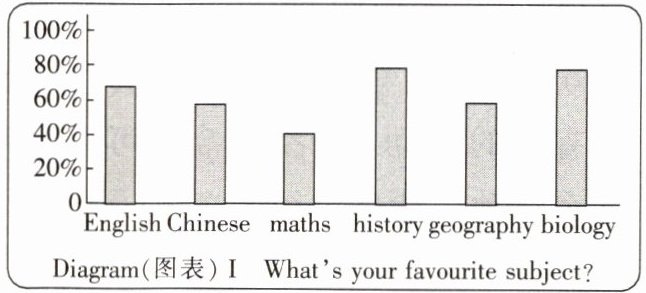
From Diagram Ⅰ, we can know
that many students don't like maths at school. Why? We did another survey and the results are in Diagram Ⅱ.
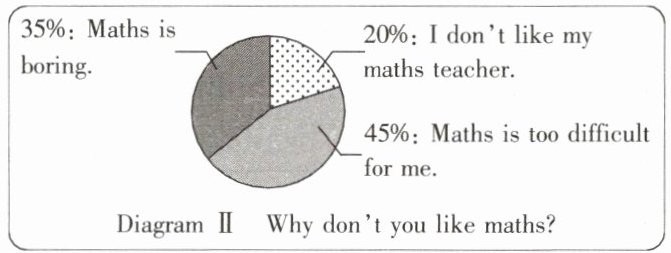
Maths is a useful and important subject because we need to use maths every day. To make students like it, maths teachers at our school want to organize(组织) some activities.
“Do you like maths? Do you like to play with numbers? Please try to find out your own ways to have fun learning maths! Maths is really an important subject,” says one of the teachers.
1. From Diagram Ⅰ, we can know that the students' two favourite subjects are and .
2. From Diagram Ⅱ, we can know that of the students think maths is boring, 45% of the students think maths is , and 20% of the students don't like their .
3. 请再次阅读文中第三段画线部分的句子,结合生活实际,想一想为了让学生喜欢数学,数学老师们可能会组织什么有趣的活动,或者你希望可以开展什么活动。请举2至3个例子。
4. What can we know from the last paragraph? ()
A. More students are enjoying learning maths now.
B. It's difficult for teachers to help students with maths.
C. A lot of students are good with numbers at this school.
D. The teacher hopes that more students can enjoy learning maths.
5. Do you like maths? Why or why not?
Students at our school learn many subjects every week. To know about students' favourite subjects well, we did a survey(调查). Here are the results(结果).
From Diagram Ⅰ, we can know
that many students don't like maths at school. Why? We did another survey and the results are in Diagram Ⅱ.
Maths is a useful and important subject because we need to use maths every day. To make students like it, maths teachers at our school want to organize(组织) some activities.
“Do you like maths? Do you like to play with numbers? Please try to find out your own ways to have fun learning maths! Maths is really an important subject,” says one of the teachers.
1. From Diagram Ⅰ, we can know that the students' two favourite subjects are and .
2. From Diagram Ⅱ, we can know that of the students think maths is boring, 45% of the students think maths is , and 20% of the students don't like their .
3. 请再次阅读文中第三段画线部分的句子,结合生活实际,想一想为了让学生喜欢数学,数学老师们可能会组织什么有趣的活动,或者你希望可以开展什么活动。请举2至3个例子。
4. What can we know from the last paragraph? ()
A. More students are enjoying learning maths now.
B. It's difficult for teachers to help students with maths.
C. A lot of students are good with numbers at this school.
D. The teacher hopes that more students can enjoy learning maths.
5. Do you like maths? Why or why not?
答案
1. history;biology
2. 35%;(too) difficult;maths teachers
3. Start a maths club. / Play fun maths games with students. / Tell interesting stories about maths to students./...
4. D
5. Yes, because it's important. We need to use maths every day.
2. 35%;(too) difficult;maths teachers
3. Start a maths club. / Play fun maths games with students. / Tell interesting stories about maths to students./...
4. D
5. Yes, because it's important. We need to use maths every day.
解析
【分析】
这是一道英语阅读理解综合题,包含细节填空题、开放表达题、选择题。解题时,第1、2题需定位原文对应调查结果,提取科目及百分比相关信息;第3题结合生活实际,围绕数学学习设计有趣活动;第4题通过最后一段老师的表述,逐一排除错误选项得出答案;第5题结合自身实际说明对数学的看法及原因。
【解析】
1. 根据调查结果,最受学生喜欢的两个科目是history(历史)和biology(生物);
2. 从另一项调查可知,35%的学生认为数学无聊,45%认为数学(太)难,20%不喜欢他们的数学老师;
3. 为让学生喜欢数学,可组织的活动有:创办数学俱乐部、和学生玩有趣的数学游戏、给学生讲数学相关的有趣故事等;
4. 最后一段老师的表述是希望更多学生能喜欢数学,对应选项D;
5. 结合自身实际,可回答喜欢数学的原因,比如数学重要且日常常用。
【答案】
1. history;biology
2. 35%;(too) difficult;maths teachers
3. Start a maths club. / Play fun maths games with students. / Tell interesting stories about maths to students.
4. D
5. Yes, because it's important. We need to use maths every day.
【知识点】
英语阅读理解、细节信息提取、开放型表达
【点评】
本题考查学生的英语阅读综合能力,涵盖细节查找、推理判断和开放表达,贴近学生学习实际,能有效检验学生的英语运用能力。
【难度系数】
0.6
这是一道英语阅读理解综合题,包含细节填空题、开放表达题、选择题。解题时,第1、2题需定位原文对应调查结果,提取科目及百分比相关信息;第3题结合生活实际,围绕数学学习设计有趣活动;第4题通过最后一段老师的表述,逐一排除错误选项得出答案;第5题结合自身实际说明对数学的看法及原因。
【解析】
1. 根据调查结果,最受学生喜欢的两个科目是history(历史)和biology(生物);
2. 从另一项调查可知,35%的学生认为数学无聊,45%认为数学(太)难,20%不喜欢他们的数学老师;
3. 为让学生喜欢数学,可组织的活动有:创办数学俱乐部、和学生玩有趣的数学游戏、给学生讲数学相关的有趣故事等;
4. 最后一段老师的表述是希望更多学生能喜欢数学,对应选项D;
5. 结合自身实际,可回答喜欢数学的原因,比如数学重要且日常常用。
【答案】
1. history;biology
2. 35%;(too) difficult;maths teachers
3. Start a maths club. / Play fun maths games with students. / Tell interesting stories about maths to students.
4. D
5. Yes, because it's important. We need to use maths every day.
【知识点】
英语阅读理解、细节信息提取、开放型表达
【点评】
本题考查学生的英语阅读综合能力,涵盖细节查找、推理判断和开放表达,贴近学生学习实际,能有效检验学生的英语运用能力。
【难度系数】
0.6
