

 登录
登录
Ⅳ. 根据短文内容,从下面所给的 A、B、C、D、E 五个选项中,选出能填入空白处的最佳选项,使文章内容完整且符合逻辑。
There are many things you can do to improve your memory. Among them are useful ways as well as taking special care of your health.
1.
2.
Healthy food and plenty of vitamins are necessary for your memory to work well. Drinking a lot of water also helps improve your memory. 4.
5.
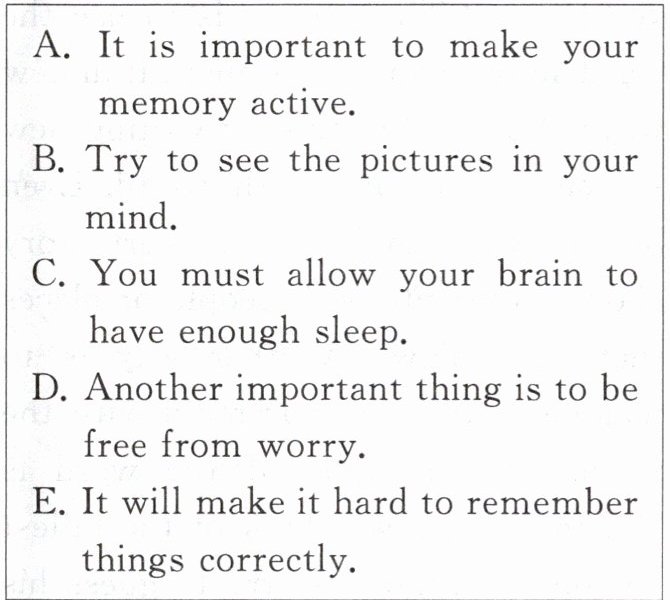
A. It is important to make your memory active.
B. Try to see the pictures in your mind.
C. You must allow your brain to have enough sleep.
D. Another important thing is to be free from worry.
E. It will make it hard to remember things correctly.
There are many things you can do to improve your memory. Among them are useful ways as well as taking special care of your health.
1.
A
Make yourself excited. You can do this by doing some new activities. Learning a new skill helps your brain to develop. When trying to remember something, you should pay special attention to the most important things about it. Do not allow other thoughts to enter your mind.2.
E
An excellent way to help improve your memory is to connect information with pictures. 3. B
Taking notes and keeping a diary will also be helpful.Healthy food and plenty of vitamins are necessary for your memory to work well. Drinking a lot of water also helps improve your memory. 4.
C
When you are asleep, your brain stores memory. Not enough sleep can cause problems with storing information. And being tired will also stop you from being able to think clearly and well.5.
D
Keeping fit and normal health checks are also important—not just for improving your memory.A. It is important to make your memory active.
B. Try to see the pictures in your mind.
C. You must allow your brain to have enough sleep.
D. Another important thing is to be free from worry.
E. It will make it hard to remember things correctly.
答案
1-5 AEBCD
解析
【分析】首先通读全文,明确文章主题是介绍提升记忆力的方法。逐个分析每个空的上下文逻辑:1空后提到让自己兴奋、做新活动,对应A选项“让你的记忆活跃很重要”,符合逻辑;1空最后一句说不要让其他想法进入大脑,2空需说明原因,对应E选项“这会让正确记住事情变得困难”;3空前提到将信息与图片关联,对应B选项“试着在脑海里看图片”;4空后围绕睡眠对记忆的重要性展开,对应C选项“你必须让大脑有足够睡眠”;5空是最后一个提升记忆的方法,对应D选项“另一个重要的是摆脱担忧”,最终匹配出正确选项序列。
【解析】1. 选A:空后“Make yourself excited(让自己兴奋)”是“让记忆活跃(make your memory active)”的具体表现,契合提升记忆的主题;2. 选E:空前“Do not allow other thoughts to enter your mind(不要让其他想法进入大脑)”,E选项说明该行为的后果,逻辑连贯;3. 选B:空前提到“connect information with pictures(将信息与图片关联)”,B选项“在脑海里看图片”是具体做法,衔接自然;4. 选C:空后围绕睡眠对记忆的作用展开,C选项“让大脑有足够睡眠”是该段核心主题;5. 选D:最后一段介绍另一个提升记忆的方法,D选项“摆脱担忧”符合语境。
【答案】AEBCD
【知识点】英语七选五阅读;说明文阅读
【点评】本题是关于提升记忆力的说明文七选五,需结合上下文逻辑和语篇主题匹配选项,考查学生的语篇逻辑理解能力,难度适中。
【难度系数】0.5
【解析】1. 选A:空后“Make yourself excited(让自己兴奋)”是“让记忆活跃(make your memory active)”的具体表现,契合提升记忆的主题;2. 选E:空前“Do not allow other thoughts to enter your mind(不要让其他想法进入大脑)”,E选项说明该行为的后果,逻辑连贯;3. 选B:空前提到“connect information with pictures(将信息与图片关联)”,B选项“在脑海里看图片”是具体做法,衔接自然;4. 选C:空后围绕睡眠对记忆的作用展开,C选项“让大脑有足够睡眠”是该段核心主题;5. 选D:最后一段介绍另一个提升记忆的方法,D选项“摆脱担忧”符合语境。
【答案】AEBCD
【知识点】英语七选五阅读;说明文阅读
【点评】本题是关于提升记忆力的说明文七选五,需结合上下文逻辑和语篇主题匹配选项,考查学生的语篇逻辑理解能力,难度适中。
【难度系数】0.5
Ⅴ. 阅读短文,选择最佳选项。
Language learners often think they have memory problems. They worry because they can't remember words. In fact, the problem usually isn't with their memory. The problem is with how they study.
To remember words better, you need to understand how memory works. There are two kinds of memory: short-term memory and long-term memory. When you see, hear, or read something, it goes first into short-term memory. But short-term memory lasts for only a few seconds. You will only remember something longer if it goes into long-term memory. Your long-term memory is like a very big library with many, many books. And like a library, it's organized. When you put away a book or memory, you can't just leave it anywhere. You have to choose a place where you can find it again.
How can you do this with vocabulary? The answer is to use the word actively and think about it in new ways. You can do this by writing new sentences that include the word. Even better, you can invent a short story about the word, with people or places that you know. Another way is to make a picture in your mind with the word. For example, if the word is "height", you can think of the tallest person you know and try to guess his or her height. All of these activities are good ways to think about words.
1. Why do language learners think they have memory problems? (
A. Because they feel worried about new words.
B. Because they can't remember words.
C. Because they have two kinds of memory.
D. Because they often feel unhappy.
2. How long does short-term memory last? (
A. For a few minutes.
B. For a few hours.
C. For a few seconds.
D. For a few days.
3. What is long-term memory like? (
A. A library with so many books.
B. A shop with so many goods.
C. A book with so many pages.
D. A library with so many librarians.
4. Which of the following sentences can be put in " " in the last paragraph? (
A. The problem is how they study.
B. They make the meanings of words stronger in your long-term memory.
C. Short-term memory is easier to lose than long-term memory.
D. You should review words again and again to remember them.
5. What does the text mainly tell us? (
A. Language learners' problems in study.
B. How to make the meanings of words stronger.
C. Short-term and long-term memory.
D. Ways to remember words better.
Language learners often think they have memory problems. They worry because they can't remember words. In fact, the problem usually isn't with their memory. The problem is with how they study.
To remember words better, you need to understand how memory works. There are two kinds of memory: short-term memory and long-term memory. When you see, hear, or read something, it goes first into short-term memory. But short-term memory lasts for only a few seconds. You will only remember something longer if it goes into long-term memory. Your long-term memory is like a very big library with many, many books. And like a library, it's organized. When you put away a book or memory, you can't just leave it anywhere. You have to choose a place where you can find it again.
How can you do this with vocabulary? The answer is to use the word actively and think about it in new ways. You can do this by writing new sentences that include the word. Even better, you can invent a short story about the word, with people or places that you know. Another way is to make a picture in your mind with the word. For example, if the word is "height", you can think of the tallest person you know and try to guess his or her height. All of these activities are good ways to think about words.
B
▲ And they give a way to find a word when you need it.1. Why do language learners think they have memory problems? (
B
)A. Because they feel worried about new words.
B. Because they can't remember words.
C. Because they have two kinds of memory.
D. Because they often feel unhappy.
2. How long does short-term memory last? (
C
)A. For a few minutes.
B. For a few hours.
C. For a few seconds.
D. For a few days.
3. What is long-term memory like? (
A
)A. A library with so many books.
B. A shop with so many goods.
C. A book with so many pages.
D. A library with so many librarians.
4. Which of the following sentences can be put in "
" in the last paragraph? (B
)A. The problem is how they study.
B. They make the meanings of words stronger in your long-term memory.
C. Short-term memory is easier to lose than long-term memory.
D. You should review words again and again to remember them.
5. What does the text mainly tell us? (
D
)A. Language learners' problems in study.
B. How to make the meanings of words stronger.
C. Short-term and long-term memory.
D. Ways to remember words better.
答案
1-5 BCABD
解析
【分析】
本题为英语阅读理解题,需结合短文内容逐一分析每道题:
1. 第1题:定位短文第一段,查找语言学习者认为有记忆问题的原因,对应原文中关于记不住单词的描述;
2. 第2题:定位短文第二段关于短期记忆时长的表述,提取明确的时间信息;
3. 第3题:定位短文第二段对长期记忆的比喻内容,匹配选项中的描述;
4. 第4题:结合上下文逻辑,前文讲强化单词的多种方法,后文讲这些方法的作用,需选择衔接两者的句子;
5. 第5题:归纳全文核心内容,确定文章主旨。
【解析】
1. 第1题:根据短文第一段“Language learners often think they have memory problems. They worry because they can't remember words.”可知,语言学习者因记不住单词觉得有记忆问题,故选B;
2. 第2题:根据短文第二段“But short-term memory lasts for only a few seconds.”可知,短期记忆仅持续几秒,故选C;
3. 第3题:根据短文第二段“Your long-term memory is like a very big library with many, many books.”可知,长期记忆像有很多书的图书馆,故选A;
4. 第4题:前文提到的写句子、编故事、想画面等活动,作用是强化长期记忆中的词义,且与后文“find a word”呼应,故选B;
5. 第5题:全文围绕如何更好地记单词展开,介绍了记忆种类及记单词的方法,故选D。
【答案】
BCABD
【知识点】
英语阅读理解、细节理解、主旨大意
【点评】
本题是关于记忆与记单词方法的英语阅读理解题,侧重考查学生对短文细节的定位理解和主旨归纳能力,题目设置常规,难度适中。
【难度系数】
0.5
本题为英语阅读理解题,需结合短文内容逐一分析每道题:
1. 第1题:定位短文第一段,查找语言学习者认为有记忆问题的原因,对应原文中关于记不住单词的描述;
2. 第2题:定位短文第二段关于短期记忆时长的表述,提取明确的时间信息;
3. 第3题:定位短文第二段对长期记忆的比喻内容,匹配选项中的描述;
4. 第4题:结合上下文逻辑,前文讲强化单词的多种方法,后文讲这些方法的作用,需选择衔接两者的句子;
5. 第5题:归纳全文核心内容,确定文章主旨。
【解析】
1. 第1题:根据短文第一段“Language learners often think they have memory problems. They worry because they can't remember words.”可知,语言学习者因记不住单词觉得有记忆问题,故选B;
2. 第2题:根据短文第二段“But short-term memory lasts for only a few seconds.”可知,短期记忆仅持续几秒,故选C;
3. 第3题:根据短文第二段“Your long-term memory is like a very big library with many, many books.”可知,长期记忆像有很多书的图书馆,故选A;
4. 第4题:前文提到的写句子、编故事、想画面等活动,作用是强化长期记忆中的词义,且与后文“find a word”呼应,故选B;
5. 第5题:全文围绕如何更好地记单词展开,介绍了记忆种类及记单词的方法,故选D。
【答案】
BCABD
【知识点】
英语阅读理解、细节理解、主旨大意
【点评】
本题是关于记忆与记单词方法的英语阅读理解题,侧重考查学生对短文细节的定位理解和主旨归纳能力,题目设置常规,难度适中。
【难度系数】
0.5
