

 登录
登录
18. 如图所示,在平面直角坐标系中,直线$y=-\dfrac{3}{4}x+3$交$x$轴于点$A$,交$y$轴于点$B$,点$P$是线段$OA$上的一个动点(不与点$A$重合),过点$P$作$PC ⊥ AB$于点$C$.
(1)求点$A$与点$B$的坐标;
(2)连接$BP$,若$BP$平分$∠ ABO$,求此时点$P$的坐标;
(3)在(2)的条件下,若$M$为$x$轴上的一个动点,$△ CPM$为等腰三角形,直接写出点$M$的坐标.

(1)求点$A$与点$B$的坐标;
(2)连接$BP$,若$BP$平分$∠ ABO$,求此时点$P$的坐标;
(3)在(2)的条件下,若$M$为$x$轴上的一个动点,$△ CPM$为等腰三角形,直接写出点$M$的坐标.
答案
18.解:(1)在 $y=-\dfrac{3}{4}x+3$ 中,令 $x=0$,则 $y=3$. 令 $y=0$,则 $x=4$. $\therefore A(4,0)$,$B(0,3)$.
(2)$\because A(4,0)$,$B(0,3)$,
$\therefore OA=4$,$OB=3$. $\therefore AB=\sqrt{OA^2+OB^2}=5$.
$\because BP$ 平分 $∠ ABO$,$PC⊥ AB$,$∠ BOP=90°$,$\therefore OP=PC$.
$\because S_{△ AOB}=S_{△ POB}+S_{△ ABP}$,$\therefore \dfrac{1}{2}OB· OA=\dfrac{1}{2}OB· OP+\dfrac{1}{2}AB· PC$.
$\therefore \dfrac{1}{2}×3×4=\dfrac{3}{2}OP+\dfrac{5}{2}OP$. $\therefore OP=\dfrac{3}{2}$. $\therefore P(\dfrac{3}{2},0)$.
(3)由(2),得 $PC=\dfrac{3}{2}$,$P(\dfrac{3}{2},0)$ ,则 $AP=\dfrac{5}{2}$.
当 $PC=PM=\dfrac{3}{2}$ 时,可得 $M(0,0)$ 或 $(3,0)$.
在 $\mathrm{Rt}△ APC$ 中,$AC=\sqrt{AP^2-PC^2}=2$.
当 $PC=MC$ 时,如图所示,过点 $C$ 作 $CN⊥ PM$ 于点 $N$,则 $MP=2PN$.
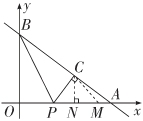
$\because S_{△ APC}=\dfrac{1}{2}AC· PC=\dfrac{1}{2}AP· CN$,$\therefore CN=\dfrac{PC· AC}{AP}=\dfrac{6}{5}$.
在 $\mathrm{Rt}△ CPN$ 中,由勾股定理,得 $PN=\sqrt{PC^2-CN^2}=\dfrac{9}{10}$,
$\therefore MP=\dfrac{9}{5}$. $\therefore OM=OP+MP=\dfrac{33}{10}$. $\therefore M(\dfrac{33}{10},0)$.
当 $MP=MC$ 时,设 $M(m,0)$,由前面的过程,可知 $C(\dfrac{12}{5},\dfrac{6}{5})$ ,
$\therefore (m-\dfrac{3}{2})^2=(m-\dfrac{12}{5})^2+(\dfrac{6}{5})^2$. $\therefore m=\dfrac{11}{4}$. $\therefore M(\dfrac{11}{4},0)$.
综上所述,点 $M$ 的坐标为 $(0,0)$ 或 $(3,0)$ 或 $(\dfrac{33}{10},0)$ 或 $(\dfrac{11}{4},0)$.
解析
【分析】
(1) 求一次函数与坐标轴的交点坐标,只需分别令x=0求对应y值得到y轴交点,令y=0求对应x值得到x轴交点,直接计算即可。
(2) 先由A、B坐标求出OA、OB、AB的长度,根据角平分线的性质:角平分线上的点到角两边的距离相等,可得OP=PC;再利用总面积等于两个小三角形面积和的关系,代入各边长即可求出OP的长度,进而得到P点坐标。
(3) 等腰三角形需分三种情况讨论:①PC=PM;②PC=MC;③MP=MC。结合(2)得到的PC长度、P点坐标,先求出C点坐标,再分别根据三种情况的边长关系,结合勾股定理或坐标距离公式计算M点的横坐标,M在x轴上纵坐标为0,注意分类时不要漏解。
【解析】
(1) 在 $y=-\dfrac{3}{4}x+3$ 中,令 $x=0$,则 $y=3$. 令 $y=0$,则 $x=4$. $\therefore A(4,0)$,$B(0,3)$.
(2)$\because A(4,0)$,$B(0,3)$,
$\therefore OA=4$,$OB=3$. $\therefore AB=\sqrt{OA^2+OB^2}=5$.
$\because BP$ 平分 $∠ ABO$,$PC⊥ AB$,$∠ BOP=90°$,$\therefore OP=PC$.
$\because S_{△ AOB}=S_{△ POB}+S_{△ ABP}$,$\therefore \dfrac{1}{2}OB· OA=\dfrac{1}{2}OB· OP+\dfrac{1}{2}AB· PC$.
$\therefore \dfrac{1}{2}×3×4=\dfrac{3}{2}OP+\dfrac{5}{2}OP$. $\therefore OP=\dfrac{3}{2}$. $\therefore P(\dfrac{3}{2},0)$.
(3)由(2),得 $PC=\dfrac{3}{2}$,$P(\dfrac{3}{2},0)$ ,则 $AP=\dfrac{5}{2}$.
当 $PC=PM=\dfrac{3}{2}$ 时,可得 $M(0,0)$ 或 $(3,0)$.
在 $\mathrm{Rt}△ APC$ 中,$AC=\sqrt{AP^2-PC^2}=2$.
当 $PC=MC$ 时,如图所示,过点 $C$ 作 $CN⊥ PM$ 于点 $N$,则 $MP=2PN$.
$\because S_{△ APC}=\dfrac{1}{2}AC· PC=\dfrac{1}{2}AP· CN$,$\therefore CN=\dfrac{PC· AC}{AP}=\dfrac{6}{5}$.
在 $\mathrm{Rt}△ CPN$ 中,由勾股定理,得 $PN=\sqrt{PC^2-CN^2}=\dfrac{9}{10}$,
$\therefore MP=\dfrac{9}{5}$. $\therefore OM=OP+MP=\dfrac{33}{10}$. $\therefore M(\dfrac{33}{10},0)$.
当 $MP=MC$ 时,设 $M(m,0)$,由前面的过程,可知 $C(\dfrac{12}{5},\dfrac{6}{5})$ ,
$\therefore (m-\dfrac{3}{2})^2=(m-\dfrac{12}{5})^2+(\dfrac{6}{5})^2$. $\therefore m=\dfrac{11}{4}$. $\therefore M(\dfrac{11}{4},0)$.
综上所述,点 $M$ 的坐标为 $(0,0)$ 或 $(3,0)$ 或 $(\dfrac{33}{10},0)$ 或 $(\dfrac{11}{4},0)$.
【答案】
(1) $A(4,0)$,$B(0,3)$;
(2) $P(\dfrac{3}{2},0)$;
(3) 点$M$的坐标为 $(0,0)$ 或 $(3,0)$ 或 $(\dfrac{33}{10},0)$ 或 $(\dfrac{11}{4},0)$。
【知识点】
一次函数交点求法,角平分线的性质,等腰三角形分类讨论
【点评】
本题是一次函数与几何的综合题,既考查了一次函数基础性质、勾股定理等基础知识点,也考查了面积法的应用和分类讨论的数学思想,解题时要注意等腰三角形分情况讨论时不要漏解,计算时需保证准确性。
【难度系数】
0.5
(1) 求一次函数与坐标轴的交点坐标,只需分别令x=0求对应y值得到y轴交点,令y=0求对应x值得到x轴交点,直接计算即可。
(2) 先由A、B坐标求出OA、OB、AB的长度,根据角平分线的性质:角平分线上的点到角两边的距离相等,可得OP=PC;再利用总面积等于两个小三角形面积和的关系,代入各边长即可求出OP的长度,进而得到P点坐标。
(3) 等腰三角形需分三种情况讨论:①PC=PM;②PC=MC;③MP=MC。结合(2)得到的PC长度、P点坐标,先求出C点坐标,再分别根据三种情况的边长关系,结合勾股定理或坐标距离公式计算M点的横坐标,M在x轴上纵坐标为0,注意分类时不要漏解。
【解析】
(1) 在 $y=-\dfrac{3}{4}x+3$ 中,令 $x=0$,则 $y=3$. 令 $y=0$,则 $x=4$. $\therefore A(4,0)$,$B(0,3)$.
(2)$\because A(4,0)$,$B(0,3)$,
$\therefore OA=4$,$OB=3$. $\therefore AB=\sqrt{OA^2+OB^2}=5$.
$\because BP$ 平分 $∠ ABO$,$PC⊥ AB$,$∠ BOP=90°$,$\therefore OP=PC$.
$\because S_{△ AOB}=S_{△ POB}+S_{△ ABP}$,$\therefore \dfrac{1}{2}OB· OA=\dfrac{1}{2}OB· OP+\dfrac{1}{2}AB· PC$.
$\therefore \dfrac{1}{2}×3×4=\dfrac{3}{2}OP+\dfrac{5}{2}OP$. $\therefore OP=\dfrac{3}{2}$. $\therefore P(\dfrac{3}{2},0)$.
(3)由(2),得 $PC=\dfrac{3}{2}$,$P(\dfrac{3}{2},0)$ ,则 $AP=\dfrac{5}{2}$.
当 $PC=PM=\dfrac{3}{2}$ 时,可得 $M(0,0)$ 或 $(3,0)$.
在 $\mathrm{Rt}△ APC$ 中,$AC=\sqrt{AP^2-PC^2}=2$.
当 $PC=MC$ 时,如图所示,过点 $C$ 作 $CN⊥ PM$ 于点 $N$,则 $MP=2PN$.
$\because S_{△ APC}=\dfrac{1}{2}AC· PC=\dfrac{1}{2}AP· CN$,$\therefore CN=\dfrac{PC· AC}{AP}=\dfrac{6}{5}$.
在 $\mathrm{Rt}△ CPN$ 中,由勾股定理,得 $PN=\sqrt{PC^2-CN^2}=\dfrac{9}{10}$,
$\therefore MP=\dfrac{9}{5}$. $\therefore OM=OP+MP=\dfrac{33}{10}$. $\therefore M(\dfrac{33}{10},0)$.
当 $MP=MC$ 时,设 $M(m,0)$,由前面的过程,可知 $C(\dfrac{12}{5},\dfrac{6}{5})$ ,
$\therefore (m-\dfrac{3}{2})^2=(m-\dfrac{12}{5})^2+(\dfrac{6}{5})^2$. $\therefore m=\dfrac{11}{4}$. $\therefore M(\dfrac{11}{4},0)$.
综上所述,点 $M$ 的坐标为 $(0,0)$ 或 $(3,0)$ 或 $(\dfrac{33}{10},0)$ 或 $(\dfrac{11}{4},0)$.
【答案】
(1) $A(4,0)$,$B(0,3)$;
(2) $P(\dfrac{3}{2},0)$;
(3) 点$M$的坐标为 $(0,0)$ 或 $(3,0)$ 或 $(\dfrac{33}{10},0)$ 或 $(\dfrac{11}{4},0)$。
【知识点】
一次函数交点求法,角平分线的性质,等腰三角形分类讨论
【点评】
本题是一次函数与几何的综合题,既考查了一次函数基础性质、勾股定理等基础知识点,也考查了面积法的应用和分类讨论的数学思想,解题时要注意等腰三角形分情况讨论时不要漏解,计算时需保证准确性。
【难度系数】
0.5
