

 登录
登录
六、星期日早上,John 在公园遇到了 Sarah。他们正在交谈。选择合适的句子补全对话。(有一项多余)
John: Good morning, Sarah.
Sarah: Morning, John! You're early. What do you often do on Sunday morning?
John: 1.
Sarah: Watch the flowers? Do you like spring?
John: 2.
Sarah: I like autumn, too.
John: 3.
Sarah: Because I like the pretty colours. What about you?
John: 4.
Sarah: We can pick apples together in autumn.
John: Great!
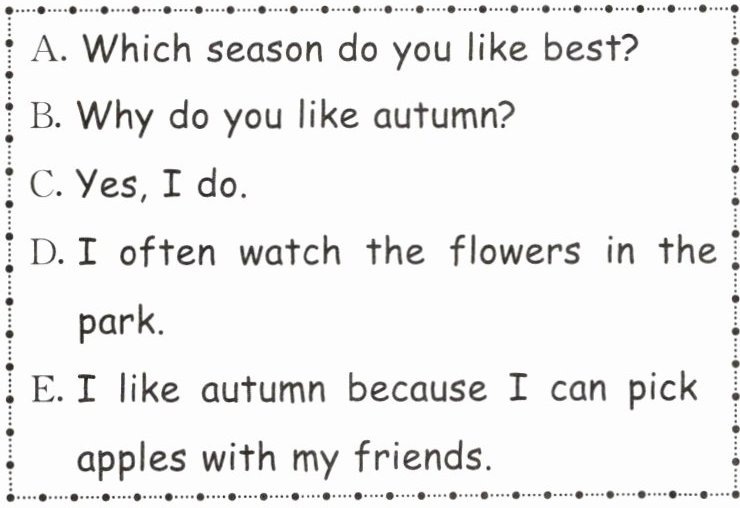
A. Which season do you like best?
B. Why do you like autumn?
C. Yes, I do.
D. I often watch the flowers in the park.
E. I like autumn because I can pick apples with my friends.
John: Good morning, Sarah.
Sarah: Morning, John! You're early. What do you often do on Sunday morning?
John: 1.
D
Sarah: Watch the flowers? Do you like spring?
John: 2.
C
But my favourite season is autumn.Sarah: I like autumn, too.
John: 3.
B
Sarah: Because I like the pretty colours. What about you?
John: 4.
E
Sarah: We can pick apples together in autumn.
John: Great!
A. Which season do you like best?
B. Why do you like autumn?
C. Yes, I do.
D. I often watch the flowers in the park.
E. I like autumn because I can pick apples with my friends.
答案
六、1.D 2.C 3.B 4.E
解析
选项:A.你最喜欢哪个季节?
B.你为什么喜欢秋天?
C.是的,我喜欢。
D.我经常在公园里赏花。
E.我喜欢秋天,因为我可以和朋友们一起摘
苹果。
分析:
1. 问句意为“你周日上午经常做什么?”,答句应为“I
often ...”,故选D。
2. 以do开头的一般疑问句,需要用Yes或No回答,
故选C。
3. 上一句表达了“我”也喜欢秋天,下一句以Because
开头,回答了喜欢秋天的原因“我喜欢美丽的颜
色”,所以设空处应该提问“你为什么喜欢秋天?”,
故选B。
4. “What about you?”用来反问对方的情况,所以应
该是Sarah问John为什么喜欢秋天,所以此处应
该回答喜欢秋天的理由。而且根据下文中提到的
“We can pick apples together in autumn.”可知,设
空处应提及摘苹果,故选E。
解析
选项:A.你最喜欢哪个季节?
B.你为什么喜欢秋天?
C.是的,我喜欢。
D.我经常在公园里赏花。
E.我喜欢秋天,因为我可以和朋友们一起摘
苹果。
分析:
1. 问句意为“你周日上午经常做什么?”,答句应为“I
often ...”,故选D。
2. 以do开头的一般疑问句,需要用Yes或No回答,
故选C。
3. 上一句表达了“我”也喜欢秋天,下一句以Because
开头,回答了喜欢秋天的原因“我喜欢美丽的颜
色”,所以设空处应该提问“你为什么喜欢秋天?”,
故选B。
4. “What about you?”用来反问对方的情况,所以应
该是Sarah问John为什么喜欢秋天,所以此处应
该回答喜欢秋天的理由。而且根据下文中提到的
“We can pick apples together in autumn.”可知,设
空处应提及摘苹果,故选E。
解析
【分析】
我们需要结合对话的上下文逻辑,逐一匹配问句与答语:
1. 第一个空,Sarah询问John周日上午的日常活动,需选择描述日常行为的句子;
2. 第二个空是do引导的一般疑问句,需用Yes/No类的句式回答;
3. 第三个空,下一句用Because开头回答原因,所以此处应是询问喜欢秋天的原因;
4. 第四个空,Sarah用“What about you?”反问John喜欢秋天的原因,且后文提到摘苹果,需选择和该内容呼应的原因表述。
【解析】
1. Sarah问“What do you often do on Sunday morning?”,是对日常活动的提问,选项D“I often watch the flowers in the park.”是对该问题的直接回应,符合语境,故选D。
2. Sarah的问题“Do you like spring?”是do开头的一般疑问句,选项C“Yes, I do.”是这类疑问句的标准肯定回答,符合要求,故选C。
3. Sarah表明自己也喜欢秋天后,用“Because I like the pretty colours.”回答原因,说明此处John的问题是询问喜欢秋天的缘由,选项B“Why do you like autumn?”符合该语境,故选B。
4. Sarah用“What about you?”反问John喜欢秋天的原因,且后文提到“We can pick apples together in autumn.”,选项E“I like autumn because I can pick apples with my friends.”既回答了原因,又和后文内容呼应,故选E。
【答案】
1.D 2.C 3.B 4.E
【知识点】
1. 情景对话应答
2. 一般疑问句回答
3. 因果语境匹配
【点评】
本题考查英语情景交际的对话补全,需要学生结合上下文语境,准确判断问句类型与对应答语,同时关注对话中的内容呼应,能有效锻炼学生的英语语境分析与交际运用能力。
【难度系数】
0.7
我们需要结合对话的上下文逻辑,逐一匹配问句与答语:
1. 第一个空,Sarah询问John周日上午的日常活动,需选择描述日常行为的句子;
2. 第二个空是do引导的一般疑问句,需用Yes/No类的句式回答;
3. 第三个空,下一句用Because开头回答原因,所以此处应是询问喜欢秋天的原因;
4. 第四个空,Sarah用“What about you?”反问John喜欢秋天的原因,且后文提到摘苹果,需选择和该内容呼应的原因表述。
【解析】
1. Sarah问“What do you often do on Sunday morning?”,是对日常活动的提问,选项D“I often watch the flowers in the park.”是对该问题的直接回应,符合语境,故选D。
2. Sarah的问题“Do you like spring?”是do开头的一般疑问句,选项C“Yes, I do.”是这类疑问句的标准肯定回答,符合要求,故选C。
3. Sarah表明自己也喜欢秋天后,用“Because I like the pretty colours.”回答原因,说明此处John的问题是询问喜欢秋天的缘由,选项B“Why do you like autumn?”符合该语境,故选B。
4. Sarah用“What about you?”反问John喜欢秋天的原因,且后文提到“We can pick apples together in autumn.”,选项E“I like autumn because I can pick apples with my friends.”既回答了原因,又和后文内容呼应,故选E。
【答案】
1.D 2.C 3.B 4.E
【知识点】
1. 情景对话应答
2. 一般疑问句回答
3. 因果语境匹配
【点评】
本题考查英语情景交际的对话补全,需要学生结合上下文语境,准确判断问句类型与对应答语,同时关注对话中的内容呼应,能有效锻炼学生的英语语境分析与交际运用能力。
【难度系数】
0.7
七、提素养 人文底蕴 妍妍介绍了家乡的四季。读一读,完成任务。
I'm Yanyan. I live in Hangzhou, a beautiful city in China.
In spring, it is warm. Sometimes there is a little rain. You can see green trees and pretty flowers everywhere. People go on a picnic in the park. In summer, it is very hot. But my father likes summer best because he can go running around the West Lake and watch the pretty water lilies(睡莲). My favourite season is fall. Colourful leaves come into view everywhere. Hangzhou looks like a beautiful painting then. It is the best time to go for a walk and take pictures. In winter, it is cold and sometimes snowy. We need to wear warm coats. The best thing to do in winter is to eat hot pot or drink Longjing Tea.
Hangzhou is beautiful all year round. Welcome to my hometown!
任务一:读一读,判断句子正(T)误(F)。
(
(
(
(
任务二:根据短文内容回答问题。
Which season does Yanyan like best? Why?
I'm Yanyan. I live in Hangzhou, a beautiful city in China.
In spring, it is warm. Sometimes there is a little rain. You can see green trees and pretty flowers everywhere. People go on a picnic in the park. In summer, it is very hot. But my father likes summer best because he can go running around the West Lake and watch the pretty water lilies(睡莲). My favourite season is fall. Colourful leaves come into view everywhere. Hangzhou looks like a beautiful painting then. It is the best time to go for a walk and take pictures. In winter, it is cold and sometimes snowy. We need to wear warm coats. The best thing to do in winter is to eat hot pot or drink Longjing Tea.
Hangzhou is beautiful all year round. Welcome to my hometown!
任务一:读一读,判断句子正(T)误(F)。
(
T
)1. The main idea(主旨) of this passage is that Hangzhou is beautiful in every season.(
F
)2. Yanyan often goes running around the lake in summer.(
T
)3. The underlined phrase "come into view" means "映入眼帘".(
T
)4. Eating hot pot and drinking tea are popular in Hangzhou in winter.任务二:根据短文内容回答问题。
Which season does Yanyan like best? Why?
Yanyan likes fall best.
Because there are many colourful leaves and Hangzhou is very beautiful in this season.
答案
七、任务一:1.T 2.F 3.T 4.T
任务二:
Yanyan likes fall best because there are many
colourful leaves and Hangzhou is very beautiful
in this season.
解析
任务一:
1. 句意:这篇文章的主旨是杭州在每个季节都很美。
依据:Hangzhou is beautiful all year round.
分析:文章依次描述了杭州四个季节的美景,最后
说明杭州全年都很美,故答案为T。
2. 句意:妍妍夏天经常绕着湖跑步。
依据:But my father likes summer best because he
can go running around the West Lake ...
分析:跑步的是爸爸,并非妍妍,故答案为F。
3. 句意:画线短语“come into view”的意思是“映入
眼帘”。
依据:Colourful leaves come into view everywhere.
Hangzhou looks like a beautiful painting then.
分析:结合语境“到处都是五颜六色的树叶 ,
那时候杭州看起来像一幅美丽的油画”可
知,“映入眼帘”符合逻辑,故答案为T。
4. 句意:在杭州,吃火锅和喝茶在冬天很流行。
依据:The best thing to do in winter is to eat hot
pot or drink Longjing Tea.
分析:冬天最棒的事是吃火锅或喝龙井茶,故答案
为T。
任务二:
句意:妍妍最喜欢哪个季节?为什么?
依据:My favourite season is fall. Colourful leaves
come into view everywhere. Hangzhou looks
like a beautiful painting then.
分析:妍妍最喜欢秋天,因为有许多五彩缤纷的树叶,
在这个季节杭州很美。回答时注意在一般现在
时中,主语为第三人称单数,谓语动词用第三人
称单数形式。
任务二:
Yanyan likes fall best because there are many
colourful leaves and Hangzhou is very beautiful
in this season.
解析
任务一:
1. 句意:这篇文章的主旨是杭州在每个季节都很美。
依据:Hangzhou is beautiful all year round.
分析:文章依次描述了杭州四个季节的美景,最后
说明杭州全年都很美,故答案为T。
2. 句意:妍妍夏天经常绕着湖跑步。
依据:But my father likes summer best because he
can go running around the West Lake ...
分析:跑步的是爸爸,并非妍妍,故答案为F。
3. 句意:画线短语“come into view”的意思是“映入
眼帘”。
依据:Colourful leaves come into view everywhere.
Hangzhou looks like a beautiful painting then.
分析:结合语境“到处都是五颜六色的树叶 ,
那时候杭州看起来像一幅美丽的油画”可
知,“映入眼帘”符合逻辑,故答案为T。
4. 句意:在杭州,吃火锅和喝茶在冬天很流行。
依据:The best thing to do in winter is to eat hot
pot or drink Longjing Tea.
分析:冬天最棒的事是吃火锅或喝龙井茶,故答案
为T。
任务二:
句意:妍妍最喜欢哪个季节?为什么?
依据:My favourite season is fall. Colourful leaves
come into view everywhere. Hangzhou looks
like a beautiful painting then.
分析:妍妍最喜欢秋天,因为有许多五彩缤纷的树叶,
在这个季节杭州很美。回答时注意在一般现在
时中,主语为第三人称单数,谓语动词用第三人
称单数形式。
解析
【分析】
对于任务一的判断题,解题思路如下:1. 先明确每个题干的含义;2. 带着题干关键信息回归原文,定位对应内容;3. 将原文内容与题干表述对比,判断二者是否一致,从而确定正(T)误(F)。
对于任务二的问答题,解题思路为:1. 在原文中找到妍妍最喜欢的季节的相关表述;2. 提取该季节中妍妍喜欢它的原因信息;3. 用规范的英语句子组织答案,注意一般现在时中第三人称单数的谓语动词形式。
【解析】
任务一:
1. 题干:这篇文章的主旨是杭州在每个季节都很美。
原文依据:Hangzhou is beautiful all year round.
解析:文章依次介绍了杭州春、夏、秋、冬四个季节的美景与特色活动,最后总结杭州全年都很美,与题干表述一致,故答案为T。
2. 题干:妍妍夏天经常绕着湖跑步。
原文依据:But my father likes summer best because he can go running around the West Lake ...
解析:原文表明夏天绕西湖跑步的是妍妍的爸爸,并非妍妍本人,题干表述与原文不符,故答案为F。
3. 题干:画线短语“come into view”的意思是“映入眼帘”。
原文依据:Colourful leaves come into view everywhere. Hangzhou looks like a beautiful painting then.
解析:结合语境“到处都是五颜六色的树叶,那时候杭州看起来像一幅美丽的油画”,可推断“come into view”表达树叶出现在视野中,即“映入眼帘”的意思,与题干表述一致,故答案为T。
4. 题干:在杭州,吃火锅和喝茶在冬天很流行。
原文依据:The best thing to do in winter is to eat hot pot or drink Longjing Tea.
解析:原文提到冬天在杭州最棒的事就是吃火锅或喝龙井茶,说明这两项活动在杭州冬天很受欢迎,与题干表述一致,故答案为T。
任务二:
题干:妍妍最喜欢哪个季节?为什么?
原文依据:My favourite season is fall. Colourful leaves come into view everywhere. Hangzhou looks like a beautiful painting then.
解析:从原文可知妍妍最喜欢秋天,原因是秋天到处都是五颜六色的树叶,杭州在这个季节美得像一幅画。组织答案时注意主语Yanyan是第三人称单数,谓语动词用likes,保证语言通顺准确。
【答案】
任务一:1.T 2.F 3.T 4.T
任务二:
Yanyan likes fall best because there are many colourful leaves and Hangzhou is very beautiful in this season.
【知识点】
1. 英语阅读理解判断
2. 细节信息提取
3. 词义猜测
【点评】
本文以妍妍的视角介绍了杭州四季的美景与特色活动,贴近生活且兼具人文性。题目考查了学生的细节查找、主旨理解和词义猜测能力,既锻炼英语阅读素养,又能加深对中国城市文化的了解。
【难度系数】
0.7
对于任务一的判断题,解题思路如下:1. 先明确每个题干的含义;2. 带着题干关键信息回归原文,定位对应内容;3. 将原文内容与题干表述对比,判断二者是否一致,从而确定正(T)误(F)。
对于任务二的问答题,解题思路为:1. 在原文中找到妍妍最喜欢的季节的相关表述;2. 提取该季节中妍妍喜欢它的原因信息;3. 用规范的英语句子组织答案,注意一般现在时中第三人称单数的谓语动词形式。
【解析】
任务一:
1. 题干:这篇文章的主旨是杭州在每个季节都很美。
原文依据:Hangzhou is beautiful all year round.
解析:文章依次介绍了杭州春、夏、秋、冬四个季节的美景与特色活动,最后总结杭州全年都很美,与题干表述一致,故答案为T。
2. 题干:妍妍夏天经常绕着湖跑步。
原文依据:But my father likes summer best because he can go running around the West Lake ...
解析:原文表明夏天绕西湖跑步的是妍妍的爸爸,并非妍妍本人,题干表述与原文不符,故答案为F。
3. 题干:画线短语“come into view”的意思是“映入眼帘”。
原文依据:Colourful leaves come into view everywhere. Hangzhou looks like a beautiful painting then.
解析:结合语境“到处都是五颜六色的树叶,那时候杭州看起来像一幅美丽的油画”,可推断“come into view”表达树叶出现在视野中,即“映入眼帘”的意思,与题干表述一致,故答案为T。
4. 题干:在杭州,吃火锅和喝茶在冬天很流行。
原文依据:The best thing to do in winter is to eat hot pot or drink Longjing Tea.
解析:原文提到冬天在杭州最棒的事就是吃火锅或喝龙井茶,说明这两项活动在杭州冬天很受欢迎,与题干表述一致,故答案为T。
任务二:
题干:妍妍最喜欢哪个季节?为什么?
原文依据:My favourite season is fall. Colourful leaves come into view everywhere. Hangzhou looks like a beautiful painting then.
解析:从原文可知妍妍最喜欢秋天,原因是秋天到处都是五颜六色的树叶,杭州在这个季节美得像一幅画。组织答案时注意主语Yanyan是第三人称单数,谓语动词用likes,保证语言通顺准确。
【答案】
任务一:1.T 2.F 3.T 4.T
任务二:
Yanyan likes fall best because there are many colourful leaves and Hangzhou is very beautiful in this season.
【知识点】
1. 英语阅读理解判断
2. 细节信息提取
3. 词义猜测
【点评】
本文以妍妍的视角介绍了杭州四季的美景与特色活动,贴近生活且兼具人文性。题目考查了学生的细节查找、主旨理解和词义猜测能力,既锻炼英语阅读素养,又能加深对中国城市文化的了解。
【难度系数】
0.7
