

 登录
登录
9. 用公式法解下列方程:
(1) $x(x-3)=3-x$;
(2) $4x^2=2x+1$;
(3) $x^2+\sqrt{5}x-\frac{1}{4}=0$;
(4) $x^2+2\sqrt{3}x-2=0$;
(5) $(3x-1)(x+2)=11x-4$;
(6) $1-t^2=2t(2t-1)$。
(1) $x(x-3)=3-x$;
(2) $4x^2=2x+1$;
(3) $x^2+\sqrt{5}x-\frac{1}{4}=0$;
(4) $x^2+2\sqrt{3}x-2=0$;
(5) $(3x-1)(x+2)=11x-4$;
(6) $1-t^2=2t(2t-1)$。
答案
9.解:(1)方程整理,得 $x^2-2x-3=0$,
$a=1,b=-2,c=-3$.
$\because b^2-4ac=4+12=16,\therefore x=\frac{2\pm4}{2}$,
$\therefore x_1=3,x_2=-1$.
(2)移项,得 $4x^2-2x-1=0,a=4,b=-2,c=-1$.
$\because b^2-4ac=(-2)^2-4×4×(-1)=20$,
$\therefore x=\frac{2\pm\sqrt{20}}{2×4}=\frac{1\pm\sqrt{5}}{4},\therefore x_1=\frac{1+\sqrt{5}}{4},x_2=\frac{1-\sqrt{5}}{4}$.
(3)$a=1,b=\sqrt{5},c=-\frac{1}{4}$.
$\because b^2-4ac=5+1=6$,
$\therefore x=\frac{-\sqrt{5}\pm\sqrt{6}}{2},\therefore x_1=\frac{-\sqrt{5}+\sqrt{6}}{2},x_2=\frac{-\sqrt{5}-\sqrt{6}}{2}$.
(4)$a=1,b=2\sqrt{3},c=-2$.
$\because b^2-4ac=12+8=20$,
$\therefore x=\frac{-2\sqrt{3}\pm2\sqrt{5}}{2}=-\sqrt{3}\pm\sqrt{5}$,
$\therefore x_1=-\sqrt{3}+\sqrt{5},x_2=-\sqrt{3}-\sqrt{5}$.
(5)方程整理,得 $3x^2-6x+2=0,a=3,b=-6,c=2$.
$\because b^2-4ac=36-24=12$,
$\therefore x=\frac{6\pm2\sqrt{3}}{6},\therefore x_1=\frac{3+\sqrt{3}}{3},x_2=\frac{3-\sqrt{3}}{3}$.
(6)方程整理,得 $5t^2-2t-1=0,a=5,b=-2,c=-1$.
$\because b^2-4ac=4+20=24$,
$\therefore t=\frac{2\pm\sqrt{24}}{10},\therefore t_1=\frac{1+\sqrt{6}}{5},t_2=\frac{1-\sqrt{6}}{5}$.
$a=1,b=-2,c=-3$.
$\because b^2-4ac=4+12=16,\therefore x=\frac{2\pm4}{2}$,
$\therefore x_1=3,x_2=-1$.
(2)移项,得 $4x^2-2x-1=0,a=4,b=-2,c=-1$.
$\because b^2-4ac=(-2)^2-4×4×(-1)=20$,
$\therefore x=\frac{2\pm\sqrt{20}}{2×4}=\frac{1\pm\sqrt{5}}{4},\therefore x_1=\frac{1+\sqrt{5}}{4},x_2=\frac{1-\sqrt{5}}{4}$.
(3)$a=1,b=\sqrt{5},c=-\frac{1}{4}$.
$\because b^2-4ac=5+1=6$,
$\therefore x=\frac{-\sqrt{5}\pm\sqrt{6}}{2},\therefore x_1=\frac{-\sqrt{5}+\sqrt{6}}{2},x_2=\frac{-\sqrt{5}-\sqrt{6}}{2}$.
(4)$a=1,b=2\sqrt{3},c=-2$.
$\because b^2-4ac=12+8=20$,
$\therefore x=\frac{-2\sqrt{3}\pm2\sqrt{5}}{2}=-\sqrt{3}\pm\sqrt{5}$,
$\therefore x_1=-\sqrt{3}+\sqrt{5},x_2=-\sqrt{3}-\sqrt{5}$.
(5)方程整理,得 $3x^2-6x+2=0,a=3,b=-6,c=2$.
$\because b^2-4ac=36-24=12$,
$\therefore x=\frac{6\pm2\sqrt{3}}{6},\therefore x_1=\frac{3+\sqrt{3}}{3},x_2=\frac{3-\sqrt{3}}{3}$.
(6)方程整理,得 $5t^2-2t-1=0,a=5,b=-2,c=-1$.
$\because b^2-4ac=4+20=24$,
$\therefore t=\frac{2\pm\sqrt{24}}{10},\therefore t_1=\frac{1+\sqrt{6}}{5},t_2=\frac{1-\sqrt{6}}{5}$.
解析
【分析】
用公式法解一元二次方程的通用思路为:①先将原方程通过去括号、移项、合并同类项,变形为$ax^2+bx+c=0$($a≠0$)的一般形式;②准确确定系数$a$、$b$、$c$的值,注意要保留系数的正负符号;③计算根的判别式$\Delta=b^2-4ac$,若$\Delta≥0$,方程有两个实数根,可继续代入求根公式计算,若$\Delta<0$则无实数根;④将$a$、$b$、$\Delta$代入求根公式$x=\frac{-b\pm\sqrt{\Delta}}{2a}$,化简后得到方程的两个根。解题时注意移项要变号,计算过程中避免符号错误。
【解析】
(1) 方程整理,得 $x^2-2x-3=0$,
$a=1,b=-2,c=-3$,
$\because b^2-4ac=(-2)^2-4×1×(-3)=4+12=16>0$,
$\therefore x=\frac{2\pm\sqrt{16}}{2×1}=\frac{2\pm4}{2}$,
$\therefore x_1=3,x_2=-1$。
(2) 移项,得 $4x^2-2x-1=0$,$a=4,b=-2,c=-1$,
$\because b^2-4ac=(-2)^2-4×4×(-1)=4+16=20>0$,
$\therefore x=\frac{2\pm\sqrt{20}}{2×4}=\frac{2\pm2\sqrt{5}}{8}=\frac{1\pm\sqrt{5}}{4}$,
$\therefore x_1=\frac{1+\sqrt{5}}{4},x_2=\frac{1-\sqrt{5}}{4}$。
(3) 方程为$x^2+\sqrt{5}x-\frac{1}{4}=0$,$a=1,b=\sqrt{5},c=-\frac{1}{4}$,
$\because b^2-4ac=(\sqrt{5})^2-4×1×(-\frac{1}{4})=5+1=6>0$,
$\therefore x=\frac{-\sqrt{5}\pm\sqrt{6}}{2×1}$,
$\therefore x_1=\frac{-\sqrt{5}+\sqrt{6}}{2},x_2=\frac{-\sqrt{5}-\sqrt{6}}{2}$。
(4) 方程为$x^2+2\sqrt{3}x-2=0$,$a=1,b=2\sqrt{3},c=-2$,
$\because b^2-4ac=(2\sqrt{3})^2-4×1×(-2)=12+8=20>0$,
$\therefore x=\frac{-2\sqrt{3}\pm\sqrt{20}}{2×1}=\frac{-2\sqrt{3}\pm2\sqrt{5}}{2}=-\sqrt{3}\pm\sqrt{5}$,
$\therefore x_1=-\sqrt{3}+\sqrt{5},x_2=-\sqrt{3}-\sqrt{5}$。
(5) 方程整理,得 $3x^2-6x+2=0$,$a=3,b=-6,c=2$,
$\because b^2-4ac=(-6)^2-4×3×2=36-24=12>0$,
$\therefore x=\frac{6\pm\sqrt{12}}{2×3}=\frac{6\pm2\sqrt{3}}{6}=\frac{3\pm\sqrt{3}}{3}$,
$\therefore x_1=\frac{3+\sqrt{3}}{3},x_2=\frac{3-\sqrt{3}}{3}$。
(6) 方程整理,得 $5t^2-2t-1=0$,$a=5,b=-2,c=-1$,
$\because b^2-4ac=(-2)^2-4×5×(-1)=4+20=24>0$,
$\therefore t=\frac{2\pm\sqrt{24}}{2×5}=\frac{2\pm2\sqrt{6}}{10}=\frac{1\pm\sqrt{6}}{5}$,
$\therefore t_1=\frac{1+\sqrt{6}}{5},t_2=\frac{1-\sqrt{6}}{5}$。
【答案】
(1) $x_1=3,x_2=-1$;
(2) $x_1=\frac{1+\sqrt{5}}{4},x_2=\frac{1-\sqrt{5}}{4}$;
(3) $x_1=\frac{-\sqrt{5}+\sqrt{6}}{2},x_2=\frac{-\sqrt{5}-\sqrt{6}}{2}$;
(4) $x_1=-\sqrt{3}+\sqrt{5},x_2=-\sqrt{3}-\sqrt{5}$;
(5) $x_1=\frac{3+\sqrt{3}}{3},x_2=\frac{3-\sqrt{3}}{3}$;
(6) $t_1=\frac{1+\sqrt{6}}{5},t_2=\frac{1-\sqrt{6}}{5}$。
【知识点】
公式法解一元二次方程,一元二次方程的一般形式,根的判别式
【点评】
本题是公式法解一元二次方程的基础训练题,解题核心是先把方程化为标准一般形式,准确识别$a、b、c$的符号,计算时注意判别式的运算规则和根式的化简,避免因符号错误、计算失误丢分。
【难度系数】
0.75
用公式法解一元二次方程的通用思路为:①先将原方程通过去括号、移项、合并同类项,变形为$ax^2+bx+c=0$($a≠0$)的一般形式;②准确确定系数$a$、$b$、$c$的值,注意要保留系数的正负符号;③计算根的判别式$\Delta=b^2-4ac$,若$\Delta≥0$,方程有两个实数根,可继续代入求根公式计算,若$\Delta<0$则无实数根;④将$a$、$b$、$\Delta$代入求根公式$x=\frac{-b\pm\sqrt{\Delta}}{2a}$,化简后得到方程的两个根。解题时注意移项要变号,计算过程中避免符号错误。
【解析】
(1) 方程整理,得 $x^2-2x-3=0$,
$a=1,b=-2,c=-3$,
$\because b^2-4ac=(-2)^2-4×1×(-3)=4+12=16>0$,
$\therefore x=\frac{2\pm\sqrt{16}}{2×1}=\frac{2\pm4}{2}$,
$\therefore x_1=3,x_2=-1$。
(2) 移项,得 $4x^2-2x-1=0$,$a=4,b=-2,c=-1$,
$\because b^2-4ac=(-2)^2-4×4×(-1)=4+16=20>0$,
$\therefore x=\frac{2\pm\sqrt{20}}{2×4}=\frac{2\pm2\sqrt{5}}{8}=\frac{1\pm\sqrt{5}}{4}$,
$\therefore x_1=\frac{1+\sqrt{5}}{4},x_2=\frac{1-\sqrt{5}}{4}$。
(3) 方程为$x^2+\sqrt{5}x-\frac{1}{4}=0$,$a=1,b=\sqrt{5},c=-\frac{1}{4}$,
$\because b^2-4ac=(\sqrt{5})^2-4×1×(-\frac{1}{4})=5+1=6>0$,
$\therefore x=\frac{-\sqrt{5}\pm\sqrt{6}}{2×1}$,
$\therefore x_1=\frac{-\sqrt{5}+\sqrt{6}}{2},x_2=\frac{-\sqrt{5}-\sqrt{6}}{2}$。
(4) 方程为$x^2+2\sqrt{3}x-2=0$,$a=1,b=2\sqrt{3},c=-2$,
$\because b^2-4ac=(2\sqrt{3})^2-4×1×(-2)=12+8=20>0$,
$\therefore x=\frac{-2\sqrt{3}\pm\sqrt{20}}{2×1}=\frac{-2\sqrt{3}\pm2\sqrt{5}}{2}=-\sqrt{3}\pm\sqrt{5}$,
$\therefore x_1=-\sqrt{3}+\sqrt{5},x_2=-\sqrt{3}-\sqrt{5}$。
(5) 方程整理,得 $3x^2-6x+2=0$,$a=3,b=-6,c=2$,
$\because b^2-4ac=(-6)^2-4×3×2=36-24=12>0$,
$\therefore x=\frac{6\pm\sqrt{12}}{2×3}=\frac{6\pm2\sqrt{3}}{6}=\frac{3\pm\sqrt{3}}{3}$,
$\therefore x_1=\frac{3+\sqrt{3}}{3},x_2=\frac{3-\sqrt{3}}{3}$。
(6) 方程整理,得 $5t^2-2t-1=0$,$a=5,b=-2,c=-1$,
$\because b^2-4ac=(-2)^2-4×5×(-1)=4+20=24>0$,
$\therefore t=\frac{2\pm\sqrt{24}}{2×5}=\frac{2\pm2\sqrt{6}}{10}=\frac{1\pm\sqrt{6}}{5}$,
$\therefore t_1=\frac{1+\sqrt{6}}{5},t_2=\frac{1-\sqrt{6}}{5}$。
【答案】
(1) $x_1=3,x_2=-1$;
(2) $x_1=\frac{1+\sqrt{5}}{4},x_2=\frac{1-\sqrt{5}}{4}$;
(3) $x_1=\frac{-\sqrt{5}+\sqrt{6}}{2},x_2=\frac{-\sqrt{5}-\sqrt{6}}{2}$;
(4) $x_1=-\sqrt{3}+\sqrt{5},x_2=-\sqrt{3}-\sqrt{5}$;
(5) $x_1=\frac{3+\sqrt{3}}{3},x_2=\frac{3-\sqrt{3}}{3}$;
(6) $t_1=\frac{1+\sqrt{6}}{5},t_2=\frac{1-\sqrt{6}}{5}$。
【知识点】
公式法解一元二次方程,一元二次方程的一般形式,根的判别式
【点评】
本题是公式法解一元二次方程的基础训练题,解题核心是先把方程化为标准一般形式,准确识别$a、b、c$的符号,计算时注意判别式的运算规则和根式的化简,避免因符号错误、计算失误丢分。
【难度系数】
0.75
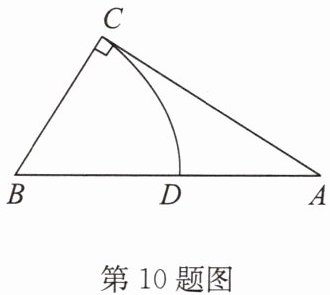
10.在欧几里得的《几何原本》中,形如$x^2 + ax = b^2(a>0,b>0)$的方程的图解法是:如图,以$\frac{a}{2}$和$b$为两直角边作$Rt△ ABC$,再在斜边上截取$BD=\frac{a}{2}$,则$AD$的长就是所求方程的一个根.试说明理由.
答案
10.解:$\because x^2+ax=b^2(a>0,b>0),\therefore x^2+ax-b^2=0$,解得
$x_1=\frac{-a-\sqrt{a^2+4b^2}}{2},x_2=\frac{-a+\sqrt{a^2+4b^2}}{2}$.
$\because ∠ ACB=90°,BC=\frac{a}{2},AC=b,\therefore AB=\sqrt{\frac{a^2}{4}+b^2}$,
$\therefore AD=AB-BD=\sqrt{\frac{a^2}{4}+b^2}-\frac{a}{2}=\frac{-a+\sqrt{a^2+4b^2}}{2}=x_2,\therefore AD$的长就是所求方程的一个根.
$x_1=\frac{-a-\sqrt{a^2+4b^2}}{2},x_2=\frac{-a+\sqrt{a^2+4b^2}}{2}$.
$\because ∠ ACB=90°,BC=\frac{a}{2},AC=b,\therefore AB=\sqrt{\frac{a^2}{4}+b^2}$,
$\therefore AD=AB-BD=\sqrt{\frac{a^2}{4}+b^2}-\frac{a}{2}=\frac{-a+\sqrt{a^2+4b^2}}{2}=x_2,\therefore AD$的长就是所求方程的一个根.
解析
【分析】
要说明AD是方程的根,可通过分别求解方程的根、计算AD的长度,验证二者相等的思路解题:第一步,先利用一元二次方程的公式法求解给定方程,舍去不符合实际意义的负根,得到正根的表达式;第二步,在Rt△ABC中,已知两条直角边的长度,用勾股定理求出斜边AB的长;第三步,根据AD=AB-BD,代入BD=a/2计算出AD的长度,化简后和方程的正根对比,若相等即可证明AD是方程的一个根。
【解析】
解:先整理方程$x^2 + ax = b^2(a>0,b>0)$,得$x^2 + ax - b^2 = 0$,
由一元二次方程求根公式得:
$x=\frac{-a\pm\sqrt{a^2+4b^2}}{2}$,即$x_1=\frac{-a-\sqrt{a^2+4b^2}}{2}$,$x_2=\frac{-a+\sqrt{a^2+4b^2}}{2}$,
∵线段长度为正数,
∴方程的正根为$x_2=\frac{-a+\sqrt{a^2+4b^2}}{2}$。
在$Rt△ ABC$中,$∠ ACB=90°$,$BC=\frac{a}{2}$,$AC=b$,
由勾股定理得:$AB=\sqrt{BC^2+AC^2}=\sqrt{(\frac{a}{2})^2 + b^2}=\sqrt{\frac{a^2}{4}+b^2}$,
又
∵$BD=\frac{a}{2}$,
∴$AD=AB-BD=\sqrt{\frac{a^2}{4}+b^2}-\frac{a}{2}=\frac{\sqrt{a^2+4b^2}}{2}-\frac{a}{2}=\frac{-a+\sqrt{a^2+4b^2}}{2}$,
可得$AD=x_2$,即AD的长就是所求方程的一个根。
【答案】
$\because x^2+ax=b^2(a>0,b>0),\therefore x^2+ax-b^2=0$,解得
$x_1=\frac{-a-\sqrt{a^2+4b^2}}{2},x_2=\frac{-a+\sqrt{a^2+4b^2}}{2}$.
$\because ∠ ACB=90°,BC=\frac{a}{2},AC=b,\therefore AB=\sqrt{\frac{a^2}{4}+b^2}$,
$\therefore AD=AB-BD=\sqrt{\frac{a^2}{4}+b^2}-\frac{a}{2}=\frac{-a+\sqrt{a^2+4b^2}}{2}=x_2,\therefore AD$的长就是所求方程的一个根。
【知识点】
公式法解一元二次方程、勾股定理、二次根式化简
【点评】
本题是数形结合类题型,将一元二次方程的解与几何线段长度计算相结合,既考查了一元二次方程的求解方法,又考查了勾股定理的应用,能帮助大家体会数形结合的数学思想。
【难度系数】
0.7
要说明AD是方程的根,可通过分别求解方程的根、计算AD的长度,验证二者相等的思路解题:第一步,先利用一元二次方程的公式法求解给定方程,舍去不符合实际意义的负根,得到正根的表达式;第二步,在Rt△ABC中,已知两条直角边的长度,用勾股定理求出斜边AB的长;第三步,根据AD=AB-BD,代入BD=a/2计算出AD的长度,化简后和方程的正根对比,若相等即可证明AD是方程的一个根。
【解析】
解:先整理方程$x^2 + ax = b^2(a>0,b>0)$,得$x^2 + ax - b^2 = 0$,
由一元二次方程求根公式得:
$x=\frac{-a\pm\sqrt{a^2+4b^2}}{2}$,即$x_1=\frac{-a-\sqrt{a^2+4b^2}}{2}$,$x_2=\frac{-a+\sqrt{a^2+4b^2}}{2}$,
∵线段长度为正数,
∴方程的正根为$x_2=\frac{-a+\sqrt{a^2+4b^2}}{2}$。
在$Rt△ ABC$中,$∠ ACB=90°$,$BC=\frac{a}{2}$,$AC=b$,
由勾股定理得:$AB=\sqrt{BC^2+AC^2}=\sqrt{(\frac{a}{2})^2 + b^2}=\sqrt{\frac{a^2}{4}+b^2}$,
又
∵$BD=\frac{a}{2}$,
∴$AD=AB-BD=\sqrt{\frac{a^2}{4}+b^2}-\frac{a}{2}=\frac{\sqrt{a^2+4b^2}}{2}-\frac{a}{2}=\frac{-a+\sqrt{a^2+4b^2}}{2}$,
可得$AD=x_2$,即AD的长就是所求方程的一个根。
【答案】
$\because x^2+ax=b^2(a>0,b>0),\therefore x^2+ax-b^2=0$,解得
$x_1=\frac{-a-\sqrt{a^2+4b^2}}{2},x_2=\frac{-a+\sqrt{a^2+4b^2}}{2}$.
$\because ∠ ACB=90°,BC=\frac{a}{2},AC=b,\therefore AB=\sqrt{\frac{a^2}{4}+b^2}$,
$\therefore AD=AB-BD=\sqrt{\frac{a^2}{4}+b^2}-\frac{a}{2}=\frac{-a+\sqrt{a^2+4b^2}}{2}=x_2,\therefore AD$的长就是所求方程的一个根。
【知识点】
公式法解一元二次方程、勾股定理、二次根式化简
【点评】
本题是数形结合类题型,将一元二次方程的解与几何线段长度计算相结合,既考查了一元二次方程的求解方法,又考查了勾股定理的应用,能帮助大家体会数形结合的数学思想。
【难度系数】
0.7
11.已知关于$x$的一元二次方程$(m-1)x^2 -2mx +m+1=0$.
(1)求该方程的根;
(2)当$m$为何整数时,该方程的两个根都为正整数?
(1)求该方程的根;
(2)当$m$为何整数时,该方程的两个根都为正整数?
答案
11.解:(1)$\because$已知方程是关于$x$的一元二次方程,
$\therefore m-1≠0$,即$m≠1$.
$\because a=m-1,b=-2m,c=m+1$,
$\therefore b^2-4ac=(-2m)^2-4(m-1)(m+1)=4>0$,
$\therefore x=\frac{2m\pm\sqrt{4}}{2(m-1)}=\frac{m\pm1}{m-1},\therefore x_1=1,x_2=\frac{m+1}{m-1}$.
(2)由(1)知 $x_1=1,x_2=\frac{m+1}{m-1}=\frac{(m-1)+2}{m-1}=1+\frac{2}{m-1}$.
要使方程的两个根都为正整数,则$\frac{2}{m-1}$是正整数,
$\therefore m-1=1$ 或 $m-1=2$,解得 $m=2$ 或 $m=3$,
$\therefore$ 当 $m=2$ 或 $m=3$ 时,该方程的两个根都为正整数.
$\therefore m-1≠0$,即$m≠1$.
$\because a=m-1,b=-2m,c=m+1$,
$\therefore b^2-4ac=(-2m)^2-4(m-1)(m+1)=4>0$,
$\therefore x=\frac{2m\pm\sqrt{4}}{2(m-1)}=\frac{m\pm1}{m-1},\therefore x_1=1,x_2=\frac{m+1}{m-1}$.
(2)由(1)知 $x_1=1,x_2=\frac{m+1}{m-1}=\frac{(m-1)+2}{m-1}=1+\frac{2}{m-1}$.
要使方程的两个根都为正整数,则$\frac{2}{m-1}$是正整数,
$\therefore m-1=1$ 或 $m-1=2$,解得 $m=2$ 或 $m=3$,
$\therefore$ 当 $m=2$ 或 $m=3$ 时,该方程的两个根都为正整数.
解析
【分析】
第(1)问解题思路:首先根据一元二次方程的定义,明确二次项系数不为0,即$m≠1$;再选用公式法解方程,先确定二次项系数$a$、一次项系数$b$、常数项$c$,计算判别式判断根的情况,最后代入求根公式计算得到两个根。
第(2)问解题思路:由第(1)问可知其中一个根为1(已是正整数),只需对另一个根的分式表达式做分离常数变形,分析得分母是2的正约数,结合$m$为整数的条件即可求出符合要求的$m$值。
【解析】
(1) $\because$ 该方程是关于$x$的一元二次方程,
$\therefore$ 二次项系数不为0,即$m-1≠0$,$m≠1$。
其中$a=m-1$,$b=-2m$,$c=m+1$,
计算判别式:$\Delta = b^2-4ac = (-2m)^2 - 4(m-1)(m+1) = 4m^2 - 4(m^2-1) = 4 > 0$,
代入求根公式$x = \frac{-b\pm\sqrt{\Delta}}{2a}$,得:
$x = \frac{2m\pm\sqrt{4}}{2(m-1)} = \frac{2m\pm2}{2(m-1)} = \frac{m\pm1}{m-1}$,
$\therefore x_1 = \frac{m-1}{m-1}=1$,$x_2 = \frac{m+1}{m-1}$。
(2) 由(1)可知,$x_1=1$是正整数,只需保证$x_2=\frac{m+1}{m-1}$为正整数即可,
对$x_2$变形:$\frac{m+1}{m-1} = \frac{(m-1)+2}{m-1} = 1 + \frac{2}{m-1}$,
要使$x_2$为正整数,则$\frac{2}{m-1}$必须为正整数,
即$m-1$是2的正约数,
$\therefore m-1=1$或$m-1=2$,
解得$m=2$或$m=3$,均满足$m≠1$的前提。
【答案】
(1) 方程的根为$x_1=1$,$x_2=\frac{m+1}{m-1}$($m≠1$);
(2) 当$m=2$或$m=3$时,该方程的两个根都为正整数。
【知识点】
1. 一元二次方程的定义
2. 公式法解一元二次方程
3. 代数式整数解分析
【点评】
本题第一问要注意先明确一元二次方程二次项系数不为0的前提,避免忽略限制条件出错;第二问使用的分离常数法是处理分式类整数解问题的常用技巧,能有效简化分析过程。
【难度系数】
0.6
第(1)问解题思路:首先根据一元二次方程的定义,明确二次项系数不为0,即$m≠1$;再选用公式法解方程,先确定二次项系数$a$、一次项系数$b$、常数项$c$,计算判别式判断根的情况,最后代入求根公式计算得到两个根。
第(2)问解题思路:由第(1)问可知其中一个根为1(已是正整数),只需对另一个根的分式表达式做分离常数变形,分析得分母是2的正约数,结合$m$为整数的条件即可求出符合要求的$m$值。
【解析】
(1) $\because$ 该方程是关于$x$的一元二次方程,
$\therefore$ 二次项系数不为0,即$m-1≠0$,$m≠1$。
其中$a=m-1$,$b=-2m$,$c=m+1$,
计算判别式:$\Delta = b^2-4ac = (-2m)^2 - 4(m-1)(m+1) = 4m^2 - 4(m^2-1) = 4 > 0$,
代入求根公式$x = \frac{-b\pm\sqrt{\Delta}}{2a}$,得:
$x = \frac{2m\pm\sqrt{4}}{2(m-1)} = \frac{2m\pm2}{2(m-1)} = \frac{m\pm1}{m-1}$,
$\therefore x_1 = \frac{m-1}{m-1}=1$,$x_2 = \frac{m+1}{m-1}$。
(2) 由(1)可知,$x_1=1$是正整数,只需保证$x_2=\frac{m+1}{m-1}$为正整数即可,
对$x_2$变形:$\frac{m+1}{m-1} = \frac{(m-1)+2}{m-1} = 1 + \frac{2}{m-1}$,
要使$x_2$为正整数,则$\frac{2}{m-1}$必须为正整数,
即$m-1$是2的正约数,
$\therefore m-1=1$或$m-1=2$,
解得$m=2$或$m=3$,均满足$m≠1$的前提。
【答案】
(1) 方程的根为$x_1=1$,$x_2=\frac{m+1}{m-1}$($m≠1$);
(2) 当$m=2$或$m=3$时,该方程的两个根都为正整数。
【知识点】
1. 一元二次方程的定义
2. 公式法解一元二次方程
3. 代数式整数解分析
【点评】
本题第一问要注意先明确一元二次方程二次项系数不为0的前提,避免忽略限制条件出错;第二问使用的分离常数法是处理分式类整数解问题的常用技巧,能有效简化分析过程。
【难度系数】
0.6
