

 登录
登录
一、朗读下面的单词,在每一行中找出粗体部分读音不一样的单词,并将其圈出来。
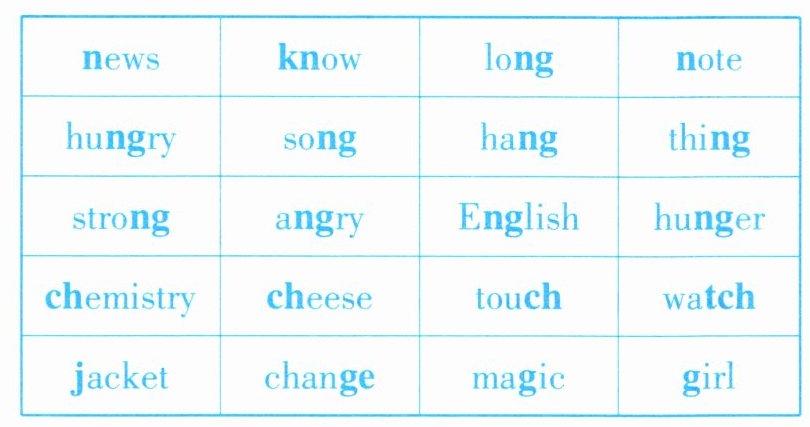
答案
long, hungry, strong, chemistry, girl
解析
第一行中,know和note的"o"发/əʊ/,long的"o"发/ɒ/,news无"o",故long不同;第二行中,song, hang, thing的"ng"发/ŋ/,hungry的"ng"发/ŋɡ/,故hungry不同;第三行中,angry, English, hunger的"ng"发/ŋɡ/,strong的"ng"发/ŋ/,故strong不同;第四行中,cheese, touch, watch的"ch"发/tʃ/,chemistry的"ch"发/k/,故chemistry不同;第五行中,jacket的"j"、change的"ge"、magic的"g"均发/dʒ/,girl的"g"发/ɡ/,故girl不同。
二、从方框中选择适当的词并用其正确形式填空。
| video | partner | technology | education | traffic |
1. We should follow
2. Modern
3. I watched some interesting
4.
5. The two companies are business
| video | partner | technology | education | traffic |
1. We should follow
traffic
rules to keep ourselves safe.2. Modern
technology
helps us communicate better with people around the world.3. I watched some interesting
videos
about animals last night.4.
Education
is very important for everyone to achieve their dreams.5. The two companies are business
partners
in developing AI.答案
1. traffic;2. technology;3. videos;4. Education;5. partners
解析
1. 空格后为名词rules,需用形容词修饰,traffic rules为固定搭配,意为“交通规则”,故填traffic。
2. 空格处作主语,需用名词,Modern修饰名词,technology意为“技术”,符合句意“现代技术帮助我们更好地与世界各地的人交流”,故填technology。
3. some后接可数名词复数或不可数名词,video为可数名词,其复数形式为videos,故填videos。
4. 空格处作主语,需用名词,Education意为“教育”,符合句意“教育对每个人实现梦想都非常重要”,故填Education。
5. 空格处前有business修饰,需用名词,partner意为“伙伴”,根据two companies可知应用复数形式partners,故填partners。
2. 空格处作主语,需用名词,Modern修饰名词,technology意为“技术”,符合句意“现代技术帮助我们更好地与世界各地的人交流”,故填technology。
3. some后接可数名词复数或不可数名词,video为可数名词,其复数形式为videos,故填videos。
4. 空格处作主语,需用名词,Education意为“教育”,符合句意“教育对每个人实现梦想都非常重要”,故填Education。
5. 空格处前有business修饰,需用名词,partner意为“伙伴”,根据two companies可知应用复数形式partners,故填partners。
三、根据要求完成下列各题,每空一词。
1. People will have more free time in the future.(改为一般疑问句并作肯定回答)
—
—
2. Those robots will work in the car factories.(对画线部分提问)
3. There will be a big park near my house.(改为否定句)
There
4. The new library will open next month.(对画线部分提问)
5. There will be five parks in the city next year.(对画线部分提问)
1. People will have more free time in the future.(改为一般疑问句并作肯定回答)
—
Will
people have
more free time in the future?—
Yes
, they
will
.2. Those robots will work in the car factories.(对画线部分提问)
Where
will
those robots work?3. There will be a big park near my house.(改为否定句)
There
won't
be
a big park near my house.4. The new library will open next month.(对画线部分提问)
When
will
the new library open?5. There will be five parks in the city next year.(对画线部分提问)
How
many
parks will
there
be
in the city next year?答案
1. Will; have; Yes; they; will
2. Where; will
3. won't; be
4. When; will
5. How; many; will; there; be
2. Where; will
3. won't; be
4. When; will
5. How; many; will; there; be
解析
1. 含有助动词will的陈述句,变一般疑问句时,需将will提到主语前,句首首字母大写;其肯定回答为“Yes, 主语+will.”,主语people用they指代。
2. 对“in the car factories”地点提问用where,然后将剩余部分will提前,主语those robots在前,动词work在后。
3. 含有助动词will的there be句型,变否定句时,需在will后加not,will not可缩写为won't ,后面动词be用原形。
4. 对“next month”时间提问用when,然后将剩余部分will提前,主语the new library在后。
5. 对“five”数量提问用how many,然后将剩余部分there be句型按变化规则调整,原句是there will be,疑问句把will提前。
2. 对“in the car factories”地点提问用where,然后将剩余部分will提前,主语those robots在前,动词work在后。
3. 含有助动词will的there be句型,变否定句时,需在will后加not,will not可缩写为won't ,后面动词be用原形。
4. 对“next month”时间提问用when,然后将剩余部分will提前,主语the new library在后。
5. 对“five”数量提问用how many,然后将剩余部分there be句型按变化规则调整,原句是there will be,疑问句把will提前。
四、根据汉语意思翻译下列句子,每空一词。
1. 学生们将来可能不会去学校。他们将会在家里或任何他们想待的地方学习。
Students probably
2. 因为我们家中将会有更好的医疗保健技术,所以人们将会活得更久。
People
3. 交通系统将更加高效,因此交通事故将会减少。
The
4. 机器将告诉我们如何在小的健康问题变得更大之前解决它们。
Machines will tell us
5. ——你认为大多数人将来能活多久?
——我认为会有更多的人活到 100 岁以上。
—
—I think more people
1. 学生们将来可能不会去学校。他们将会在家里或任何他们想待的地方学习。
Students probably
won't
go
to school in the future. They will
study
at home or any place they want.2. 因为我们家中将会有更好的医疗保健技术,所以人们将会活得更久。
People
will
live
longer because we will
have
better
medical
care
technology
in our homes.3. 交通系统将更加高效,因此交通事故将会减少。
The
transportation
system
will be more efficient, so there will
be
fewer
traffic
accidents
.4. 机器将告诉我们如何在小的健康问题变得更大之前解决它们。
Machines will tell us
how
to
solve
small health problems before
they become bigger
.5. ——你认为大多数人将来能活多久?
——我认为会有更多的人活到 100 岁以上。
—
How
long
do you think most people will
live
in the future?—I think more people
will
live
to
be
over 100 years old.答案
1. won't go; will study
2. will live; will have better medical care technology
3. transportation system; will be fewer traffic accidents
4. how to solve; before; bigger
5. How long; will live; will live to be
2. will live; will have better medical care technology
3. transportation system; will be fewer traffic accidents
4. how to solve; before; bigger
5. How long; will live; will live to be
解析
1. 第一句“将来可能不会去学校”,“将来”提示用一般将来时,否定形式“won't go”;第二句“将会在家里学习”,一般将来时“will study”。
2. “将会活得更久”用“will live”;“将会有更好的医疗保健技术”,“there be”句型的将来时“will have better medical care technology”。
3. “交通系统”是“transportation system”;“交通事故将会减少”,“there will be fewer traffic accidents”,“accidents”是可数名词,用“fewer”。
4. “如何解决”是“how to solve”;“在……之前”用“before”;“更大”是“bigger”。
5. 问句“活多久”用“How long...live”;答句“活到 100 岁以上”是“will live to be”。
2. “将会活得更久”用“will live”;“将会有更好的医疗保健技术”,“there be”句型的将来时“will have better medical care technology”。
3. “交通系统”是“transportation system”;“交通事故将会减少”,“there will be fewer traffic accidents”,“accidents”是可数名词,用“fewer”。
4. “如何解决”是“how to solve”;“在……之前”用“before”;“更大”是“bigger”。
5. 问句“活多久”用“How long...live”;答句“活到 100 岁以上”是“will live to be”。
