

 登录
登录
Ⅰ.Fill in the blanks with proper words.用适当的词语填空。
1. The brothers
2. A good story has the
3. The farmer was happy to see that the goose
4. The tortoise
5. The mother duck was
1. The brothers
made
(make) a promise to the king to make beautiful clothes for him.2. A good story has the
powerful
(power) magic to interest others.3. The farmer was happy to see that the goose
laid
(lay) a golden egg.4. The tortoise
succeeded
(succeed) in winning the race because it kept moving and didn't give up.5. The mother duck was
really
(real) surprised to see the grey duckling.答案
Ⅰ.1. made 2. powerful 3. laid 4. succeeded 5. really
解析
【分析】
本题为英语适当形式填空题,需结合句子时态、词性用法分析填空:1题描述过去发生的动作,需用动词过去式;2题修饰名词magic,需用power的形容词形式;3题描述过去的动作,需用lay的过去式;4题描述过去的事件,需用succeed的过去式;5题修饰形容词surprised,需用real的副词形式。
【解析】
1. 句子语境为过去发生的动作,谓语动词用一般过去时,make的过去式是made;
2. 此处修饰名词magic,需用power的形容词形式powerful;
3. 描述过去的动作,lay(下蛋)的过去式为laid;
4. 描述过去的事件,succeed的过去式是succeeded;
5. 此处修饰形容词surprised,需用real的副词形式really。
【答案】
1. made 2. powerful 3. laid 4. succeeded 5. really
【知识点】
一般过去时、词性转换、动词过去式
【点评】
本题考查英语基础的时态运用与词性转换,属于常见基础题型,需掌握相关语法规则。
【难度系数】
0.7
本题为英语适当形式填空题,需结合句子时态、词性用法分析填空:1题描述过去发生的动作,需用动词过去式;2题修饰名词magic,需用power的形容词形式;3题描述过去的动作,需用lay的过去式;4题描述过去的事件,需用succeed的过去式;5题修饰形容词surprised,需用real的副词形式。
【解析】
1. 句子语境为过去发生的动作,谓语动词用一般过去时,make的过去式是made;
2. 此处修饰名词magic,需用power的形容词形式powerful;
3. 描述过去的动作,lay(下蛋)的过去式为laid;
4. 描述过去的事件,succeed的过去式是succeeded;
5. 此处修饰形容词surprised,需用real的副词形式really。
【答案】
1. made 2. powerful 3. laid 4. succeeded 5. really
【知识点】
一般过去时、词性转换、动词过去式
【点评】
本题考查英语基础的时态运用与词性转换,属于常见基础题型,需掌握相关语法规则。
【难度系数】
0.7
Ⅱ.Complete the sentences with proper words.用适当的词语完成句子。
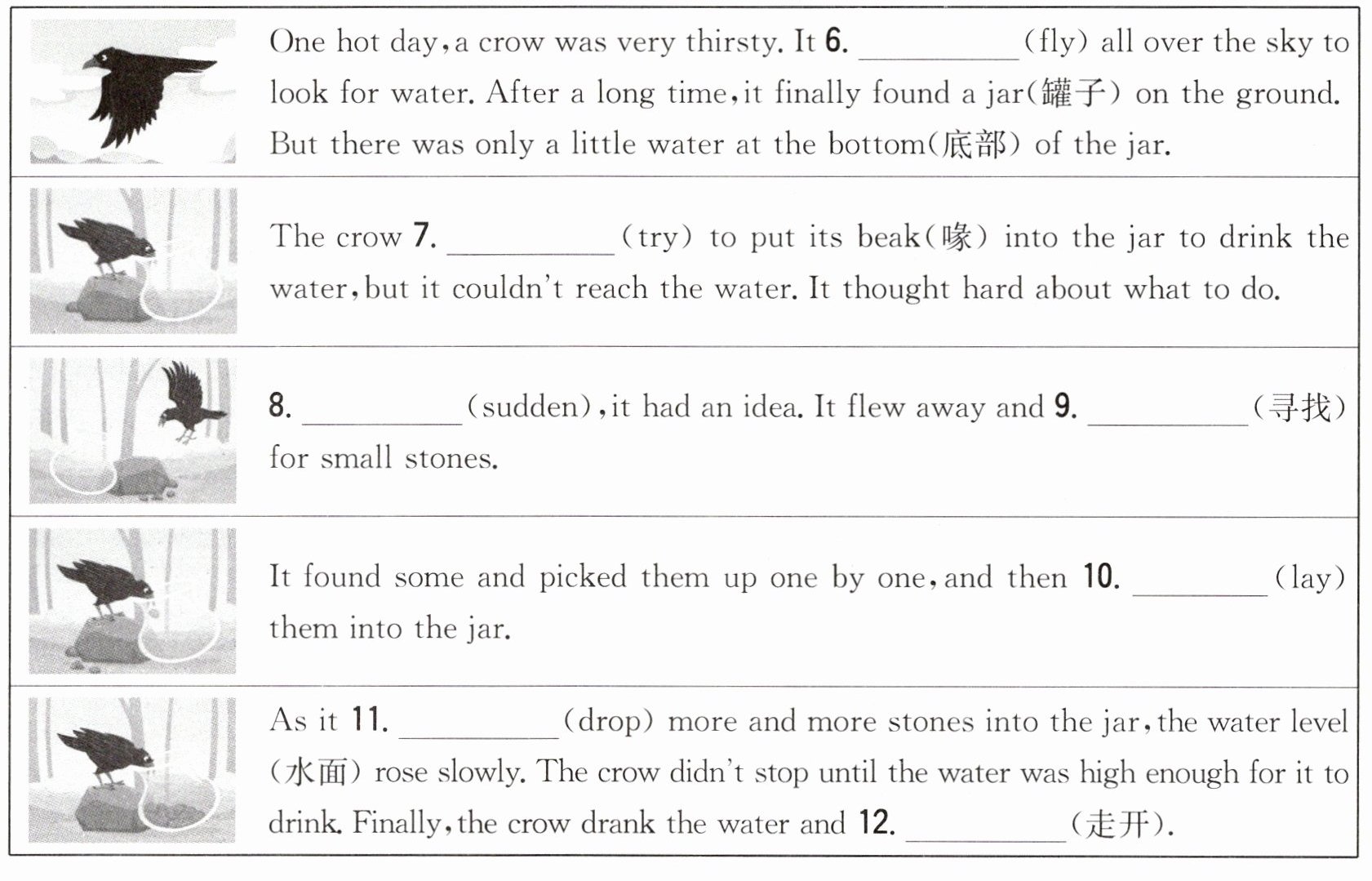
答案
Ⅱ.6. flew 7. tried 8. Suddenly 9. searched/looked
10. laid 11. dropped 12. went away
10. laid 11. dropped 12. went away
解析
【分析】
本题是英语语法填空题,需结合故事语境的时态、词性转换及固定短语解题。首先通读全文,明确故事发生在过去,多数动词需用过去式;同时注意形容词变副词、固定短语的正确形式,逐步分析每个空的语法和语境要求。
步骤1:第6空,前文用过去式was,故事为一般过去时,fly需用过去式;
步骤2:第7空,故事叙述过去动作,try用过去式;
步骤3:第8空,需副词修饰句子,sudden转换为副词;
步骤4:第9空,“寻找”对应固定短语,结合过去时态用过去式;
步骤5:第10空,lay表“放置”时,过去式为特殊变化;
步骤6:第11空,全文为一般过去时,drop用过去式;
步骤7:第12空,“走开”对应固定短语,过去式与drank并列。
【解析】
6. 由前文“was”可知,故事为一般过去时,fly的过去式是flew,故填flew;
7. 故事叙述过去发生的动作,try的过去式是tried,故填tried;
8. 此处需副词作状语修饰整个句子,sudden的副词形式为Suddenly,句首大写,故填Suddenly;
9. “寻找”对应短语search/look for,结合过去时态,用过去式searched/looked,故填searched/looked;
10. lay表示“放置”时,过去式为laid,故填laid;
11. 全文为一般过去时,drop的过去式是dropped,故填dropped;
12. “走开”的固定短语为go away,过去式为went away,与drank并列,故填went away。
【答案】
6. flew 7. tried 8. Suddenly 9. searched/looked 10. laid 11. dropped 12. went away
【知识点】
一般过去时、词性转换、动词短语
【点评】
本题结合经典乌鸦喝水的故事考查语法填空,重点围绕一般过去时的运用、形容词变副词及固定短语搭配,题型基础,贴近学生熟悉的语境,能有效考查学生的基础语法掌握情况。
【难度系数】
0.6
本题是英语语法填空题,需结合故事语境的时态、词性转换及固定短语解题。首先通读全文,明确故事发生在过去,多数动词需用过去式;同时注意形容词变副词、固定短语的正确形式,逐步分析每个空的语法和语境要求。
步骤1:第6空,前文用过去式was,故事为一般过去时,fly需用过去式;
步骤2:第7空,故事叙述过去动作,try用过去式;
步骤3:第8空,需副词修饰句子,sudden转换为副词;
步骤4:第9空,“寻找”对应固定短语,结合过去时态用过去式;
步骤5:第10空,lay表“放置”时,过去式为特殊变化;
步骤6:第11空,全文为一般过去时,drop用过去式;
步骤7:第12空,“走开”对应固定短语,过去式与drank并列。
【解析】
6. 由前文“was”可知,故事为一般过去时,fly的过去式是flew,故填flew;
7. 故事叙述过去发生的动作,try的过去式是tried,故填tried;
8. 此处需副词作状语修饰整个句子,sudden的副词形式为Suddenly,句首大写,故填Suddenly;
9. “寻找”对应短语search/look for,结合过去时态,用过去式searched/looked,故填searched/looked;
10. lay表示“放置”时,过去式为laid,故填laid;
11. 全文为一般过去时,drop的过去式是dropped,故填dropped;
12. “走开”的固定短语为go away,过去式为went away,与drank并列,故填went away。
【答案】
6. flew 7. tried 8. Suddenly 9. searched/looked 10. laid 11. dropped 12. went away
【知识点】
一般过去时、词性转换、动词短语
【点评】
本题结合经典乌鸦喝水的故事考查语法填空,重点围绕一般过去时的运用、形容词变副词及固定短语搭配,题型基础,贴近学生熟悉的语境,能有效考查学生的基础语法掌握情况。
【难度系数】
0.6
Ⅲ.Read the passage and complete the following tasks.阅读并完成下列任务。
The Lion and the Mouse
Scene 1:
Narrator:The lion is sleeping under the tree. The mouse is searching for food and runs onto the lion.
Lion:[Wakes up suddenly and roars(咆哮)] Who is it? How dare(敢) you wake me up! Ah,it's you,a little mouse!
Mouse:[Shaking with fear(害怕)] Oh, Mr Lion. I'm sorry. Please don't be angry. I didn't mean to.
Lion:You woke me up. I should eat you right now.
Mouse:Please don't,Mr Lion. If you let me go,I may be able to help you one day.
Lion:(Laughs loudly) You? Help me? That's really silly. But okay,I'll let you go this time. (Lets the mouse go)
Scene 2:
Narrator:The lion is running after a deer and accidentally(意外地) gets into a hunter's net. He tries to get out,but it's meaningless.
Lion:(Roars angrily) Roar! I can't get out. What can I do?
Scene 3:
The mouse hears the lion's roar and quickly comes. It starts to bite through the net with its small teeth.
Mouse:(Biting and saying) Hold on,Mr Lion. I'm here to help you.
Lion:(Surprised) Can you really help me,little mouse?
Mouse:Yes,I will try my best. (Continues biting the net)
Lion:(Gets out of the net) Thank you,little mouse. I was wrong. You are really a great friend.
Mouse:You're welcome,Mr Lion. From now on,we are friends.
13. Choose a proper description for each scene.为每个场景选择合适的描述。
Scene 1:
A. The Lion Gets Caught
B. The Mouse Saves the Lion
C. An Unexpected(出乎意料的) Meeting in the Forest
14. Tick the features that a script of a play has.勾选戏剧剧本具有的特点。
A script of a play...
□has different scenes and characters □is made of many conversations
□may have an introduction(介绍) of the story □may have performance instructions(指导)
The Lion and the Mouse
Scene 1:
C
Narrator:The lion is sleeping under the tree. The mouse is searching for food and runs onto the lion.
Lion:[Wakes up suddenly and roars(咆哮)] Who is it? How dare(敢) you wake me up! Ah,it's you,a little mouse!
Mouse:[Shaking with fear(害怕)] Oh, Mr Lion. I'm sorry. Please don't be angry. I didn't mean to.
Lion:You woke me up. I should eat you right now.
Mouse:Please don't,Mr Lion. If you let me go,I may be able to help you one day.
Lion:(Laughs loudly) You? Help me? That's really silly. But okay,I'll let you go this time. (Lets the mouse go)
Scene 2:
A
Narrator:The lion is running after a deer and accidentally(意外地) gets into a hunter's net. He tries to get out,but it's meaningless.
Lion:(Roars angrily) Roar! I can't get out. What can I do?
Scene 3:
B
The mouse hears the lion's roar and quickly comes. It starts to bite through the net with its small teeth.
Mouse:(Biting and saying) Hold on,Mr Lion. I'm here to help you.
Lion:(Surprised) Can you really help me,little mouse?
Mouse:Yes,I will try my best. (Continues biting the net)
Lion:(Gets out of the net) Thank you,little mouse. I was wrong. You are really a great friend.
Mouse:You're welcome,Mr Lion. From now on,we are friends.
13. Choose a proper description for each scene.为每个场景选择合适的描述。
Scene 1:
C
Scene 2:A
Scene 3:B
A. The Lion Gets Caught
B. The Mouse Saves the Lion
C. An Unexpected(出乎意料的) Meeting in the Forest
14. Tick the features that a script of a play has.勾选戏剧剧本具有的特点。
A script of a play...
□has different scenes and characters □is made of many conversations
□may have an introduction(介绍) of the story □may have performance instructions(指导)
答案
Ⅲ.13. CAB 14. All of them.
解析
【分析】
1. 第13题需结合每个场景的核心情节,匹配对应的描述:先梳理Scene1、Scene2、Scene3的关键内容,再对应选项;2. 第14题需回忆戏剧剧本的基本特征,逐一判断选项是否符合要求。
【解析】
13. 分析各场景核心内容:
Scene1:狮子在树下睡觉,老鼠意外跑上打扰,核心是“意外相遇”,对应选项C;
Scene2:狮子追鹿时意外进入猎人的网,核心是“狮子被抓住”,对应选项A;
Scene3:老鼠用牙齿咬断网救了狮子,核心是“老鼠救狮子”,对应选项B;
因此答案为CAB。
14. 逐一判断戏剧剧本的特点:
戏剧剧本会划分不同场景、设定角色,符合;
戏剧剧本以角色间的对话推进情节,符合;
戏剧剧本通常会有故事背景介绍,符合;
戏剧剧本会包含角色的动作、语气等表演指导,符合;
因此所有选项均为戏剧剧本的特点,答案为All of them。
【答案】
13. CAB 14. All of them.
【知识点】
阅读理解(故事类)、戏剧剧本常识、信息匹配
【点评】
本题分为两部分,第13题考察对故事场景内容的理解与信息匹配,第14题考察戏剧剧本的基本常识,均为英语学习中的基础题型,难度适中,能有效检验学生的阅读理解能力和常识积累。
【难度系数】
0.6
1. 第13题需结合每个场景的核心情节,匹配对应的描述:先梳理Scene1、Scene2、Scene3的关键内容,再对应选项;2. 第14题需回忆戏剧剧本的基本特征,逐一判断选项是否符合要求。
【解析】
13. 分析各场景核心内容:
Scene1:狮子在树下睡觉,老鼠意外跑上打扰,核心是“意外相遇”,对应选项C;
Scene2:狮子追鹿时意外进入猎人的网,核心是“狮子被抓住”,对应选项A;
Scene3:老鼠用牙齿咬断网救了狮子,核心是“老鼠救狮子”,对应选项B;
因此答案为CAB。
14. 逐一判断戏剧剧本的特点:
戏剧剧本会划分不同场景、设定角色,符合;
戏剧剧本以角色间的对话推进情节,符合;
戏剧剧本通常会有故事背景介绍,符合;
戏剧剧本会包含角色的动作、语气等表演指导,符合;
因此所有选项均为戏剧剧本的特点,答案为All of them。
【答案】
13. CAB 14. All of them.
【知识点】
阅读理解(故事类)、戏剧剧本常识、信息匹配
【点评】
本题分为两部分,第13题考察对故事场景内容的理解与信息匹配,第14题考察戏剧剧本的基本常识,均为英语学习中的基础题型,难度适中,能有效检验学生的阅读理解能力和常识积累。
【难度系数】
0.6
