

 登录
登录
四、词语运用。
A)选用方框里的单词或词组填空,其中有一个单词或词组是多余的。
$\boxed{government\quad result\quad effort\quad live\ on\quad increase\quad environment}$
Most students $\underline{\quad1\quad}$ rich knowledge from classes. Our school and local $\underline{\quad2\quad}$ offer good study protection for teenagers. With teachers' hard $\underline{\quad3\quad}$ and our active practice, our grades and learning skills greatly $\underline{\quad4\quad}$ term by term. We grow better and make progress every day in such a warm learning $\underline{\quad5\quad}$.
1. ______ 2. ______ 3. ______ 4. ______ 5. ______
A)选用方框里的单词或词组填空,其中有一个单词或词组是多余的。
$\boxed{government\quad result\quad effort\quad live\ on\quad increase\quad environment}$
Most students $\underline{\quad1\quad}$ rich knowledge from classes. Our school and local $\underline{\quad2\quad}$ offer good study protection for teenagers. With teachers' hard $\underline{\quad3\quad}$ and our active practice, our grades and learning skills greatly $\underline{\quad4\quad}$ term by term. We grow better and make progress every day in such a warm learning $\underline{\quad5\quad}$.
1. ______ 2. ______ 3. ______ 4. ______ 5. ______
答案
A)1. live on 2. government 3. effort 4. increase 5. environment
解析
【分析】
这是一道词语运用题,需结合句子语境和词汇词义选择合适的词填空,先明确方框内词汇含义:government(政府)、result(结果)、effort(努力)、live on(从……获取;靠……生活)、increase(增加;提升)、environment(环境),其中有一个多余。逐个分析句子:
1. 第1空需表“从课堂获取知识”的短语,对应live on;
2. 第2空与school并列,需表“当地机构”的名词,对应government;
3. 第3空需被hard修饰的名词,表“努力”,对应effort;
4. 第4空需表“成绩和技能提升”的动词,对应increase;
5. 第5空需表“学习相关环境”的名词,对应environment。
【解析】
根据语境及词汇词义逐一匹配:
1. 句意为学生从课堂获取丰富知识,live on符合“从……获取”的含义,故填live on;
2. 当地政府与学校共同为青少年提供学习保障,government符合语境,故填government;
3. hard修饰名词,表“教师的努力”,故填effort;
4. 主语“grades and learning skills”需动词表“提升”,increase符合,故填increase;
5. “learning”后需名词表“环境”,environment符合,故填environment。多余词汇为result。
【答案】
1. live on 2. government 3. effort 4. increase 5. environment
【知识点】
词语运用、名词辨析、动词短语
【点评】
本题考查词汇在具体语境中的运用,需结合句子含义匹配词汇词义,是基础题型,难度较低,适合学生巩固词汇的语境用法。
【难度系数】
0.7
这是一道词语运用题,需结合句子语境和词汇词义选择合适的词填空,先明确方框内词汇含义:government(政府)、result(结果)、effort(努力)、live on(从……获取;靠……生活)、increase(增加;提升)、environment(环境),其中有一个多余。逐个分析句子:
1. 第1空需表“从课堂获取知识”的短语,对应live on;
2. 第2空与school并列,需表“当地机构”的名词,对应government;
3. 第3空需被hard修饰的名词,表“努力”,对应effort;
4. 第4空需表“成绩和技能提升”的动词,对应increase;
5. 第5空需表“学习相关环境”的名词,对应environment。
【解析】
根据语境及词汇词义逐一匹配:
1. 句意为学生从课堂获取丰富知识,live on符合“从……获取”的含义,故填live on;
2. 当地政府与学校共同为青少年提供学习保障,government符合语境,故填government;
3. hard修饰名词,表“教师的努力”,故填effort;
4. 主语“grades and learning skills”需动词表“提升”,increase符合,故填increase;
5. “learning”后需名词表“环境”,environment符合,故填environment。多余词汇为result。
【答案】
1. live on 2. government 3. effort 4. increase 5. environment
【知识点】
词语运用、名词辨析、动词短语
【点评】
本题考查词汇在具体语境中的运用,需结合句子含义匹配词汇词义,是基础题型,难度较低,适合学生巩固词汇的语境用法。
【难度系数】
0.7
B)阅读短文,在文中空白处填入1个适当的单词,或用括号内所给单词或短语的正确形式填空。
The giant panda is one of
1.
6.
The giant panda is one of
the
most popular animals in the world. A giant panda can grow up to 1.8 metres long and weigh
(weigh) up to 180 kg. People think the giant panda is very lovely, so
it is not surprising that the WWF chose the giant panda as its symbol. The WWF tells people that giant pandas are in
danger, and we need to raise money to save
(save) them. In the early 1980s, there were
(be) about 1,100 giant pandas in the wild. The main reason why giant pandas are endangered is that the area where giant pandas can live has become smaller
(small). The WWF works for helping
(help) the giant pandas in the wild in many ways. One of the ways is to increase the size of reserves for giant pandas. There are paths(小路) that lead giant pandas from one reserve to another. No one can harm the giant pandas in these areas. The corridors let the giant pandas move from one habitat(栖息地) to another to look for food. People work/are working
(work) very hard to make sure the giant panda doesn't die
(not die) out.1.
the
2. weigh
3. so
4. in
5. to save
6.
were
7. smaller
8. helping
9. work/are working
10. doesn't die
答案
B)1. the 2. weigh 3. so 4. in 5. to save 6. were 7. smaller 8. helping 9. work/are working 10. doesn't die
解析
【分析】
本题是英语语法填空题,需结合语法规则、固定搭配及上下文语境逐个确定空白处的单词。1. 形容词最高级前必须加定冠词the,构成“one of the + 最高级”结构;2. 情态动词can后接动词原形,与前面的grow并列;3. 前后句为因果关系,用连词so连接;4. 固定短语in danger表示“处于危险中”;5. 此处用不定式作目的状语,表“筹集资金来拯救熊猫”;6. there be句型遵循就近原则,时间状语为过去时,主语是复数,be动词用were;7. 语境表示熊猫栖息地变得更小,用形容词比较级;8. 介词for后接动名词作宾语;9. 主语people是复数,结合语境用一般现在时或现在进行时;10. 主语the giant panda是单数,一般现在时的否定形式用doesn't加动词原形。
【解析】
1. 考查形容词最高级的固定结构“one of + the + 形容词最高级 + 可数名词复数”,故填the;
2. 情态动词can后接动词原形,与前面的grow并列作谓语,故填weigh;
3. 前句说明熊猫可爱,后句说WWF选它当标志不奇怪,是因果关系,故填so;
4. 固定搭配in danger意为“处于危险中”,符合语境,故填in;
5. 此处用不定式to save作目的状语,表“筹集资金的目的是拯救熊猫”,故填to save;
6. 时间状语“in the early 1980s”是过去时间,there be句型主语“1,100 giant pandas”为复数,be动词用were,故填were;
7. 语境表示熊猫可居住的区域变得更小,用形容词比较级smaller,故填smaller;
8. 介词for后接动名词作宾语,work的动名词形式是helping,故填helping;
9. 主语people是复数,结合语境描述当前人们的行为,可用一般现在时work或现在进行时are working,故填work/are working;
10. 主语the giant panda是第三人称单数,一般现在时的否定形式借助助动词doesn't,后接动词原形die,故填doesn't die。
【答案】
1. the 2. weigh 3. so 4. in 5. to save 6. were 7. smaller 8. helping 9. work/are working 10. doesn't die
【知识点】
形容词最高级、固定搭配、动词时态
【点评】
本题为初中英语基础语法填空题,考查核心语法点如形容词最高级、固定短语、时态等,需结合语境和语法规则作答,题型常规,难度适中,适合中等及以上学生完成。
【难度系数】
0.7
本题是英语语法填空题,需结合语法规则、固定搭配及上下文语境逐个确定空白处的单词。1. 形容词最高级前必须加定冠词the,构成“one of the + 最高级”结构;2. 情态动词can后接动词原形,与前面的grow并列;3. 前后句为因果关系,用连词so连接;4. 固定短语in danger表示“处于危险中”;5. 此处用不定式作目的状语,表“筹集资金来拯救熊猫”;6. there be句型遵循就近原则,时间状语为过去时,主语是复数,be动词用were;7. 语境表示熊猫栖息地变得更小,用形容词比较级;8. 介词for后接动名词作宾语;9. 主语people是复数,结合语境用一般现在时或现在进行时;10. 主语the giant panda是单数,一般现在时的否定形式用doesn't加动词原形。
【解析】
1. 考查形容词最高级的固定结构“one of + the + 形容词最高级 + 可数名词复数”,故填the;
2. 情态动词can后接动词原形,与前面的grow并列作谓语,故填weigh;
3. 前句说明熊猫可爱,后句说WWF选它当标志不奇怪,是因果关系,故填so;
4. 固定搭配in danger意为“处于危险中”,符合语境,故填in;
5. 此处用不定式to save作目的状语,表“筹集资金的目的是拯救熊猫”,故填to save;
6. 时间状语“in the early 1980s”是过去时间,there be句型主语“1,100 giant pandas”为复数,be动词用were,故填were;
7. 语境表示熊猫可居住的区域变得更小,用形容词比较级smaller,故填smaller;
8. 介词for后接动名词作宾语,work的动名词形式是helping,故填helping;
9. 主语people是复数,结合语境描述当前人们的行为,可用一般现在时work或现在进行时are working,故填work/are working;
10. 主语the giant panda是第三人称单数,一般现在时的否定形式借助助动词doesn't,后接动词原形die,故填doesn't die。
【答案】
1. the 2. weigh 3. so 4. in 5. to save 6. were 7. smaller 8. helping 9. work/are working 10. doesn't die
【知识点】
形容词最高级、固定搭配、动词时态
【点评】
本题为初中英语基础语法填空题,考查核心语法点如形容词最高级、固定短语、时态等,需结合语境和语法规则作答,题型常规,难度适中,适合中等及以上学生完成。
【难度系数】
0.7
五、阅读理解。(2025·江苏连云港·中考)
Hello from nature’s foodies
As a proud grizzly bear, I say hello from Alaska. We eat anything we can get our paws on. One of my favourite meals is catching fresh salmon. There’s nothing quite like the pleasure of a stomach full of fresh fish!
I’m a blue whale. I may eat up to 3.6 million krill(磷虾) per day! You may wonder why such huge animals live on such tiny food? It's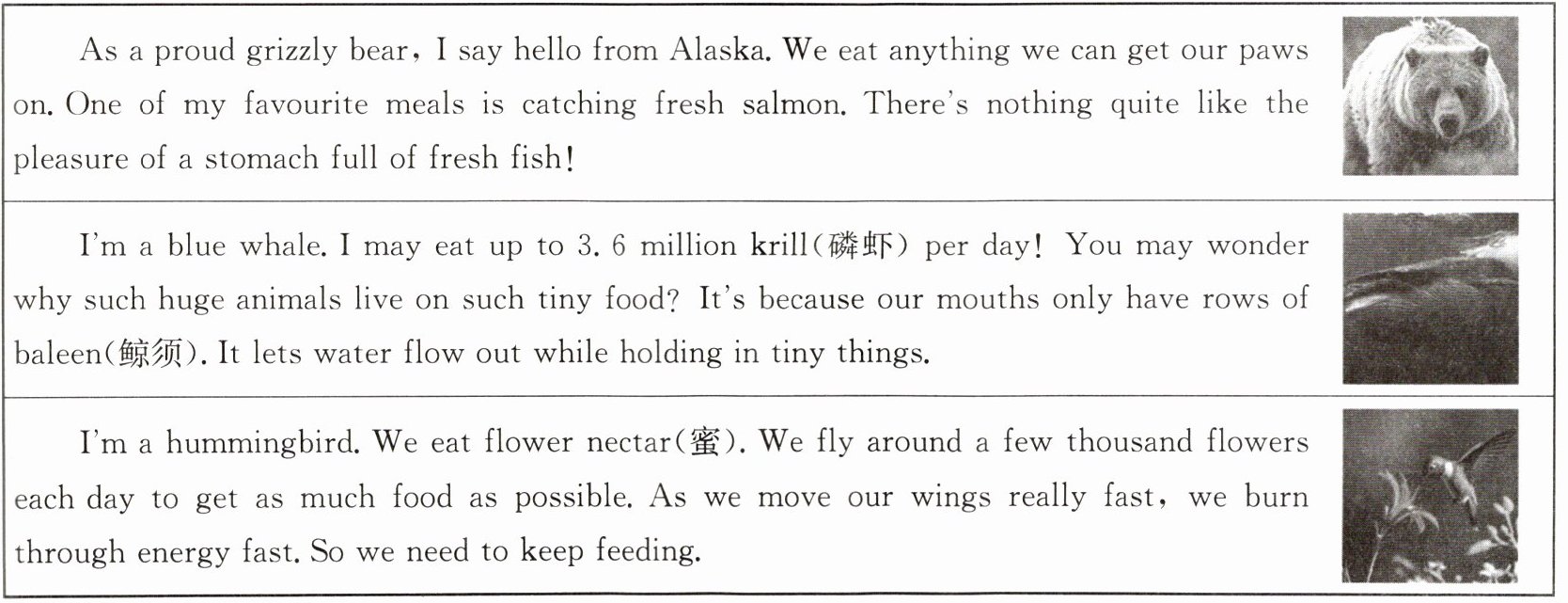 ause our mouths only have rows of baleen(鲸须). It lets water flow out while holding in tiny things.
I’m a hummingbird. We eat flower nectar(蜜). We fly around a few thousand flowers each day to get as much food as possible. As we move our wings really fast, we burn through energy fast. So we need to keep feeding.
续表
Hello~from~a~sloth~in~the~South~America! Our favourite food? Low-energy leaves! Do we eat a lot? No. We slow-movers don't need a lot of energy. Even our stomachs work so slowly that after a meal, we're too tired to do anything but... sleep!
(
A. It is the largest sea animal. B. It is too slow to catch large fish.
C. It only has baleen instead of teeth. D. It likes a stomach full of tiny food.
(
A. Living places. B. Diet lists. C. Daily activities. D. Body sizes.
(
A. Wildlife. B. Landscapes. C. Travelling. D. Photography.
Hello from nature’s foodies
As a proud grizzly bear, I say hello from Alaska. We eat anything we can get our paws on. One of my favourite meals is catching fresh salmon. There’s nothing quite like the pleasure of a stomach full of fresh fish!
I’m a blue whale. I may eat up to 3.6 million krill(磷虾) per day! You may wonder why such huge animals live on such tiny food? It's
ause our mouths only have rows of baleen(鲸须). It lets water flow out while holding in tiny things.I’m a hummingbird. We eat flower nectar(蜜). We fly around a few thousand flowers each day to get as much food as possible. As we move our wings really fast, we burn through energy fast. So we need to keep feeding.
续表
Hello~from~a~sloth~in~the~South~America! Our favourite food? Low-energy leaves! Do we eat a lot? No. We slow-movers don't need a lot of energy. Even our stomachs work so slowly that after a meal, we're too tired to do anything but... sleep!
(
C
)1. Why does a blue whale live on tiny living things?A. It is the largest sea animal. B. It is too slow to catch large fish.
C. It only has baleen instead of teeth. D. It likes a stomach full of tiny food.
(
C
)2. What decides how much hummingbirds and sloths eat?A. Living places. B. Diet lists. C. Daily activities. D. Body sizes.
(
A
)3. Which part of a magazine is the text probably from?A. Wildlife. B. Landscapes. C. Travelling. D. Photography.
答案
1. C 【点拨】根据表格第二栏可知,蓝鲸以磷虾等微小生物为食,是因为它们的嘴里只有鲸须。故选 C。
2. C 【点拨】根据表格第三栏及第四栏可知,蜂鸟需要大量进食是因为它们的翅膀快速振动,消耗能量极快,需要不断补充能量,而树懒则因为活动缓慢,能量消耗低,不需要大量进食,这都与它们的日常活动密切相关。故选 C。
3. A 【点拨】本文介绍了不同动物的饮食习性,故文章可能来自杂志的“野生生物”部分。故选 A。
2. C 【点拨】根据表格第三栏及第四栏可知,蜂鸟需要大量进食是因为它们的翅膀快速振动,消耗能量极快,需要不断补充能量,而树懒则因为活动缓慢,能量消耗低,不需要大量进食,这都与它们的日常活动密切相关。故选 C。
3. A 【点拨】本文介绍了不同动物的饮食习性,故文章可能来自杂志的“野生生物”部分。故选 A。
解析
【分析】
本题为英语阅读理解题,包含3道小题,分别考查细节理解和主旨大意。解题思路如下:
1. 第1题:定位蓝鲸的段落,查找其以微小生物为食的原因,匹配选项得出答案。
2. 第2题:分别定位蜂鸟和树懒的相关段落,分析影响二者进食量的因素,对应选项。
3. 第3题:归纳全文主旨(介绍不同动物的饮食习性),判断文章所属的杂志板块。
【解析】
1. 第1题:根据原文第二栏蓝鲸的描述“It's because our mouths only have rows of baleen(鲸须). It lets water flow out while holding in tiny things.”,可知蓝鲸以微小生物为食是因为只有鲸须而非牙齿,对应选项C。
2. 第2题:蜂鸟因翅膀快速振动消耗能量快需大量进食,树懒因活动缓慢能量消耗低无需大量进食,二者进食量均与日常活动相关,对应选项C。
3. 第3题:全文介绍了灰熊、蓝鲸、蜂鸟、树懒等动物的饮食习性,属于野生生物相关内容,故文章最可能来自杂志的Wildlife板块,对应选项A。
【答案】
1.C 2.C 3.A
【知识点】
细节理解题、主旨大意题、英语阅读理解
【点评】
本题围绕不同动物的饮食习性展开,考查学生快速定位细节信息、归纳文章主旨的能力,题型常规,难度适中。
【难度系数】
0.6
本题为英语阅读理解题,包含3道小题,分别考查细节理解和主旨大意。解题思路如下:
1. 第1题:定位蓝鲸的段落,查找其以微小生物为食的原因,匹配选项得出答案。
2. 第2题:分别定位蜂鸟和树懒的相关段落,分析影响二者进食量的因素,对应选项。
3. 第3题:归纳全文主旨(介绍不同动物的饮食习性),判断文章所属的杂志板块。
【解析】
1. 第1题:根据原文第二栏蓝鲸的描述“It's because our mouths only have rows of baleen(鲸须). It lets water flow out while holding in tiny things.”,可知蓝鲸以微小生物为食是因为只有鲸须而非牙齿,对应选项C。
2. 第2题:蜂鸟因翅膀快速振动消耗能量快需大量进食,树懒因活动缓慢能量消耗低无需大量进食,二者进食量均与日常活动相关,对应选项C。
3. 第3题:全文介绍了灰熊、蓝鲸、蜂鸟、树懒等动物的饮食习性,属于野生生物相关内容,故文章最可能来自杂志的Wildlife板块,对应选项A。
【答案】
1.C 2.C 3.A
【知识点】
细节理解题、主旨大意题、英语阅读理解
【点评】
本题围绕不同动物的饮食习性展开,考查学生快速定位细节信息、归纳文章主旨的能力,题型常规,难度适中。
【难度系数】
0.6
