

 登录
登录
五、情景交际
根据情景提示,用得体的英语完成下列对话。
51. A:
B: My birthday party was enjoyable.
52. A: Do you think Chinese will be learned by more foreigners in the future?
B:
53. A:
B: About 10 minutes' walk.
54. A: You'd better not be late next time.
B:
55. A: How well you speak English!
B:
根据情景提示,用得体的英语完成下列对话。
51. A:
How was your birthday party
?B: My birthday party was enjoyable.
52. A: Do you think Chinese will be learned by more foreigners in the future?
B:
Yes, I think/guess so/Of course/That's for sure
.53. A:
How far
is it from your home to school?B: About 10 minutes' walk.
54. A: You'd better not be late next time.
B:
Sorry, I won't/I won't
.55. A: How well you speak English!
B:
Thank you/Thanks/It's nice of you to say so
.答案
51. How was your birthday party
52. Yes, I think/guess so/Of course/That's for sure
53. How far 54. Sorry, I won't/I won't
55. Thank you/Thanks/It's nice of you to say so
52. Yes, I think/guess so/Of course/That's for sure
53. How far 54. Sorry, I won't/I won't
55. Thank you/Thanks/It's nice of you to say so
解析
【分析】
本题为英语情景交际题,需结合上下文语境补全对话内容。51题根据答语询问生日派对的情况;52题针对一般疑问句给出合适回答;53题根据答语的距离信息选择对应的特殊疑问词;54题回应对方的提醒,表达歉意和承诺;55题应对他人的夸奖,使用得体的感谢用语。
【解析】
51. 答语“My birthday party was enjoyable.”说明A询问的是生日派对的情况,对应问句为How was your birthday party;
52. 针对一般疑问句“Do you think Chinese will be learned by more foreigners in the future?”,可给出肯定回答,如Yes, I think so等;
53. 答语“About 10 minutes' walk.”表示距离,询问距离用特殊疑问词How far;
54. 面对“下次别迟到”的提醒,应道歉并承诺不再迟到,故填Sorry, I won't等;
55. 他人夸奖英语说得好时,需用感谢类表达回应,如Thank you等。
【答案】
51. How was your birthday party
52. Yes, I think/guess so/Of course/That's for sure
53. How far
54. Sorry, I won't/I won't
55. Thank you/Thanks/It's nice of you to say so
【知识点】
情景交际、日常用语、特殊疑问句
【点评】
本题考查日常场景下的英语对话表达,贴近生活实际,侧重基础交际能力的运用,是初中英语常见的基础题型。
【难度系数】
0.8
本题为英语情景交际题,需结合上下文语境补全对话内容。51题根据答语询问生日派对的情况;52题针对一般疑问句给出合适回答;53题根据答语的距离信息选择对应的特殊疑问词;54题回应对方的提醒,表达歉意和承诺;55题应对他人的夸奖,使用得体的感谢用语。
【解析】
51. 答语“My birthday party was enjoyable.”说明A询问的是生日派对的情况,对应问句为How was your birthday party;
52. 针对一般疑问句“Do you think Chinese will be learned by more foreigners in the future?”,可给出肯定回答,如Yes, I think so等;
53. 答语“About 10 minutes' walk.”表示距离,询问距离用特殊疑问词How far;
54. 面对“下次别迟到”的提醒,应道歉并承诺不再迟到,故填Sorry, I won't等;
55. 他人夸奖英语说得好时,需用感谢类表达回应,如Thank you等。
【答案】
51. How was your birthday party
52. Yes, I think/guess so/Of course/That's for sure
53. How far
54. Sorry, I won't/I won't
55. Thank you/Thanks/It's nice of you to say so
【知识点】
情景交际、日常用语、特殊疑问句
【点评】
本题考查日常场景下的英语对话表达,贴近生活实际,侧重基础交际能力的运用,是初中英语常见的基础题型。
【难度系数】
0.8
六、看图写话
根据每小题所提供的提示词,写出一个与图画情景相符的句子。
next year
56.
57.
58.
59.
根据每小题所提供的提示词,写出一个与图画情景相符的句子。
next year
56.
Great Britain is famous for Big Ben./London is famous for Big Ben.
57.
It means/expresses/shows agreement.
58.
The book will be published next year.
59.
He has been to Shanghai./The man has been to Shanghai.
答案
56. Great Britain is famous for Big Ben./London is famous for Big Ben.
57. It means/expresses/shows agreement.
58. The book will be published next year.
59. He has been to Shanghai./The man has been to Shanghai.
57. It means/expresses/shows agreement.
58. The book will be published next year.
59. He has been to Shanghai./The man has been to Shanghai.
解析
【分析】
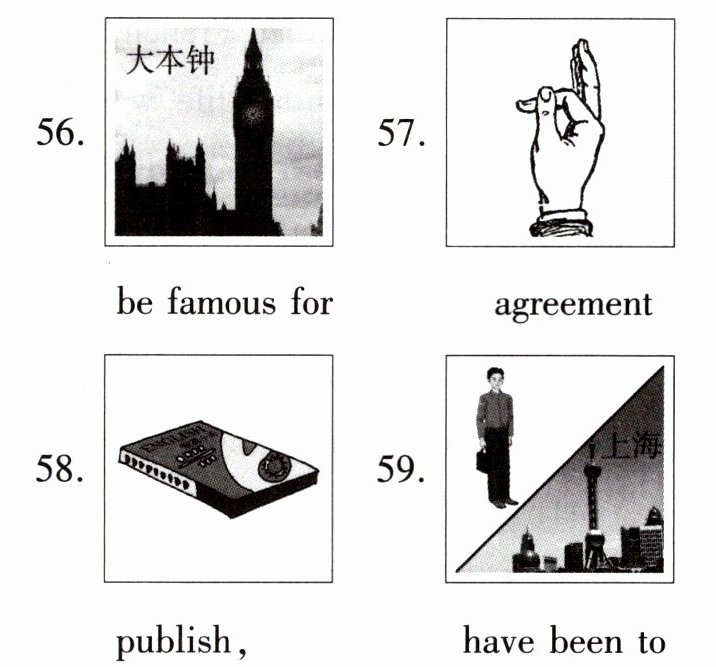
本题为看图写话题,需结合每小题的图画内容、给定提示词(含58题的时间状语next year),运用正确的语法规则构造符合情景的句子。具体思路:
1. 56题:图画是大本钟,提示词be famous for,需表达“某地以大本钟闻名”,用一般现在时;
2. 57题:图画是OK手势,提示词agreement,需表达该手势的含义,用一般现在时;
3. 58题:图画是一本书,提示词publish,还有时间next year,需用一般将来时的被动语态,表达“这本书明年将被出版”;
4. 59题:图画是人物,提示词have been to,地点是上海,需用现在完成时,表达“某人去过上海”。
【解析】
56题:根据图画大本钟和短语be famous for,可写出“Great Britain is famous for Big Ben.”(或“London is famous for Big Ben.”),符合“某地因某物闻名”的句式结构;
57题:根据图画OK手势和名词agreement,写出“It means agreement.”,准确表达该手势的含义;
58题:结合图画书、动词publish和时间状语next year,使用一般将来时的被动语态,写出“The book will be published next year.”,符合语法要求;
59题:根据图画人物、短语have been to和地点Shanghai,写出“He has been to Shanghai.”,正确运用现在完成时表达“去过某地”的含义。
【答案】
56. Great Britain is famous for Big Ben./London is famous for Big Ben.
57. It means agreement.
58. The book will be published next year.
59. He has been to Shanghai.
【知识点】
看图写句、一般现在时、一般将来时被动语态、现在完成时
【点评】
本题考查学生的图文转换能力,要求学生准确理解图画含义,结合提示词和语法知识构造正确句子,需掌握相关短语和时态的用法,难度适中。
【难度系数】
0.3
本题为看图写话题,需结合每小题的图画内容、给定提示词(含58题的时间状语next year),运用正确的语法规则构造符合情景的句子。具体思路:
1. 56题:图画是大本钟,提示词be famous for,需表达“某地以大本钟闻名”,用一般现在时;
2. 57题:图画是OK手势,提示词agreement,需表达该手势的含义,用一般现在时;
3. 58题:图画是一本书,提示词publish,还有时间next year,需用一般将来时的被动语态,表达“这本书明年将被出版”;
4. 59题:图画是人物,提示词have been to,地点是上海,需用现在完成时,表达“某人去过上海”。
【解析】
56题:根据图画大本钟和短语be famous for,可写出“Great Britain is famous for Big Ben.”(或“London is famous for Big Ben.”),符合“某地因某物闻名”的句式结构;
57题:根据图画OK手势和名词agreement,写出“It means agreement.”,准确表达该手势的含义;
58题:结合图画书、动词publish和时间状语next year,使用一般将来时的被动语态,写出“The book will be published next year.”,符合语法要求;
59题:根据图画人物、短语have been to和地点Shanghai,写出“He has been to Shanghai.”,正确运用现在完成时表达“去过某地”的含义。
【答案】
56. Great Britain is famous for Big Ben./London is famous for Big Ben.
57. It means agreement.
58. The book will be published next year.
59. He has been to Shanghai.
【知识点】
看图写句、一般现在时、一般将来时被动语态、现在完成时
【点评】
本题考查学生的图文转换能力,要求学生准确理解图画含义,结合提示词和语法知识构造正确句子,需掌握相关短语和时态的用法,难度适中。
【难度系数】
0.3
七、短文填空
阅读下面短文,根据语境或所给的单词提示,在每个空格内填入一个恰当的词,要求所填的词意义准确、形式正确,使短文意思完整、行文连贯。
Generative(生成式的)AI tools like DeepSeek 60.
Some people think it’s 61.
Foreign Studies University said it changes teaching models, resources and assessments(评价). It helps teachers 62.
Liu Li, a graduate student, said AI helps in Vietnamese 66.
Translators should learn new AI tools. Professor Wang said teachers and students should keep up with new technology and have AI-assisted translation 69.
阅读下面短文,根据语境或所给的单词提示,在每个空格内填入一个恰当的词,要求所填的词意义准确、形式正确,使短文意思完整、行文连贯。
Generative(生成式的)AI tools like DeepSeek 60.
are
used a lot in foreign language education and translation. They bring changes and challenges.Some people think it’s 61.
an
opportunity. Professor Wang from BeijingForeign Studies University said it changes teaching models, resources and assessments(评价). It helps teachers 62.
with
their teaching according to the personalities of students. Teachers can make good dialogue scenes and students get quick feedback(反馈). Universities also use AI to make learning materials and better evaluate(评估)language skills. 63. But
he said we need to balance technology and teachers' 64. judgement
(judge). And translators need to focus on critical(批判的)thinking because AI is not good at 65. cultural
(culture) and contextual things.Liu Li, a graduate student, said AI helps in Vietnamese 66.
translation
(translate) but has limitations. It is like a teacher and can improve efficiency(效率). But the human check is still 67. needed
(need). 68. Trained
(train) translators are better in flexible(灵活的)and real-time jobs like interpretation(口译).Translators should learn new AI tools. Professor Wang said teachers and students should keep up with new technology and have AI-assisted translation 69.
courses
(course).答案
60. are 61. an 62. with 63. But
64. judgement 65. cultural
66. translation 67. needed
68. Trained 69. courses
64. judgement 65. cultural
66. translation 67. needed
68. Trained 69. courses
解析
【分析】
本题为短文填空题,需结合语境、语法规则、固定搭配及词性转换解题。60题考查被动语态,主语为复数名词,需用一般现在时被动结构;61题考查不定冠词,需结合名词的可数性和发音判断;62题考查固定搭配;63题考查连词,需根据上下文逻辑判断转折关系;64题考查名词,需用名词作所有格后的宾语;65题考查形容词,需修饰名词;66题考查名词,需作介词宾语;67题考查被动语态,需用过去分词;68题考查非谓语动词,需用过去分词作定语;69题考查名词复数,需表泛指。
【解析】
60. 主语Generative AI tools是复数,与动词use为被动关系,一般现在时被动语态结构为“are+过去分词”,故填are;
61. opportunity是可数名词单数,且以元音音素开头,表泛指“一个机会”,用不定冠词an;
62. 固定搭配help sb with sth意为“在某方面帮助某人”,符合语境;
63. 前文讲AI的益处,后文转折提出需平衡技术与教师的判断,表转折用连词But;
64. 名词所有格teachers'后需接名词,judge的名词形式为judgement;
65. 此处修饰名词things,需用形容词,culture的形容词形式为cultural;
66. 介词in后接名词,translate的名词形式为translation;
67. 主语human check与need为被动关系,需用过去分词needed;
68. 过去分词trained作定语修饰translators,表“受过训练的”;
69. course为可数名词,此处表泛指“AI辅助翻译课程”,用复数形式courses。
【答案】60. are 61. an 62. with 63. But 64. judgement 65. cultural 66. translation 67. needed 68. Trained 69. courses
【知识点】被动语态、冠词、词性转换
【点评】本题考查学生对语境的理解及基础语法、词汇的运用能力,是常见的短文填空题型,需结合多方面知识解题。
【难度系数】0.6
本题为短文填空题,需结合语境、语法规则、固定搭配及词性转换解题。60题考查被动语态,主语为复数名词,需用一般现在时被动结构;61题考查不定冠词,需结合名词的可数性和发音判断;62题考查固定搭配;63题考查连词,需根据上下文逻辑判断转折关系;64题考查名词,需用名词作所有格后的宾语;65题考查形容词,需修饰名词;66题考查名词,需作介词宾语;67题考查被动语态,需用过去分词;68题考查非谓语动词,需用过去分词作定语;69题考查名词复数,需表泛指。
【解析】
60. 主语Generative AI tools是复数,与动词use为被动关系,一般现在时被动语态结构为“are+过去分词”,故填are;
61. opportunity是可数名词单数,且以元音音素开头,表泛指“一个机会”,用不定冠词an;
62. 固定搭配help sb with sth意为“在某方面帮助某人”,符合语境;
63. 前文讲AI的益处,后文转折提出需平衡技术与教师的判断,表转折用连词But;
64. 名词所有格teachers'后需接名词,judge的名词形式为judgement;
65. 此处修饰名词things,需用形容词,culture的形容词形式为cultural;
66. 介词in后接名词,translate的名词形式为translation;
67. 主语human check与need为被动关系,需用过去分词needed;
68. 过去分词trained作定语修饰translators,表“受过训练的”;
69. course为可数名词,此处表泛指“AI辅助翻译课程”,用复数形式courses。
【答案】60. are 61. an 62. with 63. But 64. judgement 65. cultural 66. translation 67. needed 68. Trained 69. courses
【知识点】被动语态、冠词、词性转换
【点评】本题考查学生对语境的理解及基础语法、词汇的运用能力,是常见的短文填空题型,需结合多方面知识解题。
【难度系数】0.6
