

 登录
登录
(五)

主题:旅游 体裁:说明文 难度:★★★★ 建议用时:10分钟 正确率: /10
阅读下面的短文,并根据所读内容,在文章后表格中第1-7小题的空格里填入一个最恰当的词,第8-10小题词数不限。
(2024·南京中考改编)What is your perfect vacation? Popular trips include relaxing on a warm beach. Or they involve sightseeing in a beautiful city. Increasingly, though, many of us don't want to just visit a place. We want to experience it.
Experiential travel allows us to get closer to local people and their culture. For example, experiential travellers might stay a few weeks with local hosts(主人). They might take classes to learn craft. In other words, these travellers immerse(沉浸) themselves in a different culture. One such trip is in Fujian. There, a small group of travellers meet with a local fishermen. They learn how to repair nets and throw them in the water. They can fish together. Afterwards they all cook and eat a meal with the fisherman's family.
Experiential travel helps people become better citizens(公民). First of all, it lets them understand a place more deeply than tourists usually do. As one traveller says, traditional travel is "like" studying science without ever doing a scientific experiment(实验). Since they often stay and work in one place, travellers learn more about the lives of local people. It exposes(使体验) them to different ways of living and working. Experiential travellers often make life-long friends with local people. They stay in touch after the trip has finished. Experiential travel helps travellers—and local people—feel like they are part of a global community.
You don't need to use a travel company to get the benefits(好处) of experiential travel. You can do it by yourself. You can ask local people questions when you travel. Ask a driver about her life. You can also join a soccer game in the street. Listening to people's stories and interacting(交流) with local people will change your understanding of the place you are visiting.
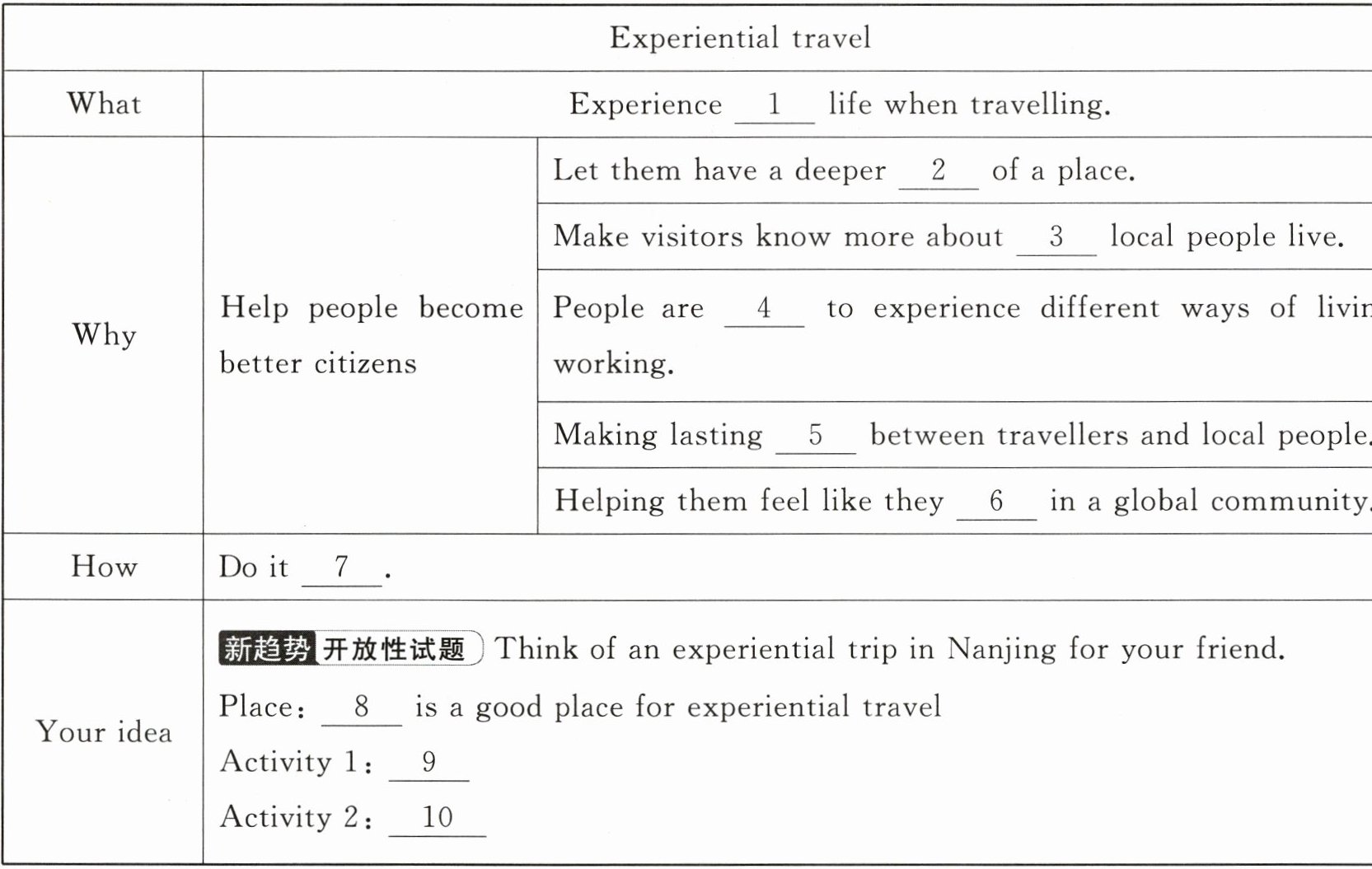
| Experiential travel |
| --- |
| What | Experience
| Why | Help people become better citizens | Let them have a deeper
Make visitors know more about
People are
Making lasting
Helping them feel like they
| How | Do it
| Your idea | 新趋势开放性试题 Think of an experiential trip in Nanjing for your friend.
Place:
Activity 1:
Activity 2:
1.
6.
9.
10.
阅读与回答问题(每小题2分,满分60分)

主题:旅游 体裁:说明文 难度:★★★★ 建议用时:10分钟 正确率: /10
阅读下面的短文,并根据所读内容,在文章后表格中第1-7小题的空格里填入一个最恰当的词,第8-10小题词数不限。
(2024·南京中考改编)What is your perfect vacation? Popular trips include relaxing on a warm beach. Or they involve sightseeing in a beautiful city. Increasingly, though, many of us don't want to just visit a place. We want to experience it.
Experiential travel allows us to get closer to local people and their culture. For example, experiential travellers might stay a few weeks with local hosts(主人). They might take classes to learn craft. In other words, these travellers immerse(沉浸) themselves in a different culture. One such trip is in Fujian. There, a small group of travellers meet with a local fishermen. They learn how to repair nets and throw them in the water. They can fish together. Afterwards they all cook and eat a meal with the fisherman's family.
Experiential travel helps people become better citizens(公民). First of all, it lets them understand a place more deeply than tourists usually do. As one traveller says, traditional travel is "like" studying science without ever doing a scientific experiment(实验). Since they often stay and work in one place, travellers learn more about the lives of local people. It exposes(使体验) them to different ways of living and working. Experiential travellers often make life-long friends with local people. They stay in touch after the trip has finished. Experiential travel helps travellers—and local people—feel like they are part of a global community.
You don't need to use a travel company to get the benefits(好处) of experiential travel. You can do it by yourself. You can ask local people questions when you travel. Ask a driver about her life. You can also join a soccer game in the street. Listening to people's stories and interacting(交流) with local people will change your understanding of the place you are visiting.
| Experiential travel |
| --- |
| What | Experience
local
1 life when travelling. || Why | Help people become better citizens | Let them have a deeper
understanding
2 of a place.Make visitors know more about
how
3 local people live.People are
able
4 to experience different ways of living and working.Making lasting
friendships
5 between travellers and local people.Helping them feel like they
live
6 in a global community. || How | Do it
alone
7. || Your idea | 新趋势开放性试题 Think of an experiential trip in Nanjing for your friend.
Place:
Xuanwu Lake.
8 is a good place for experiential travelActivity 1:
Take a boat ride on Xuanwu Lake and learn about the history of the lake from a local guide.
9Activity 2:
Visit a traditional tea house with locals.
10 |1.
local
2. understanding
3. how
4. able
5. friendships
6.
live
7. alone
8. Xuanwu Lake.
9.
Take a boat ride on Xuanwu Lake and learn about the history of the lake from a local guide.
10.
Visit a traditional tea house with locals.
阅读与回答问题(每小题2分,满分60分)
答案
1. local
2. understanding
3. how
4. able
5. friendships
6. live
7. alone
8. Xuanwu Lake.(开放性设问,言之有理即可)
9. Take a boat ride on Xuanwu Lake and learn about the history of the lake from a local guide.(开放性设问,言之有理即可)
10. Visit a traditional tea house with locals.(开放性设问,言之有理即可)
2. understanding
3. how
4. able
5. friendships
6. live
7. alone
8. Xuanwu Lake.(开放性设问,言之有理即可)
9. Take a boat ride on Xuanwu Lake and learn about the history of the lake from a local guide.(开放性设问,言之有理即可)
10. Visit a traditional tea house with locals.(开放性设问,言之有理即可)
解析
【分析】
这是一篇介绍体验式旅行的任务型阅读题,解题时首先梳理表格的逻辑框架,对应原文三个核心段落分别匹配What(定义)、Why(优势)、How(实现方式)三个模块:1. 前7个空需要先定位到原文对应语句,再通过词性转换、固定搭配替换、同义表达转换的方式得到适配空格的词汇;2. 第8-10空为开放性设问,结合南京本地知名文旅地点,设计符合体验式旅行特征的互动类活动即可,不需要和原文绑定,言之有理就符合要求。
【解析】
1. 定位原文第二段首句"Experiential travel allows us to get closer to local people and their culture",可知体验式旅行的核心是旅行过程中深入体验当地人的生活,此处用形容词local修饰名词life,符合语义。
2. 定位原文第三段第二句"it lets them understand a place more deeply than tourists usually do",转换为固定搭配have a deeper understanding of,意为“对……有更深入的理解”,将动词understand转换为名词understanding。
3. 定位原文第三段"travellers learn more about the lives of local people",语义为游客能更多了解当地人的生活状态,即当地人如何生活,填入连接副词how。
4. 定位原文第三段"It exposes(使体验) them to different ways of living and working",转换表达为人们能够体验不同的生活和工作方式,匹配固定搭配be able to do sth,填入形容词able。
5. 定位原文第三段"Experiential travellers often make life-long friends with local people",表格中lasting对应原文life-long,将复数名词friends转换为抽象名词friendships,意为“持久的友谊”。
6. 定位原文第三段最后一句"feel like they are part of a global community",语义为感觉自己属于、生活在全球社区当中,填入动词live。
7. 定位原文第四段"You don't need to use a travel company to get the benefits of experiential travel. You can do it by yourself",by yourself的同义表达为alone,即独自完成体验式旅行,填入alone。
8. 开放性设问,填写南京任意适合开展深度体验的景点即可,例如玄武湖、夫子庙等。
9. 开放性设问,结合所选地点设计互动类体验活动,符合体验式旅行贴近本地人的特征即可。
10. 开放性设问,设计第二个不同的深度体验活动,内容合理即可。
【答案】
1. local
2. understanding
3. how
4. able
5. friendships
6. live
7. alone
8. Xuanwu Lake(答案不唯一,言之有理即可)
9. Take a boat ride on Xuanwu Lake and learn about the history of the lake from a local guide(答案不唯一,言之有理即可)
10. Visit a traditional tea house with locals(答案不唯一,言之有理即可)
【知识点】
任务型阅读词义转换,英语固定搭配,本土文化常识
【点评】
本题属于中考难度的任务型阅读题型,既考查学生快速定位原文信息、灵活进行词性转换和同义替换的基础阅读能力,又结合南京本地文旅场景设置开放性问题,引导学生将文本所学内容和实际生活应用结合,避免了机械刷题的弊端,对学生的语言应用能力有较好的检测作用。
【难度系数】
0.6
这是一篇介绍体验式旅行的任务型阅读题,解题时首先梳理表格的逻辑框架,对应原文三个核心段落分别匹配What(定义)、Why(优势)、How(实现方式)三个模块:1. 前7个空需要先定位到原文对应语句,再通过词性转换、固定搭配替换、同义表达转换的方式得到适配空格的词汇;2. 第8-10空为开放性设问,结合南京本地知名文旅地点,设计符合体验式旅行特征的互动类活动即可,不需要和原文绑定,言之有理就符合要求。
【解析】
1. 定位原文第二段首句"Experiential travel allows us to get closer to local people and their culture",可知体验式旅行的核心是旅行过程中深入体验当地人的生活,此处用形容词local修饰名词life,符合语义。
2. 定位原文第三段第二句"it lets them understand a place more deeply than tourists usually do",转换为固定搭配have a deeper understanding of,意为“对……有更深入的理解”,将动词understand转换为名词understanding。
3. 定位原文第三段"travellers learn more about the lives of local people",语义为游客能更多了解当地人的生活状态,即当地人如何生活,填入连接副词how。
4. 定位原文第三段"It exposes(使体验) them to different ways of living and working",转换表达为人们能够体验不同的生活和工作方式,匹配固定搭配be able to do sth,填入形容词able。
5. 定位原文第三段"Experiential travellers often make life-long friends with local people",表格中lasting对应原文life-long,将复数名词friends转换为抽象名词friendships,意为“持久的友谊”。
6. 定位原文第三段最后一句"feel like they are part of a global community",语义为感觉自己属于、生活在全球社区当中,填入动词live。
7. 定位原文第四段"You don't need to use a travel company to get the benefits of experiential travel. You can do it by yourself",by yourself的同义表达为alone,即独自完成体验式旅行,填入alone。
8. 开放性设问,填写南京任意适合开展深度体验的景点即可,例如玄武湖、夫子庙等。
9. 开放性设问,结合所选地点设计互动类体验活动,符合体验式旅行贴近本地人的特征即可。
10. 开放性设问,设计第二个不同的深度体验活动,内容合理即可。
【答案】
1. local
2. understanding
3. how
4. able
5. friendships
6. live
7. alone
8. Xuanwu Lake(答案不唯一,言之有理即可)
9. Take a boat ride on Xuanwu Lake and learn about the history of the lake from a local guide(答案不唯一,言之有理即可)
10. Visit a traditional tea house with locals(答案不唯一,言之有理即可)
【知识点】
任务型阅读词义转换,英语固定搭配,本土文化常识
【点评】
本题属于中考难度的任务型阅读题型,既考查学生快速定位原文信息、灵活进行词性转换和同义替换的基础阅读能力,又结合南京本地文旅场景设置开放性问题,引导学生将文本所学内容和实际生活应用结合,避免了机械刷题的弊端,对学生的语言应用能力有较好的检测作用。
【难度系数】
0.6
